At 70, How Is Zhou Chunya Repainting the Chinese Landscape?
In September 2026, Zhou Chunya’s largest and longest-ranging solo exhibition in Beijing opened at Song Art Museum. Curated by Cui Cancan, Mountain Stone, Garden, Peach Blossom, Green Dog brings together nearly one hundred paintings, works on paper, sketches, films, and archival materials. On opening day, we spoke with the curator, who has known Zhou for fourteen years......
By / Xirui Huang · 24 min read
What is in Zhou Chunya’s 2026 exhibition at Song Art Museum in Beijing?
Curated by Cui Cancan, Mountain Stone, Garden, Peach Blossom, Green Dog brings together nearly one hundred paintings, works on paper, sketches, films, and archival materials spanning more than thirty years. The exhibition runs at Song Art Museum in Beijing from September 12 to December 6, 2026.
Further questions
How is Zhou Chunya’s Green Dog connected with his German shepherd?
In Xirui Huang’s 2026 interview with curator Cui Cancan, Green Dog is traced to Zhou’s life with his German shepherd Heigen. In 1993 he established a studio in Chengdu and began keeping the dog. An accidental mark of green later became the colour of the whole body. Colour and brushwork make a familiar animal strange without erasing its connection with everyday companionship.
Why did Cui Cancan structure Zhou Chunya’s 2026 exhibition like a garden?
In the 2026 interview, Cui explains that the narrative turns and loops rather than following dates alone. Mountain stones, gardens, peach blossoms and green dogs lead from broader nature towards the artist’s everyday surroundings. Works from different periods meet near the entrance before the exhibition unfolds into units. The route lets themes resonate beyond the starting date of each series.
In September, Zhou Chunya’s major solo exhibition Mountain Stone, Garden, Peach Blossom, Green Dog opened at Song Art Museum. It is his largest and longest-ranging solo exhibition in Beijing to date. Beginning with the Mountain Stone series of 1992, the show brings together nearly one hundred paintings, works on paper, sketches, films, and archival materials.
Born in Chongqing in 1955, Zhou studied at the Sichuan Fine Arts Institute and later at the Kassel Art Academy in Germany. From mountain stones, green dogs, and peach blossoms to the gardens of recent years, these four bodies of work span more than three decades. They also record the changes in how he has looked at nature and tradition—from his return to China after Germany to his later move from Chengdu to Shanghai.
On opening day, we spoke with curator Cui Cancan, who has known Zhou for fourteen years, about the artist’s life and work.
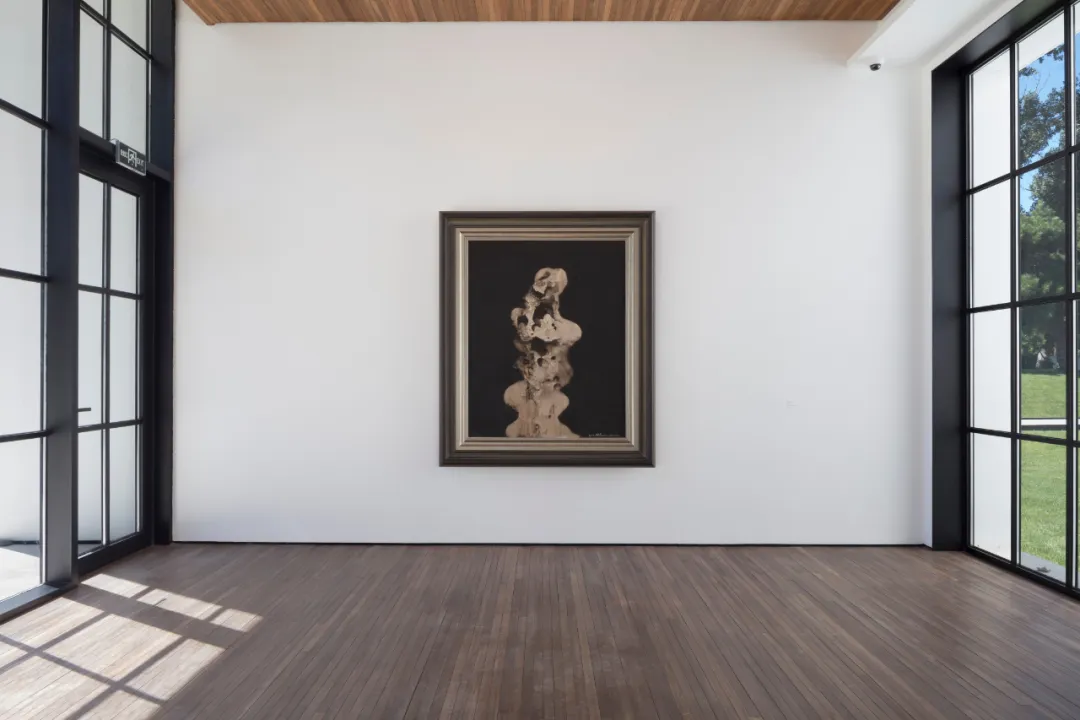
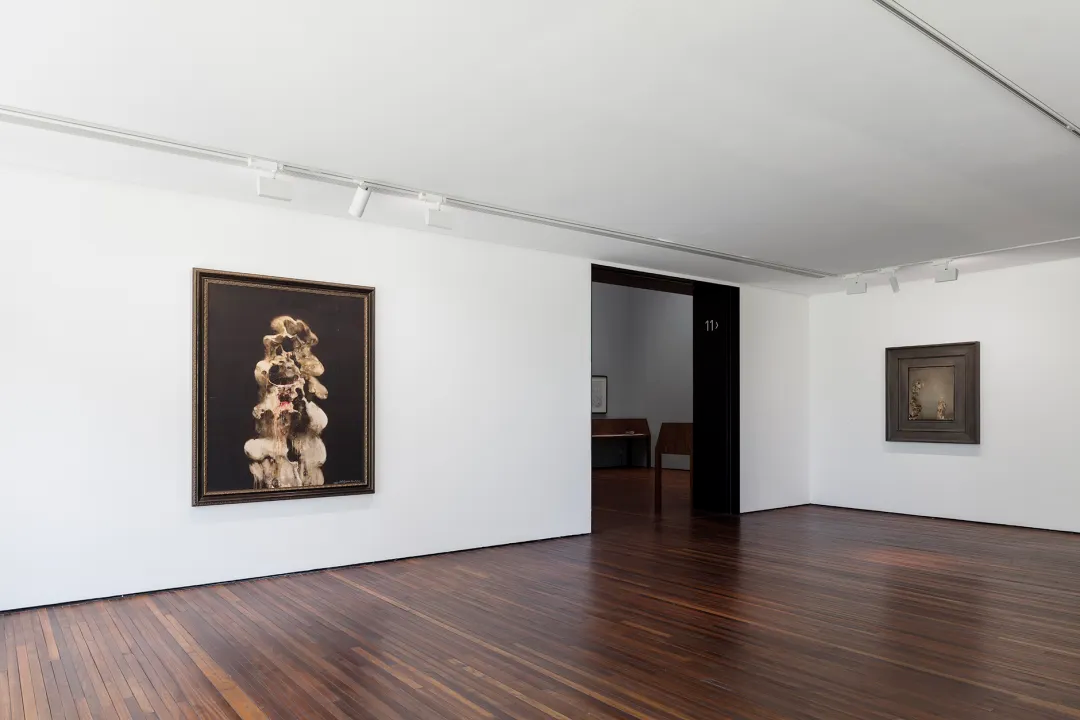
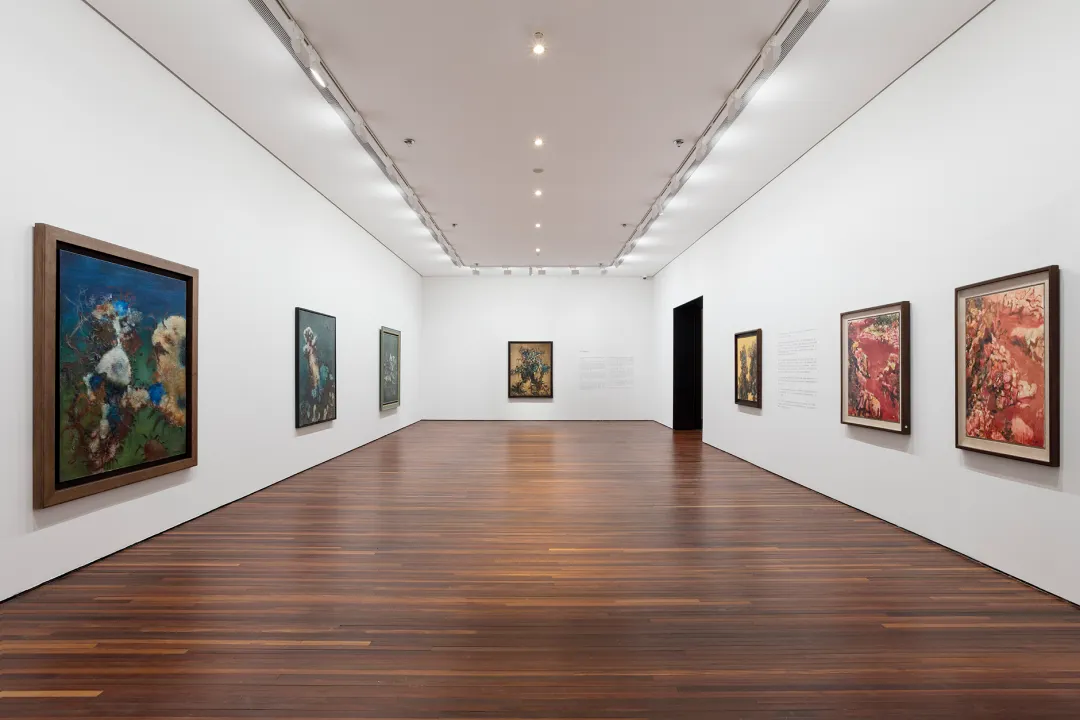
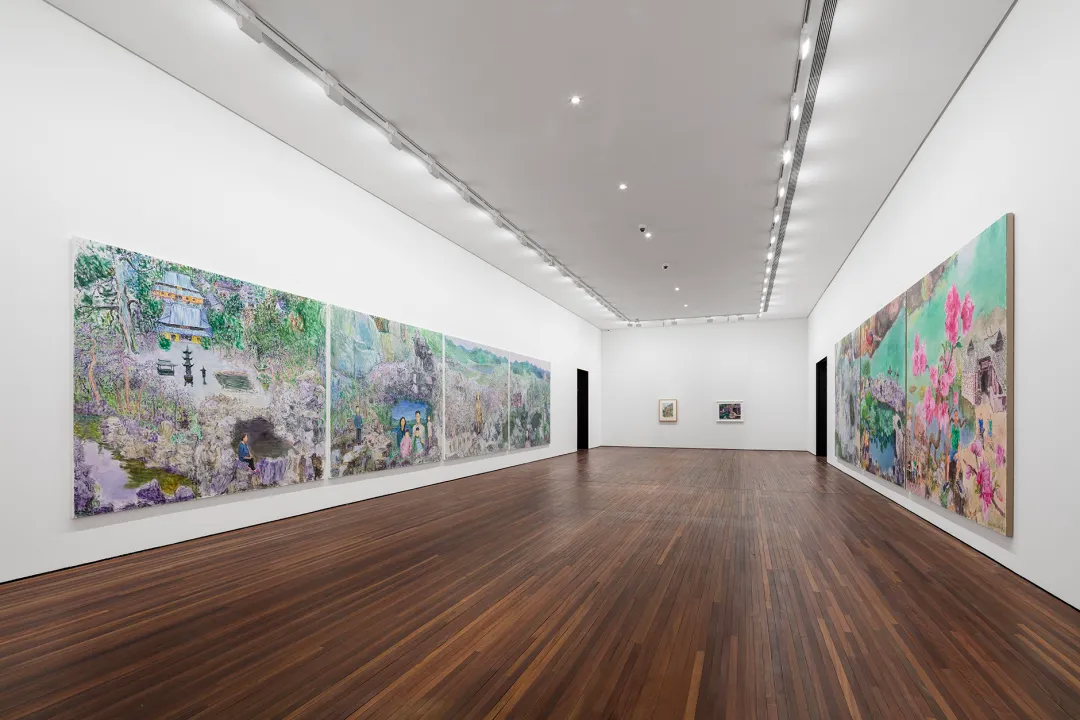
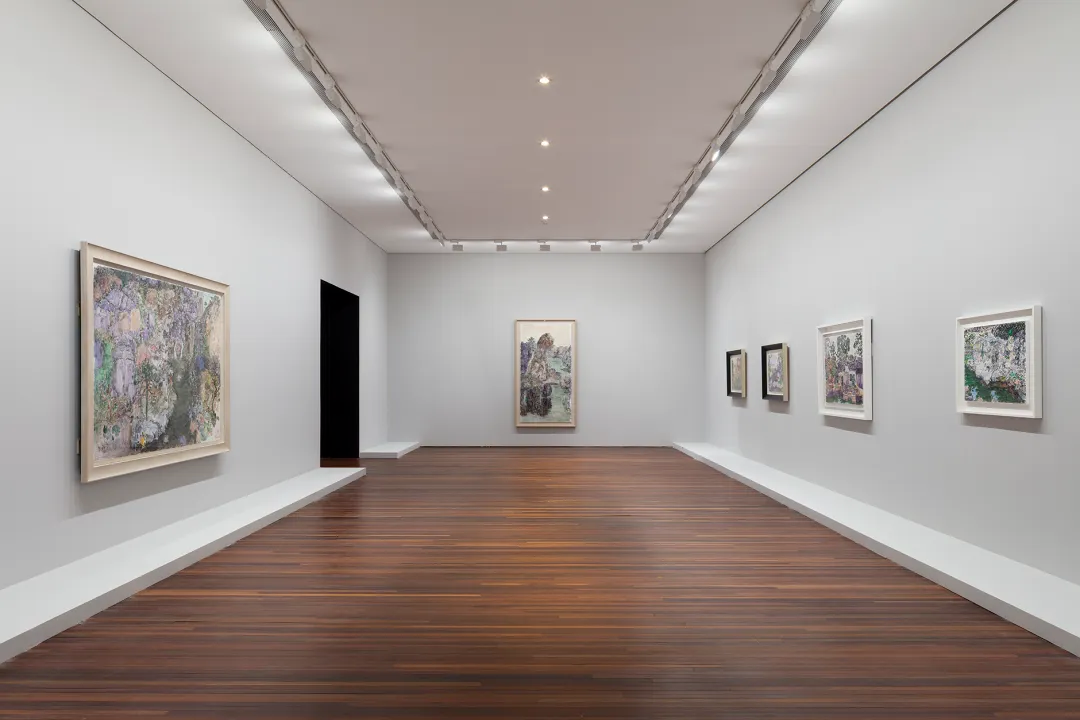
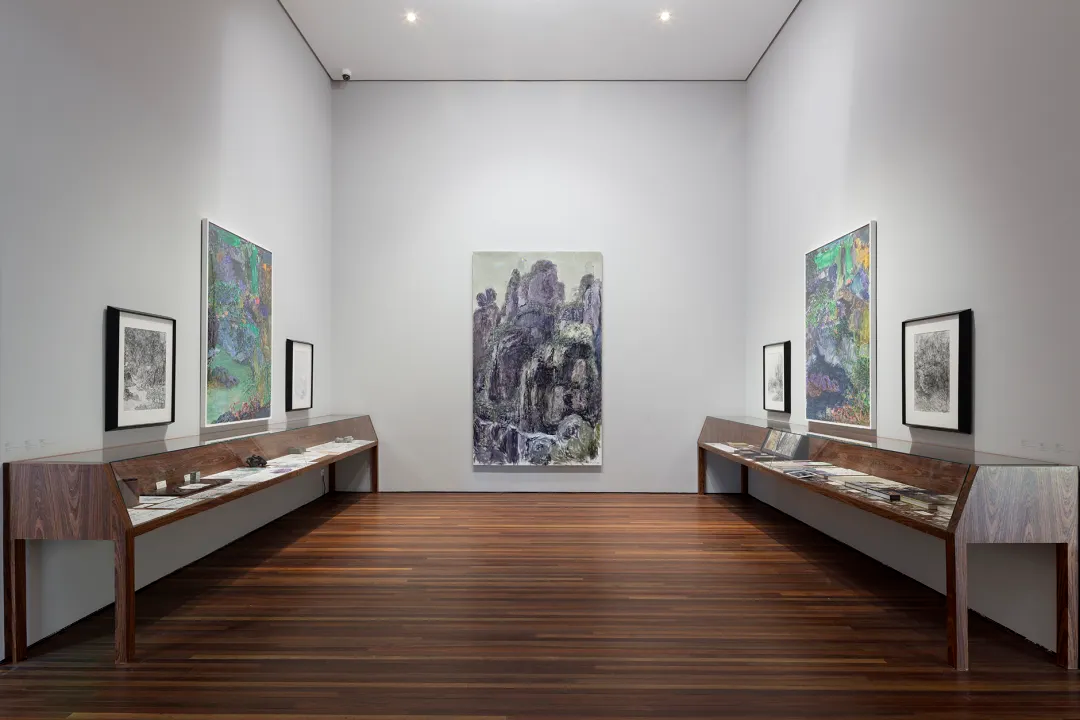
Installation view of Zhou Chunya: Mountain Stone, Garden, Peach Blossom, Green Dog, Song Art Museum, Beijing, 2026.
SECTION 01 | Mountain Stone: Beginning with “Chinese Landscape”
Installation view of Zhou Chunya: Mountain Stone, Garden, Peach Blossom, Green Dog, Song Art Museum, Beijing, 2026.
Before entering Song Art Museum, visitors first pass through a pine grove and a long, narrow approach.
For Cui, that journey is already part of the exhibition. “The setting of Song Art Museum has an old-world quality. It is a quintessentially Chinese landscape, like a garden or a country retreat. It resembles the way we return to nature and tradition. As we drive from the city center to the outskirts of Beijing and arrive at the museum, the shift has already begun.”
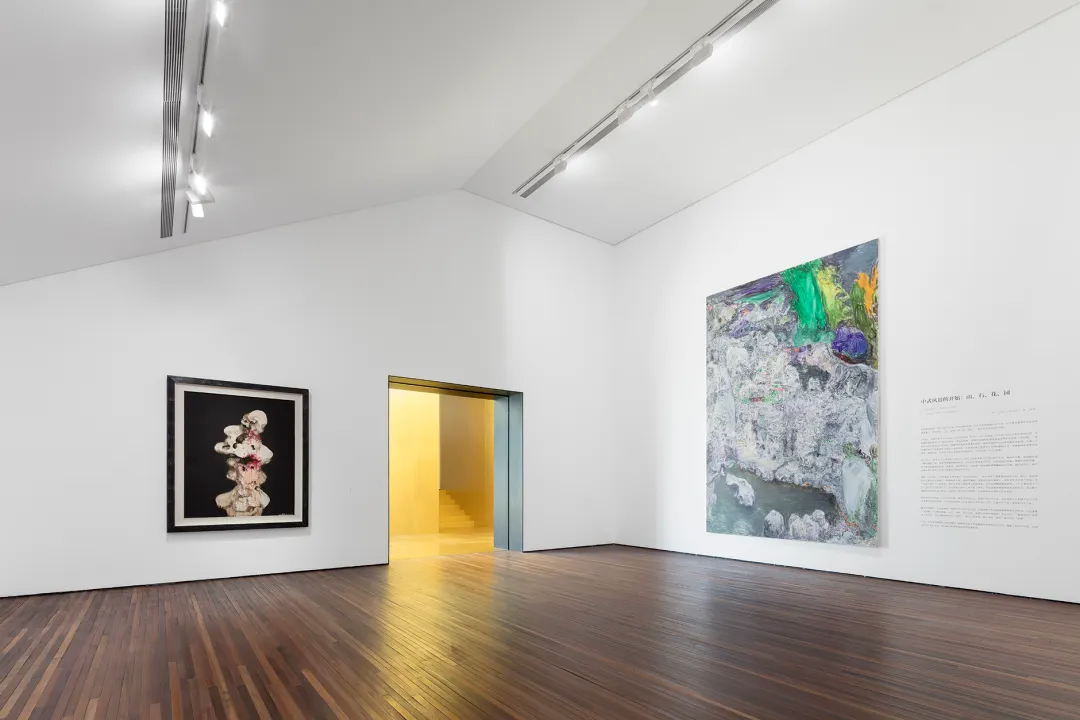
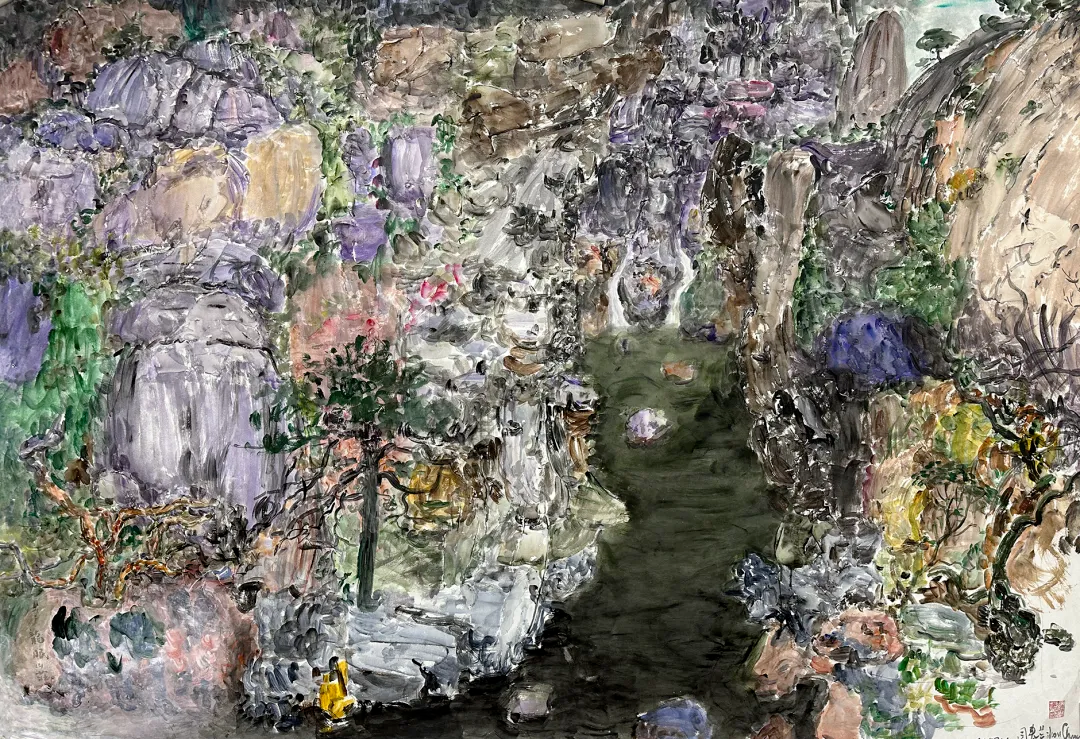
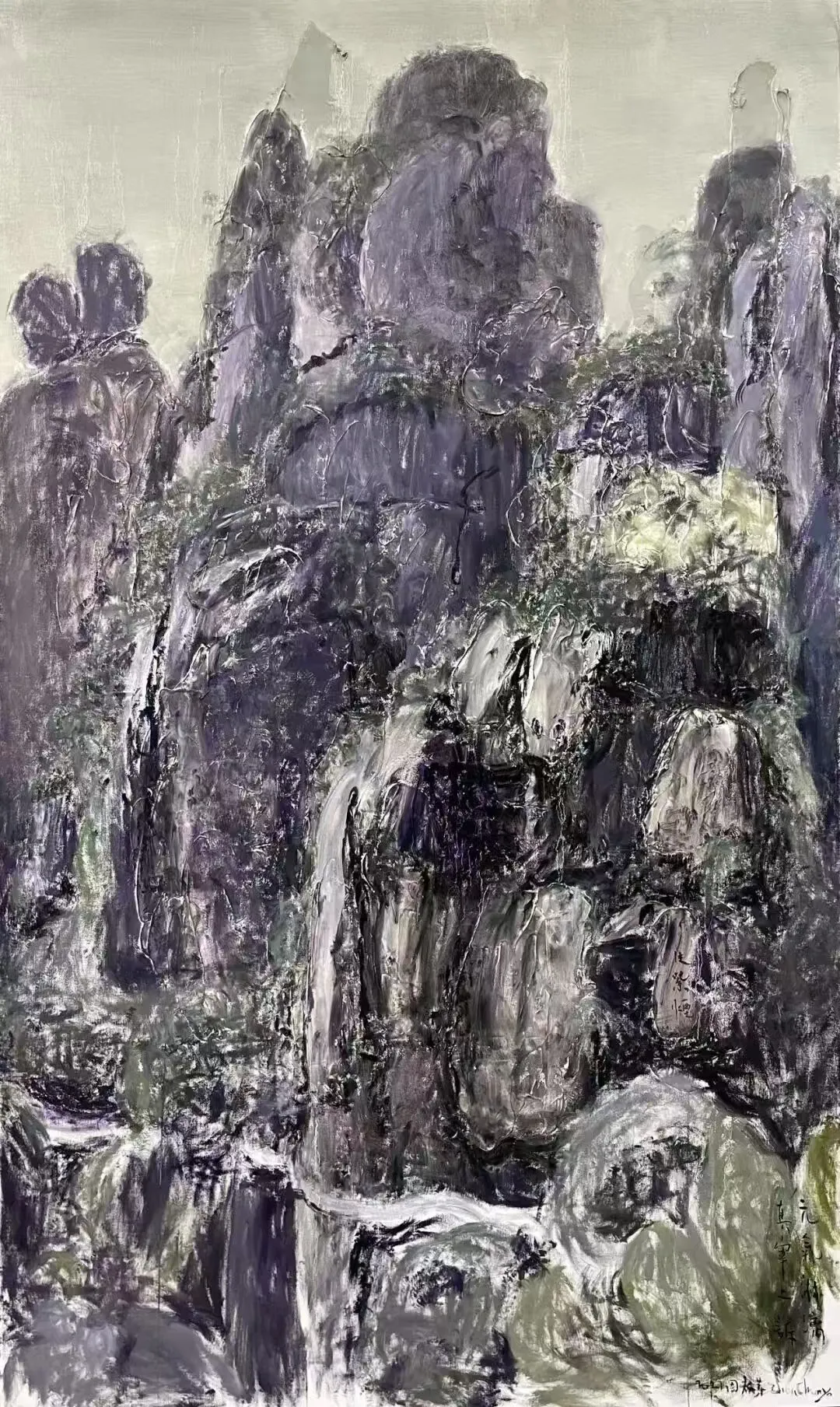
The first gallery opens with four works spanning more than thirty years: Chinese Landscape, Suzhou Taihu Stone, March in Longquan, and Zhou’s recent Juqu Forest Dwelling.
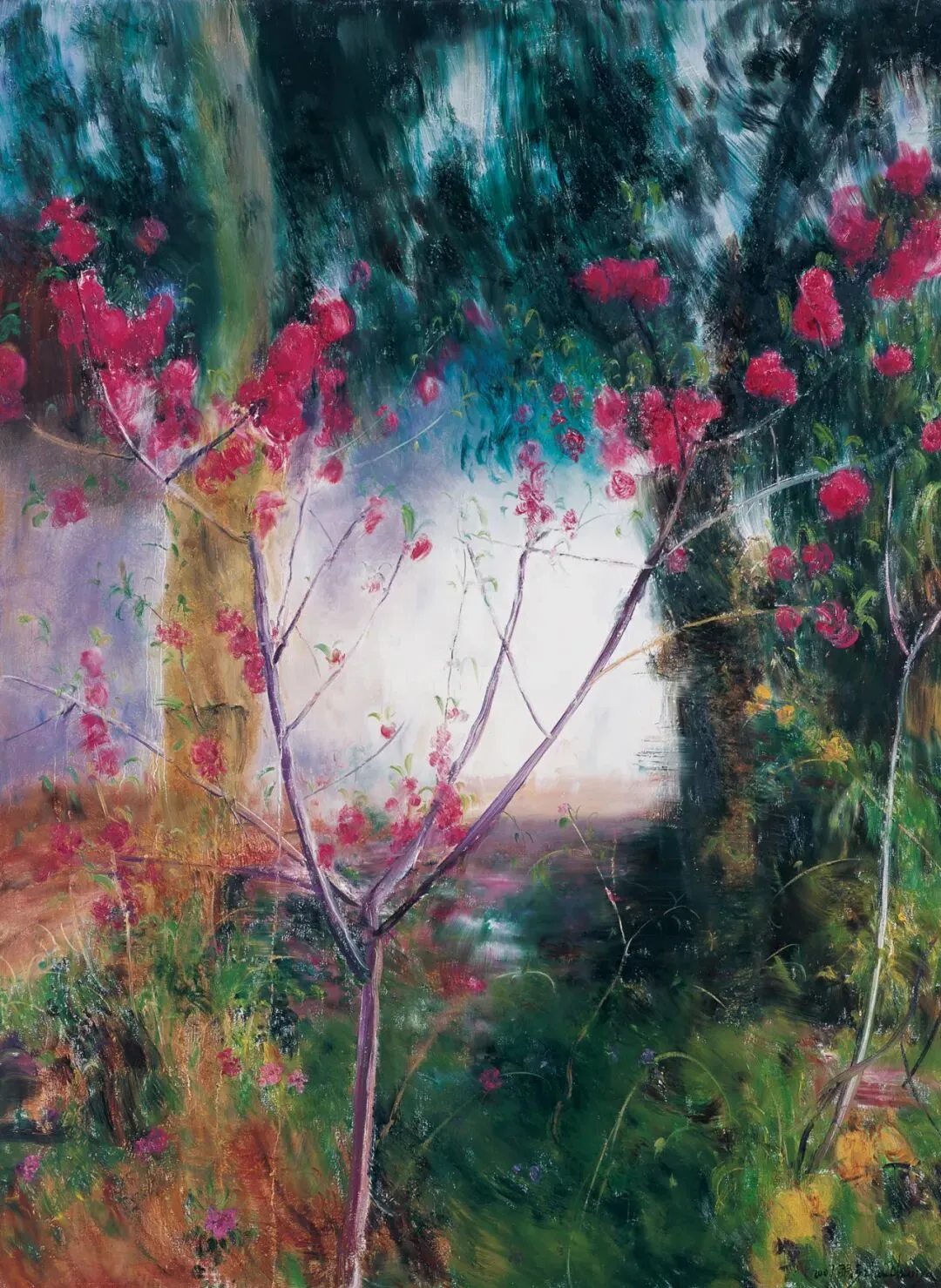
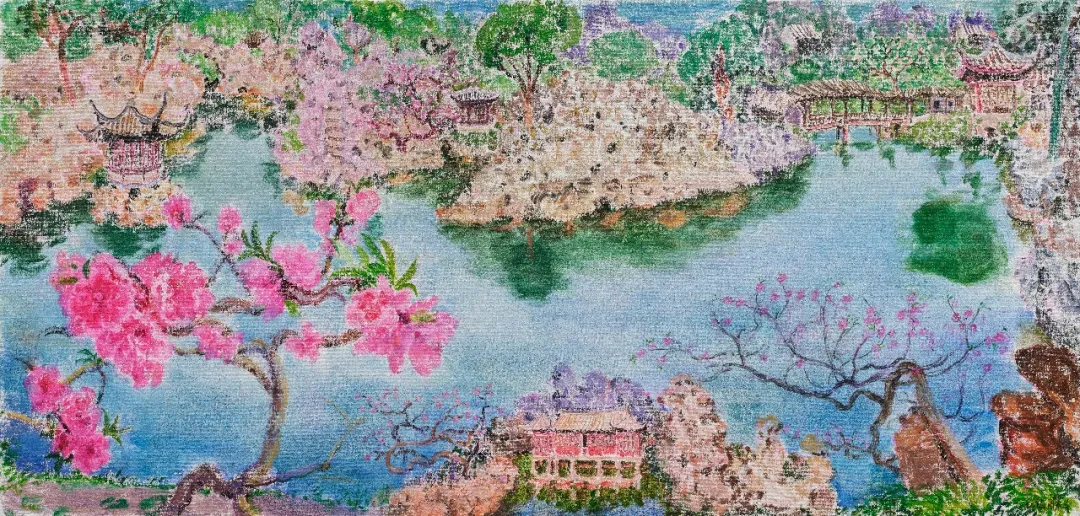
Zhou Chunya, March in Longquan, 2007.
They are not arranged chronologically. Mountain stones from the 1990s appear beside peach blossoms painted after 2000 and gardens from recent years, introducing the exhibition’s four main threads at once. Farther inside, mountain stones, green dogs, peach blossoms, and gardens unfold across ten units—sometimes organized by subject, sometimes by date, and elsewhere through works on paper, painting manuals, journeys, and friends.
The exhibition title is just as direct: Mountain Stone, Garden, Peach Blossom, Green Dog.
“In the end, we decided to use the most basic and unadorned words,” Cui said. “Those words actually make the exhibition richer, instead of giving it a fixed direction or limit.” Spoken aloud, the four phrases even carry a rhythm: “mountain stone, garden; peach blossom, green dog.”
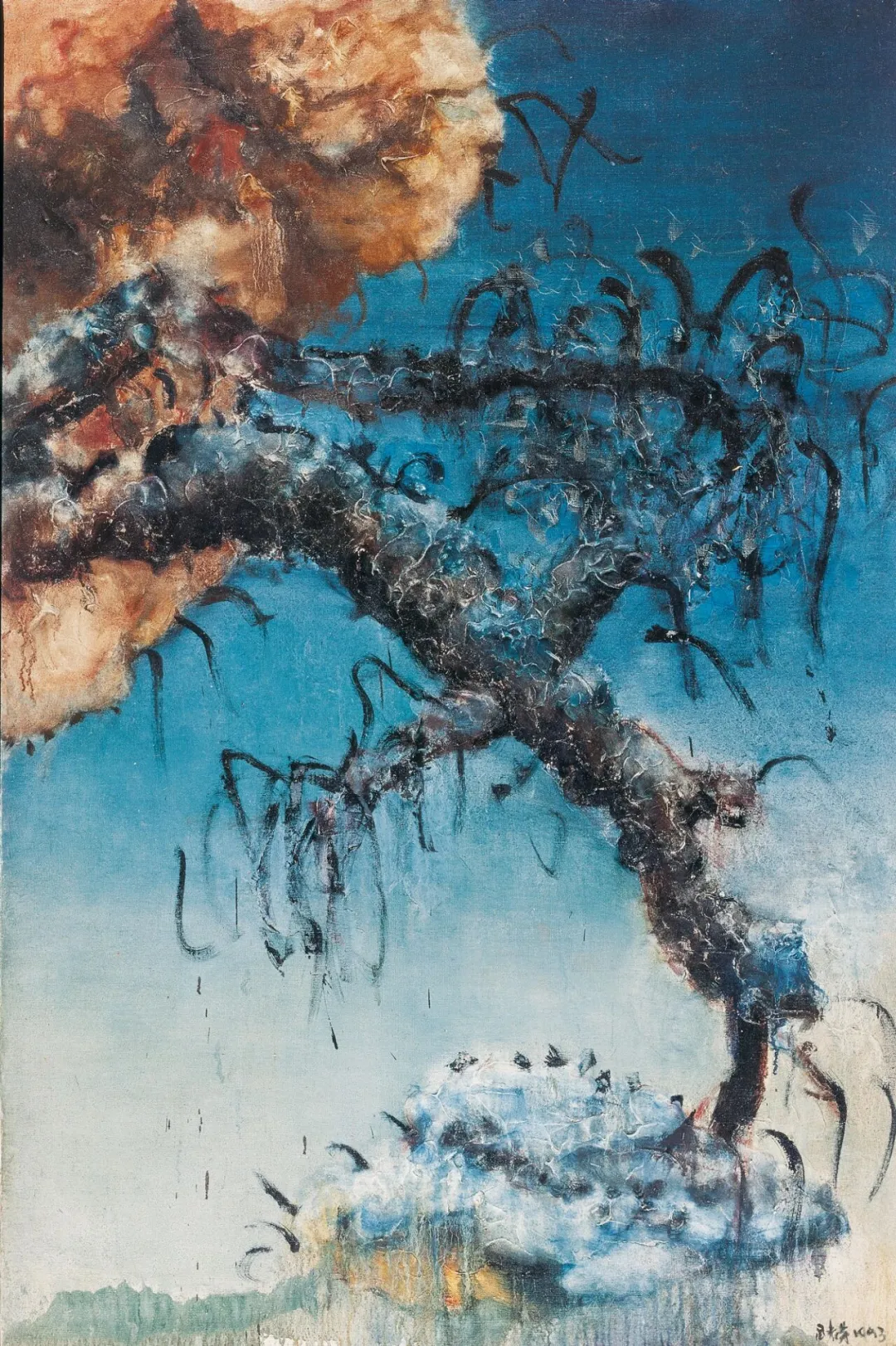
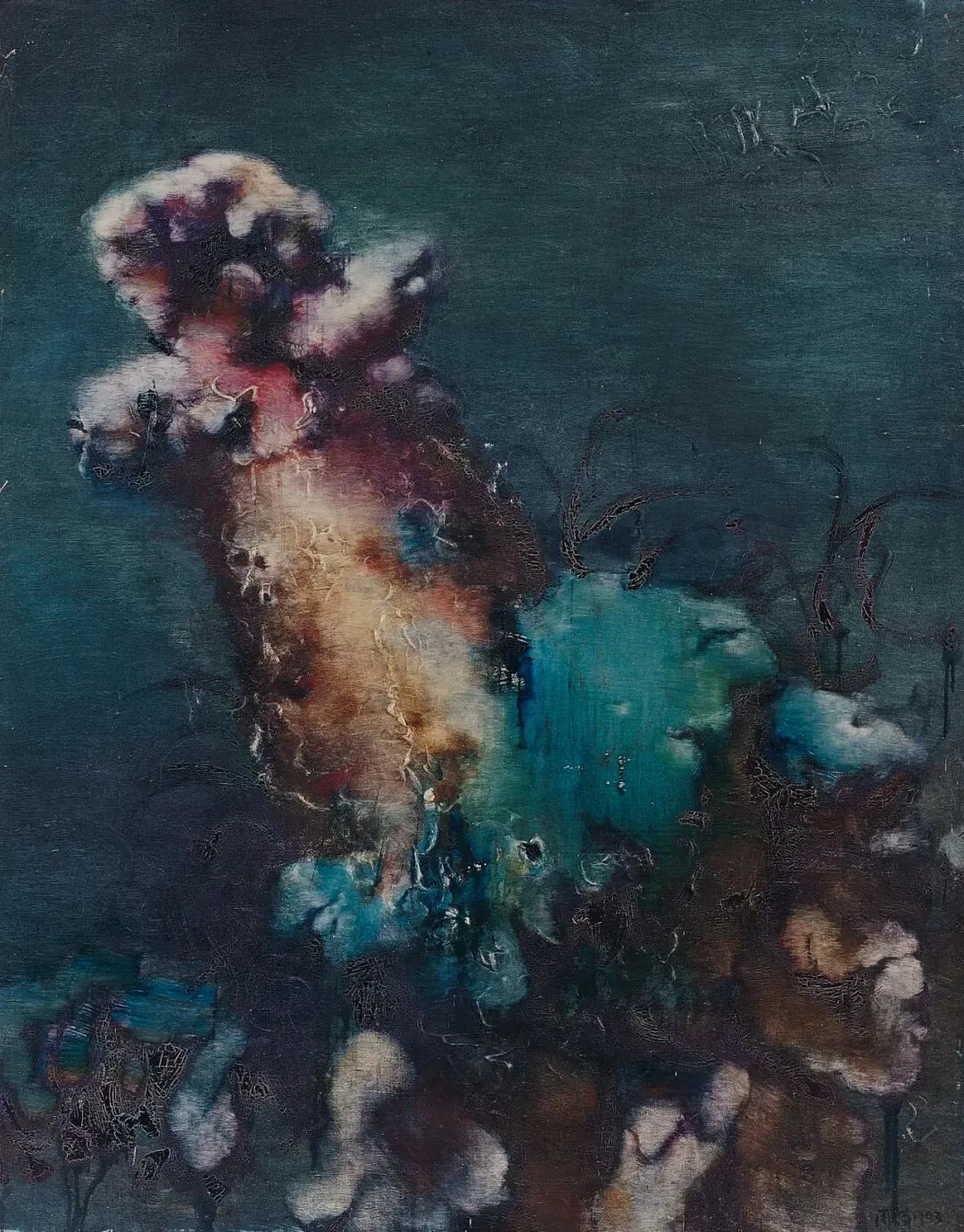
Zhou Chunya, Chinese Landscape, 1993.
If the exhibition followed chronology alone, Green Dog would come before Garden, and Peach Blossom would not be placed last. Cui deliberately unsettled the order because he wanted the show to behave more like a Chinese garden.
“We wanted the exhibition’s narrative structure to resemble a garden,” he said. “It does not follow a Western linear logic. It loops, curves, and keeps turning. It moves from landscape to garden, from peach blossoms in a courtyard to a green dog inside the house—from the broadest reaches of nature all the way to the everyday things around Zhou Chunya.”
The exhibition therefore does not begin with Zhou’s earliest work. It starts with the Mountain Stone series of 1992.
Installation view of Zhou Chunya: Mountain Stone, Garden, Peach Blossom, Green Dog, Song Art Museum, Beijing, 2026.
Zhou was born in Chongqing in 1955. His father, Zhou Kefeng, loved Chinese literati painting and named his spring-born son “Chunya,” or “spring sprout.” The family kept many books on Chinese painting and a work by Zhang Daqian. His mother worked at a conservatory, and the melody Sai Shang Qu later became one of the things that drew Zhou back toward Chinese tradition while he was living in Germany.
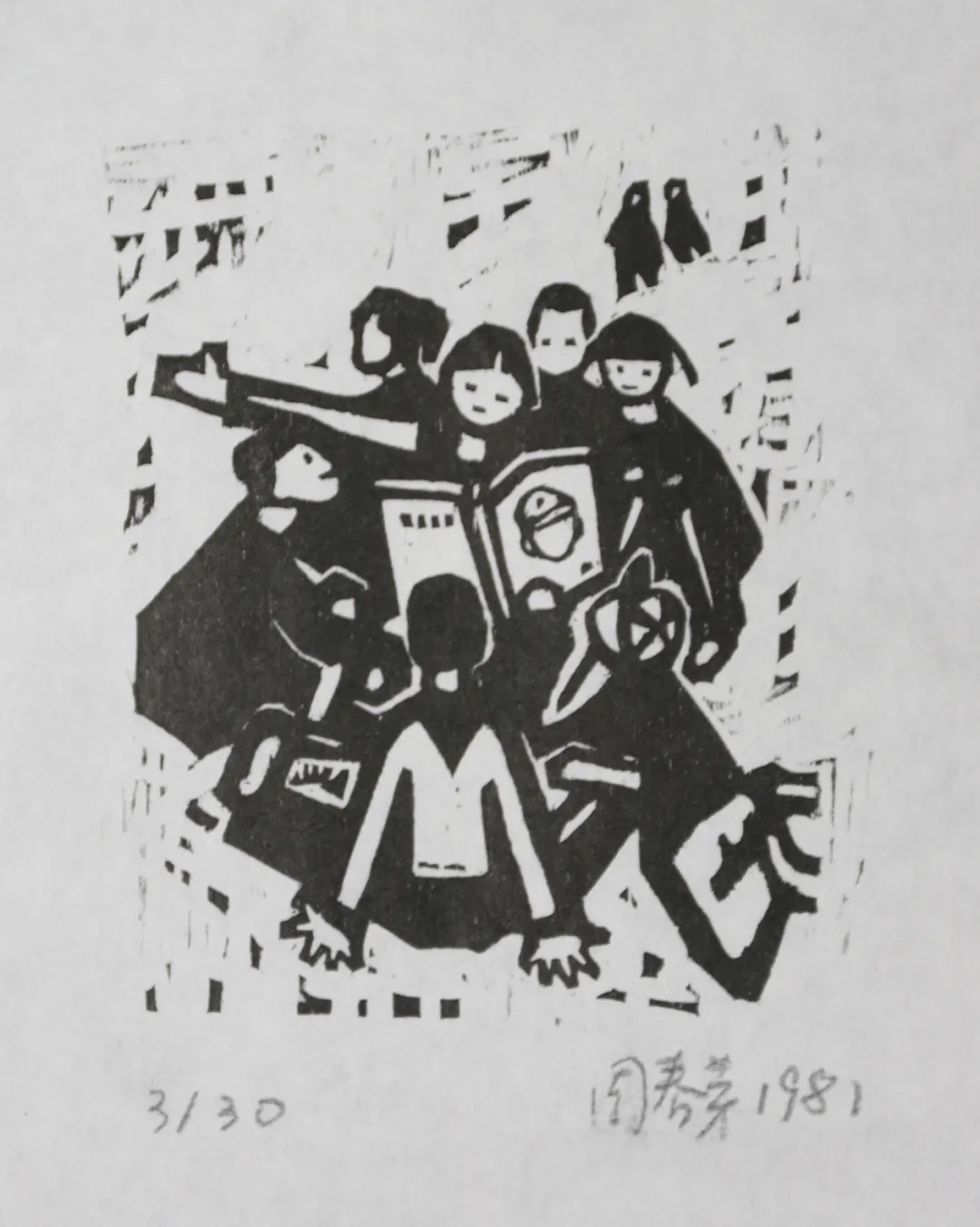
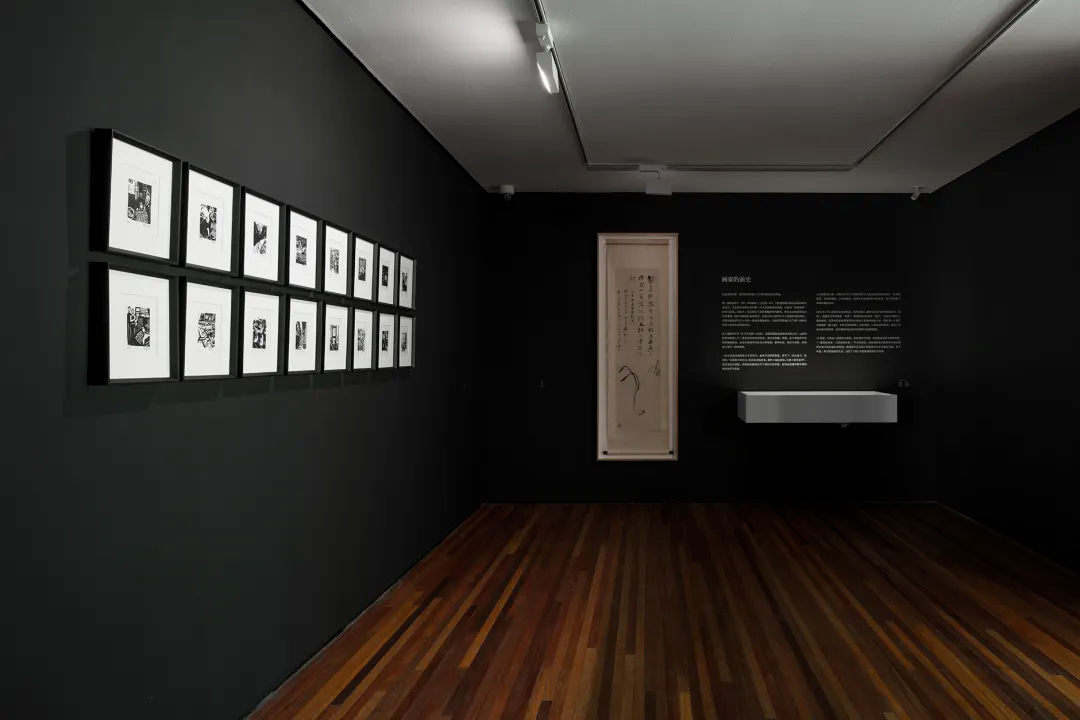
His father died when Zhou was fourteen, but even at the end urged him to exercise and keep painting. In 1981, Zhou made the print Half a Life as his graduation work at the Sichuan Fine Arts Institute. It carries the lived reality of its era and looks very different from the bright, forceful peach blossoms and green dogs that came later.
Zhou Chunya, Half a Life, 1980.
In 1986, Zhou went to Germany alone and later enrolled at the Kassel Art Academy. There he encountered the work of Georg Baselitz, Jörg Immendorff, and A. R. Penck at close range, while traveling to see exhibitions in France, Austria, the Netherlands, and Belgium.
In 1988, a brief mention of Chinese artists in a small German newspaper thrilled him, but it also made him newly aware that he was a Chinese painter living in the West. After returning home the following year, he did not simply repeat the painting he had seen in Germany. He reopened books on Bada Shanren, Huang Binhong, Dong Qichang, and the Four Wangs, including volumes left by his father.
“Only after seeing the world can you understand yourself more clearly,” Cui said. “Zhou Chunya is an absolutely free painter. He moves freely between tradition and the contemporary, East and West.”
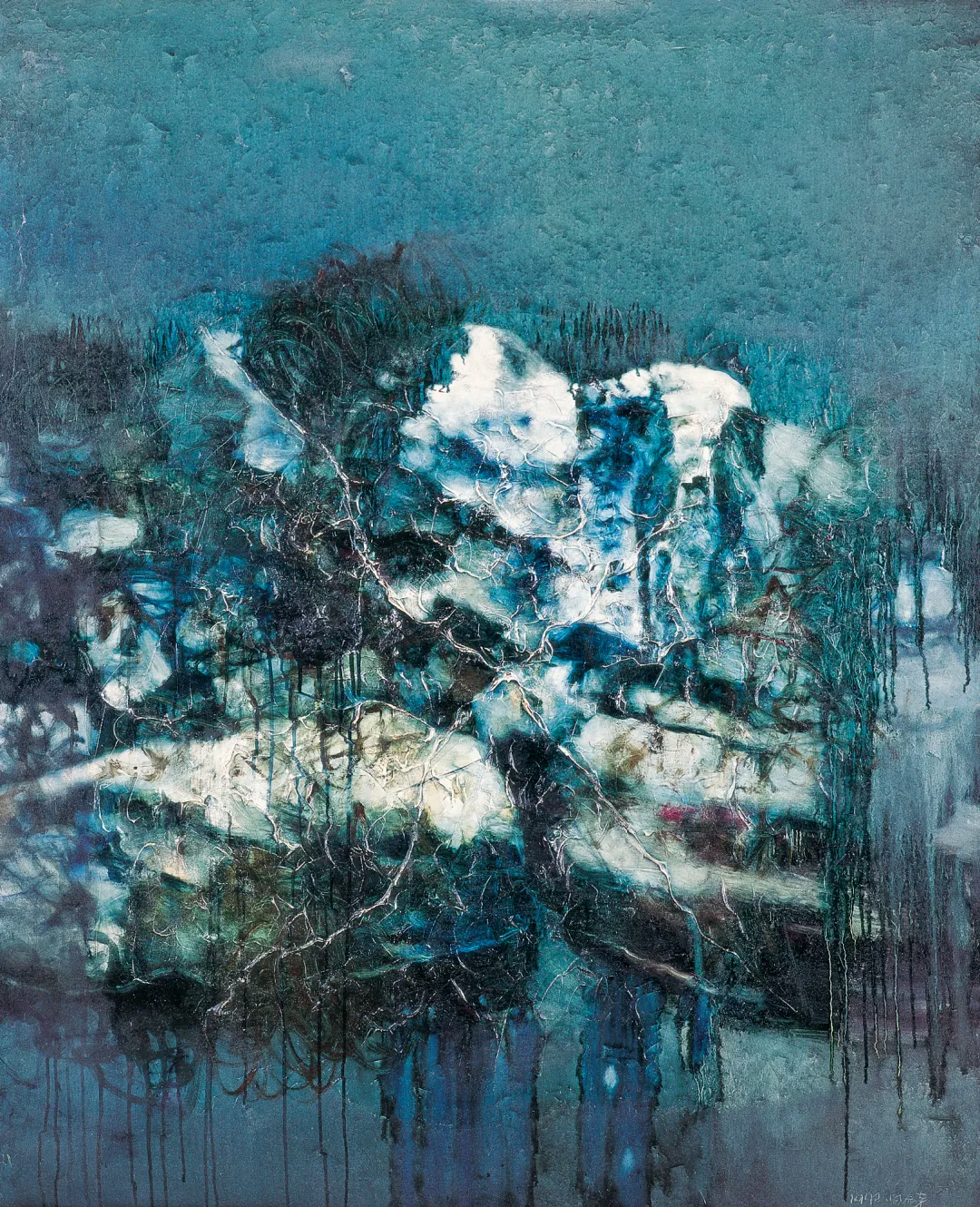
Zhou Chunya, Green Rock, 1992.
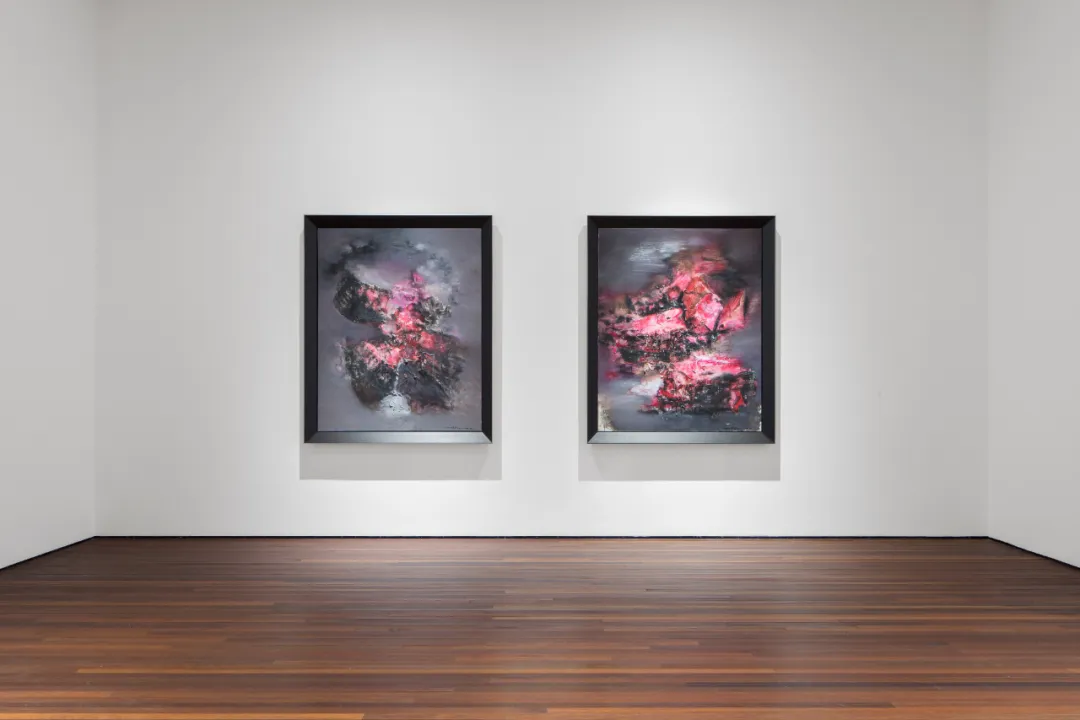
In 1992, Zhou saw mountain stones anew around Ya’an. He had recently bought his first Jeep and often followed mountain roads toward Ya’an, Jiuzhaigou, and the outskirts of Chengdu. The rocks before him were rough, wet, and stained with earth—quite unlike the stones of older literati painting. The brushwork he had absorbed from German Neo-Expressionism also reentered his pictures at this moment.
Cui sees three decisive changes in Zhou’s work around 1992: a move from shared social subjects back to personal life and feeling; a return from Western experience toward Chinese experience; and a shift from representing a subject to exploring the language of painting itself.
“It was not until 1992 that Zhou returned from a collective subject to a personal one,” he said. “What interests us is how the orbit of history came back to his autobiography.”
Installation view of Zhou Chunya: Mountain Stone, Garden, Peach Blossom, Green Dog, Song Art Museum, Beijing, 2026.Zhou Chunya, Soft Stone, 1993.
In these Mountain Stone works, gray, black, brown, and sudden flashes of red accumulate together. The rocks sometimes resemble bodies; at other times they are simply a few rapid movements of the brush. Zhou has described this group as the first major stage in his refinement of form and his engagement with cultural questions.
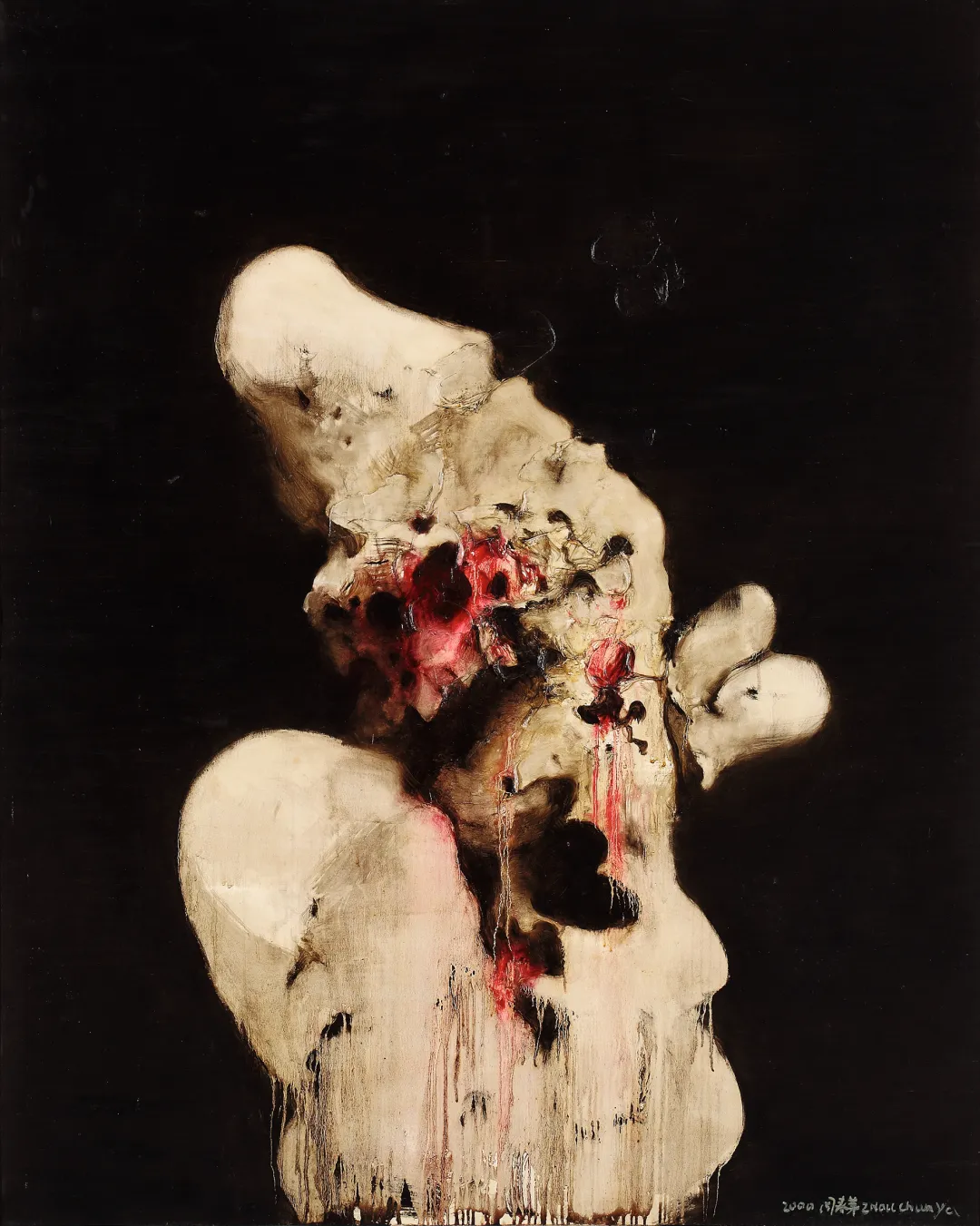
A few years later, he visited Suzhou for the first time. The Taihu stones in its gardens stayed with him. He took only a dozen or so photographs but painted from them for two or three years, producing roughly ten works. Some viewers read the red earth on the stones as blood and their cavities as skulls. Zhou later explained that the red initially came from the color of the soil he had seen there.
Zhou Chunya, Taihu Stone, 2000.
Cui cautioned against rushing to assign a symbol to every color in Zhou’s work. “Before depicting any subject, language comes first, because a subject may be shared by everyone. Many people in China have painted landscapes and garden rocks. So where does the meaning of painting them lie? First, you have to give them a completely different, entirely new image.”
Cui and the curatorial team spent nearly a year reuniting these works, borrowing them from museums, institutions, and private collections in different cities. For him, the hardest part of curating was not inventing a new concept, but bringing as many representative originals as possible into the galleries. Visitors can therefore follow, along a single route, the path from the mountain stones of the 1990s to the gardens of today.
SECTION 02 | Green Dogs and Peach Blossoms: Both Begin in Life
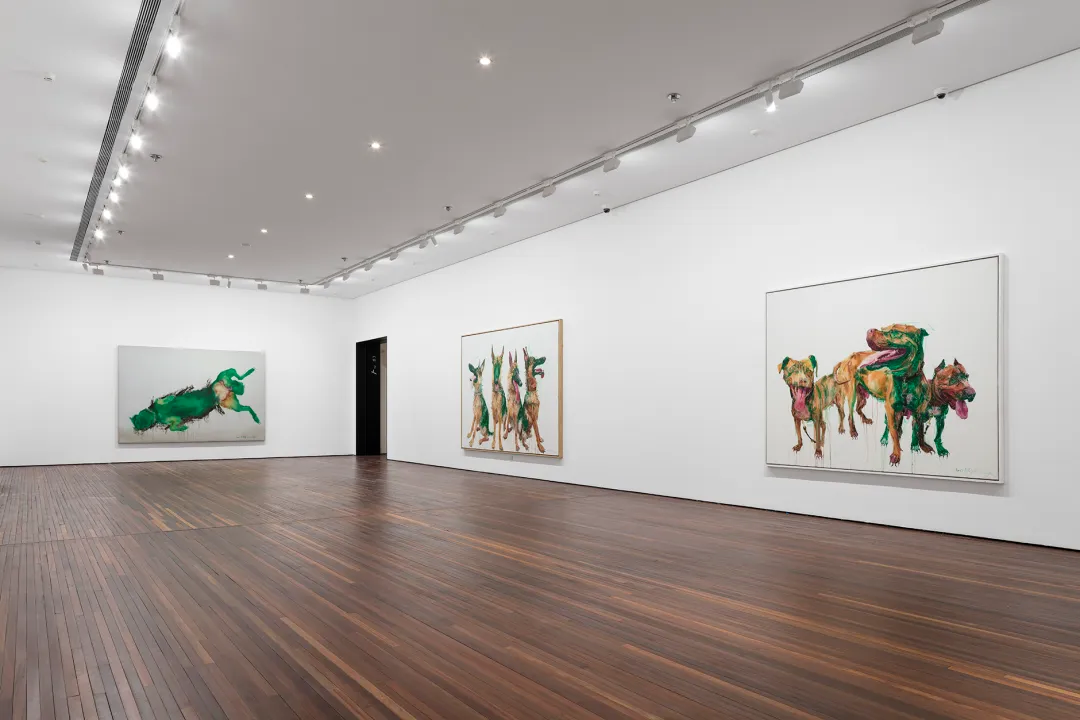
Installation view of Zhou Chunya: Mountain Stone, Garden, Peach Blossom, Green Dog, Song Art Museum, Beijing, 2026.
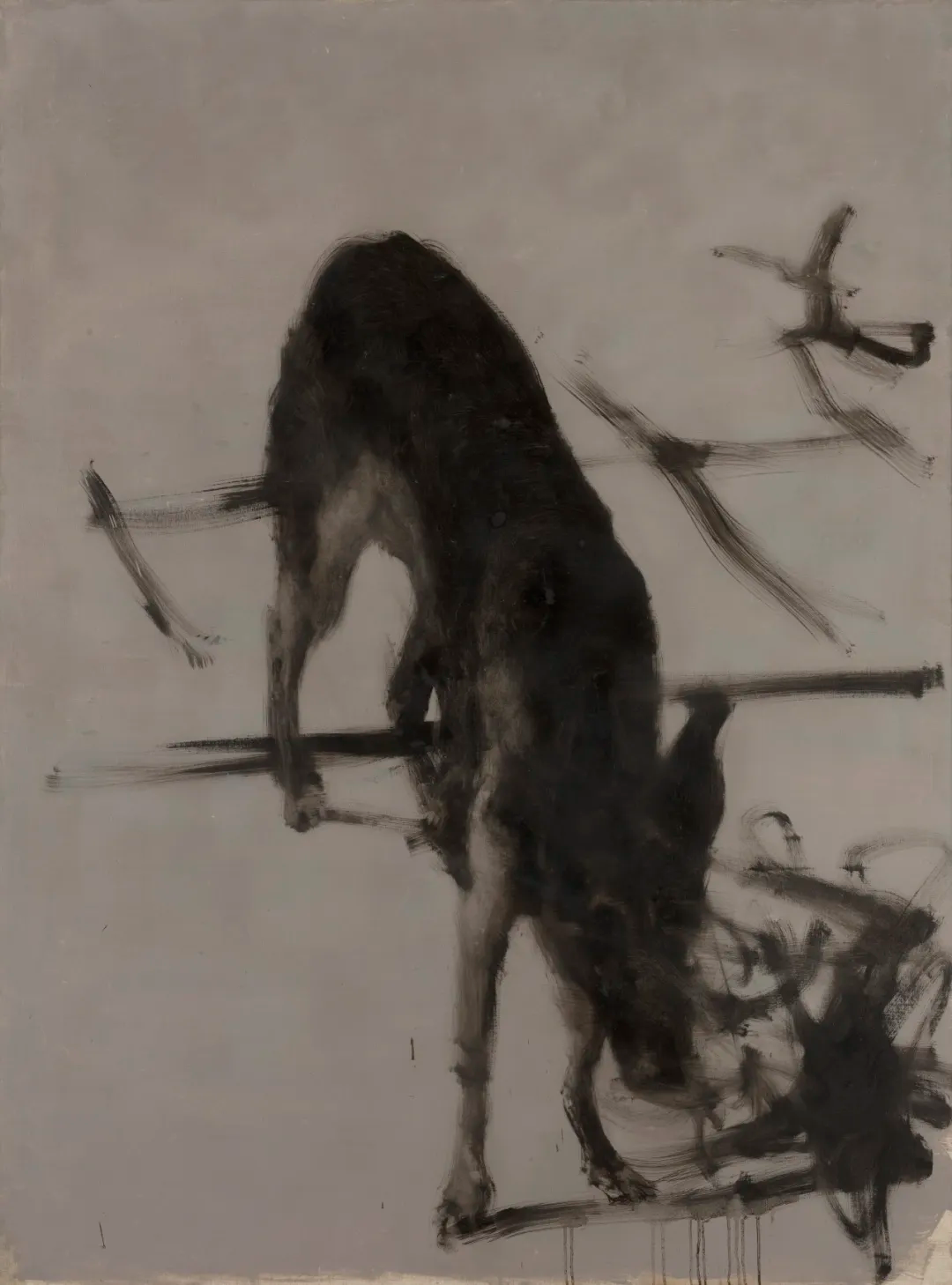
Beyond the Mountain Stone gallery comes Zhou’s best-known subject, the Green Dog. It has often been interpreted as desire, loneliness, the spirit of an era, or a cultural symbol. The story begins in 1993, when Zhou established his first proper studio in Chengdu and brought home a German shepherd named Heigen.
Heigen had followed him since he was one month old, watching him work in the studio and sleeping beside him. Zhou began to paint the dog. One day, a streak of green was accidentally left across its body; later he decided to paint the entire animal green.
Zhou Chunya, Heigen Standing on a Low Wall, 1996.
After Heigen died, Zhou stopped the series for a time.
“For the artist, this was a lived, everyday subject,” Cui said. “What is interesting is that a subject from ordinary life creates another kind of internationalism. People from almost any culture have experience living with dogs or other animals. It breaks through regional symbols.”
That helps explain why Zhou’s work is so easy to remember. Dogs, flowers, and stones are familiar to almost everyone; viewers do not need a grounding in complex art theory before entering the pictures.
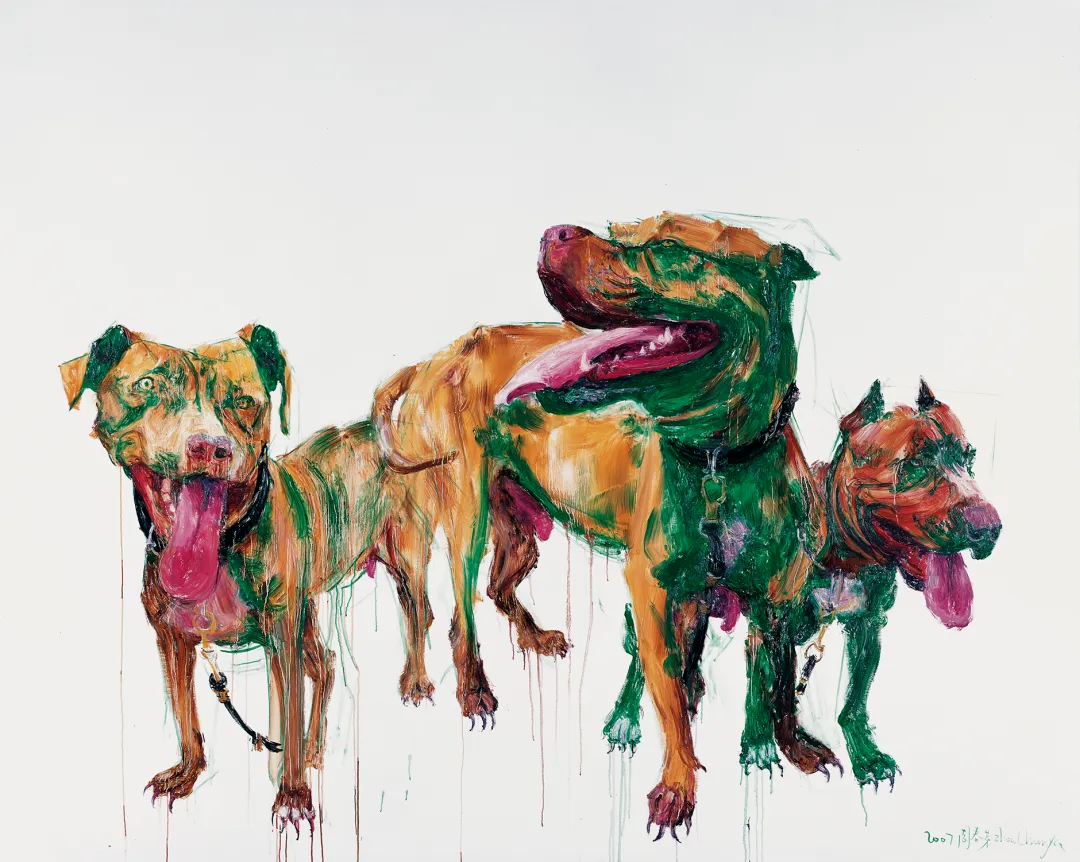
Zhou Chunya, Three Fighting Dogs, 2007.
“Zhou’s universality comes precisely from the accessibility of his subjects,” Cui said. “Their value lies in the fact that, on this familiar ground, he built a language and an imaginative sensibility that belong to contemporary people—to the present moment.”
The more familiar the subject, the more urgently a painter must find a personal way to treat it. Through green, rapid brushwork, and the dog’s physical poses, Zhou made Heigen appear both intimate and strange.
For Cui, this language cannot be neatly classified as Eastern or Western. “It is neither Eastern nor Western. It always occupies a middle ground. And where is that middle ground? The individual.”
Installation view of Zhou Chunya: Mountain Stone, Garden, Peach Blossom, Green Dog, Song Art Museum, Beijing, 2026.
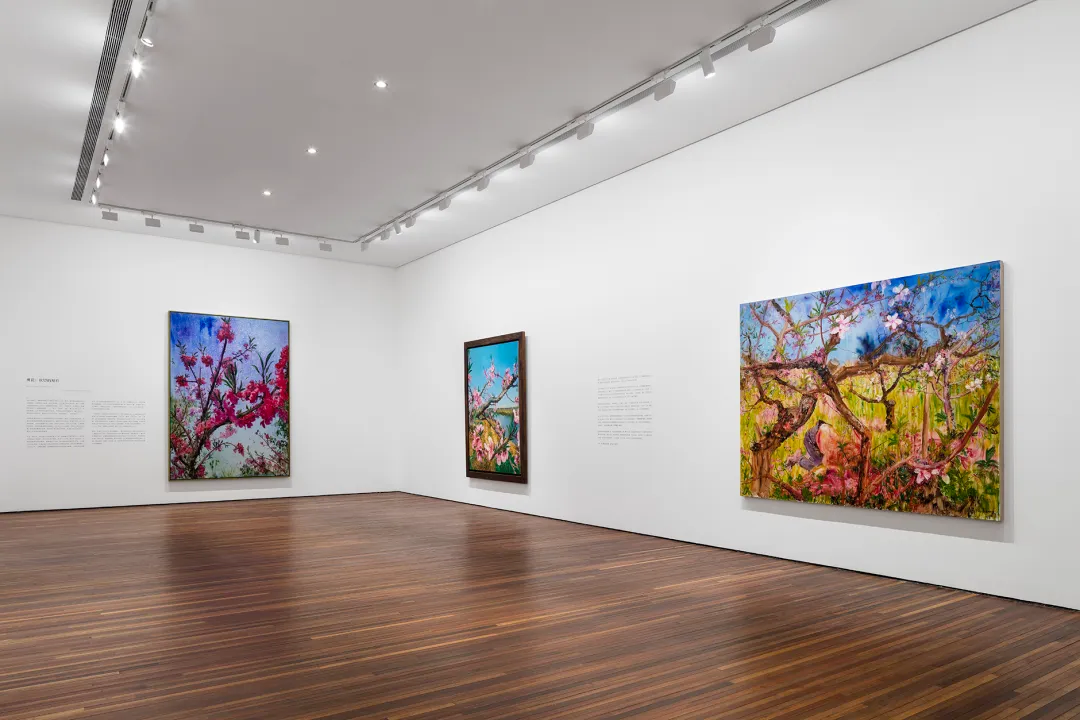
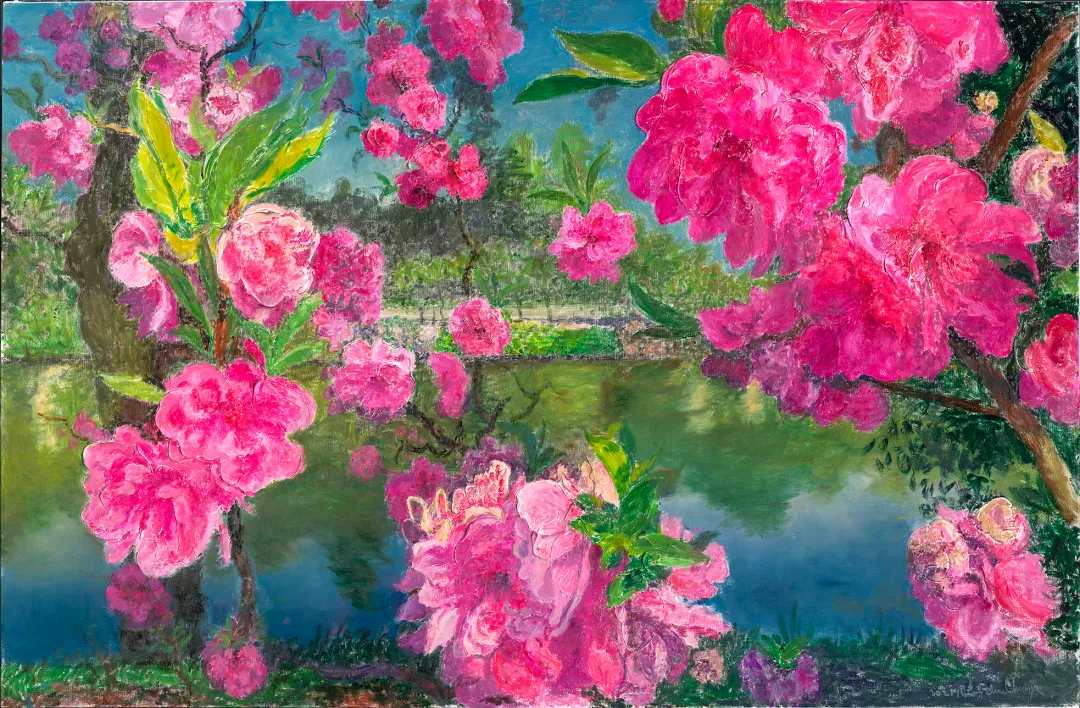
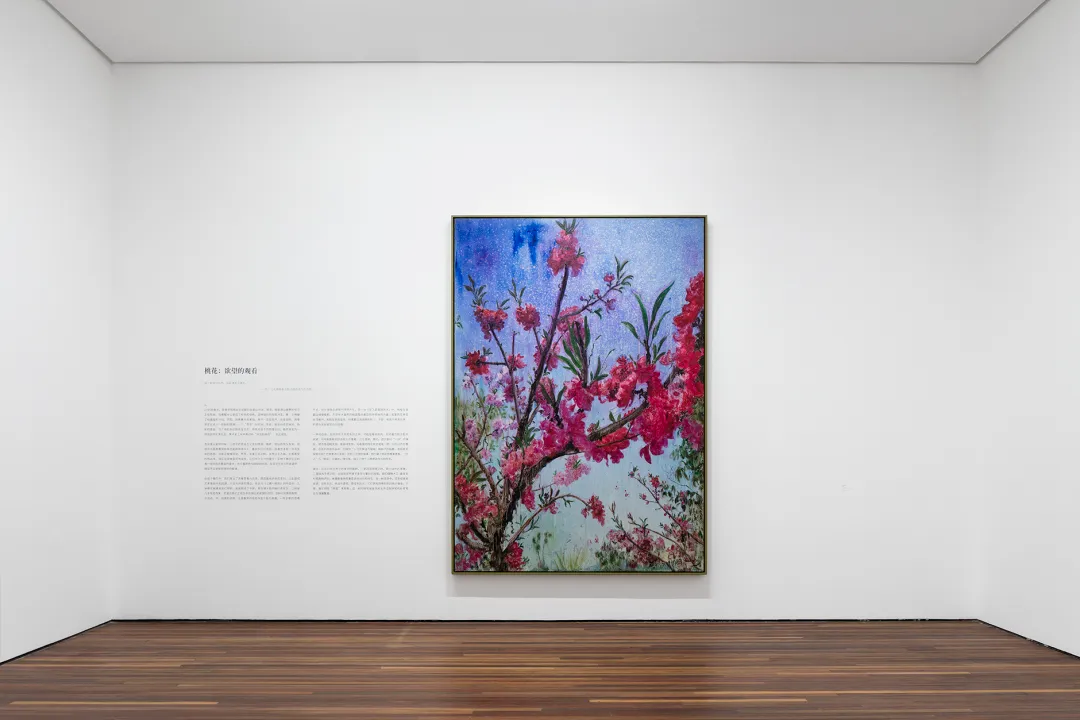
Leaving the Green Dog gallery, visitors encounter broad expanses of vivid pink. Zhou began concentrating on peach blossoms in the mid-2000s. Every March and April, he traveled to Longquan, Slender West Lake, and other places south of the Yangtze to see the flowers. In the paintings, branches often extend like rapidly growing bones, while dense blooms seem ready to burst out of the canvas. Nudes, skeletons, and everyday figures sometimes appear among them.
“I think Zhou’s peach blossoms move in two directions,” Cui said. Peach trees bloom profusely in a year of favorable weather, but in extreme drought they can also flower intensely in order to survive and reproduce. In Zhou’s paintings, peach blossoms are therefore bound to desire, the body, and life force, while carrying the unease of something that will quickly fade after reaching full bloom.
He paints peach trees with skulls, placing death beside the instant of fullest bloom. When bodies enter the flowers, flesh, desire, and nature become entangled.
Installation view of Zhou Chunya: Mountain Stone, Garden, Peach Blossom, Green Dog, Song Art Museum, Beijing, 2026.
“People in China have a yearly habit of going out in spring to see flowers,” Cui said. “Even when life is not going well, people still look to nature for an opening. Many collectors may love more than the peach blossom itself. They love spring and the abundance of life it represents—a passage toward another Peach Blossom Spring when facing society.”
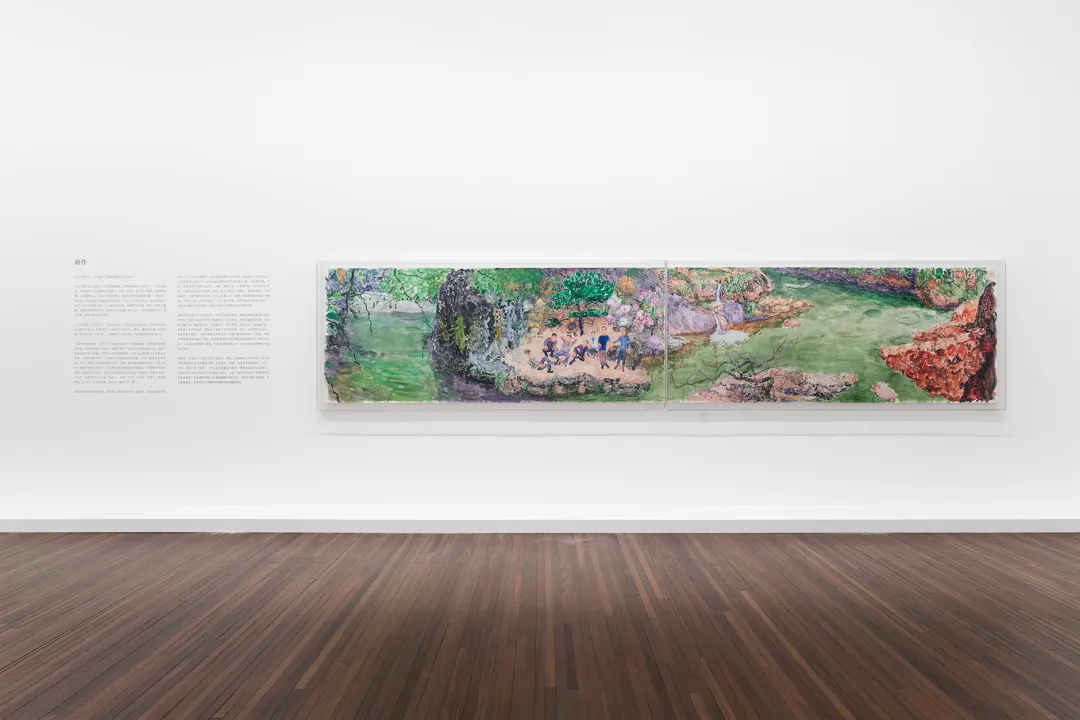
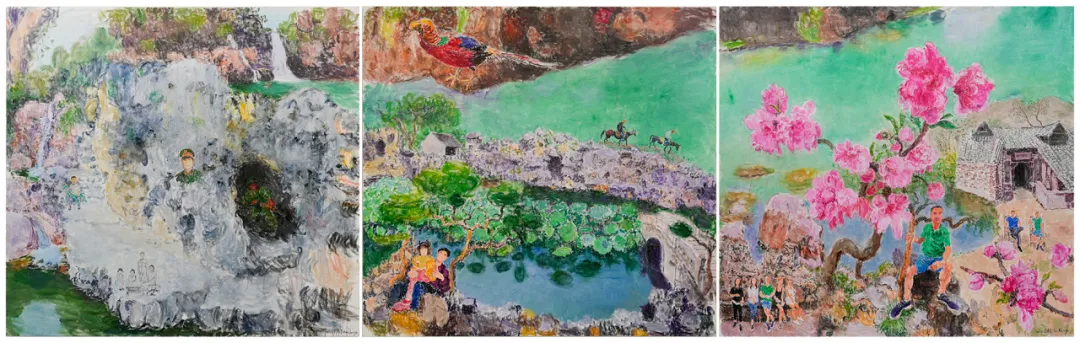
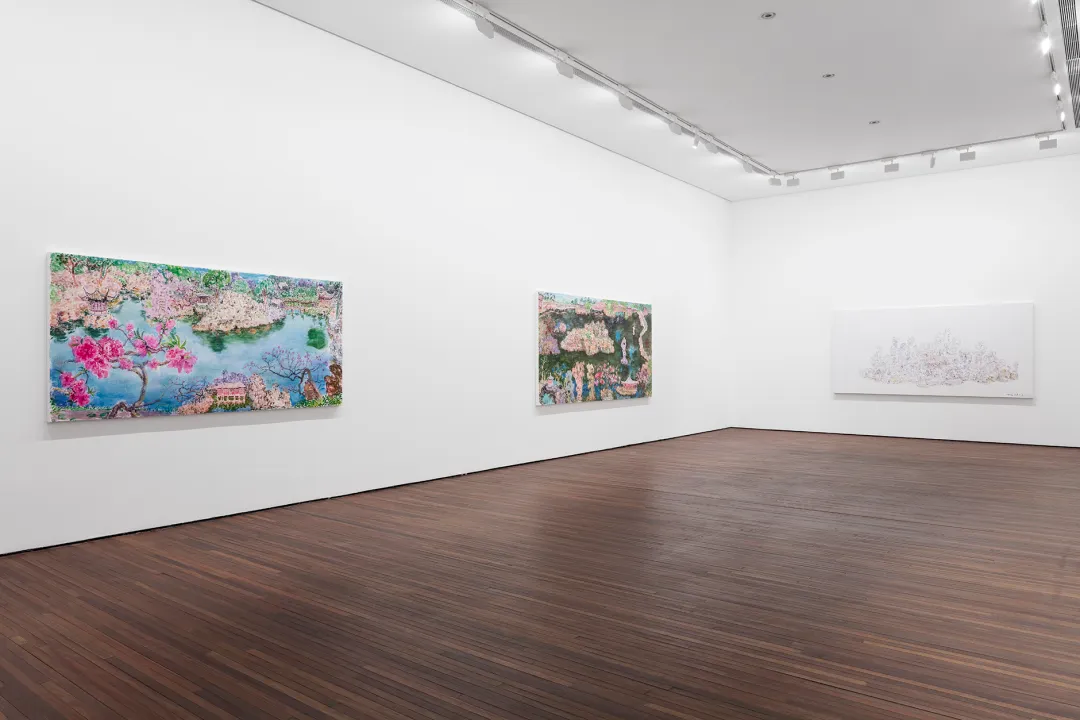
In more recent paintings, the peach blossom is no longer always the protagonist. The nine-meter-long The Peach Blossom Pool Is a Thousand Feet Deep uses ten sections to tell the life of his friend Deng Hong. Mount Taibai borrows a structure from Wang Meng and fills it with Zhou’s memories of his mother’s life.
“The peach blossom used to be the protagonist,” Cui said. “In Zhou’s later work, it becomes an actor in life—one role within the theater of a lifetime.”
Zhou Chunya, The Peach Blossom Pool Is a Thousand Feet Deep, 2025.
When he was younger, Zhou might fill an entire canvas with one stone or one dog. Later, flowers, rocks, figures, and friends began to appear together, and the picture shifted from a single object into a story.
Cui has known Zhou for fourteen years and still remembers the care this important artist of an older generation showed toward younger people in the field. “The first time we met, we only spoke briefly. I had just begun curating and hardly knew anyone. When we met again a year later, many people were gathered around him, so I did not dare go over. But Zhou came to greet me and talk with great warmth. I was deeply moved.”
Zhou Chunya, Waiting Fifteen Years for the Flowers to Bloom, 2021.
In 2013, when the Chengdu Biennale was selecting curators, Zhou publicly supported younger curators, including Cui. When speaking about the artist himself, Cui returns most often to two words: relaxed and free.
“Zhou Chunya has a sense of purpose, but it is not oppressively heavy. His outlook on life is open and generous,” Cui said. Zhou is warm with people, without the airs of a major artist, and deeply kind. “It is like the life force in his peach blossoms. Their blooming is always ardent, always full of warmth.”
Once the Green Dog and Peach Blossom are returned to Heigen, to yearly spring outings, and to the lives of friends, they stop being merely two familiar market symbols. Zhou has always painted the life he has actually touched.
SECTION 03 | After 70: Painting a Garden of His Own
Installation view of Zhou Chunya: Mountain Stone, Garden, Peach Blossom, Green Dog, Song Art Museum, Beijing, 2026.
In the second half of the exhibition, works on paper, long scroll-like paintings, and gardens come into view. The stones, plants, and figures that appeared separately earlier now begin to share one space.
For the past seven or eight years, the garden has been Zhou’s central direction. Cui pointed out that Chinese Landscape, painted around 1992, already contained the beginnings of a garden in its stones, branches, buds, and deep recession. Zhou later painted Taihu stones and peach blossoms separately, repeatedly enlarging details of the garden.
“It moves from one corner of a garden back into a more complete, more expansive garden narrative,” Cui said. “The account of space shifts from physical space to the space of a life. The artist is not simply depicting a garden; he is more interested in the stories within it.”
Installation view of Zhou Chunya: Mountain Stone, Garden, Peach Blossom, Green Dog, Song Art Museum, Beijing, 2026.Zhou Chunya, Longmian Mountain Villa, 2022.
Around 2018, Zhou moved to Shanghai for a simple reason: it is closer to Suzhou’s gardens, the mountains south of the Yangtze, and the peach blossoms of spring.
In recent years, he has returned again and again to the Humble Administrator’s Garden, Mountain Villa with Embracing Beauty, Tiger Hill, and Slender West Lake—looking at bare branches in winter, then new bamboo, duckweed, and peach blossoms in spring. He traveled to Yangzhou with Mao Yan in 1996 and, more recently, spent three rainy days in Huangshan with friends. The mist and the sensation of walking through the mountains later entered Linjiangxian. He also made a special trip with friends to find a Taihu stone he had painted more than twenty years earlier.
Zhou Chunya, Linjiangxian, 2023.
Walking, looking at mountains, and visiting gardens gradually became part of Zhou’s method. Changes in the paintings also followed changes in his reading: Van Gogh and Monet carried over from the 1980s; Huang Binhong and Bada Shanren, who reawakened him in the 1990s; and now the Four Wangs, the Four Monks, Wen Zhengming, Shen Zhou, Kuncan, Xu Wei, and several collected volumes on Suzhou gardens.
His reading moved from West to East and then backward through time, from the modern era toward the ancient world. At the same time, he increasingly relied on landscapes encountered through travel. Looking at paintings, moving through places, and changes in everyday life all reshaped the landscapes on his canvases.
Cui described the shift this way: “Zhou Chunya is not an artist led by theory or knowledge. He is more concerned with a person’s intuition and an abundant capacity to feel.”
Zhou Chunya, A Garden of Spring, Dreaming of Suzhou, 2026.Installation view of Zhou Chunya: Mountain Stone, Garden, Peach Blossom, Green Dog, Song Art Museum, Beijing, 2026.
After sixty, Zhou increasingly wanted a garden of his own.
“The artist has told me many times that he deeply wishes to have his own garden,” Cui said. A Chinese garden is built within the city: close the gate and it becomes a private landscape; open it and everyday life returns at once. One need not actually live deep in the mountains to witness the seasons change each day.
Cui therefore places Zhou beside two artists separated by great distances in time and place: Wen Zhengming, who participated in shaping the Humble Administrator’s Garden, and Monet, who cultivated his own garden at Giverny late in life.
Late in life, Monet no longer traveled often, but he could observe the light and plants in his garden from morning to night. Through the seasons, flowers opened and faded, fruit ripened, and the world shifted from green to yellow and red. Zhou’s garden paintings are similarly attentive to change.
Zhou Chunya, Purple Mist Rising, 2021.Installation view of Zhou Chunya: Mountain Stone, Garden, Peach Blossom, Green Dog, Song Art Museum, Beijing, 2026.
“Whether it is the garden Wen Zhengming helped create or Monet’s garden, in Zhou’s paintings they are both cycles of life force,” Cui said. “For him, each is the garden of a human life. Gathered together, they become a garden that no longer belongs to Zhou Chunya alone.”
Juqu Forest Dwelling, Waiting Fifteen Years for the Flowers to Bloom, Mount Taibai, Linjiangxian, and the recent Humble Administrator’s Garden are not reconstructions of old paintings or real views.
“Whether in ancient times or today, no matter how many years separate us, we share similar feelings when we face spring, separation, peach blossoms in bloom, and the rises and falls of life,” Cui said.
Installation view of Zhou Chunya: Mountain Stone, Garden, Peach Blossom, Green Dog, Song Art Museum, Beijing, 2026.
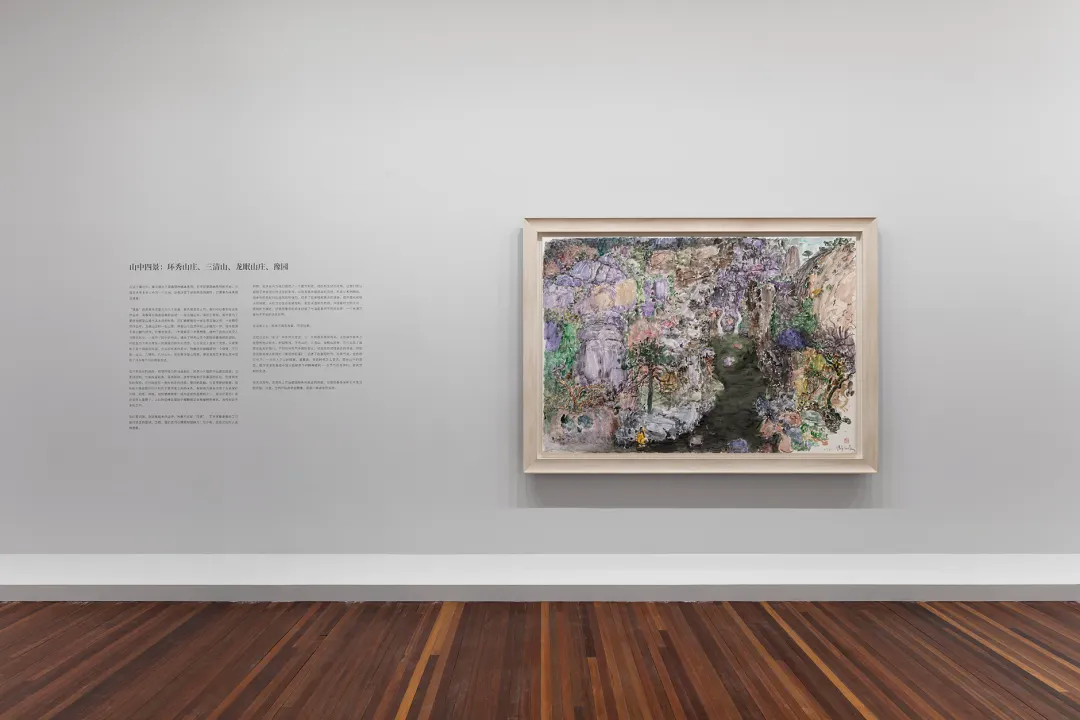
A section devoted to works on paper reveals the artist’s thinking and preparation. Traces of erasure, overpainting, and hesitation remain intact. Some sketches eventually became large oil paintings; others stayed on paper.
Near the end, the exhibition returns to the artist’s early years. The print Half a Life, books left by his father, and a work by Zhang Daqian appear beside the newest gardens. Decades later, his father’s final instruction—“keep painting”—resurfaces in the exhibition.
“This is not a ‘retrospective.’ We selected four of the most representative slices,” Cui said. Zhou has not held an exhibition of this scale in Beijing for nearly twenty years, and many works are being seen by local audiences for the first time. “You can understand it as an exchange among friends through painting.”
Installation view of Zhou Chunya: Mountain Stone, Garden, Peach Blossom, Green Dog, Song Art Museum, Beijing, 2026.
Seeing works from several decades brought together again was also a rare experience for Zhou himself.
“It is like watching a film of your own life, and also like unrolling a Chinese handscroll,” Cui told us. After the installation was finished, Zhou stood in the gallery and said it was the first time he had seen several of the paintings together.
After seventy, Zhou continues to change subjects and travel to look at mountains, flowers, and landscapes.
Installation view of Zhou Chunya: Mountain Stone, Garden, Peach Blossom, Green Dog, Song Art Museum, Beijing, 2026.
“When you paint one subject for too long, the excitement diminishes,” Cui said. “An artist keeps renewing the subject in order to keep that life force as fresh as it was at the beginning.”
At the end of the interview, we asked what an artist with a fully developed language can still offer younger viewers.
Cui’s answer was simple: “That a seventy-year-old artist is still seeking the new and still changing is, in itself, an encouragement to life. If, after seeing Zhou’s exhibition, visitors want to look at peach blossoms next March and gardens next April, I think that would be a very good thing.”