A major retrospective at the Beyeler Foundation surveys more than sixty years of Vija Celmins’s art: a body of work shaped by war, solitude, and an unhurried, exacting attention to surfaces that seem at once ordinary and unfathomable......
By / Xirui Huang · 8 min read
What are the highlights of Vija Celmins’s retrospective at Fondation Beyeler?
Fondation Beyeler’s Vija Celmins retrospective presents 90 works from 1964 to 2025, her largest survey in Europe. It traces studio objects and wartime imagery, 15 years of pencil drawing, ocean and night-sky paintings, paired stones and blackboard sculptures, spider webs and the new snowfall series.
Vija Celmins is one of the most important and singular living women artists in the world, and at eighty-seven she is still at work. Born in Riga, Latvia, in 1938, she lived through a displaced childhood and war, witnessed sweeping social upheaval, and yet never moved with the crowd, choosing instead to shut herself away to make art. Even now, she works alone in her New York studio, slowly, with a concentration that is almost meditative.
Over more than sixty years, Celmins has made a large body of meticulous paintings and drawings of everyday objects, shimmering ocean surfaces, deserts, spider webs, star-filled night skies, and heavy snowfall by day and by night, along with sculptures of stones, blackboards, and ropes so convincing they verge on illusion. From June 15 to September 21, 2025, the Beyeler Foundation, one of the world’s most authoritative art institutions, presented the largest retrospective of her work ever mounted in Europe, bringing together ninety representative works from 1964 to the present, including a group of new pieces made this year.
SECTION 01 | Paint everything in the studio”
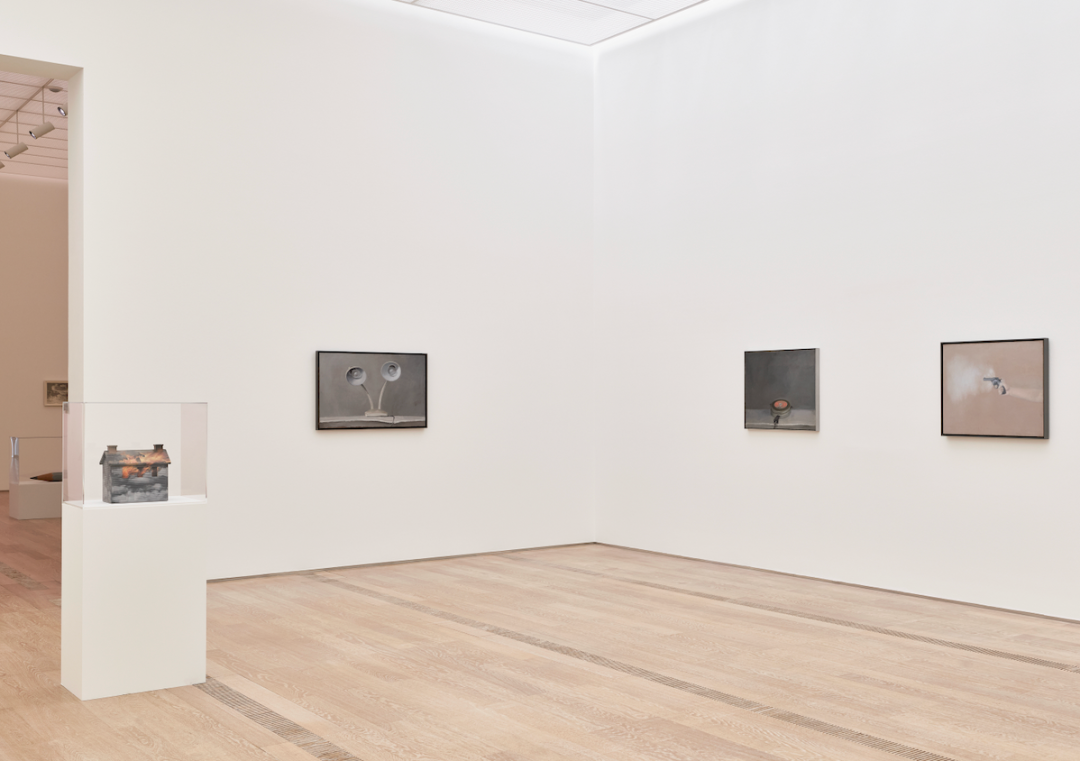
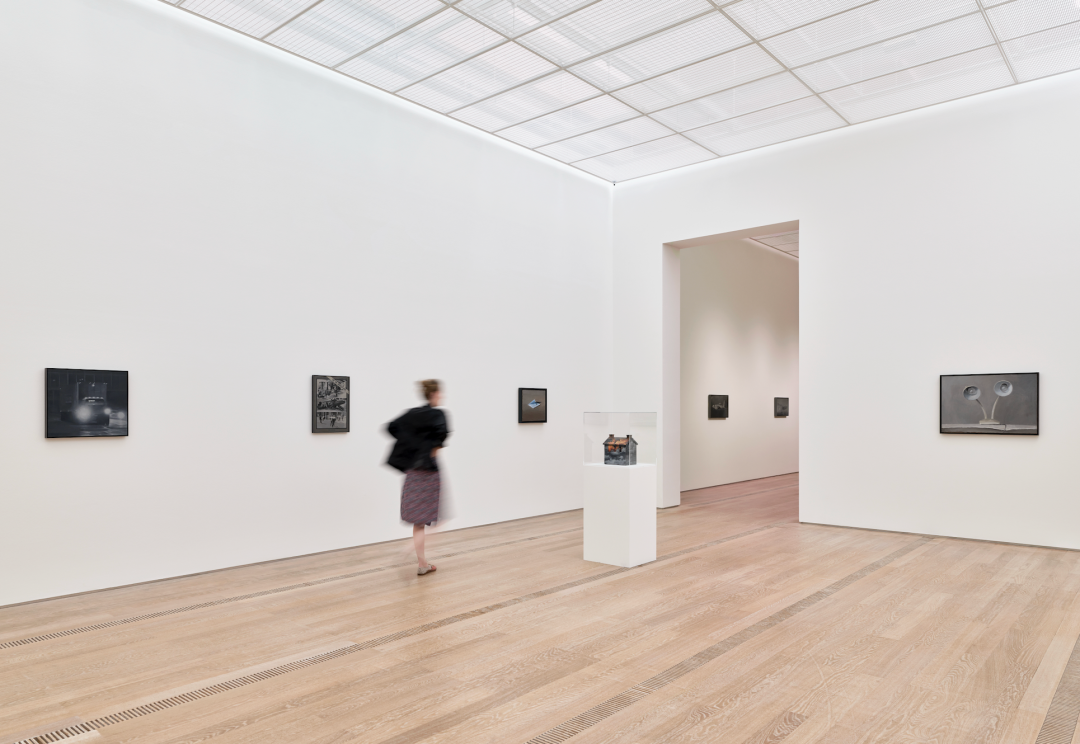
“She has always been regarded as ‘an artist’s artist,’” the exhibition’s curator, Laura Wilde, told us. In June, we visited the Beyeler Foundation to speak with Wilde about the artist’s life, marked by hardship yet also by calm. In the installation view of Vija Celmins at the Beyeler Foundation, 2025, featuring Lamp #1, 1964, the first thing one sees upon entering the gallery is a pair of lamps against a gray ground, staring at newly arrived viewers like eyes.
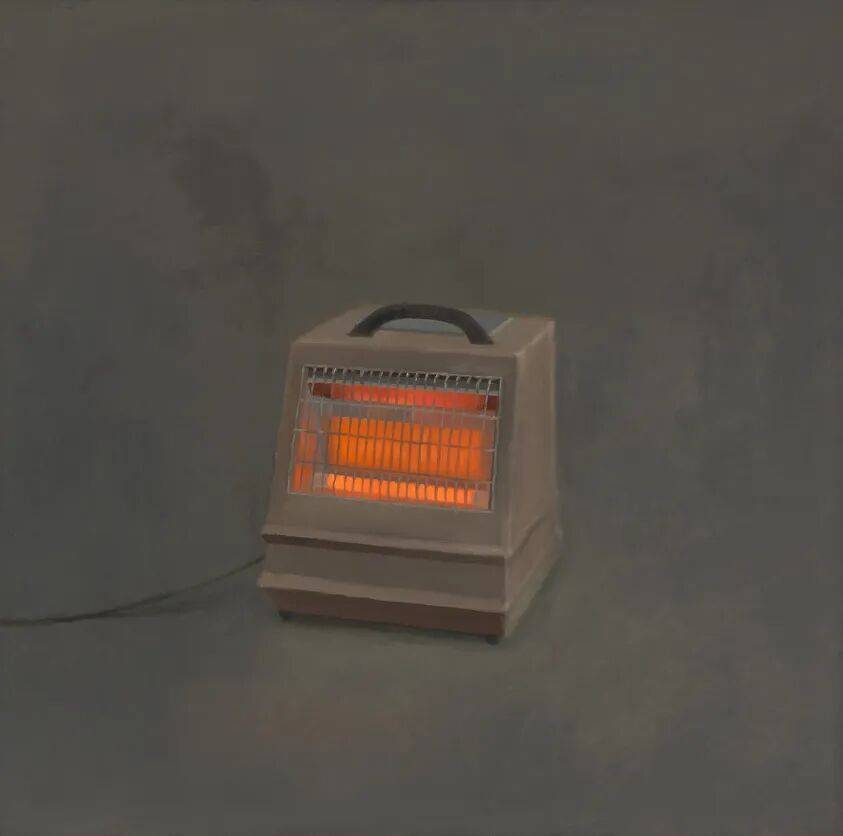
“That’s exactly why we put it at the beginning,” Laura said with a laugh. “You see two eye-like lamp heads. There’s a sense of playfulness there, and looking closely is very important to understanding the play in her art.” Vija Celmins, Heater, 1964; Vija Celmins, Envelope, 1964; Celmins’s 1964 U.C.L.A. graduate exhibition: at that point, Celmins was still studying at the U.C.L.A. art school, having just moved from Indianapolis to her first studio in Los Angeles.
Abstract Expressionism was then in full force, and she was only beginning to recognize herself as an artist.
“She said to herself, You have to observe the things around you and in front of you,” Laura said. We noticed that all the objects in the first gallery, including the heater, the lamps, and the envelope, were things Celmins could find in her own studio or daily life. Letter was in fact a drawing of a letter her mother had written to her. And the isolated heater with its orange glow, the artist herself has said, conveyed “a sense of menace.”
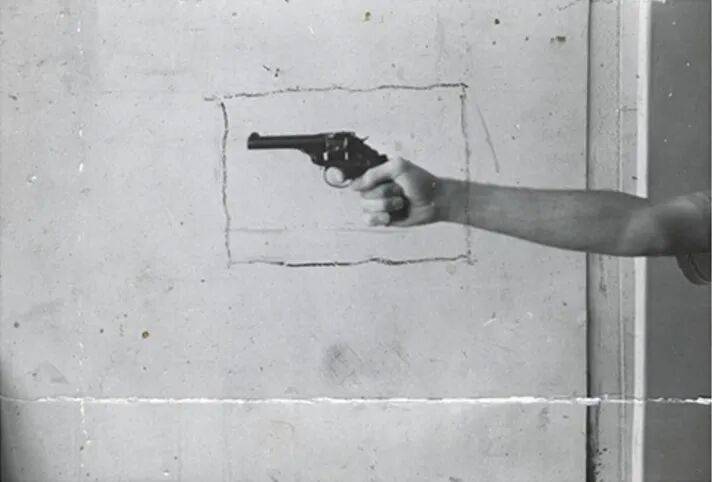
Vija Celmins, Hand Holding a Gun #1, 1964: at the time, the artist photographed her boyfriend holding a gun in her studio. Seeing a smoking handgun in the gallery, we asked the curator whether this, too, had been an object from her studio.
“The gun actually belonged to her boyfriend at the time, and Celmins took the photograph as source material. Of course, she added the white smoke herself,” Laura told us. It was also during this period that such photographs became the point of departure for her work. She painted the life recorded in photographs, and she painted news events, trying to register social reality through painting. In doing so, she established the method that would define her later work: keeping her distance from dominant art movements and from the noise of the outside world, and concentrating on an objective, unsentimental form of narration.
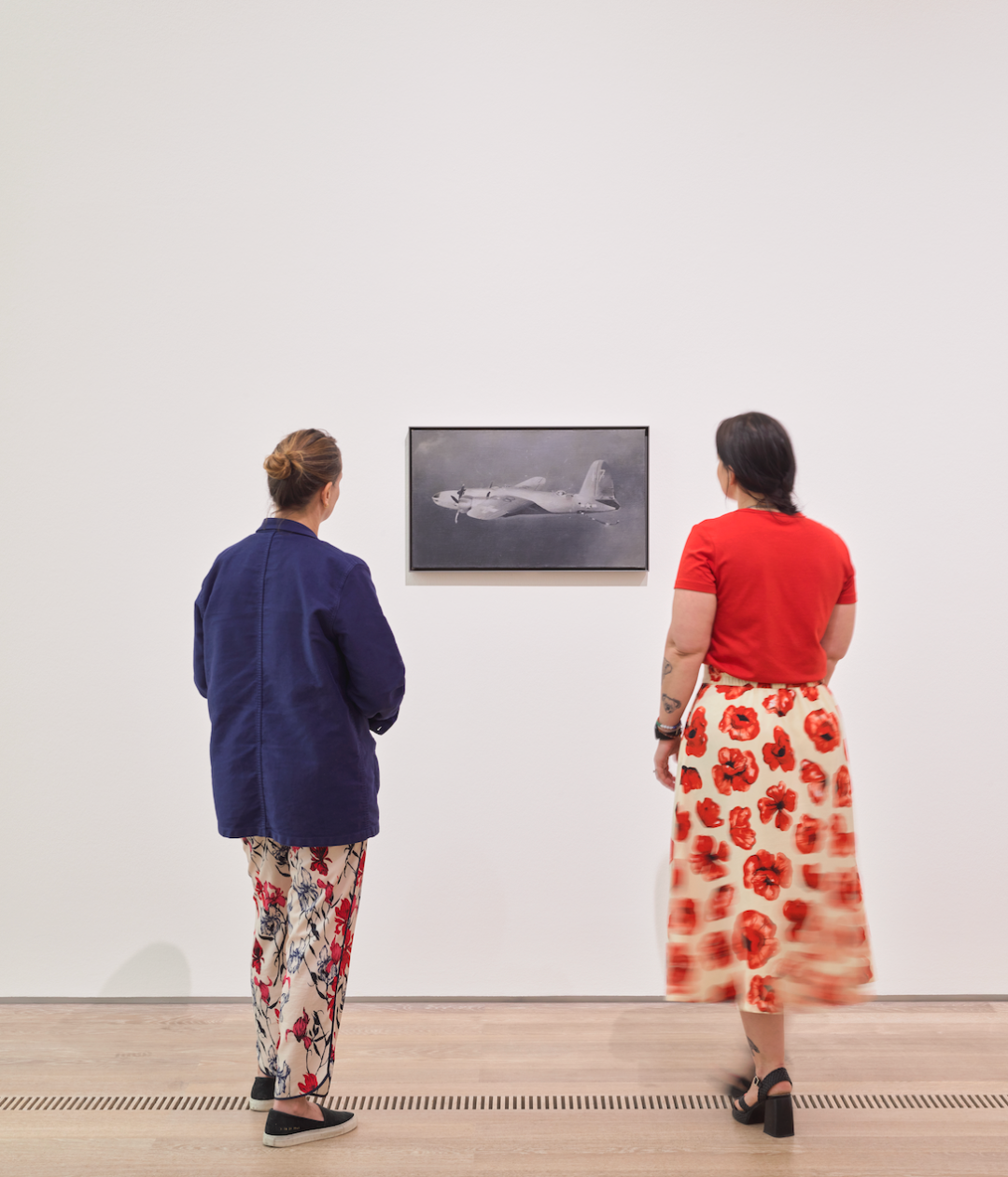
In another installation view of Vija Celmins at the Beyeler Foundation, 2025, featuring Suspended Plane, 1966, another subject given special weight in the galleries is the airplane, which is also bound up with war. “Airplanes are connected to her childhood memories. As a child she saw too many planes flying over the city, and they might drop bombs,” Laura told us. Born in Latvia in 1938, Celmins fled with her family to Germany at the age of six to escape the advancing Red Army, spent four years moving through refugee camps, and did not immigrate to the United States until 1948, when the family finally settled in Indianapolis.
In an interview, she once said, “It wasn’t until I was 10 and settled in Indianapolis that I realized fear was not supposed to be a constant condition of life.” The restraint and coolness of her palette are bound up with those unsettled early years: in wartime, one must maintain a cool, self-protective distance to minimize the damage war can do. Celmins with her Untitled (Comb), 1970; Vija Celmins at the Beyeler Foundation, 2025; Vija Celmins, Pencil, 1966: most of the sculptures she made in this phase were enlarged versions of ordinary objects close at hand, combs, erasers, and the like.
The enormous pencil sculpture we saw seemed almost to foreshadow the direction of her next phase: she abandoned color and oil painting, choosing instead to make trompe-l’oeil drawings in pencil alone. In the Beyeler Foundation installation view, 2025, Vija Celmins, Bikini, 1968, the next gallery presents a black-and-white image of a giant mushroom cloud rising above the beach at Bikini Atoll.
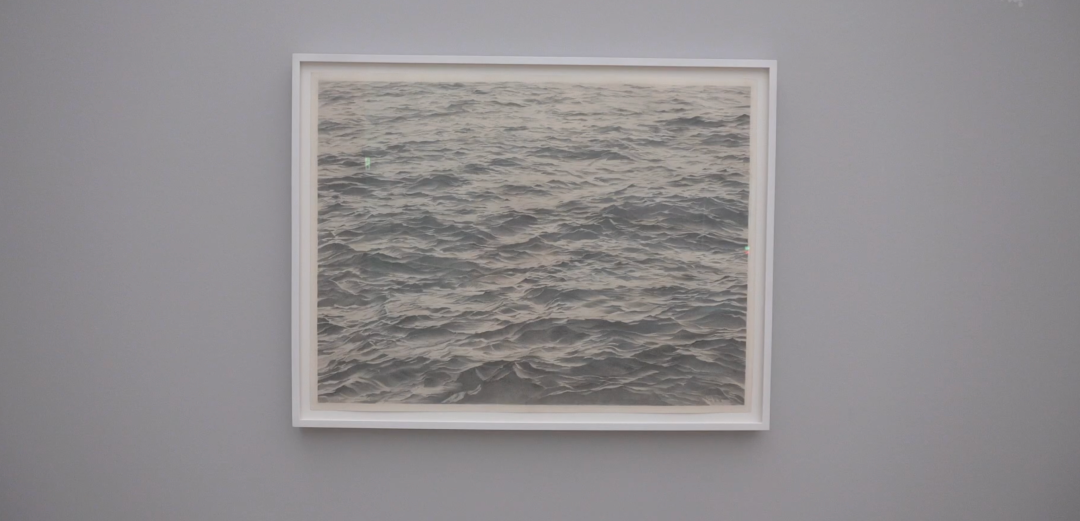
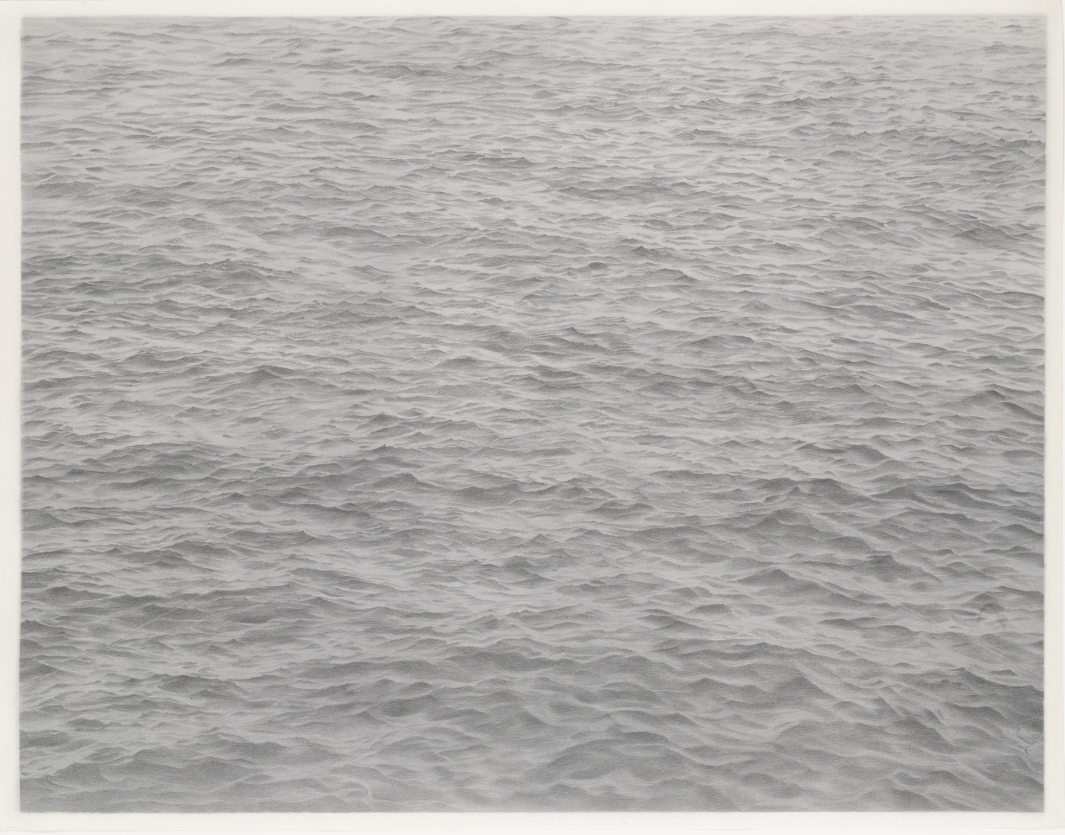
“The original source for this drawing was a magazine spread. In 1946, the United States conducted the first of twenty-three nuclear tests there,” Laura told us. Celmins’s use of photographs as templates kept a distance between herself and the events she depicted. The gray tonalities of pencil intensified that sense of remove. Vija Celmins, Cloud, 1968; Vija Celmins at the Beyeler Foundation, 2025, Untitled (Big Sea #2), 1969: in 1968, Celmins began translating photographs of the Pacific Ocean’s surface into pencil drawings.
SECTION 02 | For 15 years, I insist on drawing only with pencils
“These photographs were all taken by her during walks near her studio in Los Angeles, around the Venice Beach pier,” Laura told us. The artist’s aim was never simply to “draw photographs,” but to make what she herself called “impossible images”: pictures that depict surface texture alone, with no beginning and no end, no horizon, and no creature or object to give the viewer any clue to spatial orientation.
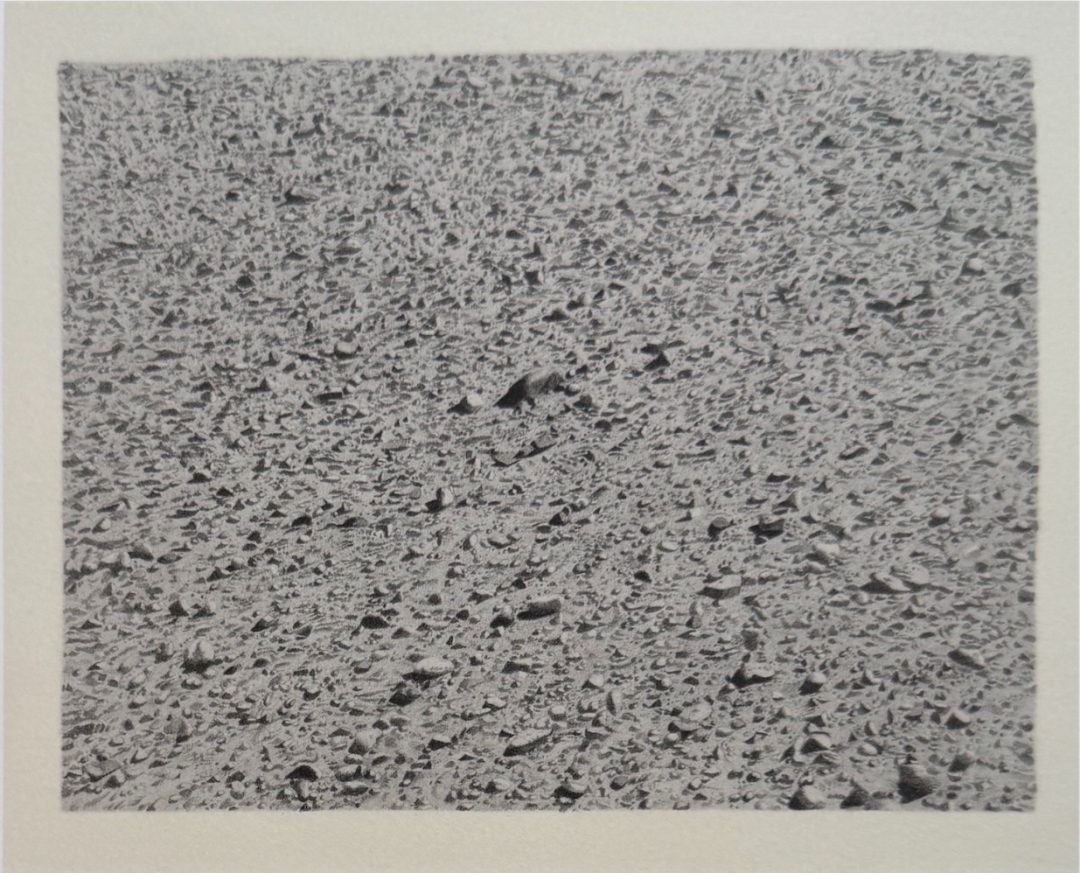
Vija Celmins, Untitled (Ocean with Cross #1), 1971; Vija Celmins, Untitled (Desert-Standard), 1973; Vija Celmins, Lunar Surface (Surveyor 1), 1971-1972; and the assorted reference materials in Celmins’s studio all point to the next fifteen years, when she gave up oil painting entirely and devoted herself to drawing. She drew clouds in the sky and calm expanses of sea; she drew deserts, and the untouched surface of the moon.
For each drawing, she used only one hardness of pencil and never made corrections with an eraser, because she felt that any revision would disrupt the evenness she wanted on the picture’s surface. Perhaps that helps explain why she is such a slow artist: her images contain ideas of time, thought, and space, and at times even she herself seems to lose her way inside them. Vija Celmins at the Beyeler Foundation, 2025; Vija Celmins, Untitled (Desert-Galaxy), 1974; Vija Celmins, Barrier, 1985/86: “She is concerned with the material of painting and the essence of painting, rather than the things she appears to depict on the surface.”
That was how Laura put it. After more than a decade of working with this almost ascetic discipline, Celmins reached another turning point in 1985: a return to oil painting, and an unflagging engagement with dark, star-strewn night skies. The sky is so densely black, and the stars so entirely stripped of the perspective we bring to older paintings of the night sky, that there is no sense of direction, no distinction between up and down, and no way to gauge distance from the earth; one gets lost in a darkness that feels almost like a black hole.
“We can also understand the title Barrier to mean that, for the human body, truly entering this pictorial space is impossible,” Laura said. In the Beyeler Foundation installation view, 2025, Vija Celmins, Night Sky #11, 1995, this series, in its later development, shows increasingly complex celestial surfaces.
There are stars of different brightnesses, even stardust, and white nights reversed against the dark.
“She developed a technique that let the surface remain completely flat while still allowing us to see bright stars and other stars that are less bright. Because she liked liquid rubber, she made holes in the black paint and put liquid rubber into them, so the black paint formed layers, and then she sanded it down. After that, she filled the holes again with white paint. That was because she wanted the surface to look completely flat to the naked eye,” Laura told us.
The Night Sky paintings may look simple, but they were extraordinarily difficult to make; each one took the artist months, sometimes years, to complete. In the Beyeler Foundation installation view, 2025, we also noticed pairs of smooth-surfaced stones. At first, we assumed they were simply stones the artist had picked up in the New Mexico desert, perhaps kept as sources of inspiration, but Laura told us that in each pair only one is real.
At Eighty-Seven, Vija Celmins Is Still Working
Another Beyeler Foundation installation view, 2025, makes clear what that means: Celmins made a bronze “twin” for each stone by hand, painting it with painstaking care to match the original. In size, color, and surface texture, they are almost exactly alike; to distinguish the true from the false with the naked eye is nearly impossible.
“Achieving the most perfect copy possible was the artist’s main impetus in making these works,” Laura said. In the Beyeler Foundation installation view, 2025, one sees that she brought that same commitment to replication to works based on old school blackboards.
“Celmins found these blackboards at flea markets, and then she began the process of remaking them: the scratched wooden frame, the wire hook wrapped around it, the slate darkened with age, the surface turned gray by use and chalk dust . . .” Perhaps what interested the artist was the act of deceiving the viewer, and the strange visual experience that deception produces. Only when we look carefully and compare the exhibited objects do we realize that the apparently blank surface of a blackboard is full of countless details.
In a photograph of the artist in her Long Island studio, Vija Celmins, Untitled (Web #1), 1995, Celmins also began drawing the spider webs in neglected corners of her studio. In 1992, she happened upon a photograph of a web in a book: “I found that image, and a thought flashed through my mind: this is an image I want to explore.” She has also said that she is like a spider herself, weaving her own web day after day, with minute care.
In the Beyeler Foundation installation view, 2025, the final gallery is devoted to Celmins’s newest body of work, the Snow Fall series, including a painting completed in 2024 that is the largest she has made to date. It is also her first attempt to depict snowflakes as a new subject. Against the background of a deep black night, the flakes glimmer faintly, and the sky is no longer as black as it was in her earlier paintings; instead, it becomes a hazy gradation between the dark blue of the sky and the pure white of the ground.
SECTION 03 | Resisting Loneliness with 'Twins'
It captures an instant in the real world, yet expresses a deep and extended silence. In the Beyeler Foundation installation view, 2025, the exhibition ends with a documentary the Beyeler Foundation made especially for this retrospective, after a film crew spent a week living alongside Celmins. The film is the most candid and intimate public presentation of the artist’s personal life now available. After so many years of living and working in seclusion, this eighty-seven-year-old artist can be seen moving before the camera from awkward unfamiliarity to easy fluency, even showing a kind of childlike innocence.