Matisse’s Femme au chapeau at SFMOMA: The Painting That Sparked a Modern Art Scandal
On a July afternoon, we walked into SFMOMA to see “Matisse’s Femme au chapeau: A Modern Scandal,” on view from May 16 through September 13......
By / Xirui Huang · 13 min read
Why did Matisse’s Femme au chapeau cause a scandal, and what does the SFMOMA exhibition reveal?
Matisse’s Femme au chapeau shocked viewers at the 1905 Salon d’Automne with its non-naturalistic colour and helped define Fauvism. SFMOMA’s 2026 exhibition reconstructs that controversy and follows the painting’s 120-year journey through collectors and museums to San Francisco.
The exhibition has an odd title because everything in it revolves around Femme au chapeau, the intensely saturated painting by Matisse, the most famous “Fauvist” artist of the twentieth century. Created in 1905, the work set off panic and dispute across the art world and marked the formal beginning of Fauvism.
For this show, the San Francisco Museum of Modern Art, or SFMOMA, cleared out its entire fourth floor for a single exhibition centered on that one painting.
Tickets are ten dollars on weekdays, twelve on weekends, and free for members. In San Francisco, where museum admission often runs twenty or thirty dollars, that counts as relatively accessible pricing. Perhaps that was deliberate on the curators’ part: this is, after all, an exhibition about who gets to judge a painting, and admission should not be the barrier.
Section One: A Cutting Remark, a Longer Story
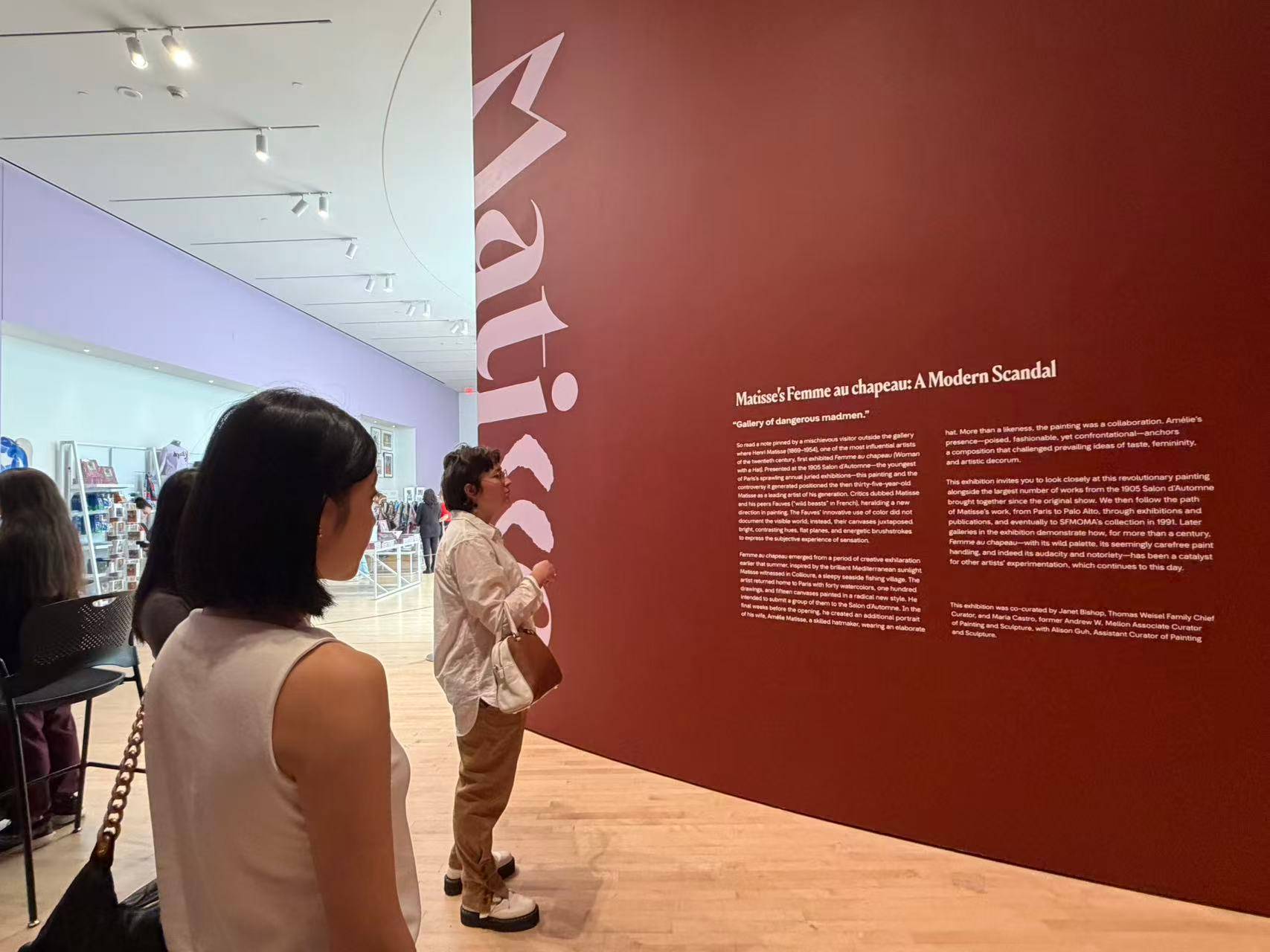
Exhibition entrance, “Matisse’s Femme au chapeau: A Modern Scandal,” SFMOMA, 2026
The entrance is marked by a curved wall painted a wine-dark red. The word “Matisse,” in large slanted script, cuts across the surface, and the exhibition’s full title appears in black on white. The design nods to an episode from 121 years ago, when Matisse’s Femme au chapeau was shown at the Salon and a mischievous visitor reportedly posted a note outside the gallery reading “Gallery of dangerous madmen.”
That quip appears intact as the first line of the wall text, as if to greet, across a span of 121 years, the original shouting match. The gesture is relaxed, faintly self-mocking.
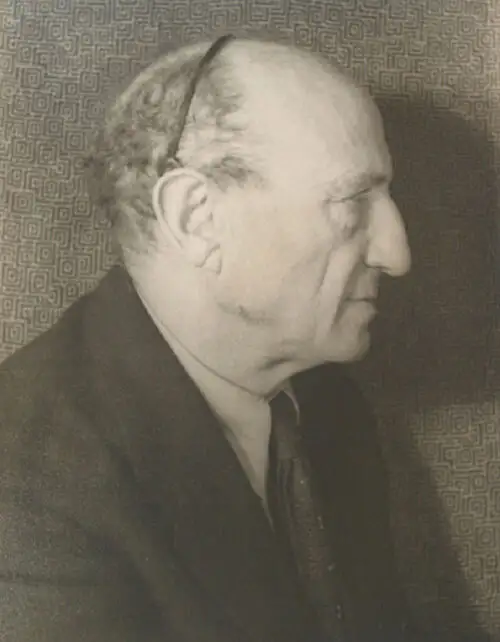
Portrait of the famed twentieth-century collector Leo Stein, who was also a major collector of Picasso and Cezanne
The uproar was, in effect, the art world’s biggest news story of the year. Leo Stein, the painting’s first buyer, described it as “the nastiest smear of paint I had ever seen.”
In its first year, the painting nearly was ordered removed from the Salon walls; only the intervention of a friend on the jury kept it in place. Critics were harsher still, calling it “the greenest attack on taste and common sense.”
Femme au chapeau emerged from an ecstatic burst of work during Matisse’s stay in the Mediterranean fishing village of Collioure. That summer, struck by the local glare, he returned to Paris with forty watercolors, one hundred drawings, and fifteen oil paintings made in an entirely new style, intending to select a group for the upcoming Salon d’Automne, one of Paris’s largest annual juried exhibitions. Matisse, then thirty-five, was still among the younger artists showing there.
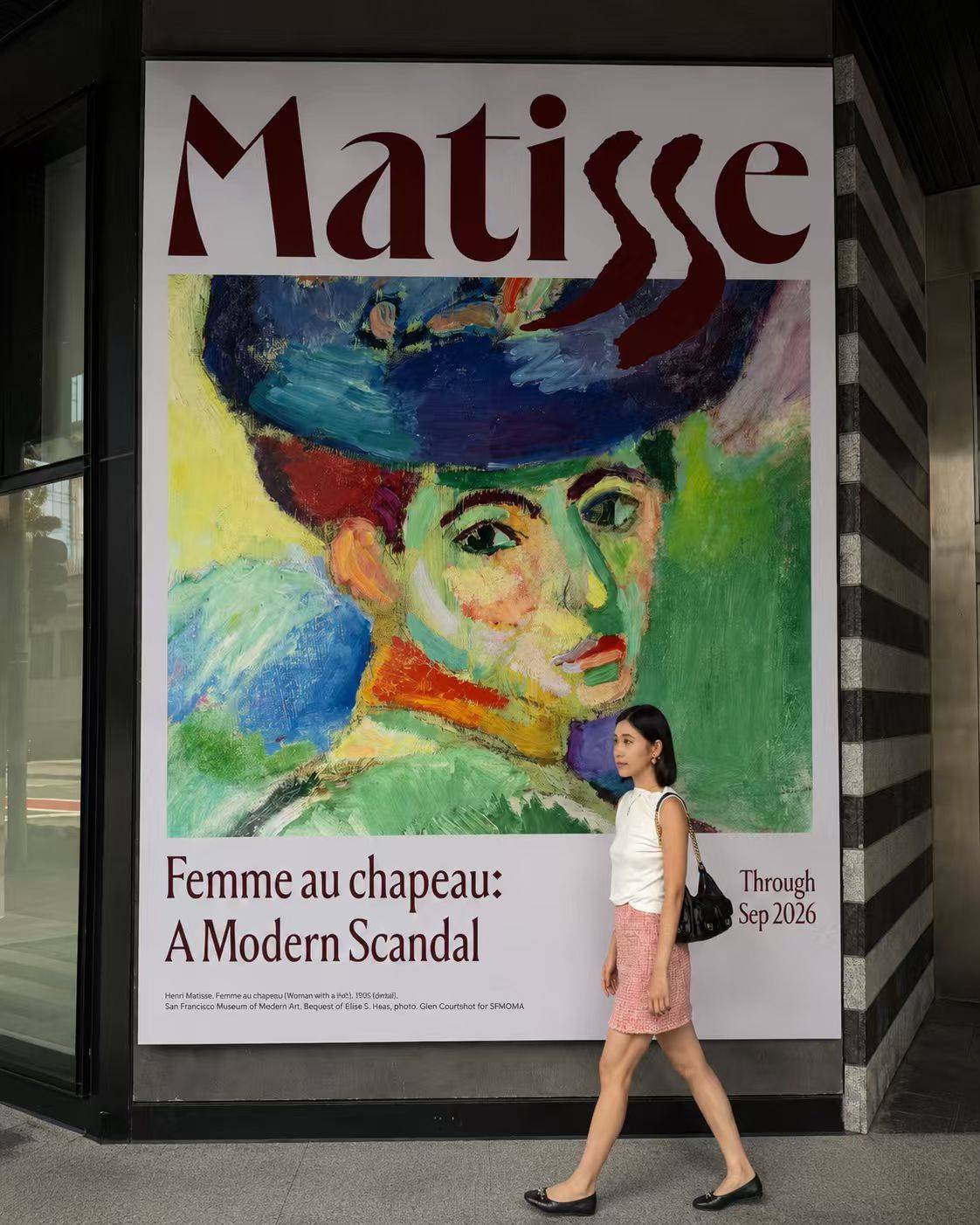
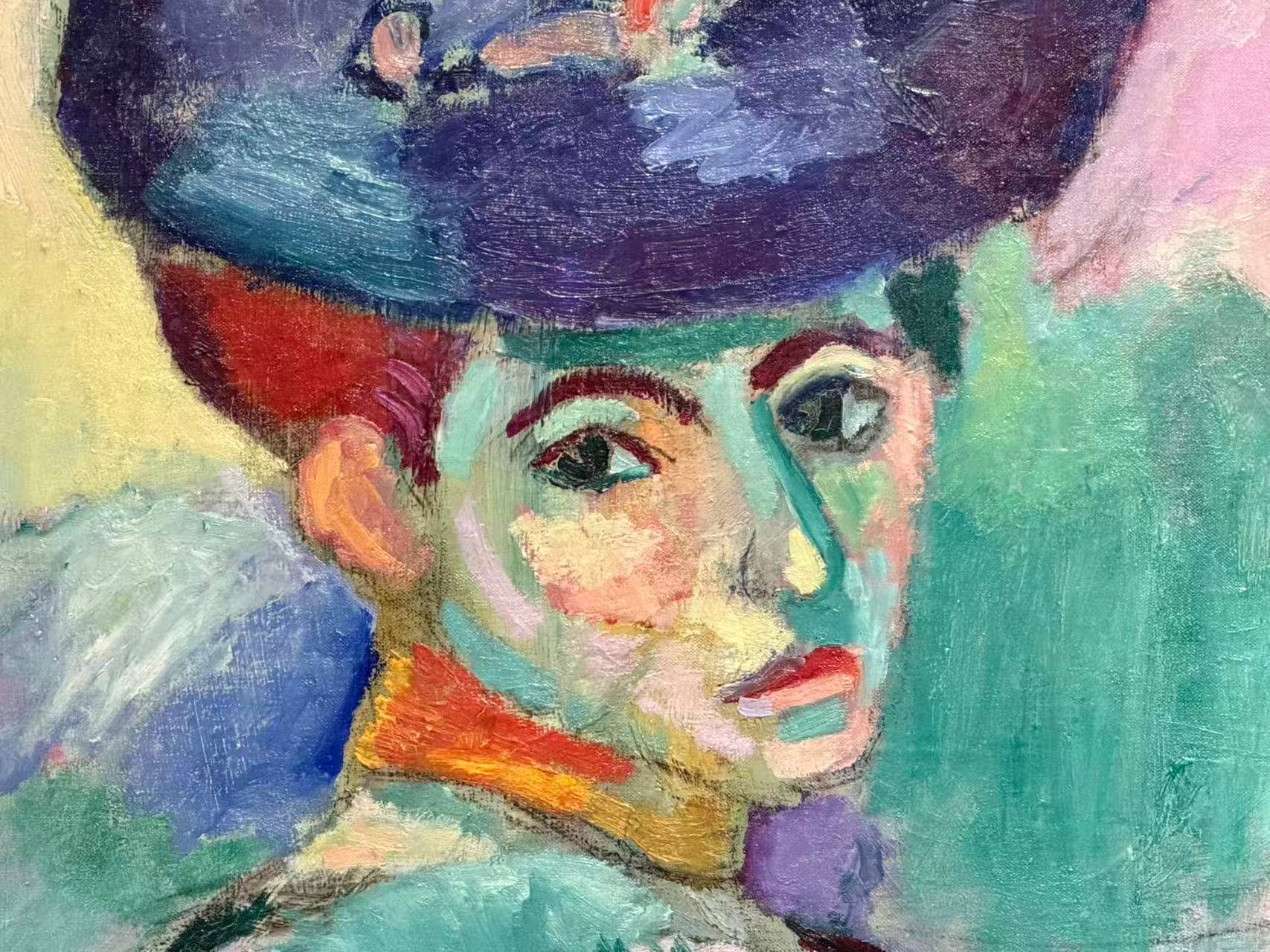
Matisse, Femme au chapeau (detail), 1905, “Matisse’s Femme au chapeau: A Modern Scandal,” SFMOMA, 2026
In the final weeks before the opening, he added one more work: a portrait of his wife, Amelie Matisse. Amelie herself was a skilled milliner, which is where the title Femme au chapeau comes from. The wall label puts it plainly: the painting is less a portrait than a “collaboration.” Amelie’s presence, stylish and faintly defiant, sustains the work’s challenge to taste, femininity, and artistic decorum.
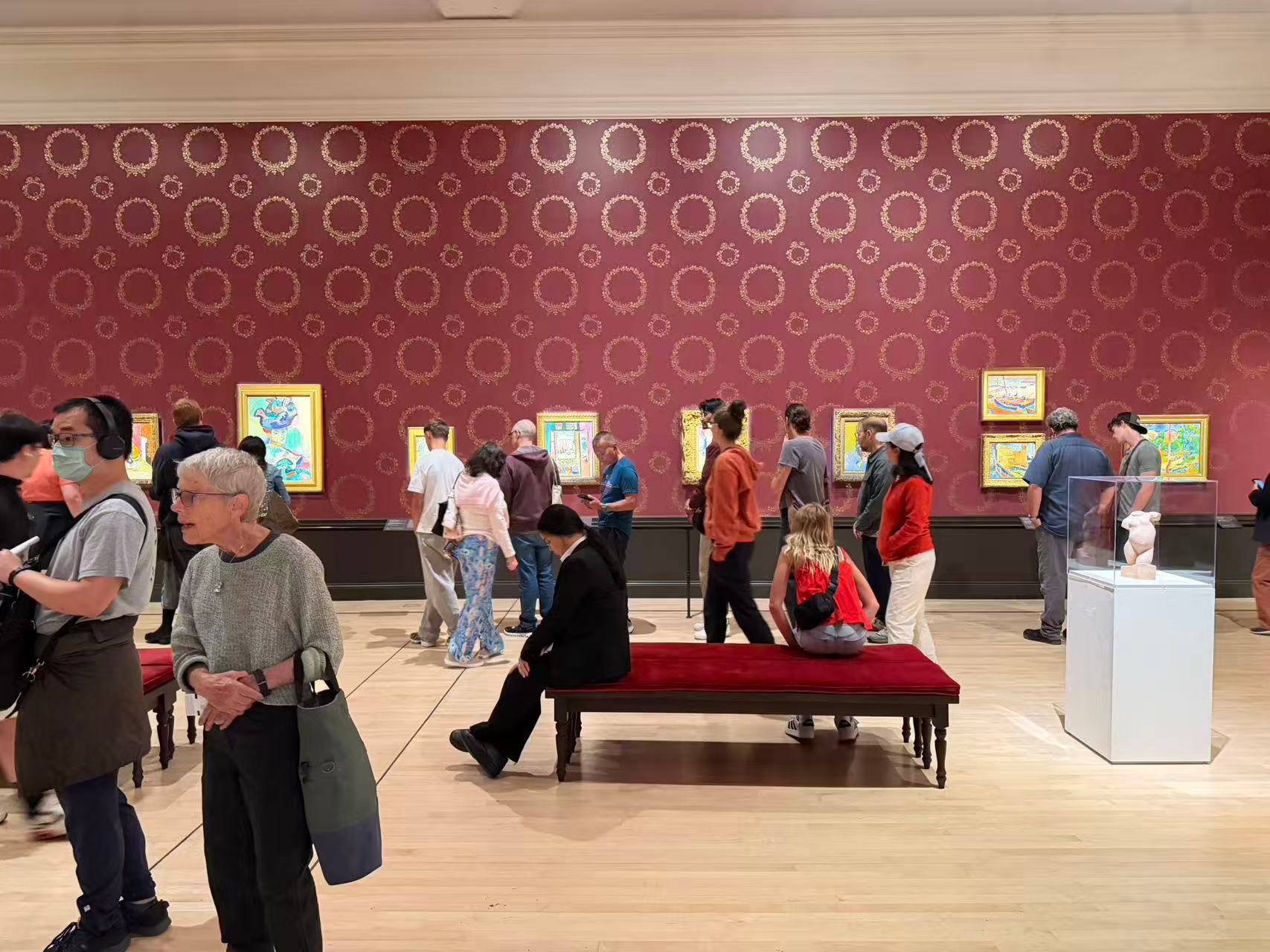
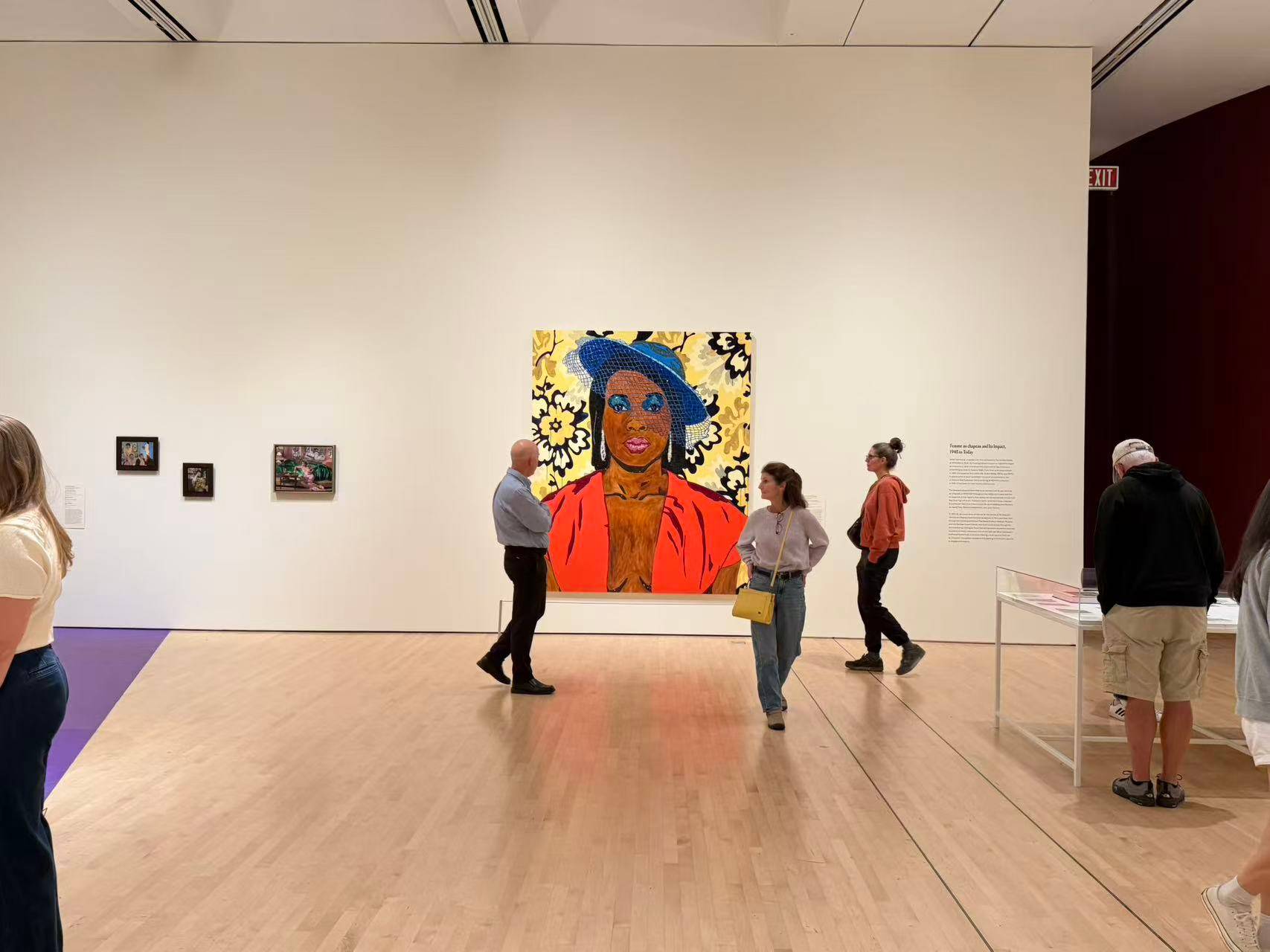
In this exhibition, the painting itself hangs deep in the gallery, and we had to queue through nearly half a ring of people before edging close. The room was crowded: an older man held up his phone and kept adjusting the focus; a younger visitor stood quietly to one side, absorbed.
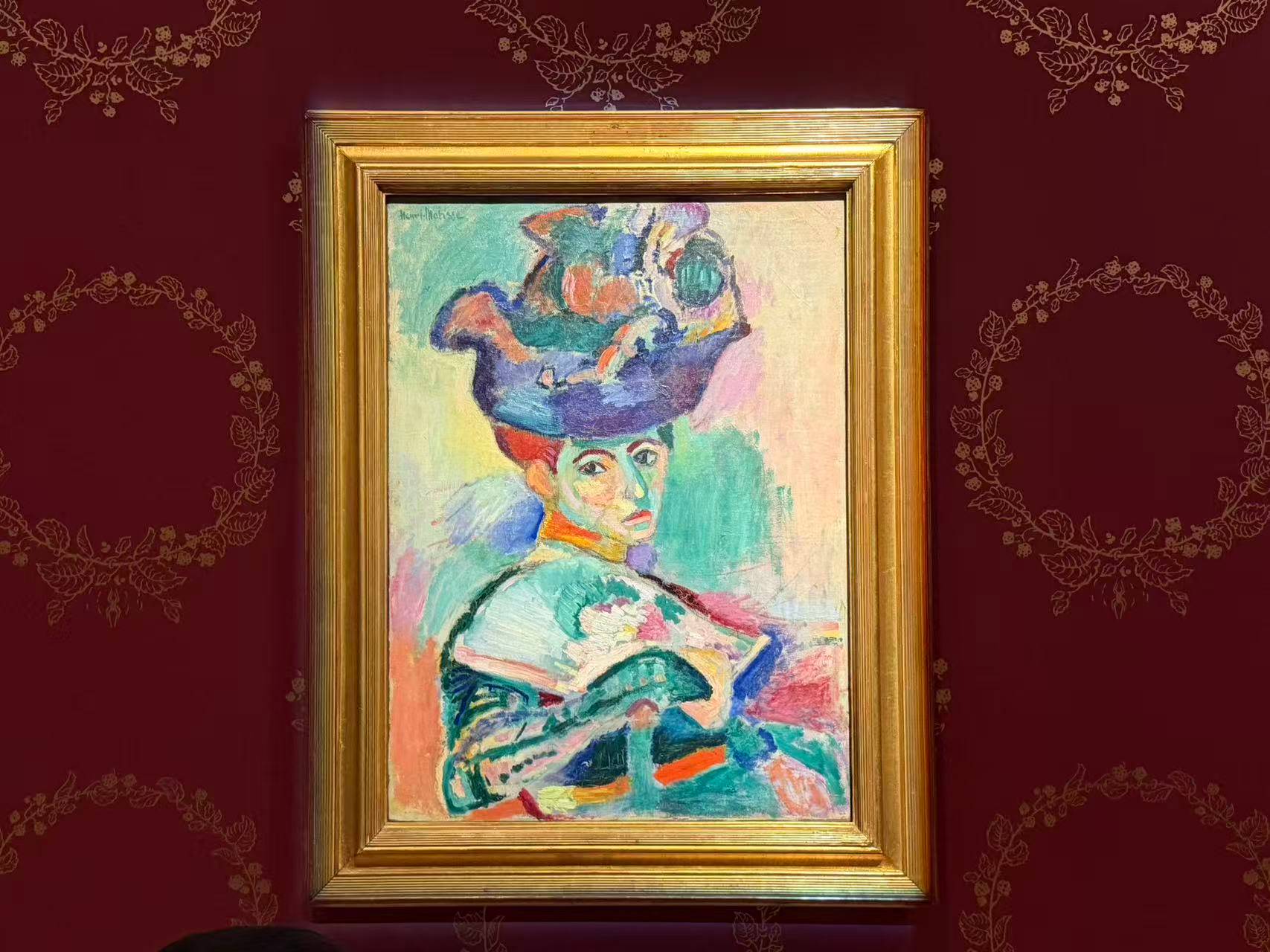
Matisse, Femme au chapeau, 1905, “Matisse’s Femme au chapeau: A Modern Scandal,” SFMOMA, 2026
At first glance, the painting can seem almost careless. Pencil guidelines remain visible; the edges of the canvas are deliberately left bare; the brushwork looks dashed off. That sense of incompletion was exactly what enraged critics in 1905. But up close, Matisse’s calculation becomes legible: a firm green stroke props up Amelie’s nose; a touch of red-orange, tipped with purple, defines her lips; warm and cool tones strain against one another and then resolve in the enormous blue hat above, trimmed with swirling ornaments, perhaps fruit and feathers.
Someone once asked Matisse what color Amelie’s dress was supposed to be in the painting, and he answered, deadpan, “Black, of course.” The airy joke became his most understated rejoinder to the entire controversy.
The chief curator, Bishop, described the painting’s radicalism this way: “This painting is radical in several places. One of them is the palette he used to paint her face, green.”
In the painting, Amelie looks straight at the viewer with an unyielding, oppositional air. She is not an object of scrutiny so much as the one actively returning the gaze.
Section Two: A Room in Color Revolt
Gallery VII, “Matisse’s Femme au chapeau: A Modern Scandal,” SFMOMA, 2026
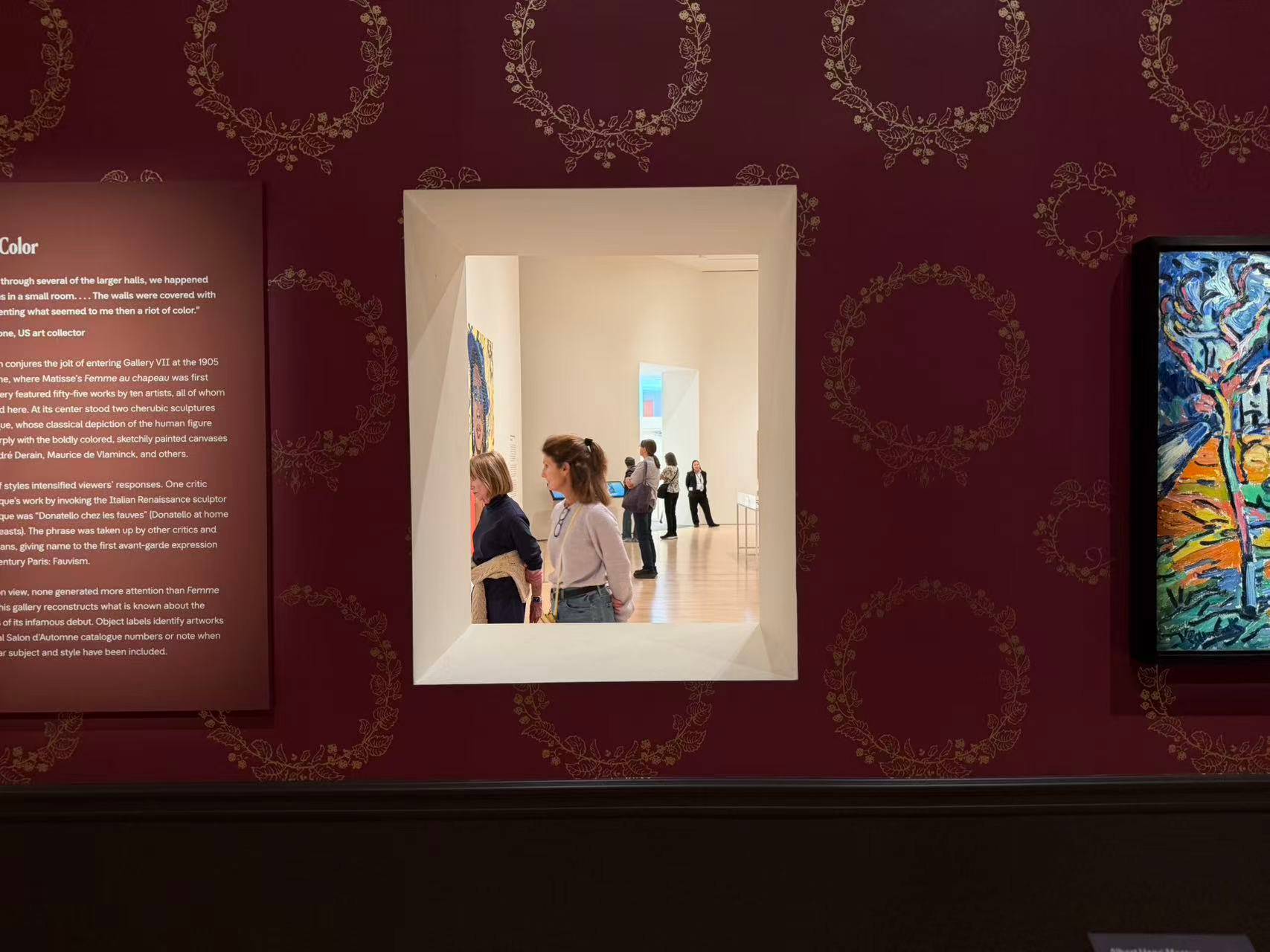
The exhibition’s center is a full-scale reconstruction of Gallery VII as it appeared at the 1905 Salon. On another wine-red wall, printed with gold garland motifs, we came upon a quotation turned into a gallery title: a recollection by the American collector Dr. Claribel Cone. “After passing through several galleries, we accidentally entered a small room . . . The walls were covered with canvases and, to me at the time, it was nothing less than a riot of color.”
Gallery VII, “Matisse’s Femme au chapeau: A Modern Scandal,” SFMOMA, 2026
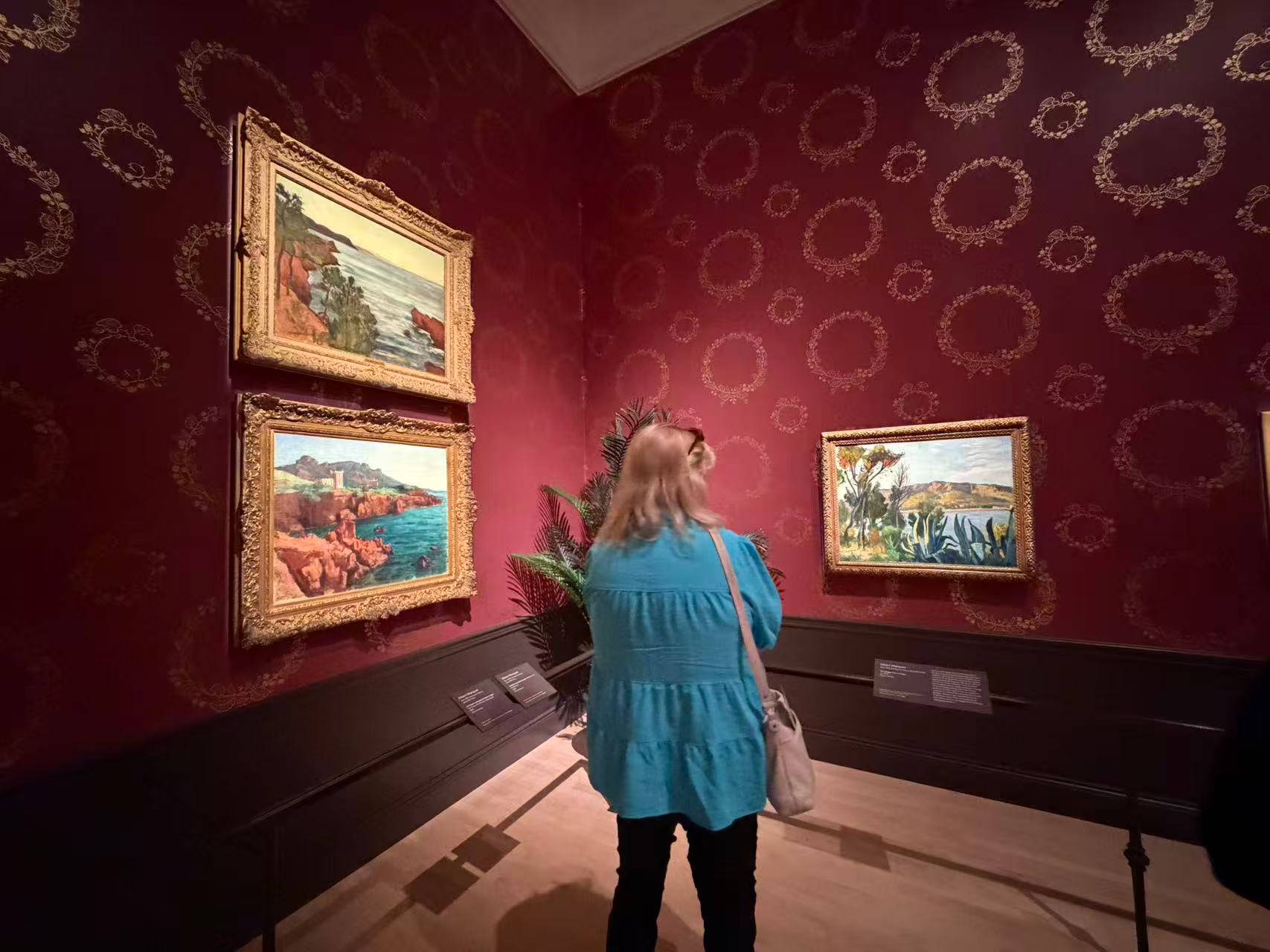
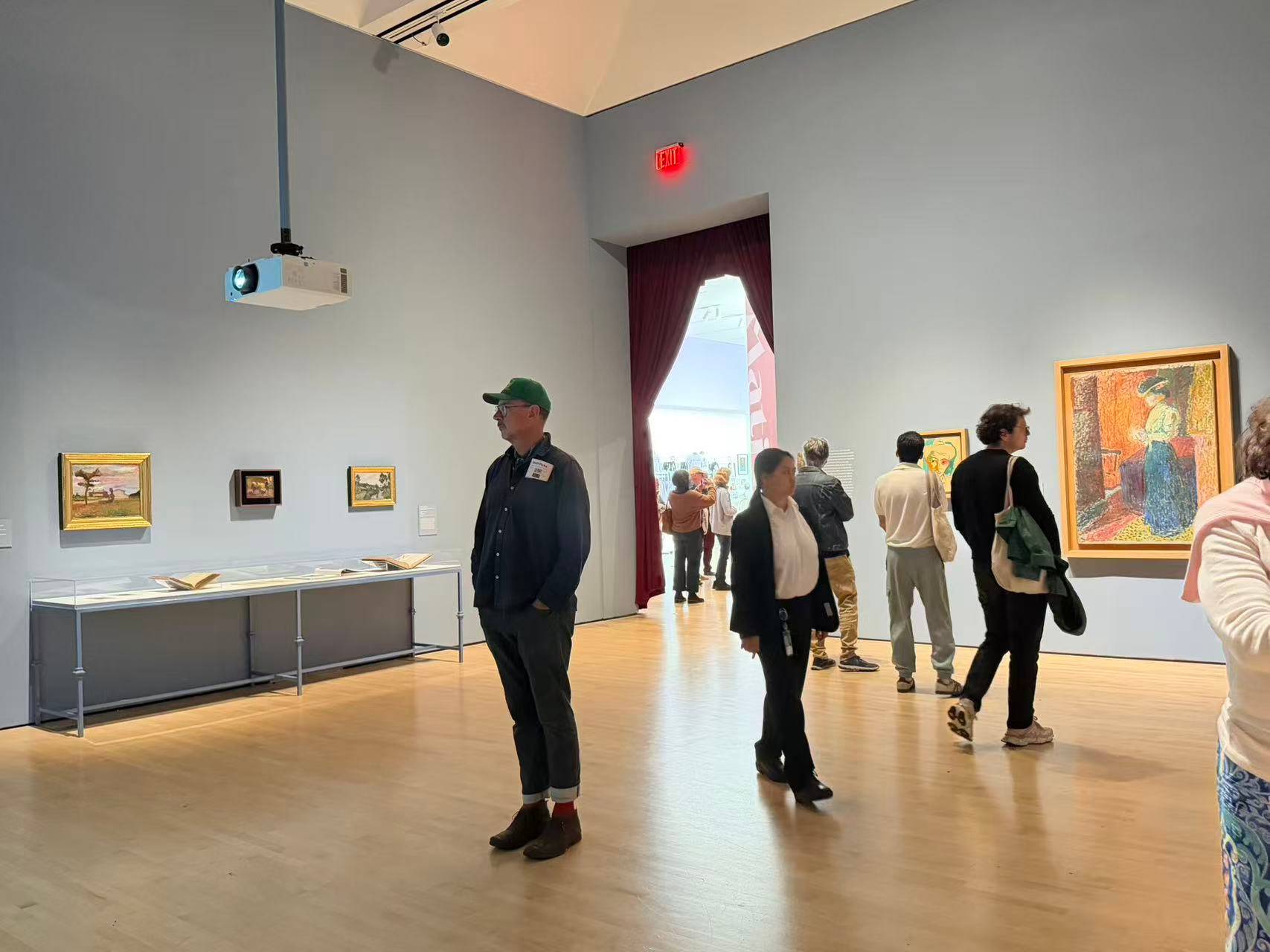
Ten artists showed fifty-five works in that room. For this exhibition, almost all of them have been brought back together, and the curatorial team deliberately preserved the Salon’s original catalogue numbers so that each work corresponds to its historical position on the wall.
Charles Camoin, Bord de mer a Agay, 1905, “Matisse’s Femme au chapeau: A Modern Scandal,” SFMOMA, 2026
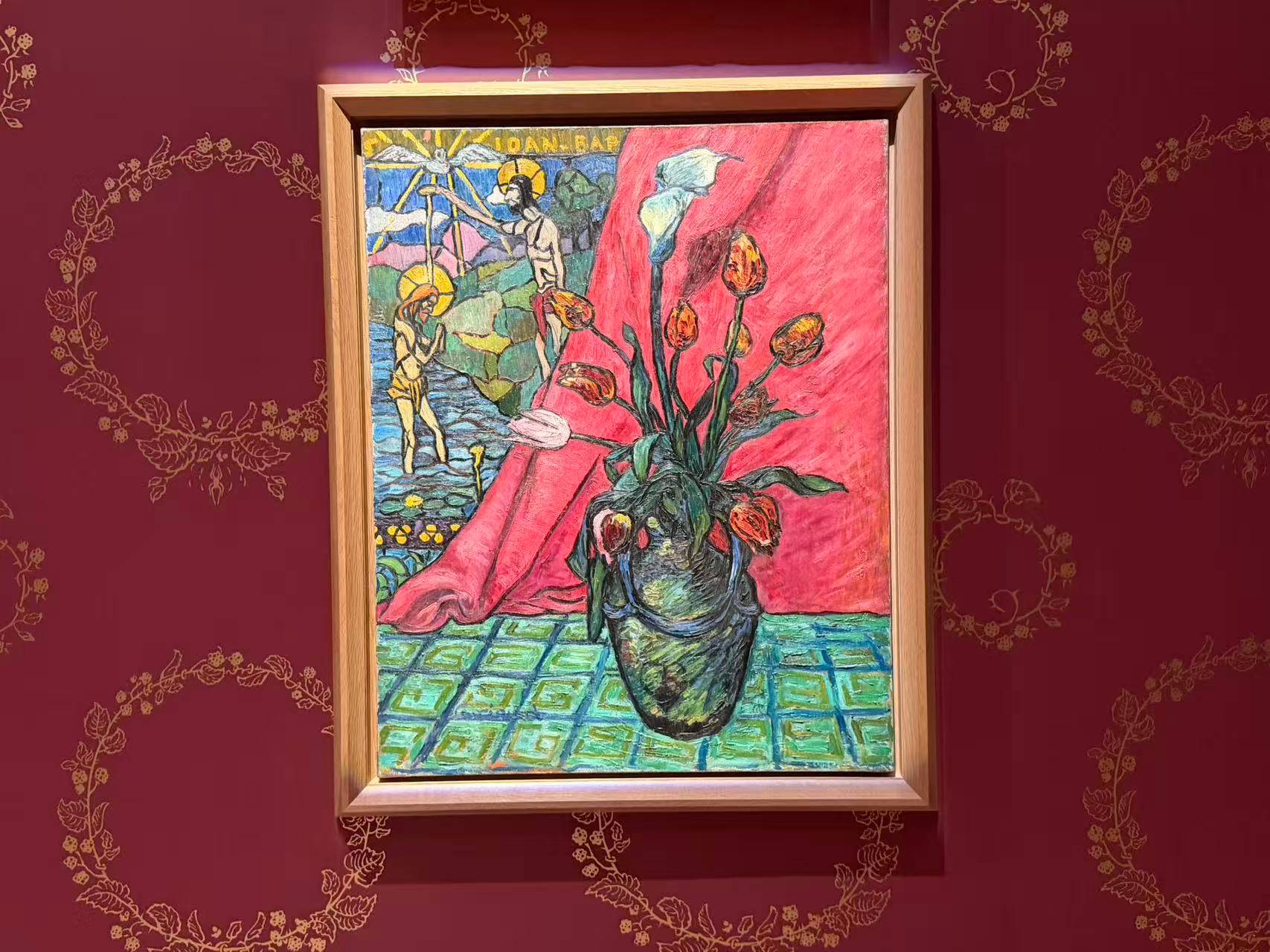
We counted them one by one. In Charles Camoin’s Bord de mer a Agay, the Mediterranean blue is painted to the point of luminosity, and critics of the time, unusually, praised his “spiritual” handling of light. In a canvas by Pierre Girieud, whom his peers teasingly called a “fauve indecis,” a bright pink curtain collides with a patterned green floor. The bold juxtapositions of color and the weighty, emphatic brushwork frame a stained-glass image of John the Baptist baptizing Jesus in the background. That religious citation, along with popular Epinal prints nearby, including Legende de Saint Nicolas, suggests that Girieud’s visual interests ranged well beyond the internal concerns of the art world and drew broadly on the popular visual culture of the day.
Pierre Girieud, Tulipes et vitrail (Tulips and Stained Glass), 1905, “Matisse’s Femme au chapeau: A Modern Scandal,” SFMOMA, 2026“Matisse’s Femme au chapeau: A Modern Scandal,” SFMOMA, 2026
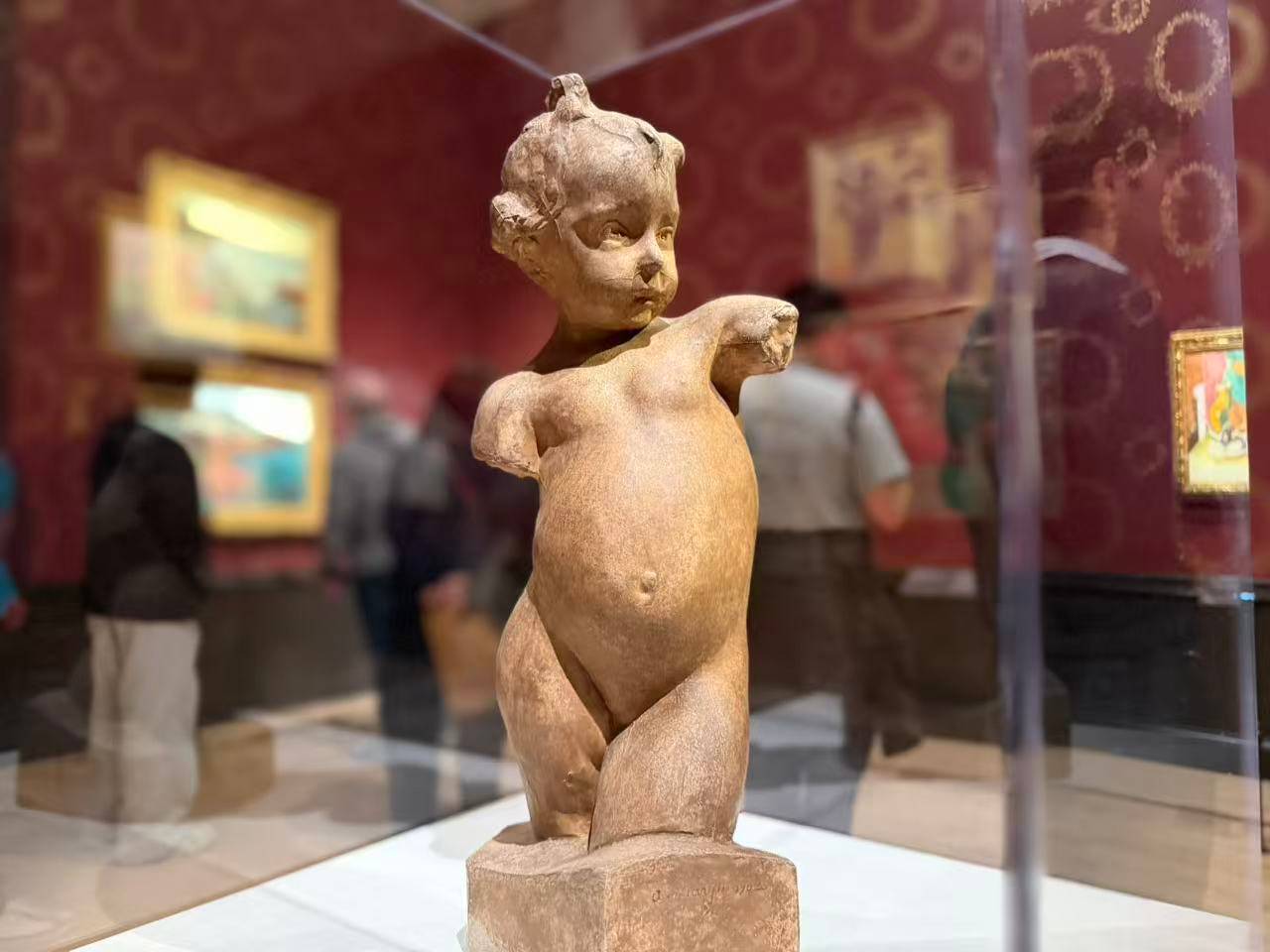
In the middle of the room stand two classically styled putto sculptures by Albert Marque, rounded and naturalistic, in almost comic opposition to the unruly Fauvist canvases on the walls. It was precisely this contrast, classical sculpture against savage blocks of color, that led one critic to exclaim, “Donatello chez les fauves.” The sneer unexpectedly became the starting point for the name “Fauvism,” and was repeatedly adopted by art history thereafter as the official label for Paris’s first avant-garde movement of the twentieth century.
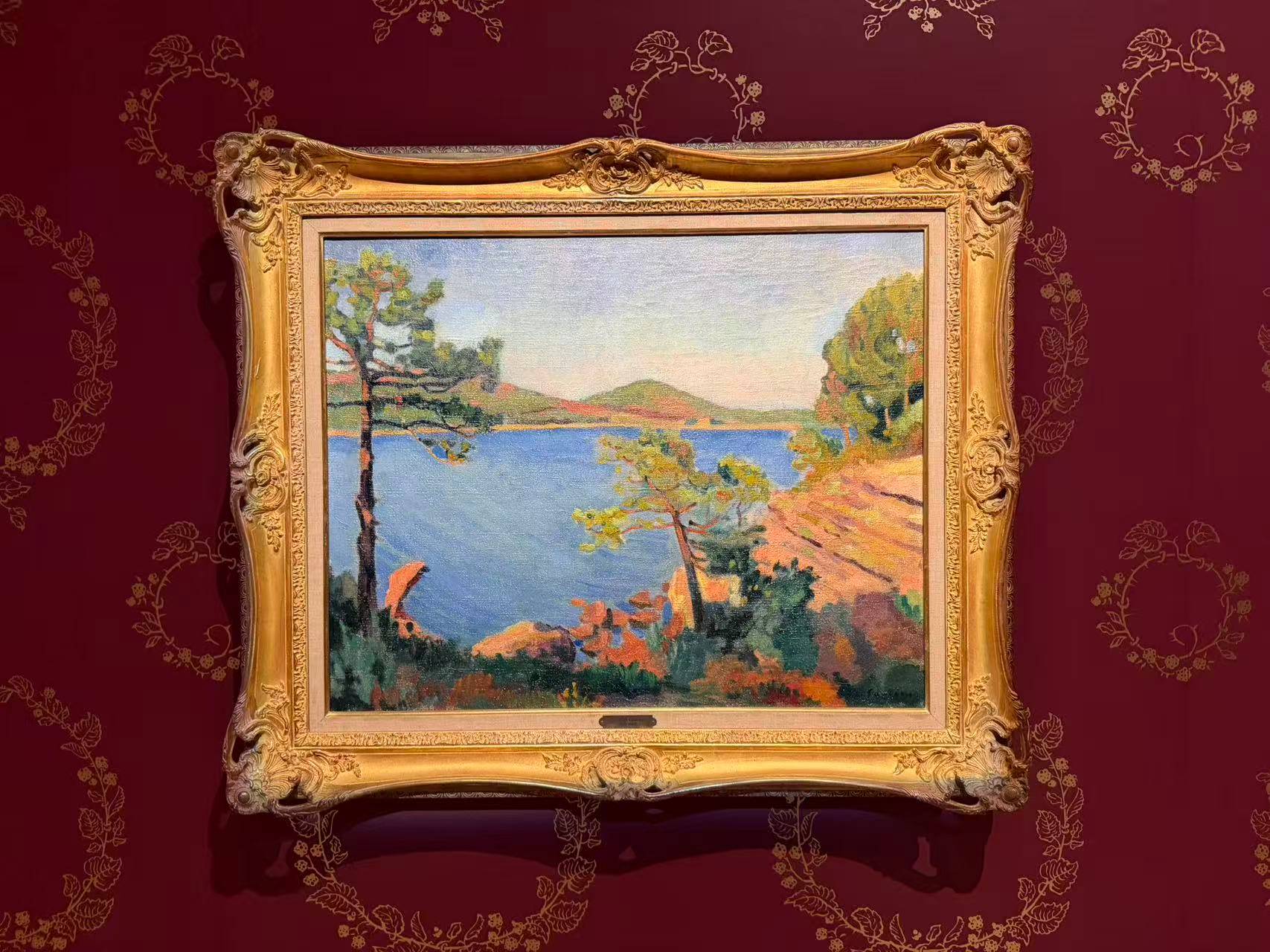
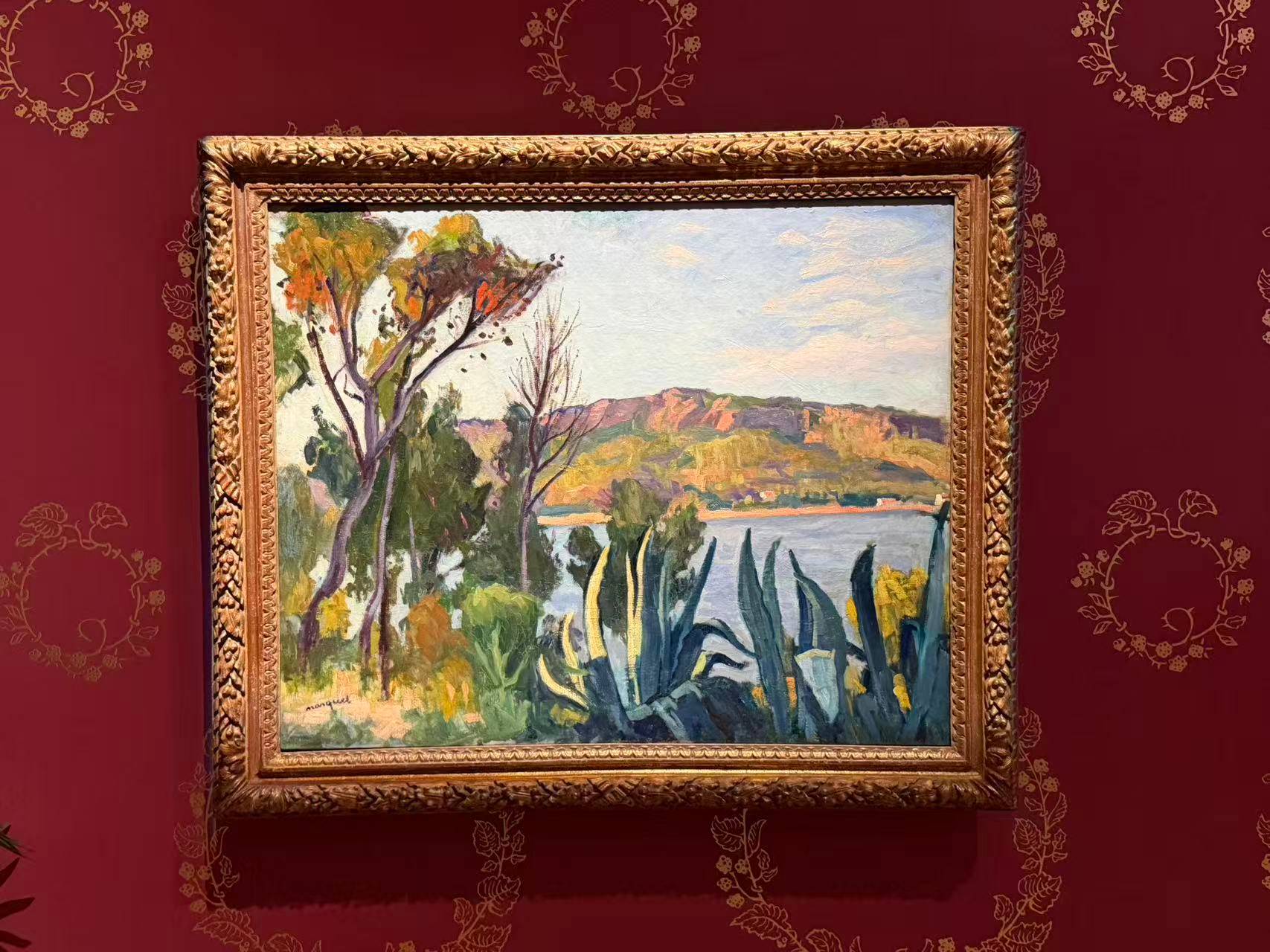
Albert Marquet, Vue d'Agay (View of Agay), circa 1905, “Matisse’s Femme au chapeau: A Modern Scandal,” SFMOMA, 2026
It is worth noting that Dr. Claribel Cone’s memory of a “riot of color” came from a collector whose eye later proved remarkably sure. Over the following decades, she and her sister Etta Cone continued buying Matisse, assembling the Cone Collection, now one of the treasures of the Baltimore Museum of Art. In other words, the room that left her reeling in 1905 would later help produce another astonishing cache of Matisse. Panic and fascination, it turns out, are often two names for the same pulse.
The critic who coined the word “fauves” was Louis Vauxcelles, who published the famous review in the November 4, 1905, issue of L’Illustration. But earlier, and harsher, criticism came from the general atmosphere on the exhibition’s opening day, when nearly every major newspaper described the works in Gallery VII as “barbaric,” arguing that Matisse and his companions had abandoned the most basic respect for the visible world.
Section Three: One Painting, Three Generations of Collectors, 121 Years
“Matisse’s Femme au chapeau: A Modern Scandal,” SFMOMA, 2026
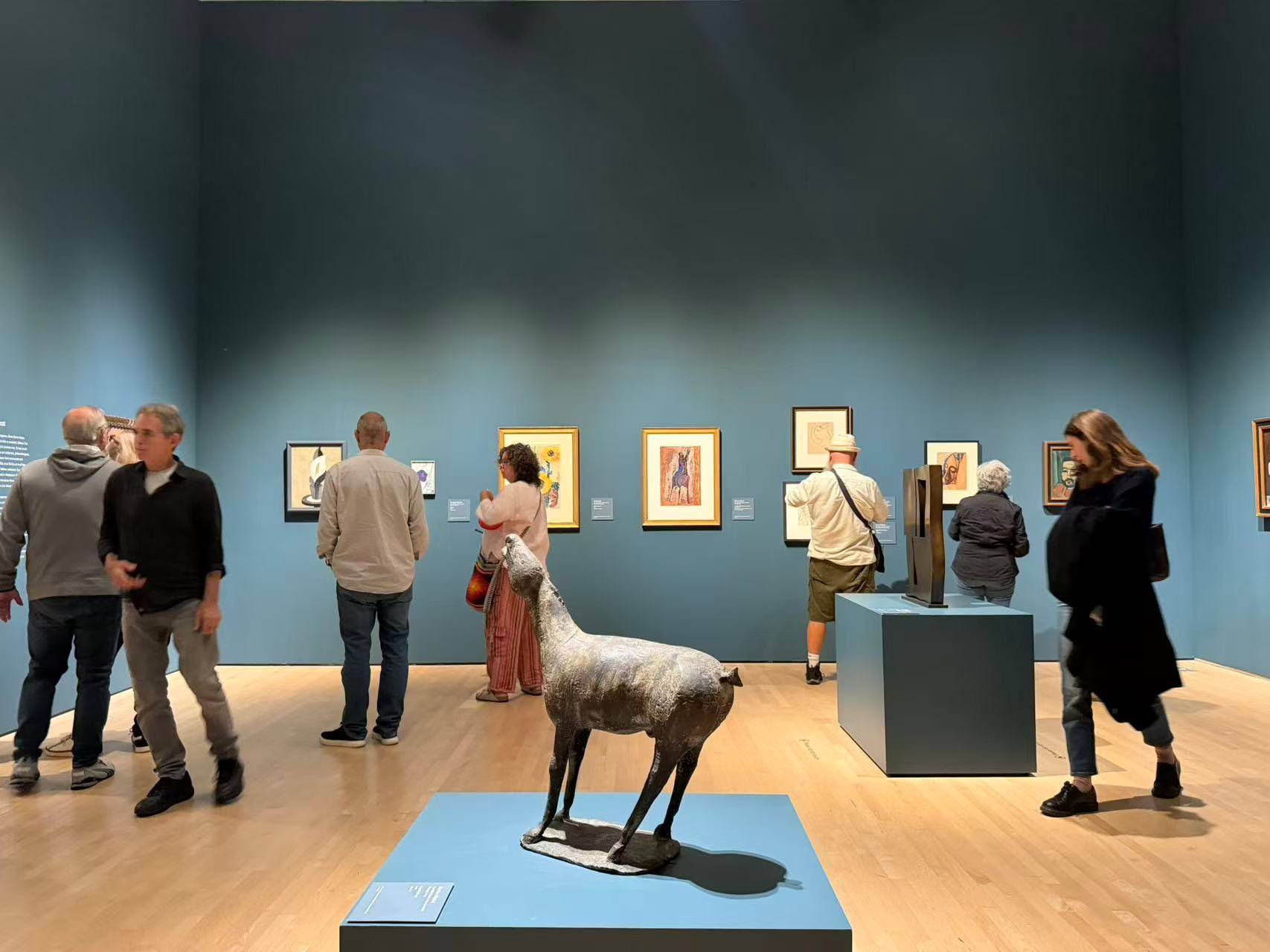
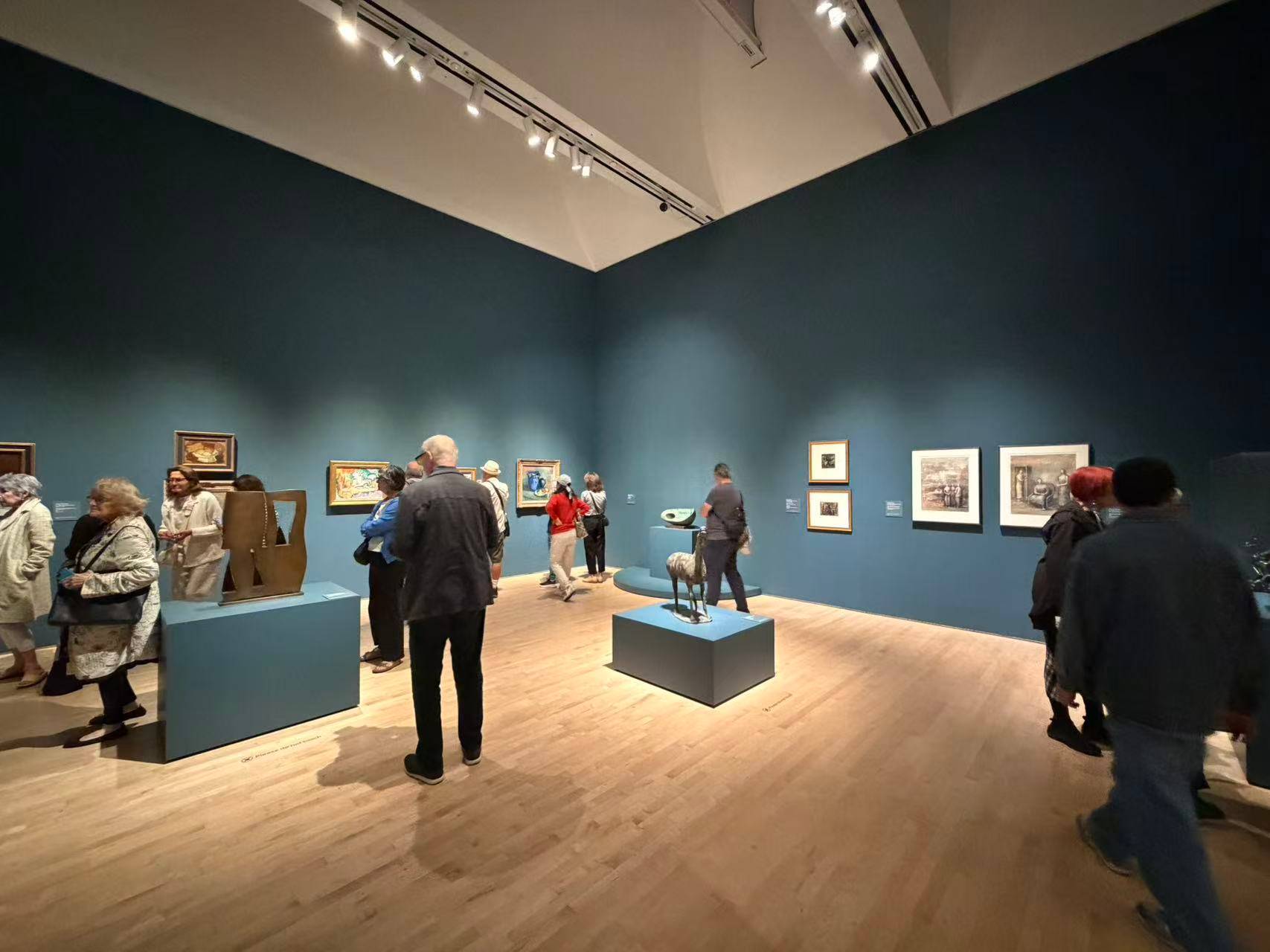
Beyond the reconstructed Gallery VII, the exhibition opens into two or three side rooms in a gray-blue palette, hung with the landscapes and portraits that Andre Derain and Maurice de Vlaminck showed in the same 1905 exhibition. During those years, Derain often painted outdoors with Matisse, and the two at times seemed almost to share a palette. Vlaminck was more untamed: his brushwork is urgent and thick, as if the paint had been squeezed straight from the tube onto the canvas.
“Matisse’s Femme au chapeau: A Modern Scandal,” SFMOMA, 2026
On a pedestal at the center of the room sits a small bronze deer, its four thin legs planted on a wooden base, creating a strange stillness against the richly saturated oils that seem almost to spill out of their frames. A young visitor in a floral shirt stood before it, thinking; on the other side, two older visitors with shopping bags exchanged quiet remarks. The light was soft, and footsteps were clearer than voices.
In a case in the corner, we also saw several sketches Matisse made while preparing this painting. A few spare pen lines describe two figures; the outline of a hat has been revised again and again. You can sense the painter hesitating over how exaggerated to make it. That uncertainty before the leap feels, in some ways, more intimate than the finished work.
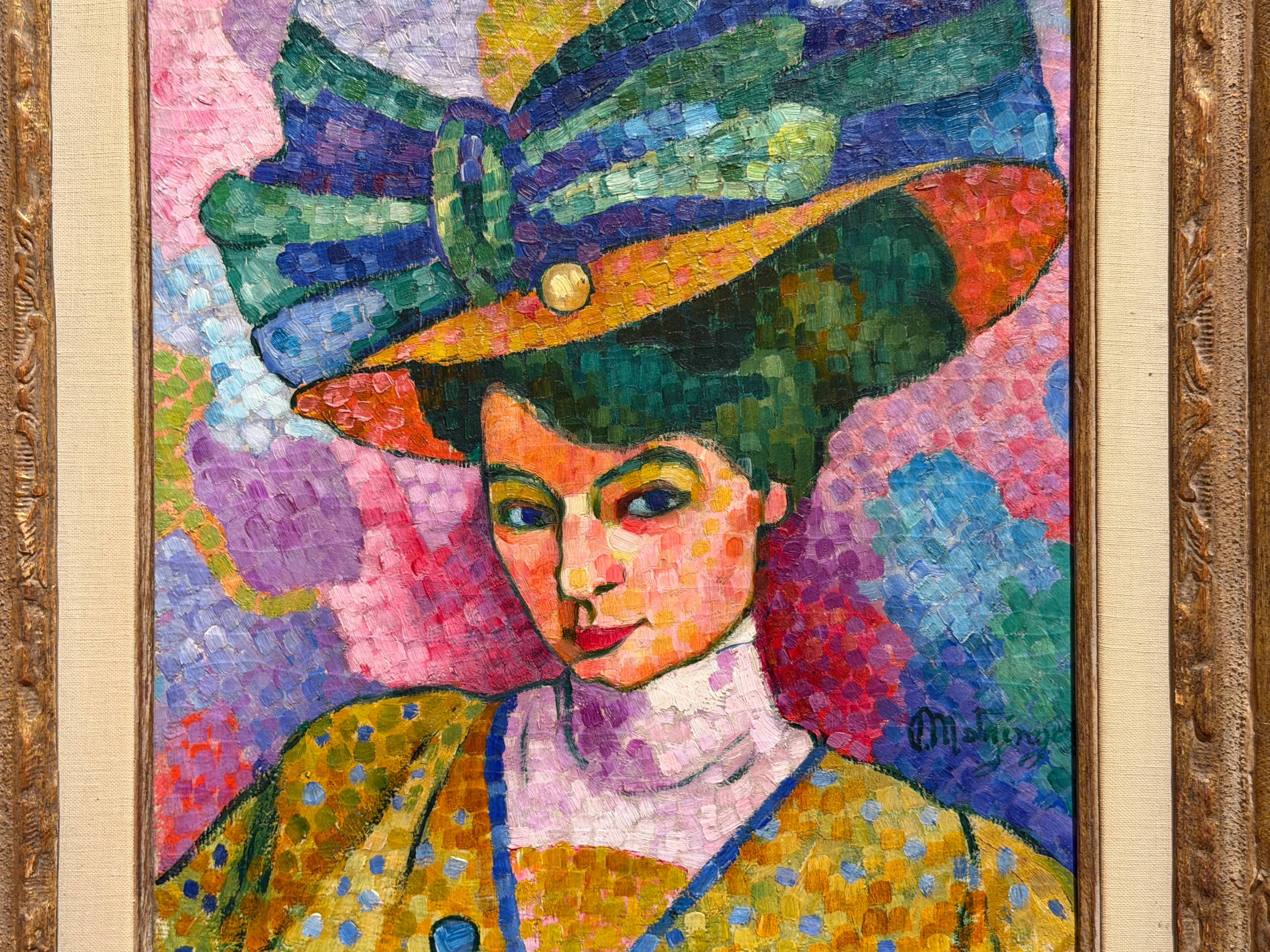
Jean Metzinger, Femme au chapeau, circa 1906, “Matisse’s Femme au chapeau: A Modern Scandal,” SFMOMA, 2026
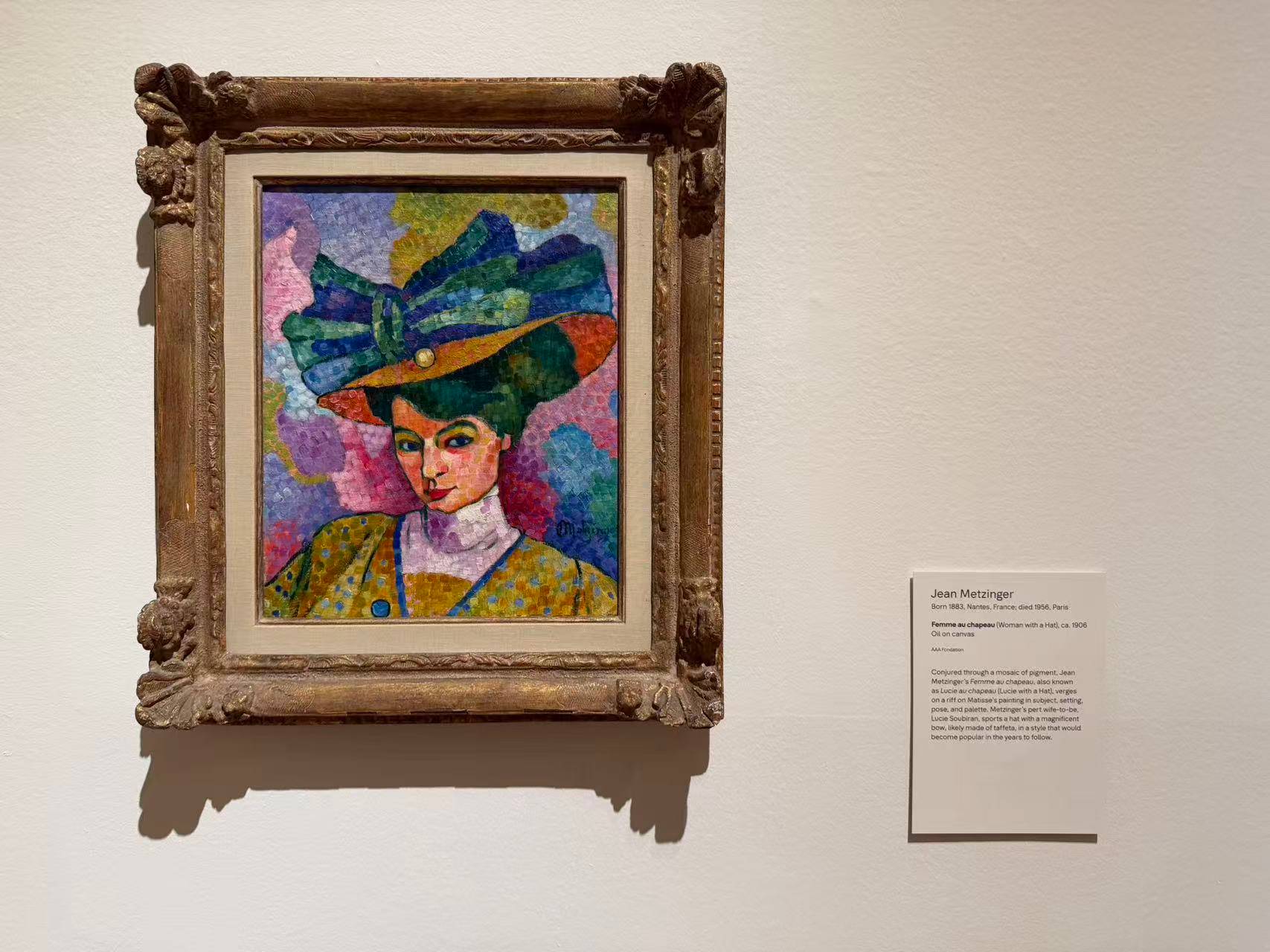
Our most surprising discovery was tucked into a small adjoining gallery: a female portrait, equally intense in color, but built dot by dot in a dense, pecked surface, signed Jean Metzinger. It turns out that in the year after Matisse’s painting exploded in Paris, Metzinger made another work with the same title, Femme au chapeau, circa 1906. His subject was his future wife, Lucie Soubiron, who also wears a broad-brimmed hat, with a blue-green bow tied at the brim, and also looks out at the viewer with calm directness. But the technique could not be more different. Matisse works in broad sweeps and planes of color; Metzinger uses a Neo-Impressionist division of tones, with blue, green, and purple scattered like splinters of light. Up close, the face dissolves into a dense field of dots; only from a few steps back does it reassemble.
By placing these two identically titled but very differently fated paintings in the same exhibition, the curators let us see, firsthand, how young painters in Paris responded in sharply divergent ways after the 1905 riot of color: some chose abandon; others chose analysis.
Jean Metzinger, Femme au chapeau (detail), circa 1906, “Matisse’s Femme au chapeau: A Modern Scandal,” SFMOMA, 2026
Later art history would place Metzinger’s method in a transitional zone between Divisionism and Cubism, and the painting itself is often regarded as a prelude to his later turn toward a geometric language. The two Femme au chapeau paintings, facing one another in the same gallery, feel almost like a contest conducted across a one-year delay.
In the exhibition’s latter half, we came to a full wall tracing the painting’s movements over the past 120 years. The story is more winding than a novel.
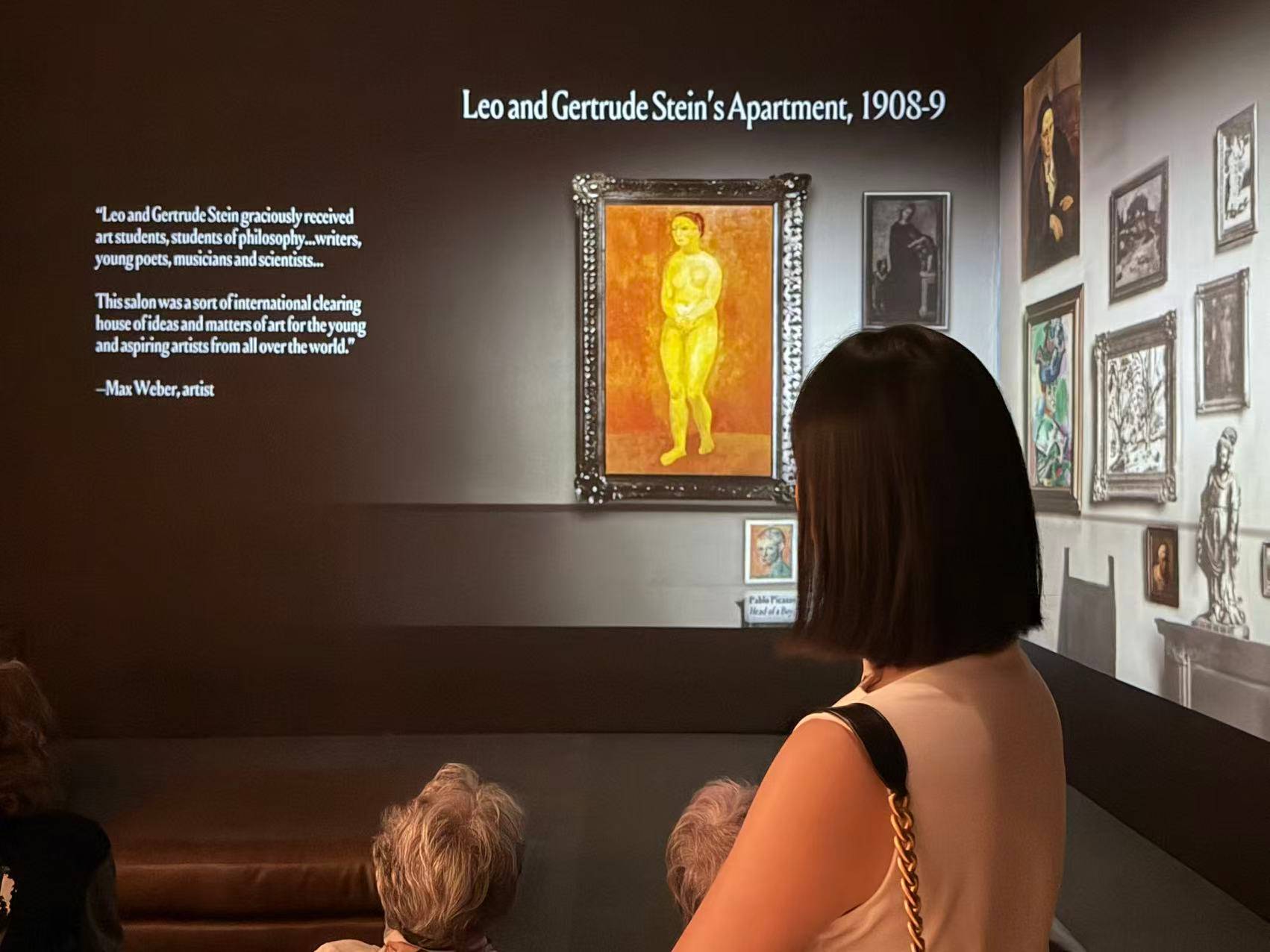
In 1905, Leo and Gertrude Stein bought the painting directly from the Salon. It then hung in their Paris apartment for a full ten years, becoming the place where countless visitors first encountered Fauvism; Pablo Picasso was among the apartment’s regular guests.
“Matisse’s Femme au chapeau: A Modern Scandal,” SFMOMA, 2026
In 1915, the siblings parted ways and divided their collection. Leo later described the experience as his family’s having “participated in opening a new era.” Femme au chapeau went to Gertrude, who sold it to her brother and sister-in-law, Michael and Sarah Stein, among Matisse’s staunchest early supporters. In 1935, Michael and Sarah moved back to the Bay Area, bringing the painting with them to their home in Palo Alto, where it hung for another thirteen years.
In 1936, it was first borrowed by SFMOMA’s founding director, Grace McCann Morley, for public exhibition, its first public appearance in the United States. In the late 1940s, the widowed Sarah began gradually selling works from the collection; the buyer was the San Francisco collector Elise S. Haas, the great-grandniece of Levi Strauss, founder of the jeans brand. Haas kept the painting with her from 1948 until her death in 1990, after which it was formally given to SFMOMA as a bequest and entered the collection in 1991. For more than three decades afterward, it hardly left the wall. Between the 1950s and the 1970s, it appeared in at least seventeen museum exhibitions, ten of them in San Francisco alone. Its only real long trip came in 2011 and 2012, when, as part of the traveling exhibition The Steins Collect: Matisse, Picasso, and the Parisian Avant-Garde, it went to Paris and New York under a one-time exception written into the terms of the bequest.
Over that long passage, the painting itself was gradually worn smooth, from a scandalous troublemaker into an heirloom deemed worthy of reverence.
“Matisse’s Femme au chapeau: A Modern Scandal,” SFMOMA, 2026
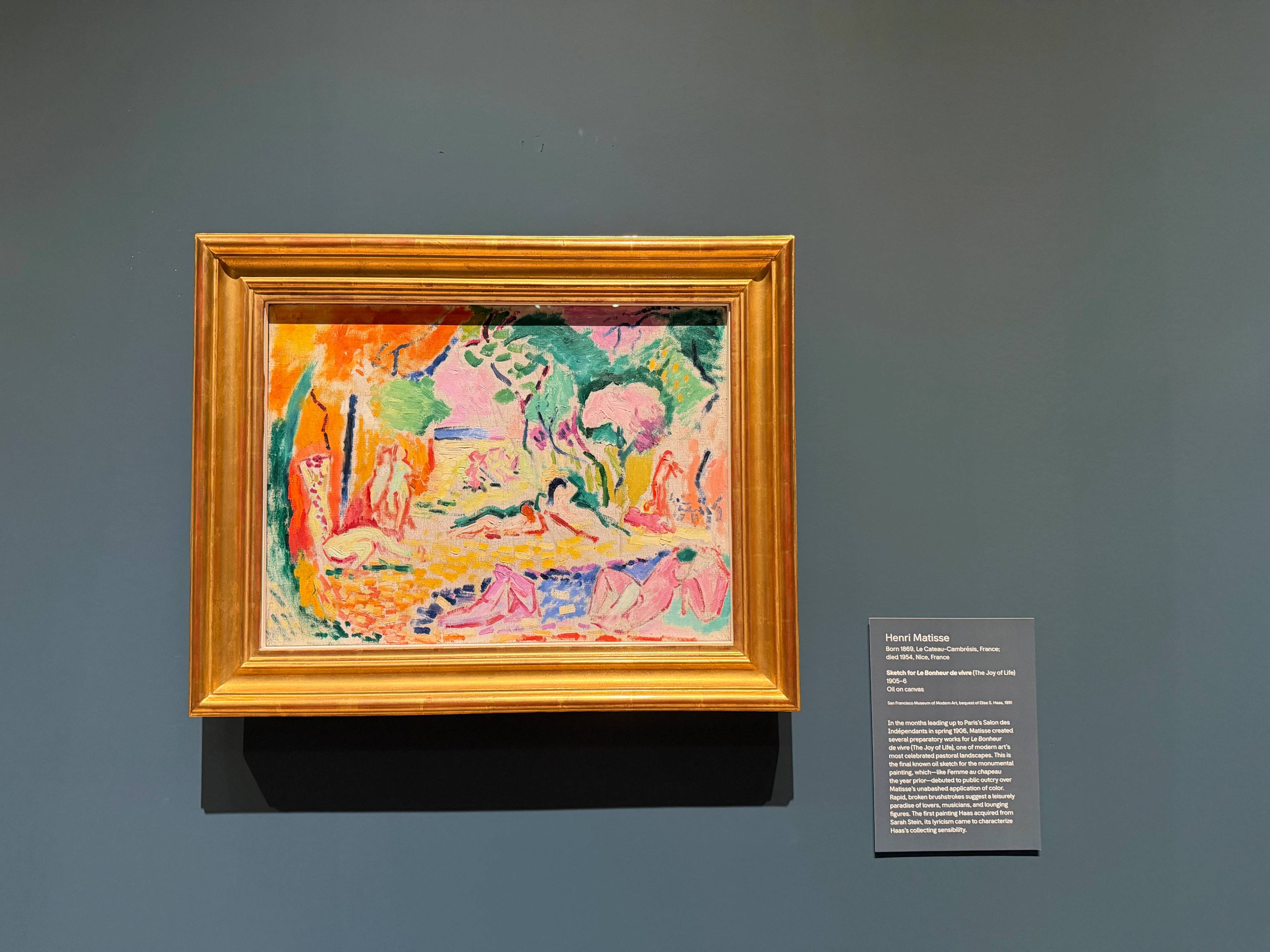
In the exhibition’s final stretch, we turned into a deep-blue gallery where other works by Matisse from the same period hang at irregular intervals, including a vividly colored small oil study regarded as the last version before the finished Le Bonheur de vivre. When it was shown at the Salon des Independants in 1906, it too drew a storm of abuse: reclining nudes, kissing lovers, and musicians are crowded into a field of nearly ungovernable orange, pink, and green.
The years when SFMOMA kept Femme au chapeau on view through the 1950s happened to coincide with the rise of the Bay Area’s first widely recognized art movement, Bay Area Figurative art. Figures such as David Park, Richard Diebenkorn, and Joan Brown all treated the painting as a kind of color textbook. Looking up, we saw a thickly painted self-portrait: a furry hat compresses the face into a small patch; the background is a black-and-gold checkerboard; a pair of eyes stares straight at us. Its bluntness and candor make it hard not to think of Matisse’s own confidence, that sense of painting exactly as he pleased.
“Matisse’s Femme au chapeau: A Modern Scandal,” SFMOMA, 2026
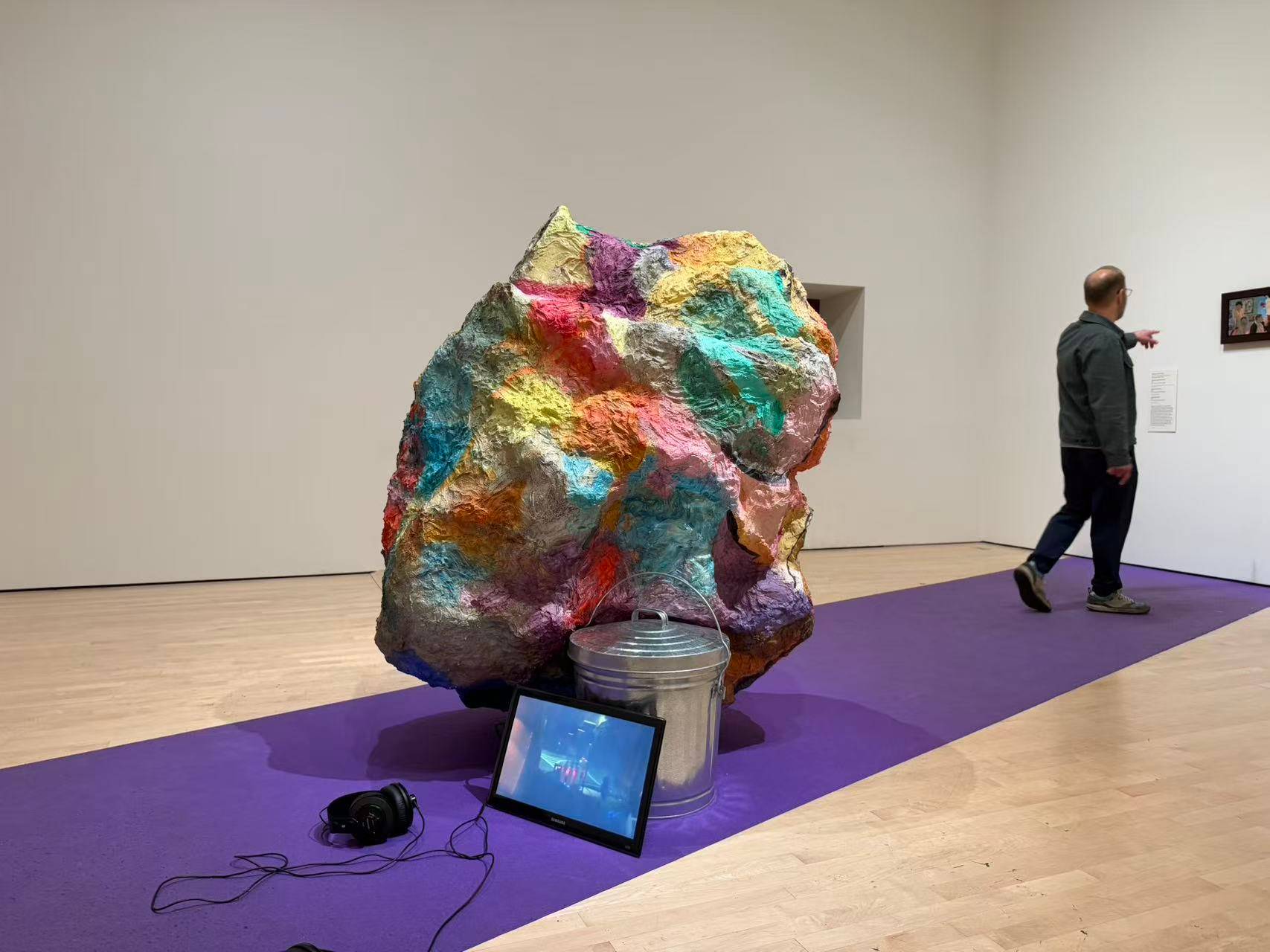
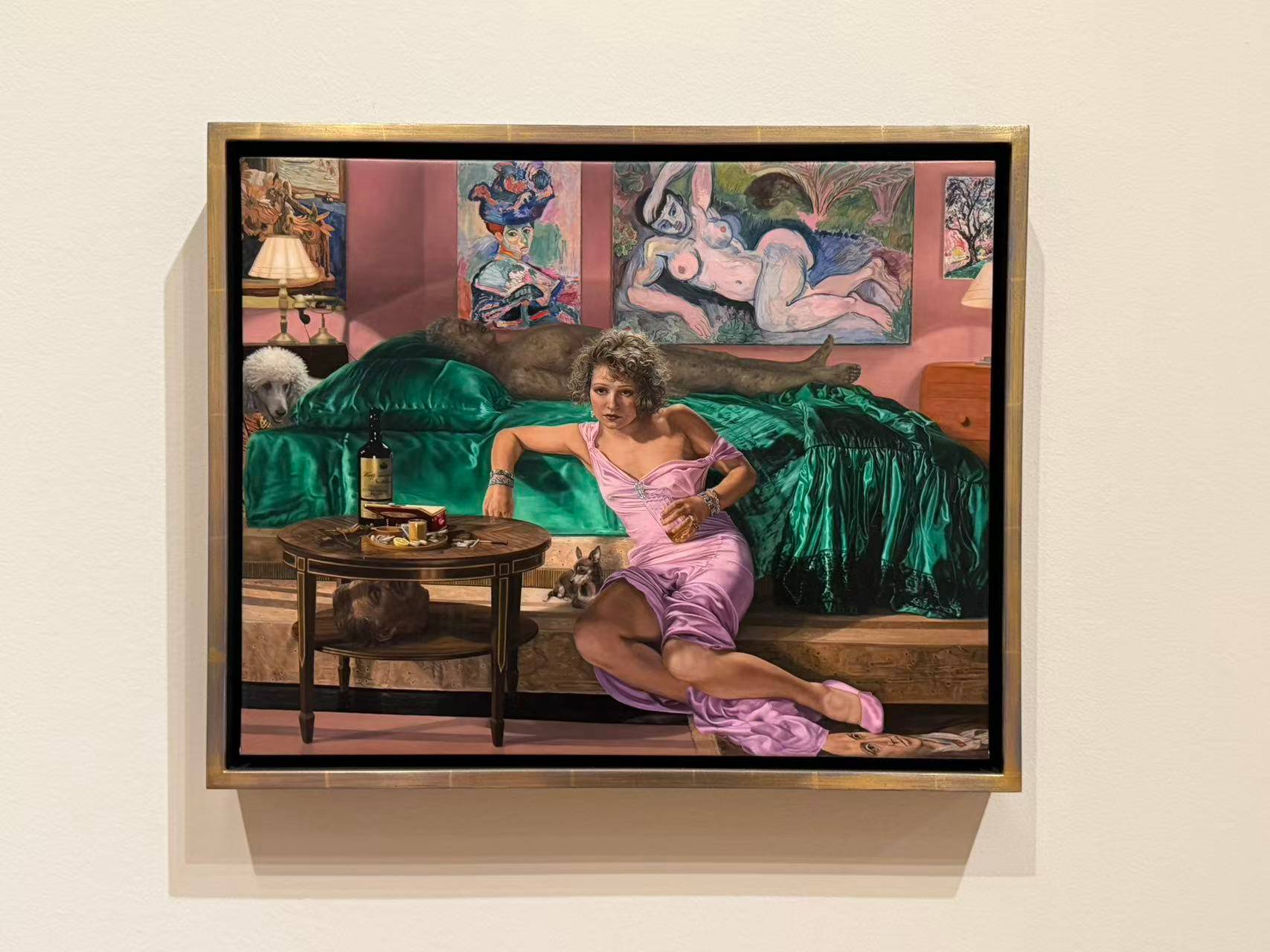
Farther on come the responses by contemporary artists. Hilary Harkness has made a group of oils charged with narrative tension: on a green satin bed lies a naked body; at the foot, a white poodle peers out; under the table sits a severed head; a woman in a pink dress leans against the bed holding a glass of whiskey. The scene is absurd and dangerous at once. Hanging on the wall behind are several small paintings that salute Matisse’s nude subjects, one of them unmistakably a variant on his later Blue Nude. Nearby, an abstract sculpture by Rachel Harrison takes up, in a more contemporary language, Matisse’s old freedom from caring whether the viewer liked what he made.
“Matisse’s Femme au chapeau: A Modern Scandal,” SFMOMA, 2026
The curatorial team deliberately placed these two groups of works where, through a window, they look back toward Femme au chapeau. Artists 120 years later are still conducting a long-distance conversation with the Matisse of that summer.
On the wall at the exit, a line of small text reads: “If you did not manage to see Femme au chapeau this time, there is no need to try your luck elsewhere in the future. Under the terms of the bequest, it will hang, for the rest of its life, only on this wall on SFMOMA’s fourth floor.”