Xiao Jiang: After a Decade of Painting Mountains, More Than Ten New Works Go on View in Shanghai
Born in 1977 in Jinggangshan, Jiangxi, Xiao Jiang liked drawing from childhood. After graduating from a teachers college, he worked as a designer at the local cultural center, and painting from life was then little more than a pastime. He later studied in the oil-painting department at the China Academy of Art in Hangzhou. In 2006, at his uncle’s suggestion, he moved to Shanghai and, by some mix of accident and fate, became a professional artist......
By / Xirui Huang · 9 min read
How do the mountains in Xiao Jiang’s paintings move from childhood memory into pictorial structure?
In Xirui Huang’s 2023 studio interview, Xiao Jiang traces his recurring mountains to growing up in Jinggangshan, Jiangxi. Later hikes with friends reactivate those memories. His paintings gradually move beyond photographic reference toward arranging mountains, figures and colour through the structure of the image itself. The resulting landscapes remain rooted in lived experience while moving between reality and dream.
Xiao Jiang was born in 1977 in Jinggangshan, Jiangxi. He had loved drawing since childhood. After graduating from a teachers college, he took a job as a designer at the local cultural center in Jinggangshan, and going out to sketch and paint was, at the time, only a diversion. Later, he pursued further study in the oil-painting department at the China Academy of Art in Hangzhou. In 2006, on the advice of an uncle who was working in Shanghai, he moved there. Whether by chance or by destiny, he became a professional artist.
Artist | Xiao Jiang: "I'm Just Someone Who Paints"
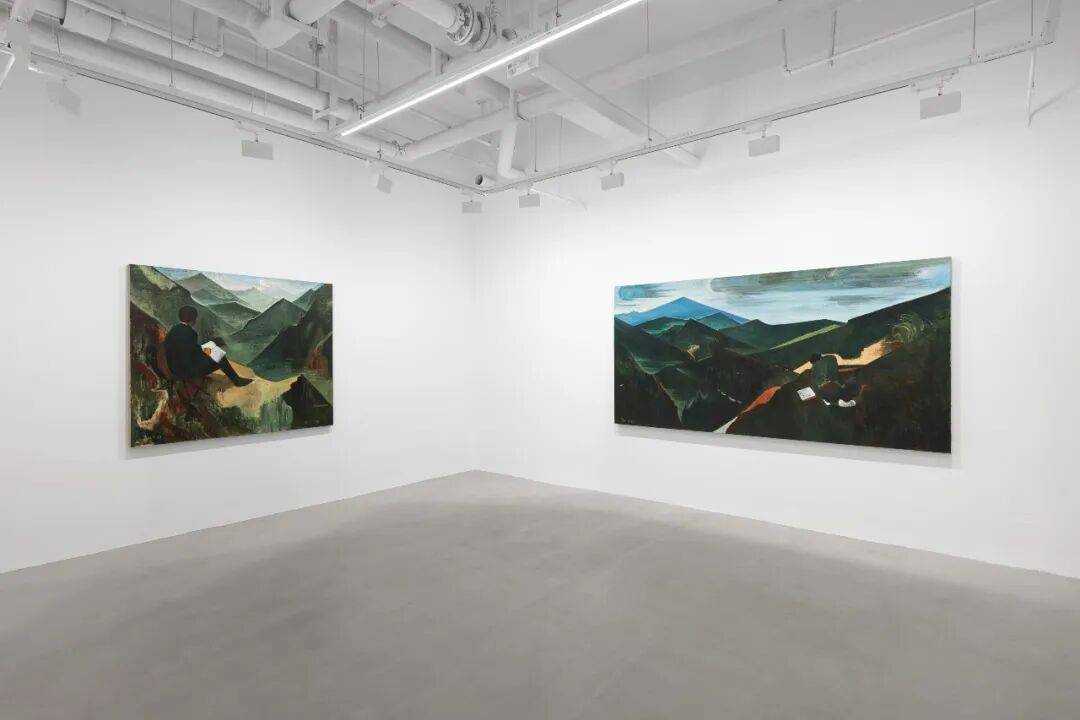
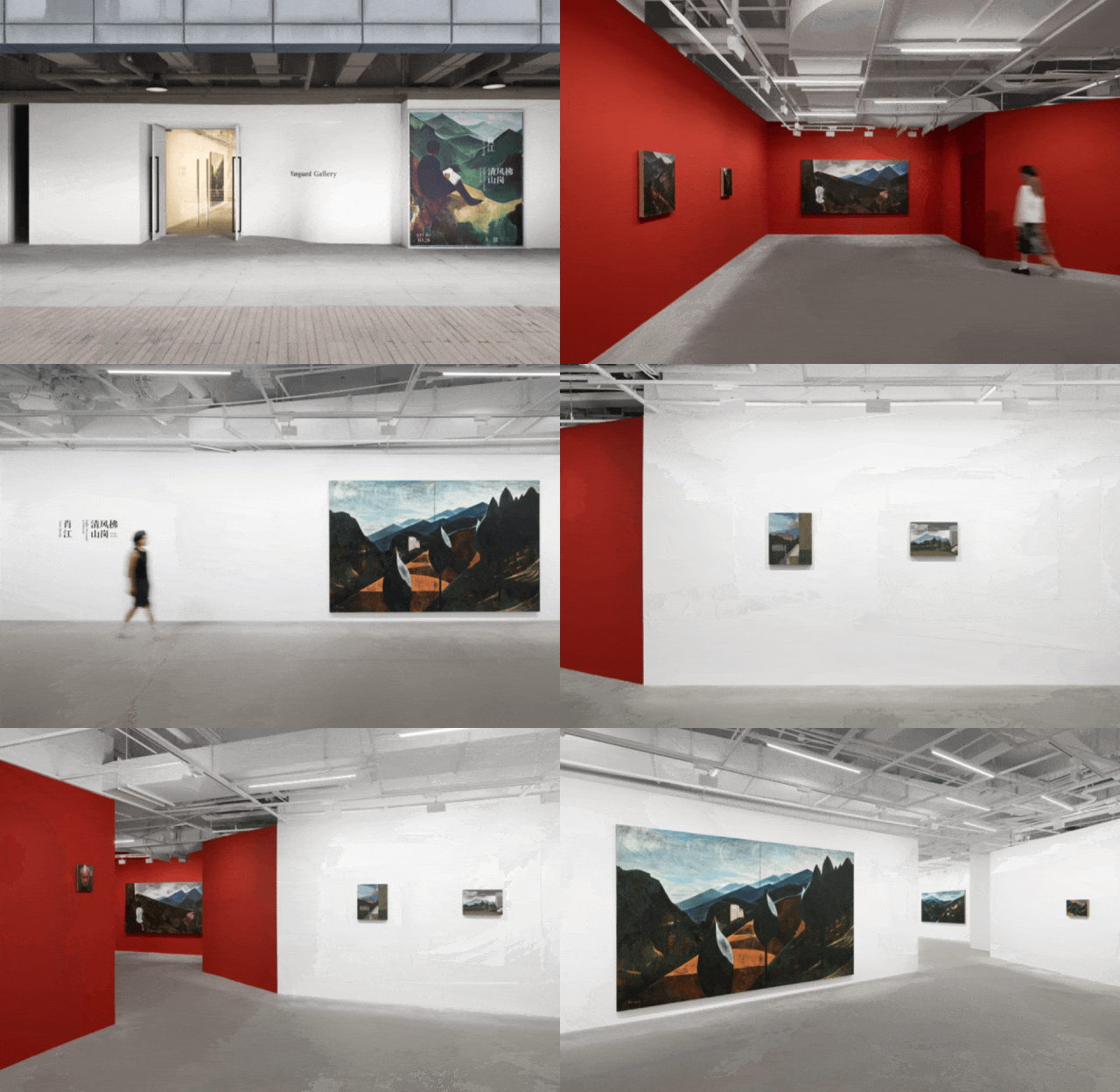
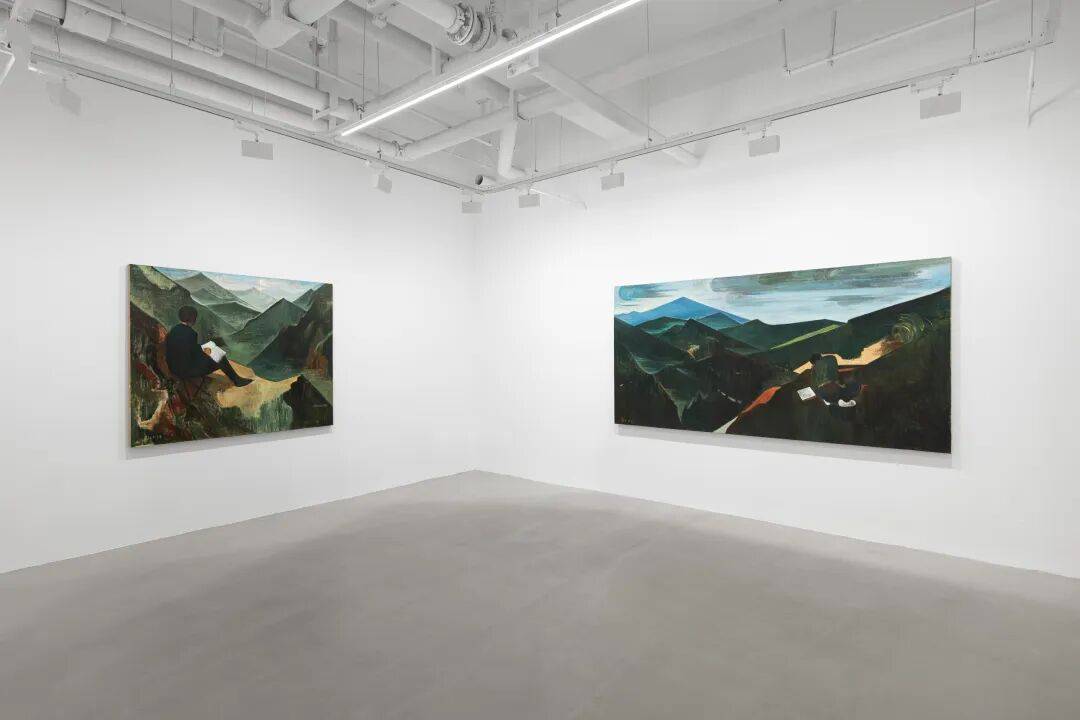
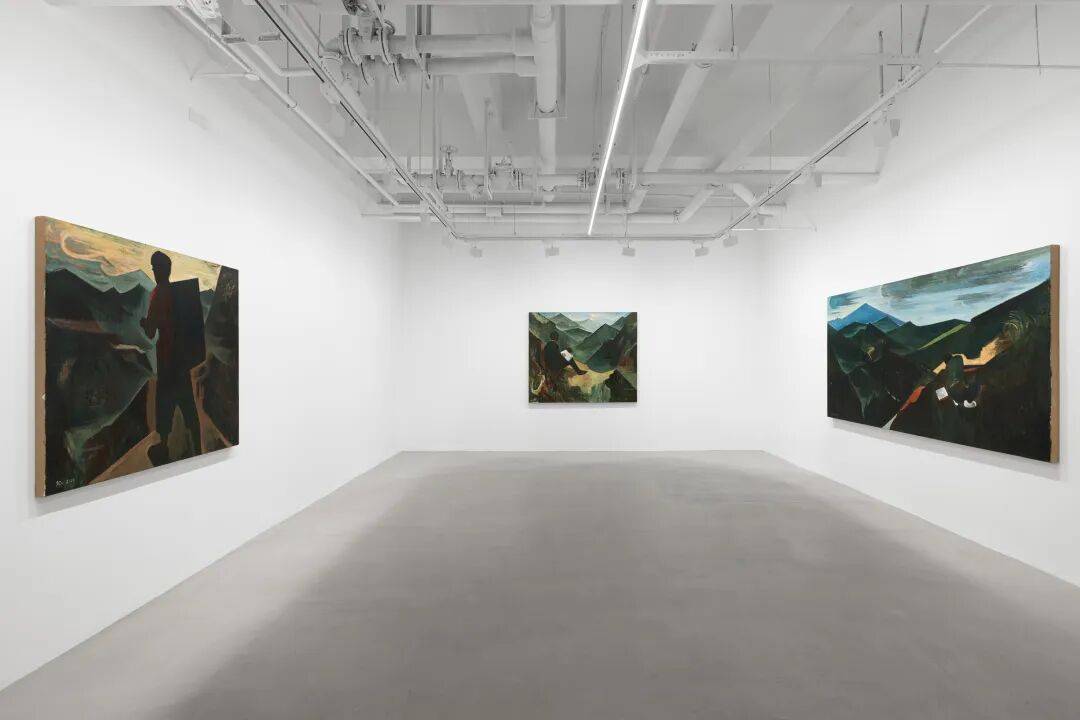
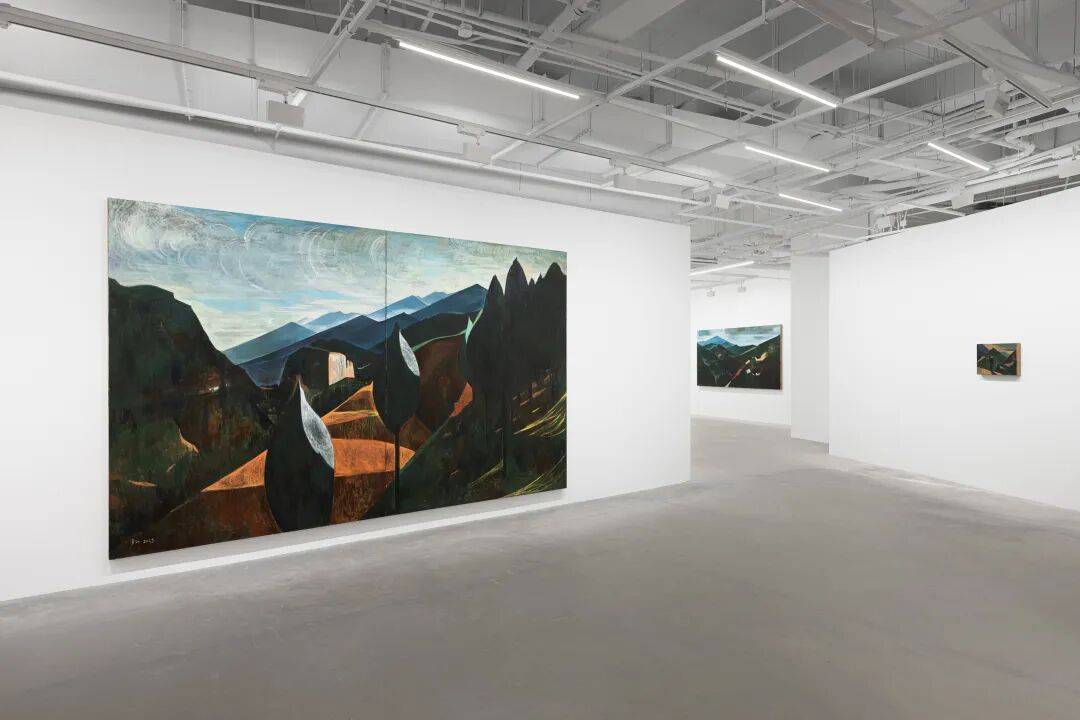
At Vanguard gallery, installation view of Xiao Jiang’s solo exhibition “A Fresh Breeze Sweeps the Hillside,” 2023. On September 16, his newest solo exhibition, “A Fresh Breeze Sweeps the Hillside,” opened in Vanguard’s new space, presenting more than ten works he made in 2023. In October, his first solo exhibition in Europe, “Ordinary Days,” will open at Lopez de la Serna CAC, in Madrid, Spain.
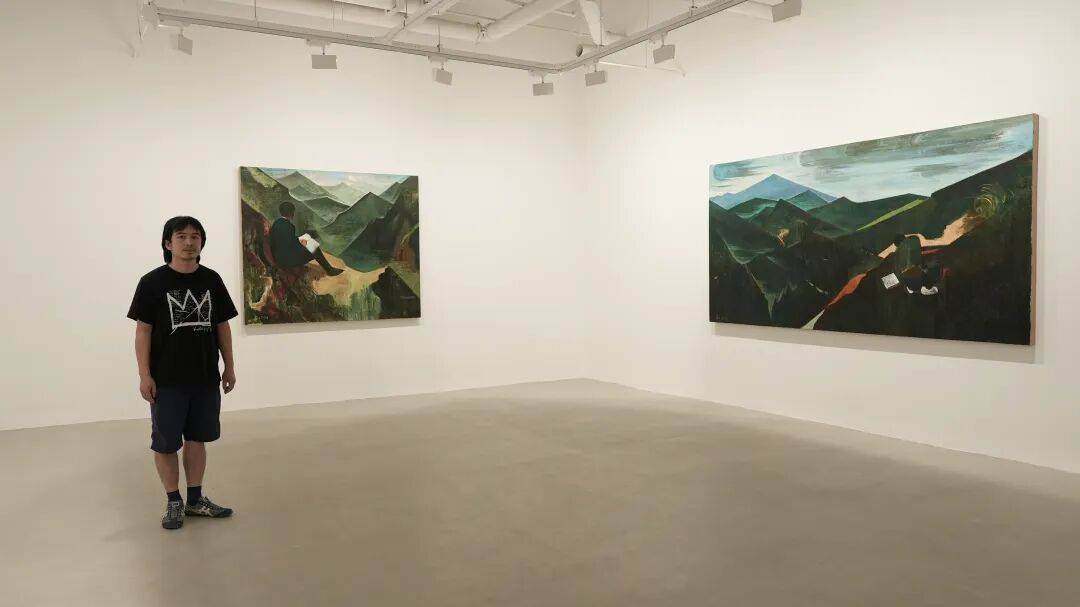
On the eve of the exhibition, we visited Xiao Jiang’s studio in Songjiang, Shanghai, to talk about the scenes in his work, at once real and dreamlike, and about his life. In the gallery for “A Fresh Breeze Sweeps the Hillside,” the artist Xiao Jiang. The day we arrived at his studio, he was wearing an ordinary T-shirt and black pants, his shoulder-length hair falling loosely around him, very much like someone in the midst of working. We had barely stepped inside and not yet sat down when he volunteered a confession: “I’m not very good at talking. I’m hard to interview. You’ll see in a minute.”
SECTION 01 | I can't speak very well, I can only draw.
A corner of Xiao Jiang’s studio. The studio occupies the third floor of an industrial park building in Songjiang, a large open room of roughly 160 square meters. When we walked in, we were a little startled. The surrounding walls were clad in red soundproof wood panels; from the ceiling hung two highly plastic-looking “crystal” chandeliers of the sort popular in the early 2000s; and the floor was covered in gray carpet. At the front of the studio there was even a slightly raised stage, and on it stood a work in progress, about thirty per cent complete, with the overall composition already visible.
This tacky, early-millennium “retired-cadre” decor formed a kind of comic theatrical contrast with the canvases piled on the floor, the works hanging on the walls, the unfinished paintings, and the white canvases the artist had just prepared. The whole space stood perfectly still, yet seemed to be staging some silent drama. A corner of Xiao Jiang’s studio. Among the artists’ studios we have visited, we had never seen anything quite like this style of interior.
“I moved into this studio in April of this year,” Xiao Jiang said. “It used to be a company conference room. They often held events here, which is why there’s a small stage. Other than the lighting, I basically didn’t change a thing. You could say I moved right in with my stretcher bars.” He told us that the works to be shown in the exhibition had been shipped out two days earlier, but a few paintings still hanging in the studio were also new works from this year. One large canvas of overlapping mountain ranges stood in a kind of spatial opposition to the interior scene with figures that he was currently painting.
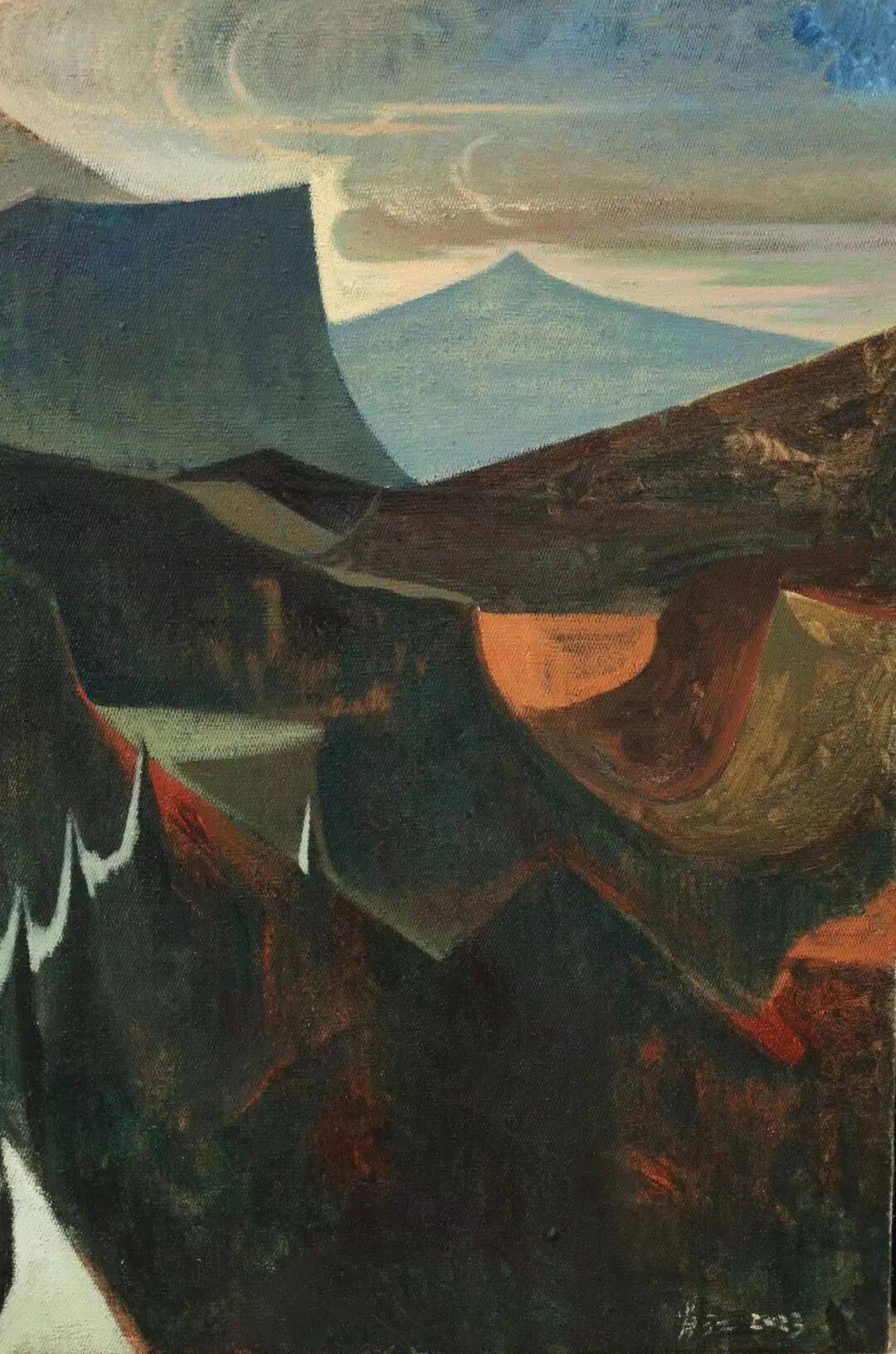
Xiao Jiang, Urban and Rural, 2023. Xiao Jiang, Mountain Scene, 2023. Mountains are an extraordinarily important element in Xiao Jiang’s paintings.
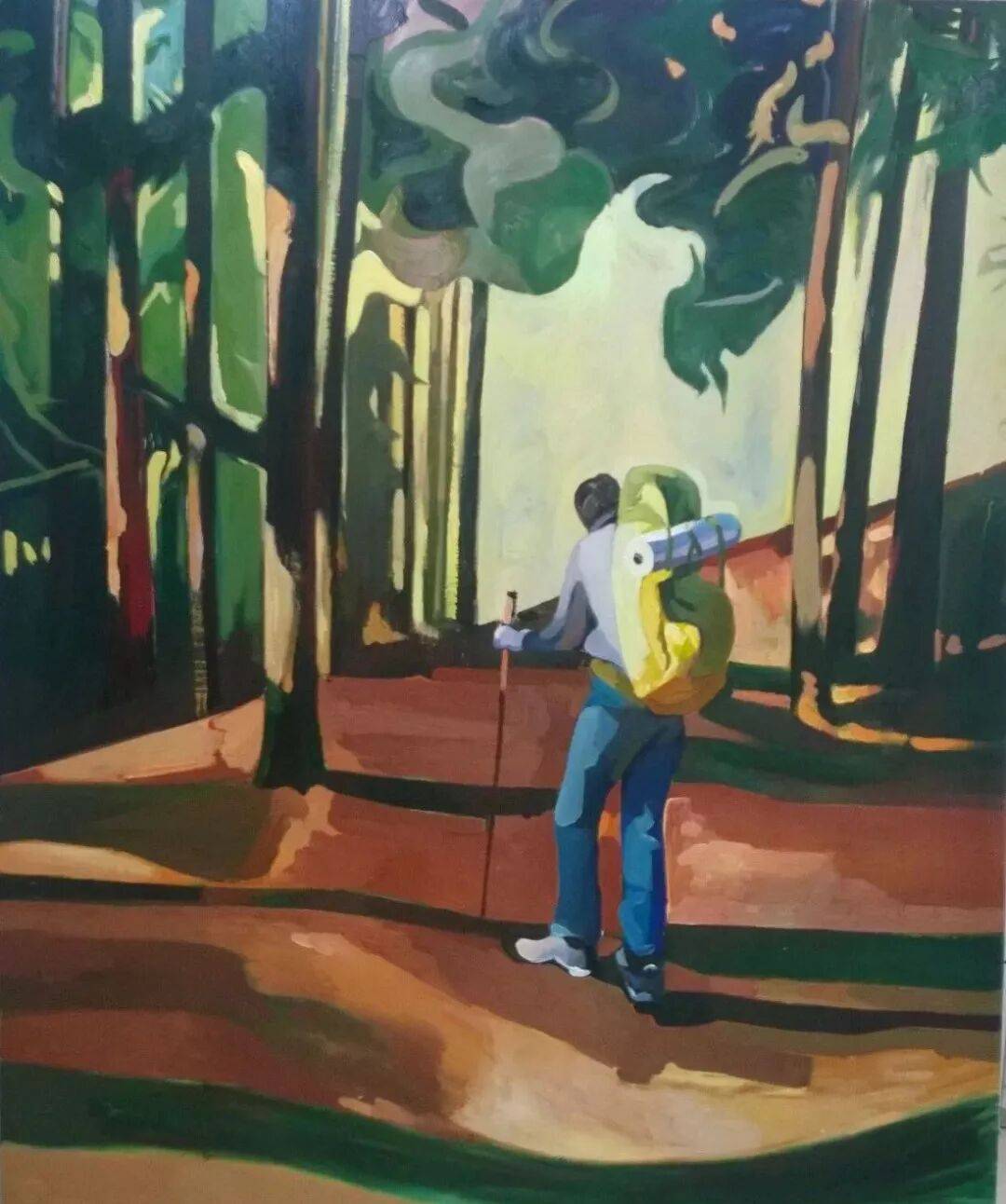
“The image of the mountain really came, at first, from my hometown, Jinggangshan,” Xiao Jiang said. “I lived in the mountains as a child. That was the environment I grew up in.” Landscape photographs of Jinggangshan taken by Xiao Jiang. Xiao Jiang, A Hike, 2014. In fact, for a long time he did not make mountains a subject of painting. It was not until 2013 and 2014, when he often went hiking in the hills around Shanghai with friends, that the many mountains he saw caused his childhood memories of the range to return and accumulate in his mind once more.
“At first, when I painted mountains, I might work from photographs I had taken. But later it became more of a habit of thought. I worked more directly from the structure of the picture itself.” Landscape photographs of Jinggangshan taken by Xiao Jiang. Installation view of Xiao Jiang’s solo exhibition “A Fresh Breeze Sweeps the Hillside” at Vanguard gallery, 2023. Xiao Jiang, Crossing the Mountain, 2023. Xiao Jiang, Mountain Scene, 2023. As if after long accumulation, Xiao Jiang’s depiction of, and attachment to, mountains became unstoppable from that point on.
From earlier exhibition titles such as “In These Mountains” (2017), “Beyond the Mountain” (2021), and “Seeing the Mountain Upon Opening the Door” (2021) to this exhibition’s “A Fresh Breeze Sweeps the Hillside,” and from painting titles such as In the Mountains, Deep Mountain, Mountain After Mountain, Crossing Mountains and Ridges, and Mountain Scene, the element of the mountain is never far away.
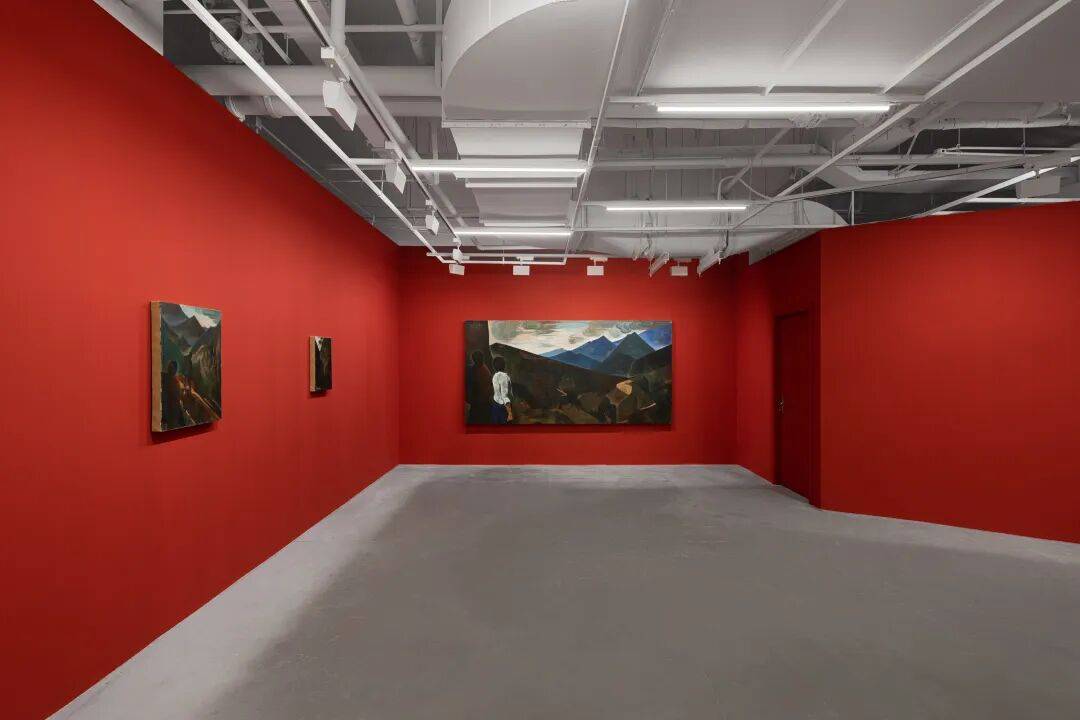
“It was as if those memories of growing up had been activated. I wanted to bring mountains into the paintings, and before I knew it I’d been painting them all the way up to now,” Xiao Jiang said. By our rough count, from 2013 to 2023, that makes a full decade. Installation view of Xiao Jiang’s solo exhibition “A Fresh Breeze Sweeps the Hillside” at Vanguard gallery, 2023. Walking into the exhibition, our memory seemed to overlap with the visual memory of the artist’s studio from a few days earlier: the large red walls in the gallery echoed, across space, the red soundproof-panel walls of the studio.
The deep red of the walls and the reddish brown of the soil in the paintings, together with expanses of dark green and olive green, answer one another in color even as they clash.
“This red was recreated from Xiao Jiang’s studio,” the gallerist Li Li told us with a smile. Installation view of Xiao Jiang’s solo exhibition “A Fresh Breeze Sweeps the Hillside” at Vanguard gallery, 2023. Xiao Jiang, A Fresh Breeze Sweeps the Hillside, 2023. The title of the exhibition, “A Fresh Breeze Sweeps the Hillside,” comes from a line in a Jin Yong martial-arts novel.
“I thought the phrase was pretty interesting, so I used it as the title of the exhibition,” Xiao Jiang said. The work A Fresh Breeze Sweeps the Hillside is also one of several monumental paintings in the exhibition that stretch three meters in length. In it, layered mountain ranges advance in bands: the reddish brown of the near slopes, the dark green of the middle valleys, the deep blue of the distant peaks, and, in the sky and mist, pinkish blue and pinkish violet, all seeming to continue beyond the edges of the canvas. In the lower right corner, a figure crouches with his back to the viewer, spreading a white canvas on the ground and sketching from life.
SECTION 02 | Find inspiration from Jinggang Mountain in my hometown
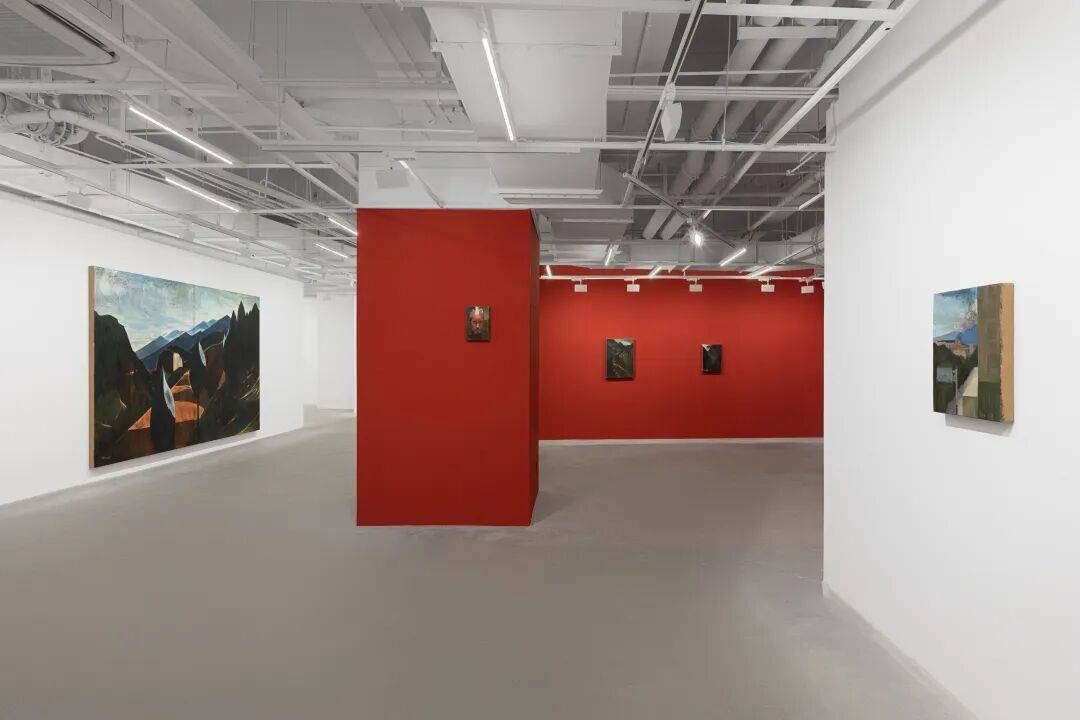
Xiao Jiang, A Fresh Breeze Sweeps the Hillside (detail), 2023. The white shoes and the white canvas, the dark-green clothing and the dark-green peaks: the composition feels at once like the rendering of a real scene and the rearrangement and reconstruction of blocks of color and structure, hovering between haze and realism, its boundaries indistinct. Xiao Jiang said that there are not many colors on his palette, but he is especially fond of earthy red, Naples yellow, and olive green. In the paintings, these colors appear again and again, layered and built up. Installation view of Xiao Jiang’s solo exhibition “A Fresh Breeze Sweeps the Hillside” at Vanguard gallery, 2023. Xiao Jiang, Across Mountains and Ridges, 2023. Installation view of Xiao Jiang’s solo exhibition “A Fresh Breeze Sweeps the Hillside” at Vanguard gallery, 2023. Left: Across Mountains and Ridges, 2023. Center: Landscape Sketch, 2023. Right: A Fresh Breeze Sweeps the Hillside, 2023. “Honestly, I don’t think there’s much point in having me explain my pictures. The picture can express itself, and it’s already quite clear.”
The artist said that the sketching scenes in Across Mountains and Ridges, Landscape Sketch, and Crossing the Mountain, as well as the image of the traveler carrying a pack, all come from his own memories and experiences.
Xiao Jiang: After a Decade of Painting Mountains, More Than Ten New Works Go on View in Shanghai
“The person in the painting is like the me who used to go out sketching, a younger version of myself. I’ve consciously gathered a lot of things from the past into a single picture. You could say there’s a bit of my own private thinking in it.” Installation view of Xiao Jiang’s solo exhibition “A Fresh Breeze Sweeps the Hillside” at Vanguard gallery, 2023. Xiao Jiang, On the Hillside (detail), 2023. The largest work in the exhibition is this four-meter-long On the Hillside, which takes up an entire wall.
Its structure is somewhat similar to that of A Fresh Breeze Sweeps the Hillside, with the left side lighter and the right side denser. Sunlight enters from the right, falling across the valley and the thick woods in bands of light and shadow, some pale, some deep. The illuminated areas glow in orange-red and grassy green; the dark passages show the reddish-brown tones typical of Jiangxi’s red soil; and the branches and leaves appear in brown-black and inky green. Interestingly, some trees are shaped like leaves, with the sunlit side appearing as if a corner has been cut away; others resemble drops of water. What they share is that the pointed tops of the trees all thrust straight into the sky, forming, together with the triangular distant mountains, a kind of structural solemnity, monumental and quietly powerful.
“The trees are no longer the shape of trees. Sometimes that’s really because the composition requires it. More than restoring their actual form, what I’m thinking about is what the composition needs,” Xiao Jiang told us. Xiao Jiang, Spring Outing, 2023. Beyond the large canvases, the smaller new paintings are especially arresting. Unlike the immersive effect of the big works, which make you feel as if you have fallen into them, the small paintings carry an intimacy touched by distance. Spring Outing measures only 50 x 35, with bright, brilliant colors and an atmosphere that is easy and cheerful.
“It was painted from a very specific photograph of mine, and I made almost no changes to it. In May of this year, I went back to my hometown, Jinggangshan. I was walking on the mountain near my home and through the fields and just casually took the picture. It’s the sort of scene you see everywhere where we’re from,” the artist said. Installation view of Xiao Jiang’s solo exhibition “A Fresh Breeze Sweeps the Hillside” at Vanguard gallery, 2023. Xiao Jiang, Mountain City, 2023. Another small painting, Mountain City, takes a perspective like a view from the balcony of a tall building.
“This is actually the view from the balcony of my parents’ home in Jinggangshan. They’re all real scenes. When painting them, I made only slight adjustments according to the needs of the picture.” When we asked Xiao Jiang to confirm the source of the work’s inspiration, this was what he told us, not far from what we had expected, though still pleasing in its precision. Installation view of Xiao Jiang’s solo exhibition “A Fresh Breeze Sweeps the Hillside” at Vanguard gallery, 2023. In the exhibition, the juxtaposition of large and small paintings creates tension and release, distance and closeness; visually, the overall effect is rich.
When we asked whether there was any difference between painting large and painting small, he felt there was not much difference at all.
“With a large painting, you may need to control the whole more carefully, and the workload is greater, so it’s also more physically demanding. But in terms of what I’m thinking about, large and small paintings are the same: how to make a picture work. Sometimes, as I’m painting, I realize the image might actually suit a smaller scale better, or the other way around, that the structure would open up more if it were larger.” For Xiao Jiang, the response he has in front of a picture is immediate, and liable to change at any moment.
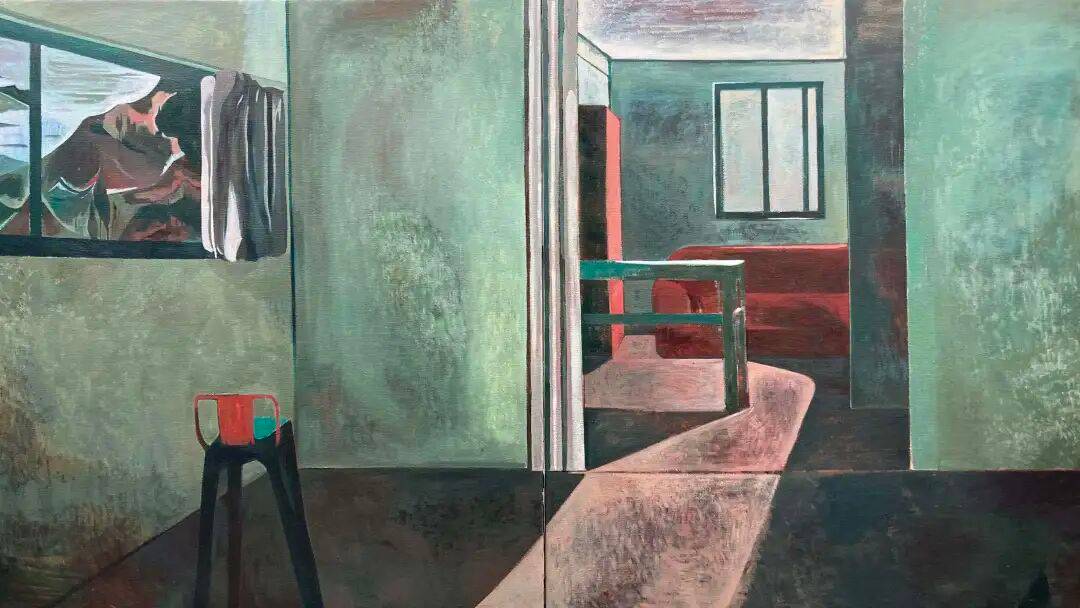
“The beginning of every painting is the hardest. Faced with a blank canvas, I won’t know how to start.” But he has never had the habit of making sketches, because he changes things so drastically as he paints. Sometimes the initial state of a work is one thing, but by the time it is finished it has become something entirely different. Xiao Jiang, Rest, 2021. Xiao Jiang, The Big Room, 2020. Xiao Jiang, In the Room, 2021. Xiao Jiang, Good Times, 2021. Although most of what we see in this exhibition are outdoor “landscape paintings,” the interior scenes he paints are, in fact, an equally important part of the arc of his work.
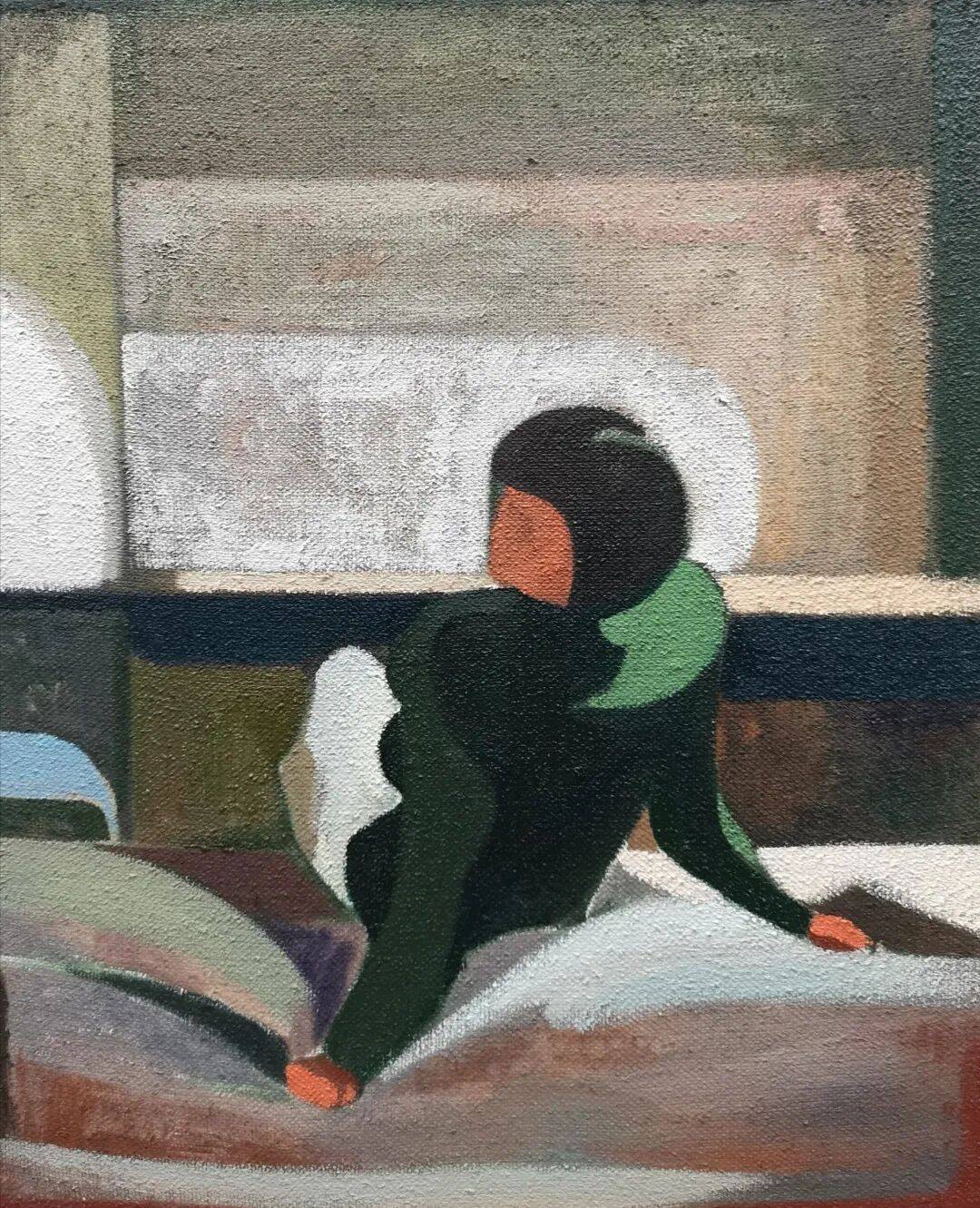
In these rooms, sofas and tables and silent figures, standing or sitting in various poses, are placed together in a single scene that feels both real and dreamlike. Freed from the logic of perspective, the pictures contain a great dramatic tension that operates in secrecy. Xiao Jiang, Kitchen, 2021. Xiao Jiang, Solitude, 2017. The figures in his paintings have blurred faces, or else simply turn their backs to the viewer. They assume many different postures, yet always carry a quality of coming close only to remain remote, as if something were on the verge of being said and then withheld. They bring to mind European Romantic painting, and also the slow movement of a symphony, the tenderest passage in a grand narrative.
“The interior paintings may have more concrete figures, and because the content is different, the emotion or atmosphere they finally convey is naturally different too,” Xiao Jiang said. Xiao Jiang, Sketch Practice, 2021. Xiao Jiang, Reclining Figure, 2020. As for the people in the paintings, he sees them more as shapes, as blocks of color: “They exist for the structure of the picture, so they have no faces. I’m not painting portraits.”
When we asked whether the figures had real-life models, Xiao Jiang laughed. “Of course they do. They’re basically all me, my family, and my friends. I don’t go out of my way to tell them. But a lot of people can recognize themselves when they look at the paintings. If they can smile to themselves, I think that’s pretty good.” Left: Xiao Jiang, Birthday Cake Hat, 2017. Installation view of Xiao Jiang’s solo exhibition “A Fresh Breeze Sweeps the Hillside” at Vanguard gallery, 2023. Xiao Jiang, Self-Portrait, 2023. The exhibition also includes two very small paintings, both self-portraits by the artist, hung on opposite sides of a column in the gallery, one slightly to the left and one slightly to the right. You have to circle the column to find them, a quietly charming bit of humor in the installation.
SECTION 03 | Draw friends, draw ordinary things in life
“My self-portraits are just for fun,” Xiao Jiang said with a laugh. Installation view of Xiao Jiang’s solo exhibition “Seeing the Mountain Upon Opening the Door” at Vanguard. Installation view of Xiao Jiang’s solo exhibition “Beyond the Mountain” at Platform China Contemporary Art Institute, 2021. Installation view of Xiao Jiang’s solo exhibition “Interior Landscape” at Vanguard gallery, 2021. Installation view of Xiao Jiang’s solo exhibition “Along the Way” at Vanguard gallery, 2014. Installation view of Xiao Jiang’s solo exhibition “Unbroken,” at karma, New York, 2022. Xiao Jiang told us that after finishing his advanced study in the oil-painting program at the China Academy of Art in Hangzhou, he came to Shanghai in 2006 and has been painting ever since.
“Actually, I never planned much of anything. It all seems to have happened just like that. I simply went along with it.” Xiao Jiang, Who Knew Someone Would Come, 2008. Xiao Jiang, Public Bathhouse, 2012. Xiao Jiang, Iron Gate, 2012. In his early work, his inspiration came mostly from images or from film. Between 2010 and 2014, he painted many objects: mops, dirt, iron gates, the sorts of things in everyday life that usually go unnoticed, and even urinals and public bathhouses.
“The inconspicuous things in life are interesting too, don’t you think?” It was not until 2013, while hiking in Shanghai, that he found a new direction for his work, one that has continued to the present and that he is still refining in the way he handles and constructs a picture. Xiao Jiang, Profile Before a Landscape Painting (Self-Portrait), 2017. Xiao Jiang, Rest, 2018. “Change in making art is actually a very long process. Sometimes you only see the changes of seven or eight years when you look back. But while you’re developing, you aren’t really conscious of it yourself. One year passes, then another, and you just keep painting.”
Speaking about how he spends his time away from painting, Xiao Jiang said that he used to enjoy playing soccer, and we did indeed find, among his works, a painting of someone lying on the grass after a game, which could not help but make us smile. It also seemed to confirm what the artist had said: “You don’t need to go looking for inspiration on purpose. In fragments of everyday life, there may already be something that moves you.”