The Legendary German Artist Finally Makes His China Debut
“The most compelling thing about my work, I think, is the humor, satire, and sadness behind the laughter,” Werner Büttner said in an interview. In the 1990s, Chinese painters almost all seemed to own a Büttner monograph; this summer, his long-delayed first exhibition in China opened at Triumph Art Space in Beijing......
By / Xirui Huang · 10 min read
How does Werner Büttner use absurdity and humour to explore the human condition?
In Xirui Huang’s 2022 interview, Werner Büttner describes analogy, allegory and metaphor as tools for considering human behaviour. Absurd animals and strange figures meet serious composition in the Beijing exhibition, leaving satire and sadness beneath the humour. His defence of Bad Painting questions habitual ideas of beauty and correctness while maintaining a connection with reality. The conversation also touches on solitude, teaching and his interest in Chinese literati traditions.
“The most compelling thing about my work, I think, is the humor, satire, and sadness behind the laughter,” Werner Büttner said in an interview. In the 1990s, Chinese painters almost all seemed to own a Büttner monograph; this summer, his long-delayed first exhibition in China opened at Triumph Art Space in Beijing.
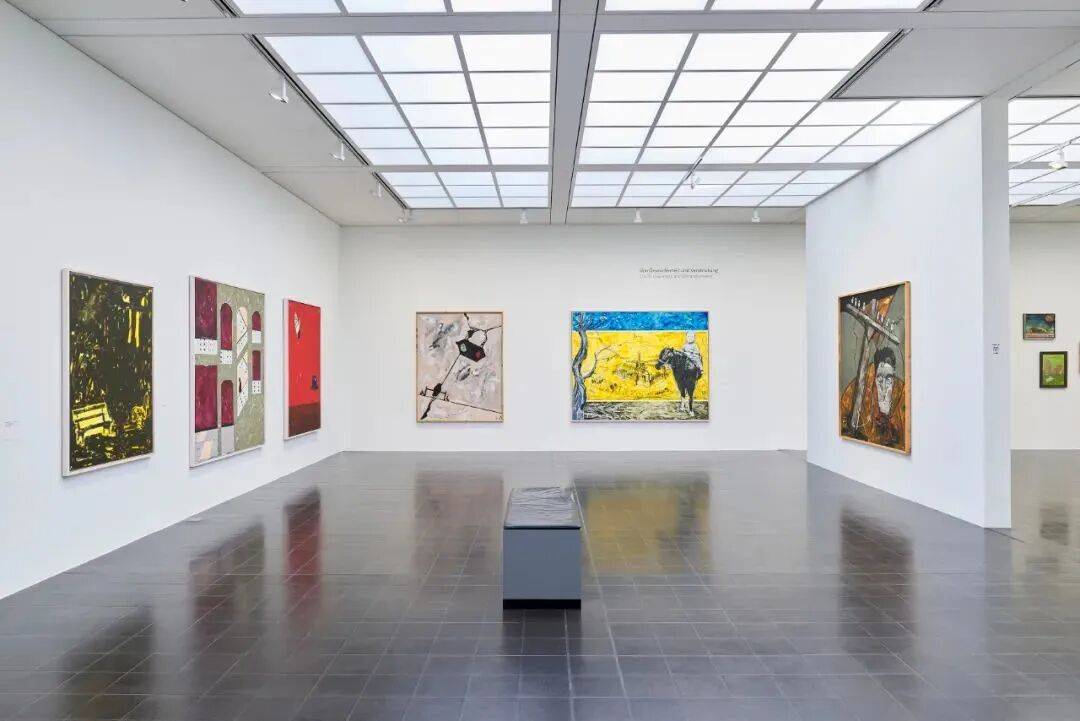
Installation view of “Werner Büttner: The Human Situation: Similes, Parables and Metaphors,” Triumph Art Space, China, 2022. Born in 1954, Büttner is one of the most important postwar contemporary artists in Germany. Trained as a lawyer, he never spent a day in art school and became a defender of “bad painting,” which is one side of his radical boldness. On the other, he is witty in conversation, dislikes socializing, and spent 30 years teaching at the Hamburg University of Fine Arts, where many of his students went on to become central figures in contemporary art; some young Chinese artists even went to Germany to study because of his reputation.
SECTION 01 | German-style Comedy
I interviewed the indefatigable legendary artist remotely, and, unexpectedly, he brought up the Seven Sages of the Bamboo Grove. “I like solitude, and I’m not obsessed with fame or applause. My pleasures are much the same as theirs,” he said.
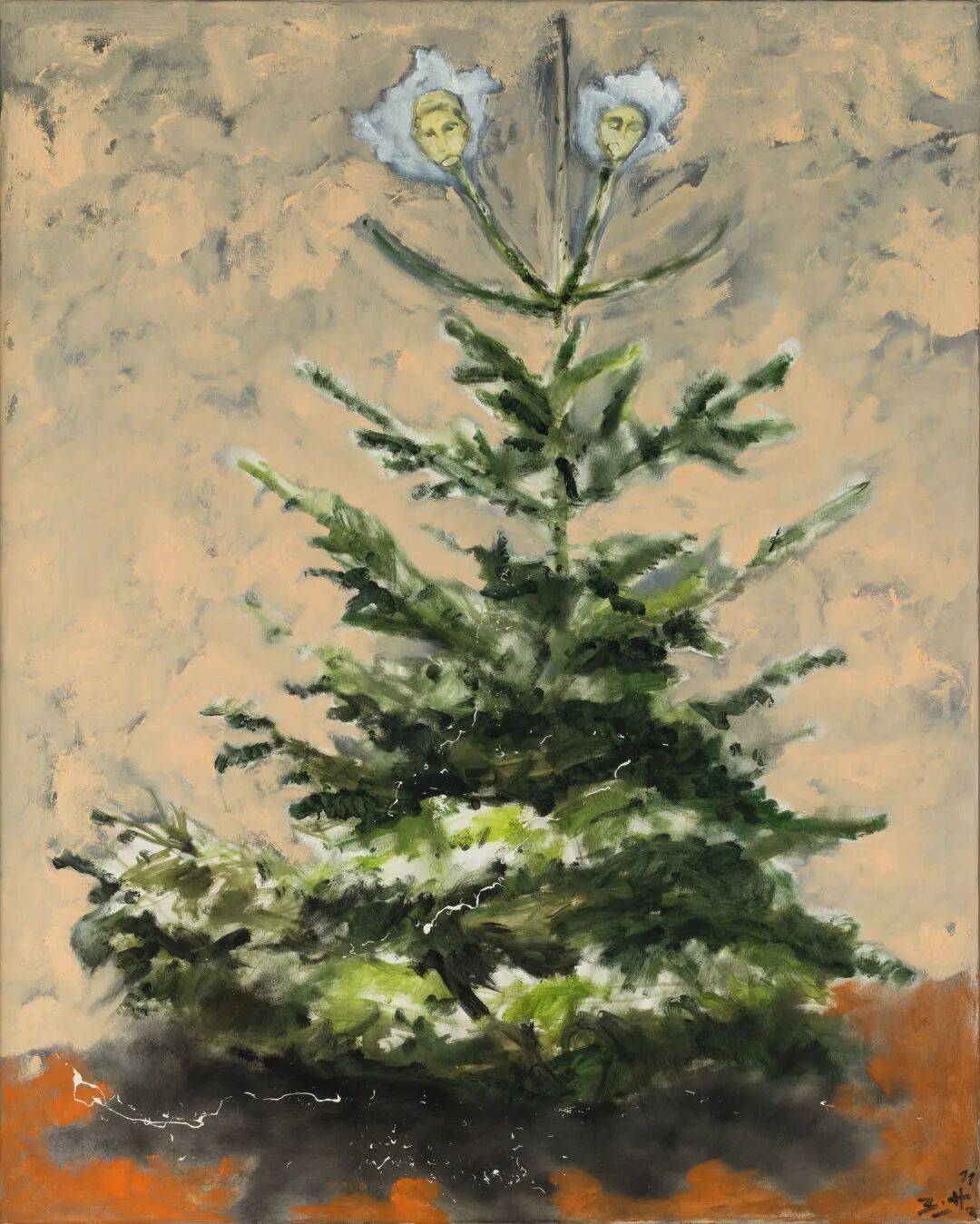
Installation view of “Werner Büttner: The Human Situation: Similes, Parables and Metaphors,” Triumph Art Space, China, 2022. Büttner’s work has a way of making viewers widen their eyes at once. A grinning dinosaur in a plaid shirt, the Loch Ness Monster clutching a guitar, pink toilet paper hanging from a human face, a cluster of dimwitted geese huddled together: the imagery is absurd and unrestrained, yet the color and composition are serious, and the pictures are dense with narrative. Critics have called his paintings “full of murky colors” and “anti-aesthetic.”
That is also why he is known as a defender of “bad painting.” Here, of course, “bad” means bad in the sense of a bad actor. Even for viewers who know the reputation of “bad painting,” encountering a Büttner original for the first time can still feel visually overturning. Werner Büttner, Fame and Little Baskets, 1995. Büttner is deeply excited about this Chinese debut, “many years late” by his reckoning. Together with the gallery and the curator, he carefully selected nearly forty works spanning 30 years, from the 1990s to a new piece from 2021, allowing viewers to trace the arc of his development at a glance.
The exhibition title, “The Human Situation: Similes, Parables and Metaphors,” is Büttner’s own summary of his artistic method. “As a person and as an artist, from the very beginning, ‘the real condition of human beings’ has been something that interested me enormously,” he said. “I use simile, parable, and metaphor as tools for depicting and outlining human nature.” Analogy and metaphor, he noted, are also devices used in poetry. “Poetry and painting are especially closely bound in China,” he said, referring to the literati painting tradition dating back to the Song and Ming periods. “I believe Chinese viewers will certainly understand.”
Werner Büttner, Five Cranes and Sketches From Charles Darwin’s Notebook on the Theory of Evolution, 2021. This work, made last year, places a sketchbook by the biologist Darwin on the left and, on the right, a stack of distorted cranes that look more like small birds: the kind Darwin used to explain the origin of species, birds that live in the Galápagos Islands and are also known as Darwin’s finches.
“To some extent, this work is a celebration of evolution,” Büttner said. “Darwin discovered the secret of evolution. In the course of evolution, living beings developed a great many colors and forms, and these were preserved in them. I want to develop and evolve my painting in the same way that evolution does.”
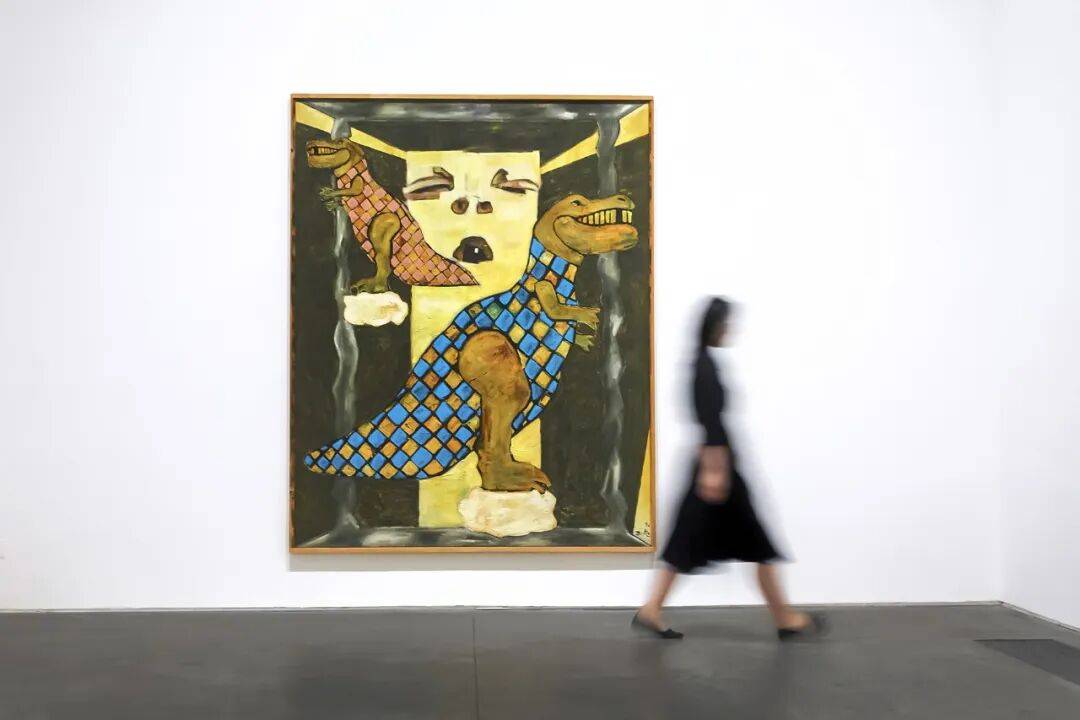
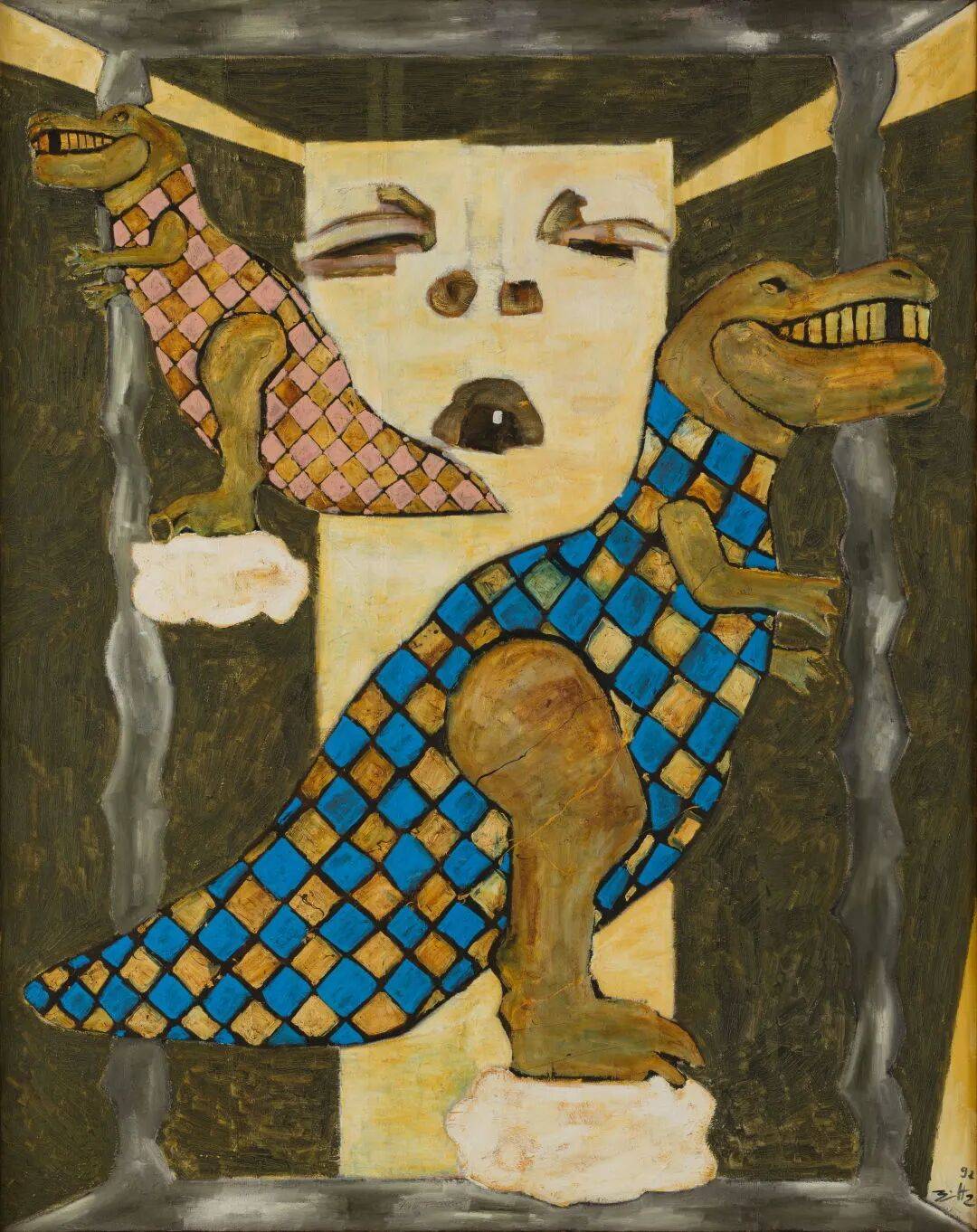
“I especially like surprise,” Büttner said. Creating conflict and a sense of absurdity has therefore become a principle running through his career, and estranged, distorted animals recur throughout his paintings. Werner Büttner, Is Humor a Natural Concept?, 1992. This work from the 1990s is among his most frequently reproduced. One of its protagonists is a grinning dinosaur in a pink-and-blue plaid shirt, both hind legs planted on weightless clouds.
Behind it is a human face that looks slightly despondent. The logic of the image is utterly scrambled, yet one thing unifies it: they are all missing a tooth. Left: Werner Büttner, Venice, 2020. Right: Werner Büttner, Playing With a Giraffe, 2017. There are many brightly colored works in the exhibition. Could the Loch Ness Monster really be this cute? At first glance, it seems to be holding a guitar, about to burst into song; then you look closer and realize it has no hands.
A giraffe, an animal of the tropics, glides happily over a sheet of ice: contradictory, absurd. Humor and satire run through Büttner’s work; he uses them to resist social norms and register his dissatisfaction with human behavior, imbuing the pictures with a reality at once comic and tragic. Also on view are works from the series Attempt to Symbolize Being, 1993. He likes, too, to force together things that have nothing to do with one another: body parts, animals, plants, tools, all joined in baffling combinations.
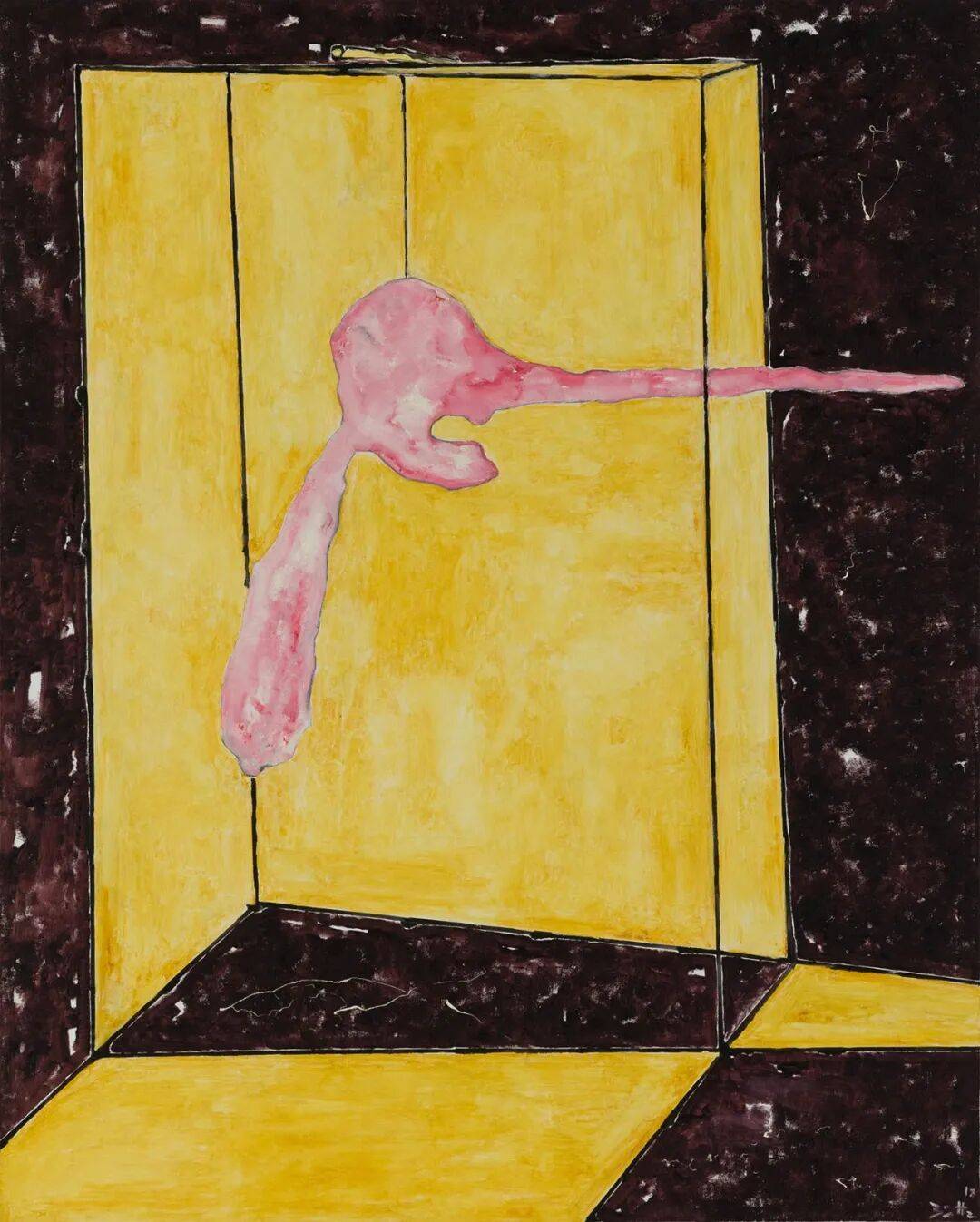
A run of early works on paper is the clearest expression of that attitude. This was the artist’s second series, Attempt to Symbolize Being, made in the 1990s. The result of these combinations is “surprising, absurd, and mysterious,” Büttner said, “but they represent my experience, and I felt I had to paint them.” Werner Büttner, Details of Our Daily Life, 2016. Werner Büttner, Nose — A Stable Corner of Reality, 2018. Viewers well versed in art history are often prompted to smile knowingly by Büttner’s work.
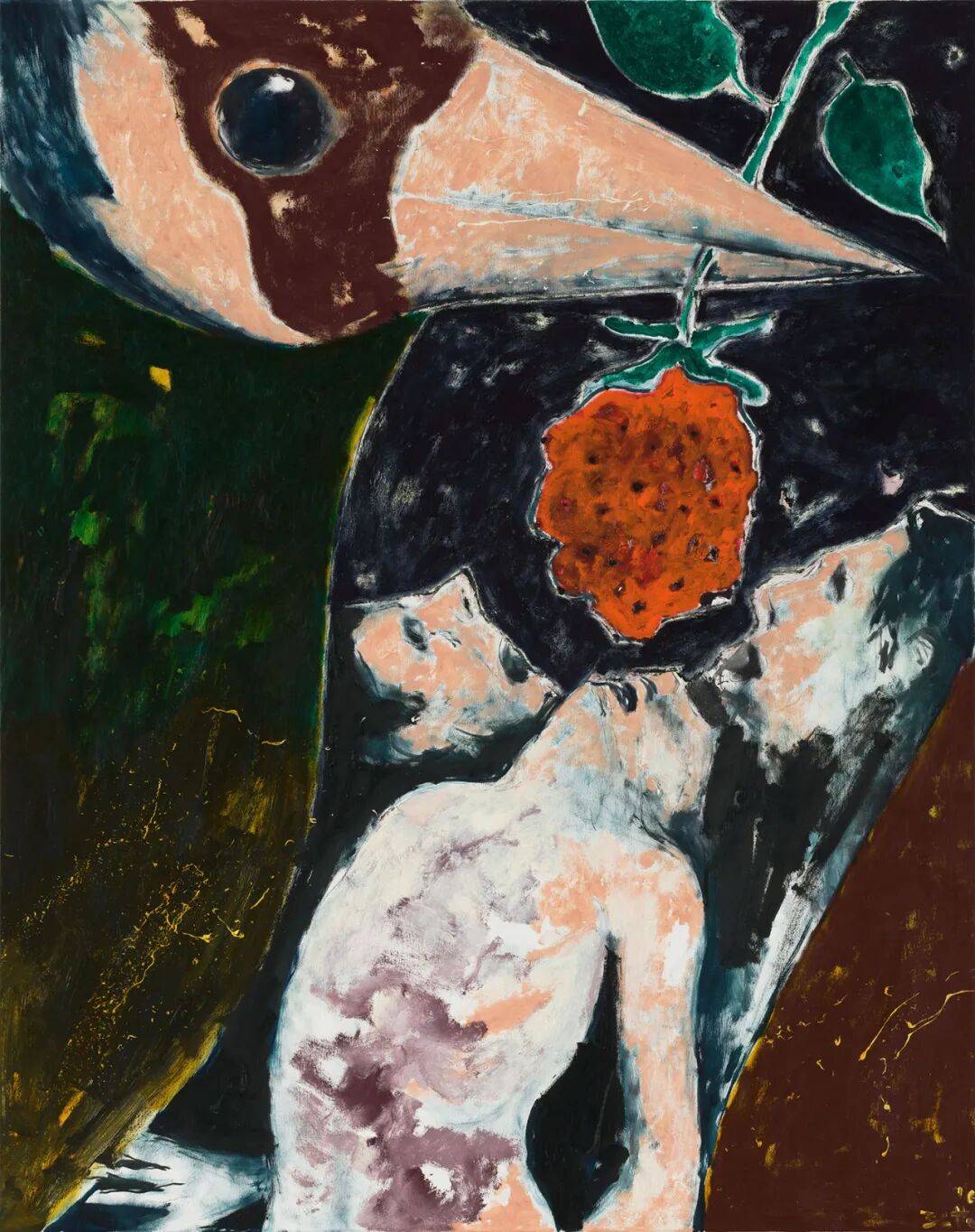
In Details of Our Daily Life, a fragment from Bosch’s masterpiece The Garden of Earthly Delights is lifted out, though this time it is no longer Adam and Eve who steal the forbidden fruit. There is also Giacometti’s signature sculpture Nose, originally black, now painted pink and almost squeezed out of the frame. From left to right, the works are Werner Büttner, Size Matters, 2019; Space With a Soul, 2020; and The Pleasure of Functioning, 2019. In a recent series, he stamps text directly onto the picture surface, revealing the title to the viewer.
What is the point of doing that? “I like using image and text to form a ‘stable’ narrative on the canvas,” he replied. “In these works, the title is part of the work. I want it to ‘shout’ at you.” Werner Büttner, Palpitations, 2007. Werner Büttner, Compassion Family Tree, 2011. He thinks these two works may be the best representatives of his artistic method.
“Perhaps that is because in these works, things are combined in their purest and most absurd form. That is what I most like to paint: surprising images,” Büttner said. After 40 years of making art, he remains somewhat allergic to the word “artist,” feeling that it carries too many modern misunderstandings.
SECTION 02 | A rebellious young man who never went to art school for a day
“I prefer ‘character’ or ‘personality.’ Like everyone else, I have been helped by my parents’ DNA, by the social conditions in which I grew up, and by the people I met, but above all by good books.” His work is also closely tied to literature. As in Cervantes’s Don Quixote, tears lie behind the laughter.
“There is no use preaching in a work. It only irritates people, so I pretend to mock the world.” Whether in the 1980s, when his pictorial style was just taking shape, or in recent works, Büttner’s art has struck his peers as excessively avant-garde and rebellious. That willingness to challenge authority and satirize the times has much to do with his early life. Werner Büttner at Galerie Chantal Crousel in Paris, 1986. Image source: internet. Büttner was born in 1954 in Jena, then in East Germany. When he was 5, his father left him and went alone to West Germany.
In 1961, his mother fled to West Germany with him. Within a few weeks, the Berlin Wall was built. He left home at 16 and supported himself with odd jobs. He finished high school with poor grades, but chose to study law at university, first because the field had no admission requirements at the time, and second because he believed law was philosophy put into practice and could help the poor out of difficulty. He later discovered that this was “an utterly naive idea.” In an earlier interview, Büttner said, “Three semesters of studying law deepened my distrust of all agreements among human beings. Whether law, tradition, or custom, they all have an expiration date. They are highly arbitrary.”
He decided that “one can rely only on things one has tested oneself and found suitable for oneself. Sometimes those things may be unconventional.” From left: Martin Kippenberger, Werner Büttner, and Albert Oehlen at the opening of the exhibition Women in My Father’s Life, 1983. Photograph: Franz Fischer. By chance, Büttner met the painter Albert Oehlen. For nearly three years, the two talked constantly about art, taking Beuys and Polke as “milestone teachers.” Later they met Martin Kippenberger, and the three like-minded artists founded the “League Against Contradictory Behavior.”
The three reckless, hotheaded young men shared a studio and were known as “the young Wildes.” They were highly action-oriented: “think today, make it tomorrow”; “acting together is more powerful than acting alone.” German society at the time was thick with contradiction and crisis. Economic growth was close to zero, riots broke out in a number of cities, punk music was wildly popular among young people, and painting became another kind of punk. Büttner felt he had found in art a way to express his disgust with human entanglements; making work also suited his aloof temperament.
Werner Büttner, Self-Portrait in a White Shirt, 1998. When he paints, Büttner works boldly, roughly, directly. He adds another layer before the first has dried, wet onto wet. Because he does not want to spend all day on a canvas, many parts are finished in a rush, and he dislikes signing his work. By then, the art world was gradually growing tired of Minimalism and Conceptual art; under the onslaught of lines, dots, and expanses of color, it began to long again for paintings that cited concrete images and things.
Installation view of Werner Büttner’s solo exhibition “The Last Lecture,” 2021. Installation view of Werner Büttner’s solo exhibition “Creating Abysses,” Museum for Contemporary Art Marburg, 2015. Though he never attended art school for a single day, Büttner has worked across a remarkably wide range of forms, including still life, genre painting, self-portraiture, animal painting, history painting, and symbolic painting. Many of these works are sharply satirical and aimed at the ills of their time. “When I first began making art, painting was strictly forbidden,” he said.
SECTION 03 | Wild” college professor and “freak” genius student
“Even after it became permissible to paint some things, religious subjects, animals, and scenes of reproduction were still forbidden.” He wanted to break those taboos and believed that artists ought to be heretical. Martin Kippenberger and Werner Büttner in St. Georgen, 1983. In this way, the trio came to be known in Germany as defenders of the “bad painting” movement, and Büttner was unquestionably its leading figure. Their collective force was not confined to painting. They also did many rash things. He was once fined for urinating in a police station; the ticket listed a cleaning fee of 9.5 marks and postage of 50 pfennigs.
Büttner’s response, recalling that absurd episode, was: “My God, rebellion was so simple then, just 10 marks!” As for the criticism of conservative figures in the art world at the time, he remains breezy about it: “Although it was irritating, it also kept a lot of idiots away from us.” Installation view of Werner Büttner’s solo exhibition “The Last Lecture,” 2021. Büttner taught for more than 30 years at the Hamburg University of Fine Arts (HfbK). Asked how he became a professor, he joked that it stemmed from a walk and an especially congenial conversation after drinking with Franz Erhard Walther, who had been a professor there.
About 2 years ago, when he reached retirement age, Büttner stepped away from front-line teaching. Among his students are active Chinese contemporary artists today, all shaped to some degree by the German Neo-Expressionism he cultivated, including Liang Ying, born in the 1960s, and the post-90s painter Wang Xiyao. Daniel Richter and Jonathan Meese at Büttner’s solo exhibition “The Last Lecture.” There are many other prominent former students as well, including Daniel Richter and Jonathan Meese.
Even now, more than 20 years after they graduated, they remain close friends with Büttner, calling and seeing one another from time to time. Yet for all the intimacy among the three, neither of these former students remembers him as any kind of model life mentor; their relationship was full of impish mockery. Werner Büttner, Looking Out From the Cheese, 2004. The head protruding from the cheese in the picture is a self-portrait of the artist. In an earlier interview, Daniel recalled: “Exams were always full of put-downs and criticism.”
“Once, a student presented work in front of the whole class, and Büttner just buried his head in the table for at least 10 minutes. Then he lifted his head and said to the student, ‘You’re still here?’” Meese said that on one occasion he showed his teacher photographs of a sculpture he had made in his apartment. Büttner’s response was: “Ha ha, have you ever seen such an ugly apartment?” Meese was furious at the time and could not understand why his teacher had fixed on the apartment, of all irrelevant things.
Richter and Meese also burst out laughing in the interview: “Büttner’s laugh is terrifying. It’s all squawky and squeaky, like Kermit the Frog.” Werner Büttner, Disgusting Ice Show of the 1950s, 2021. When we asked Büttner what he made of these two “celebrity students,” he recalled that at first the other professors at the Hamburg University of Fine Arts thought Daniel had “almost no talent at all.” Büttner overruled them and “forced” the others to agree to admit Daniel.
As for Meese, Büttner’s first response was, “He also found his lifelong partner in my class. An interesting, slightly strange Icelandic girl.” The remark was entirely down to earth. In the interview, this peculiar sense of humor of Büttner’s kept making us laugh. Daniel once summed up his amiable teacher this way: “He loves satire, but behind it there’s a soft, beating rabbit heart, as if trapped inside a metal barrel.”
Werner Büttner at the launch of one of his catalogues. Image source: internet. Contrary to what many people imagine, Büttner is not especially sociable. He told us that the more than two years of pandemic-enforced social isolation had not changed his life very much.
“I like being alone. I don’t like too much contact with the world. I’m not obsessed with applause, and fame means nothing to me.” He added, “My pleasures are basically much the same as those of the Seven Sages of the Bamboo Grove.” The curator Amos Ai said that if Germany has a literati culture of its own, Büttner would count as one of its most important adherents. Büttner’s current studio. Some years ago, he bought the former Hamburg municipal hotel and turned it into his studio and the headquarters of his art foundation, naming it Störer des Stumpfsinns.
But he is by no means immersed in a private world, and believes that “art must have something to do with reality.” He emphasized that he likes to observe people and things from a distance. “If it has nothing to do with what is happening on this planet, then to me it is very boring.” That seemingly contradictory quality is fully visible in his work: funny, startling, and deeply melancholy; armored all over, yet still ardent and tender.