Ahead of Art Basel Paris: Ten Asian Artists to Watch
In October, after Fashion Week, Paris gives itself over to a larger spectacle: from October 18 to 22, with previews on October 18 and 19 and public days from October 20 to 22, Art Basel returns for the second edition of Paris+, expanding across the city and drawing many of the world’s leading galleries......
By / Xirui Huang · 11 min read
Why does the Paris+ 2023 feature resist the idea of a single Asian style?
The Paris+ 2023 preview follows ten Asian artists and groups across moving images, painting, sculpture and installation. Lu Yang’s digital bodies, Vivien Zhang’s organisation of images and Haegue Yang’s exploration of materials and perception arise from different concerns. Appearing at the same fair does not make these practices alike. The feature is best read as a juxtaposition of distinct artistic paths, rather than a geographical or market label defining a single Asian style.
Paris this October seems to require a word stronger than fashionable. After Fashion Week, the city will receive one of its largest art events in recent years: from October 18 to 22, with previews on October 18 and 19 and public days from October 20 to 22, Art Basel, the venerable blue-chip fair brand, will stage the second edition of Paris+ par Art Basel in the French capital.
With the Grand Palais Ephémère as its center of gravity, Paris+ will send art radiating into every corner of the city. One hundred and fifty-four leading galleries from thirty-three regions will bring works by their most important artists to the fair. The presentation spans nearly every medium, including painting, sculpture, installation, film, and multimedia. Twentieth-century masters and younger emerging artists alike will be shown in breadth.
At Paris+ in 2022, presented by Art Basel, one could already see the forceful rise of Asian art. Artists and galleries from China, South Korea, Japan, and Southeast Asia occupied a more prominent place within this major European fair. We have selected ten Asian artists or groups worth watching at Paris+, whose work offers a glimpse of new shifts in the market and in collectors’ tastes.
SECTION 01 | Artist Lu Yang
Lu Yang, DOKU-Animal (still), 2022, with the digital figure in the video modeled on the artist Lu Yang; image courtesy of BANK. Galleries: BANK, Société. The multimedia artist Lu Yang is among the most closely watched Chinese artists in the international art world today. BANK, the Shanghai gallery making its first appearance in the Discoveries sector this year, brought her new video work DOKU The Self, which runs for more than twenty minutes.
The series is also currently on view at MUDEC, the Museum of Cultures in Milan. Société, from Berlin, presented DOKU-PsyFi-Hungry Ghost 2. Lu Yang, born in 1984, remains strikingly young for an artist who has already participated in the Venice Biennale and had solo exhibitions at Kunstmuseum Basel in Switzerland, ARoS Aarhus Art Museum in Denmark, and Palais Populaire in Berlin.
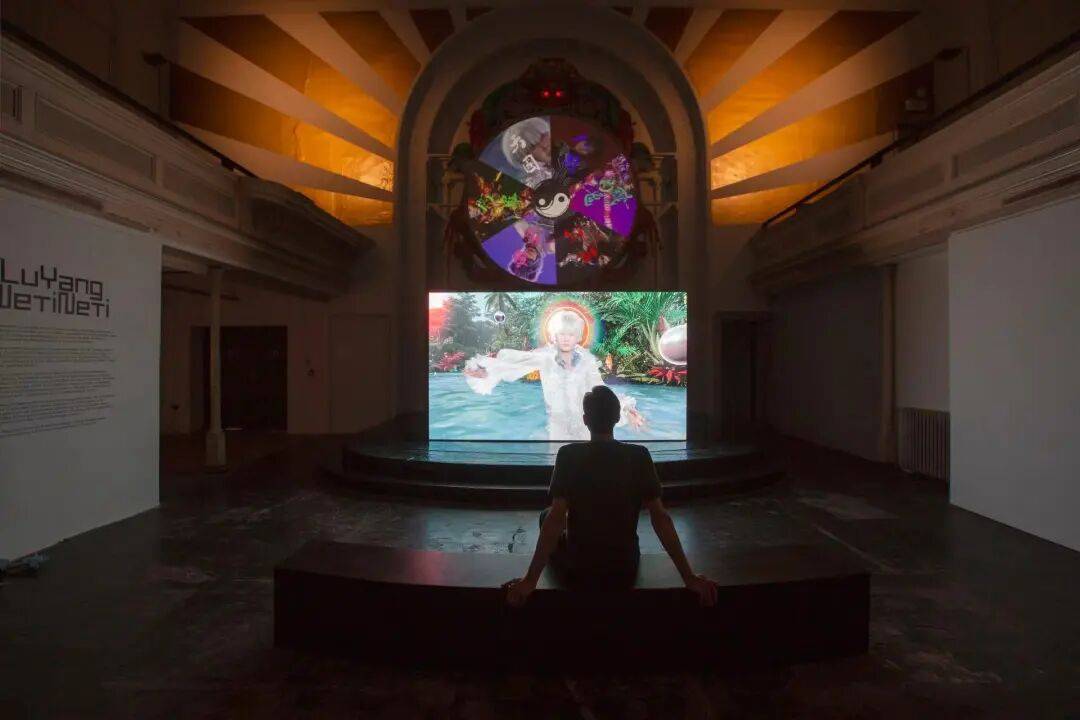
Lu Yang has long been drawn to large subjects such as DNA, disease, death, and religion. The decision to turn the self into a digital being came from a practical insight: a digital body is not bound in the way a physical one is, and so is more useful for making work. In these pieces, that figure can shift at will among forms, genders, and appearances; it feels no illness and is no longer constrained by lifespan. In DOKU Series - LuYang NetiNeti, shown at the Zabludowicz Collection in London in 2022, photographed by David Bebber, Lu Yang used motion sensors and 3D imaging technology to input the self into a computer; fifty facial expressions were captured and reconstructed, reincarnated as DOKU.
Six video segments play in sequence across an LED wall, presenting six incarnations of Lu Yang’s digital avatar DOKU and suggesting the eternal cycle of life, death, and rebirth. In stills from the DOKU The Self series, 2022, courtesy of BANK, this avatar becomes part of a multimedia project in which Lu Yang explores the posthuman figure through the cosmological frameworks of Buddhism and Hinduism. DOKU is a reincarnation of the artist in a parallel universe, an extension of the soul into the digital realm.
SECTION 02 | Artists Guan Xiao & Zhou Siwei
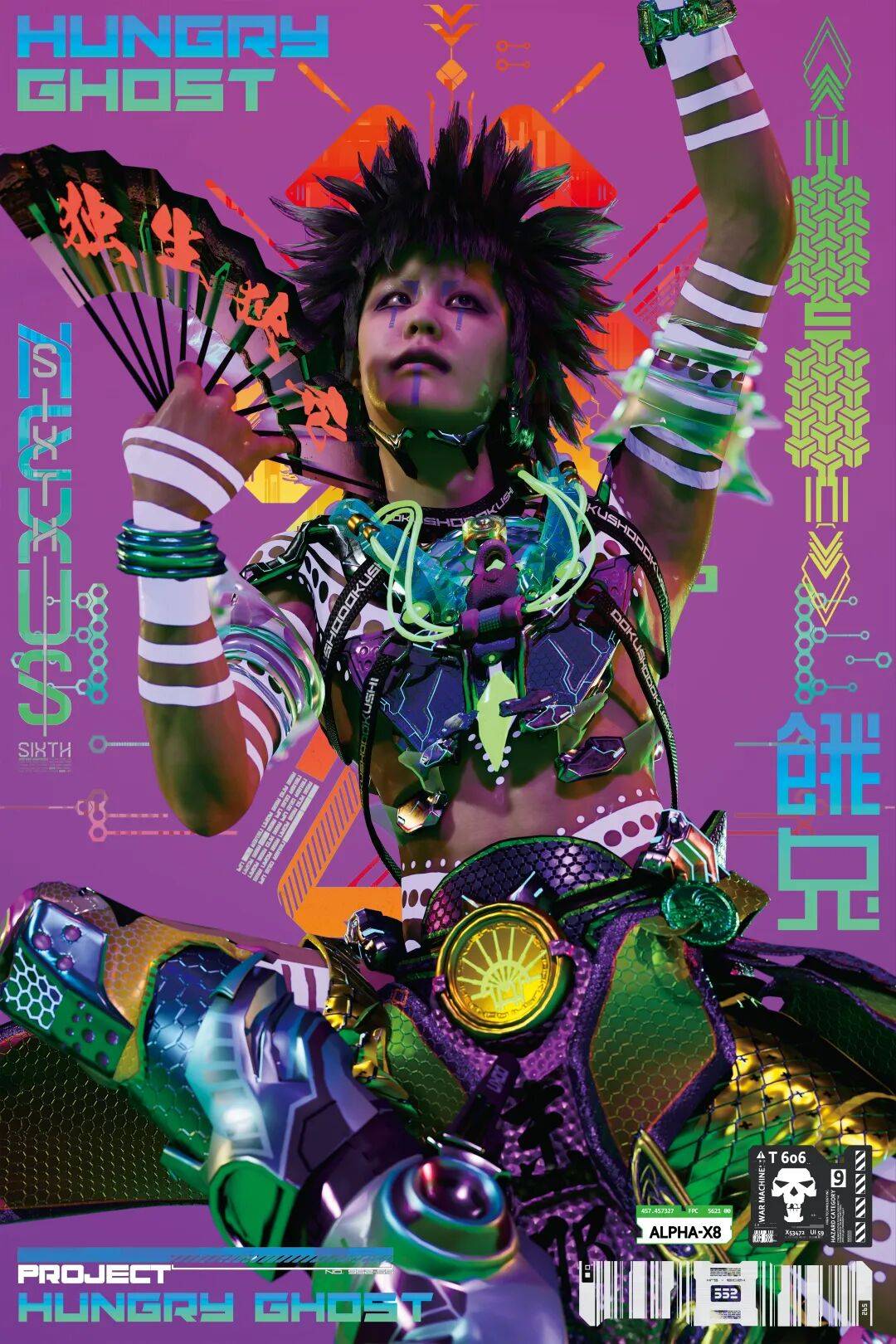
In this work, Lu Yang becomes an enigmatic figure living in a parallel digital universe, passing through six reincarnations and setting out alone to probe the furthest reaches of mind and cosmos, in search of samadhi and the end of human suffering. DOKU was conceived to investigate the mysteries of the human spirit and the intentions of the universe. Lu Yang, DOKU-PsyFi-Hungry Ghost 2, 2023, courtesy of Société, also reworks the DOKU avatar: here Lu Yang appears as a hungry ghost, the face carrying a trace of pain, the fan in the left hand plainly inscribed with the words “born alone, die alone.”
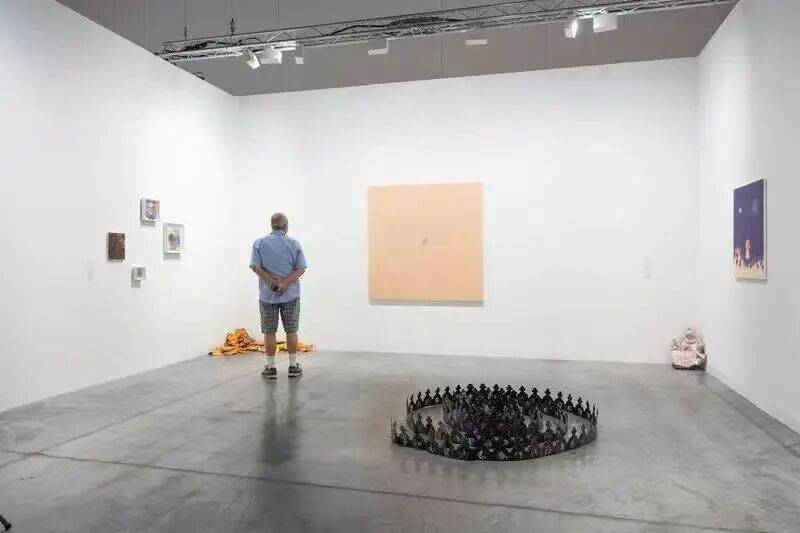
Artist: Guan Xiao. Gallery: Antenna Space. Antenna Space, from Shanghai, is the only gallery from mainland China in the main sector this time, a sign of real standing. Last year it participated in the Discoveries section and was met with strong responses from all sides, which helped it move up to the main sector this year. Its booth takes the form of a two-person presentation of Guan Xiao and Zhou Siwei, whose works are closely linked and generate what feels like an endless conversation within a limited space.
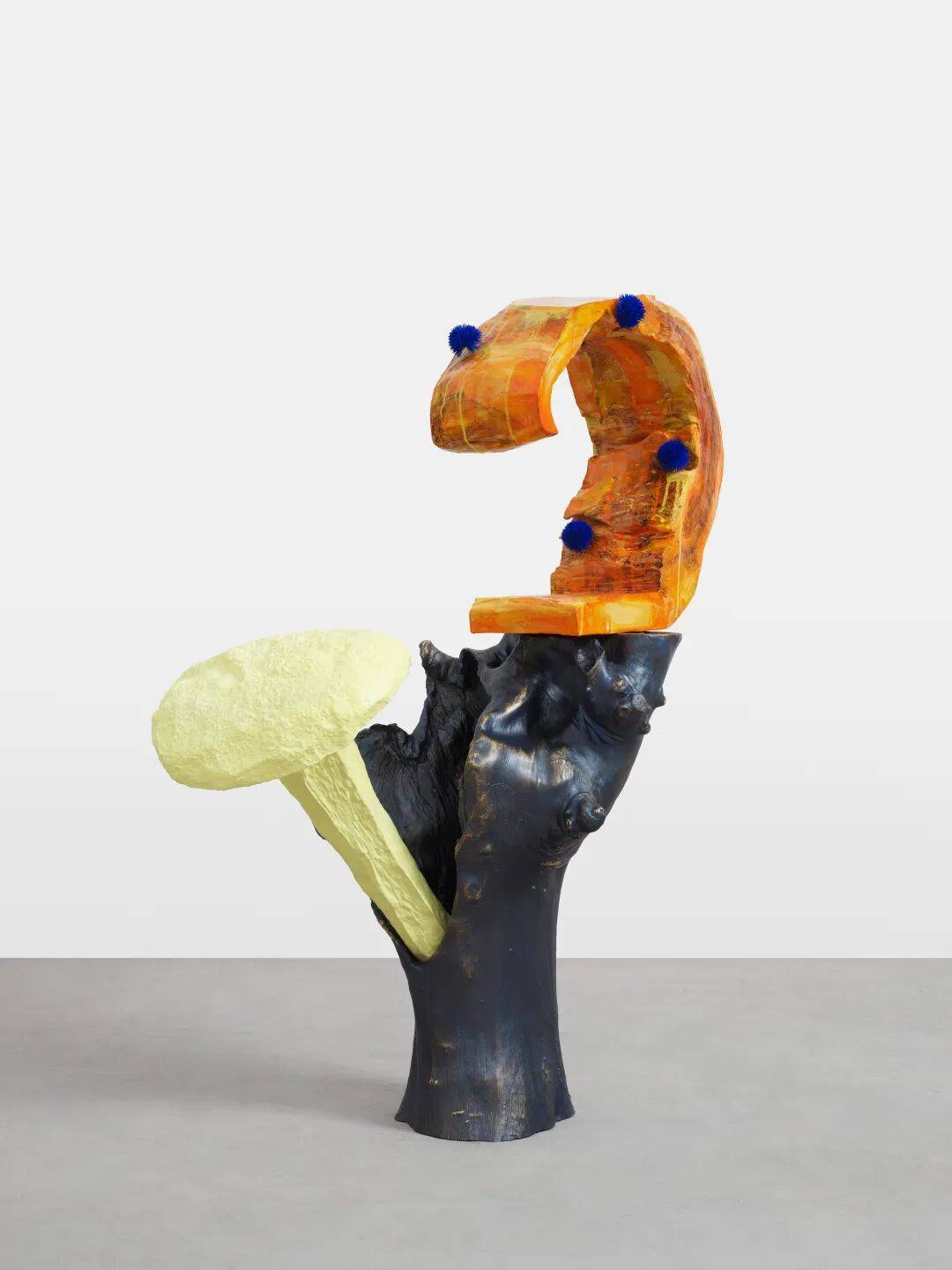
Guan Xiao, Nix in 2023, 2023, courtesy of Antenna Space; Guan Xiao, Attack 001, 2022, courtesy of Antenna Space. Guan Xiao, born in Chongqing in 1983, works primarily in sculpture, video, and installation. Her visual language is often playful, fusing classical artistic vocabularies with the civilization of industrial manufacture. In works such as Nix in 2023 and Attack 001, hard bronze is placed beside plastic flowers, while soft white feathers seem to grow from dead wood. These binary oppositions and material contrasts blur the line between the organic and the synthetic, inviting viewers to consider the points where nature, technology, and human intervention meet.
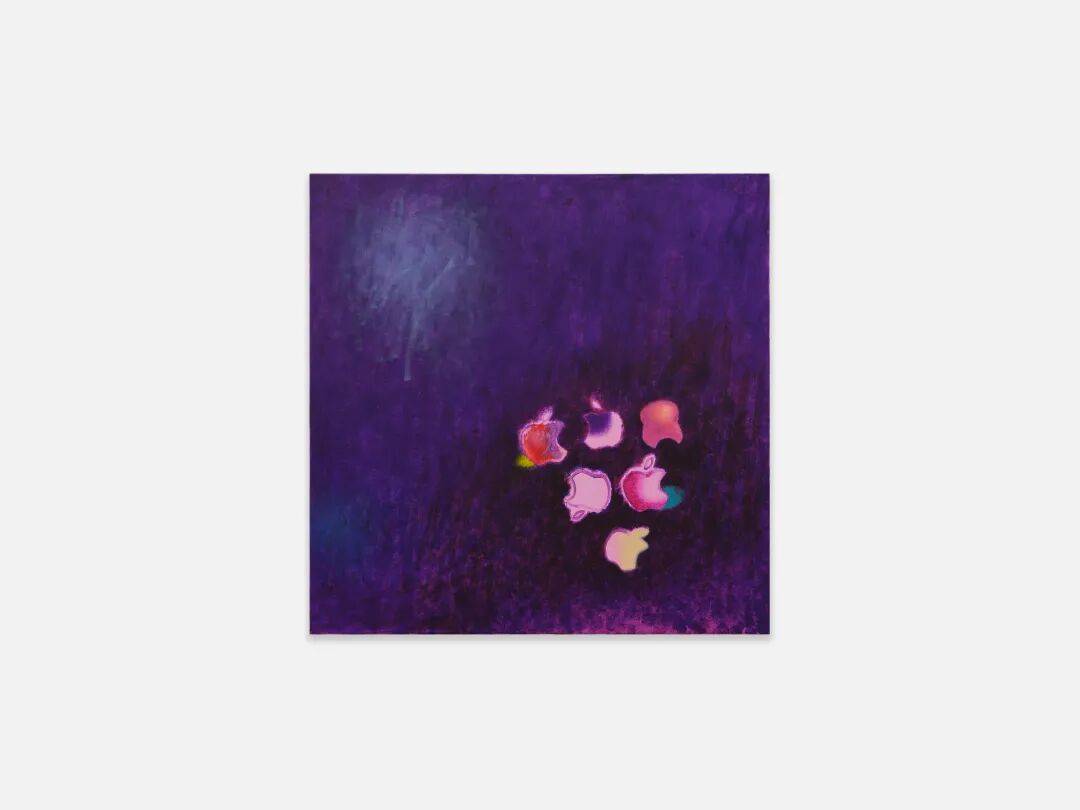
Zhou Siwei, Apple 03, 2023, courtesy of Antenna Space; Zhou Siwei, Apple, 2021-2023, courtesy of Antenna Space. Zhou Siwei is also from Chongqing and is only two years older than Guan Xiao, which gives their work a natural affinity without sameness. Between them unfolds a complex, overlapping exchange about technology, industrial production, labor, and craft.
Works by Zhou Siwei shown at Art Basel Miami Beach, 2022; Zhou Siwei, 5G Wind 01, 2022, courtesy of Antenna Space; Zhou Siwei, 5G Wind 02, 2022, courtesy of Antenna Space. The apples in Zhou’s work, the 5G signal moving through wind, the self-driving Apple car: all reduce the routines of contemporary life to a sign, a curve, a wash of color. He uses this old artistic method of observation to describe the state one enters when complex reality connects to an individual world.
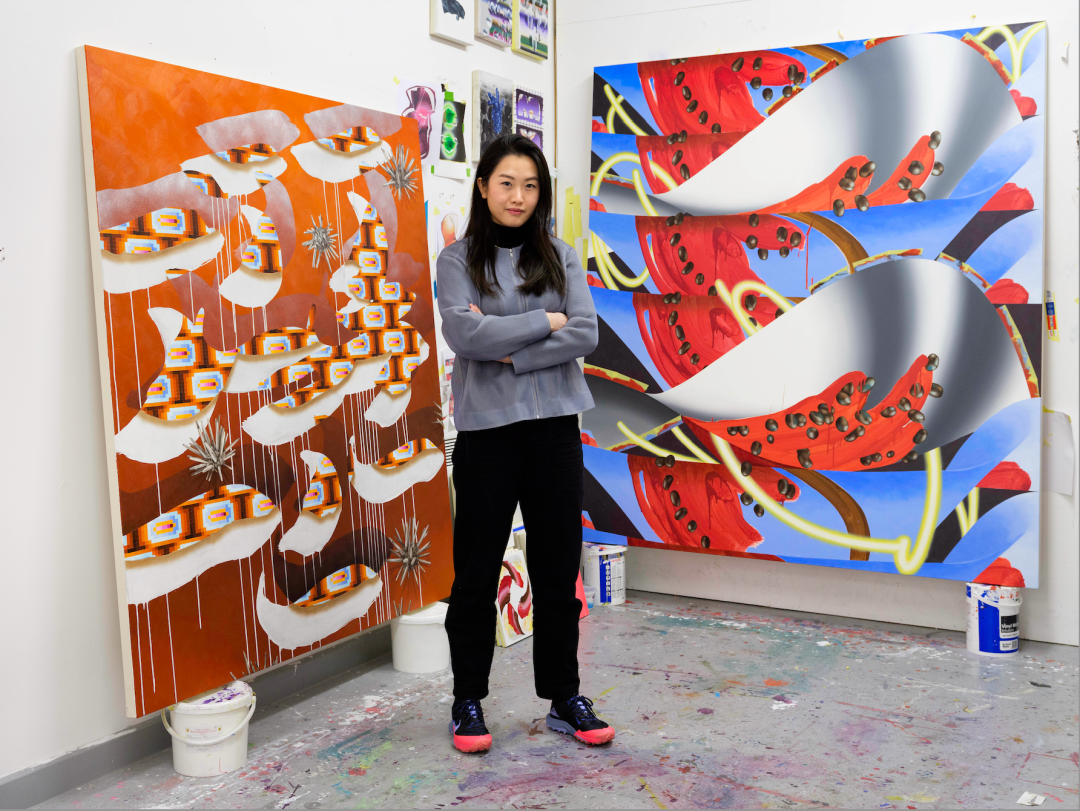
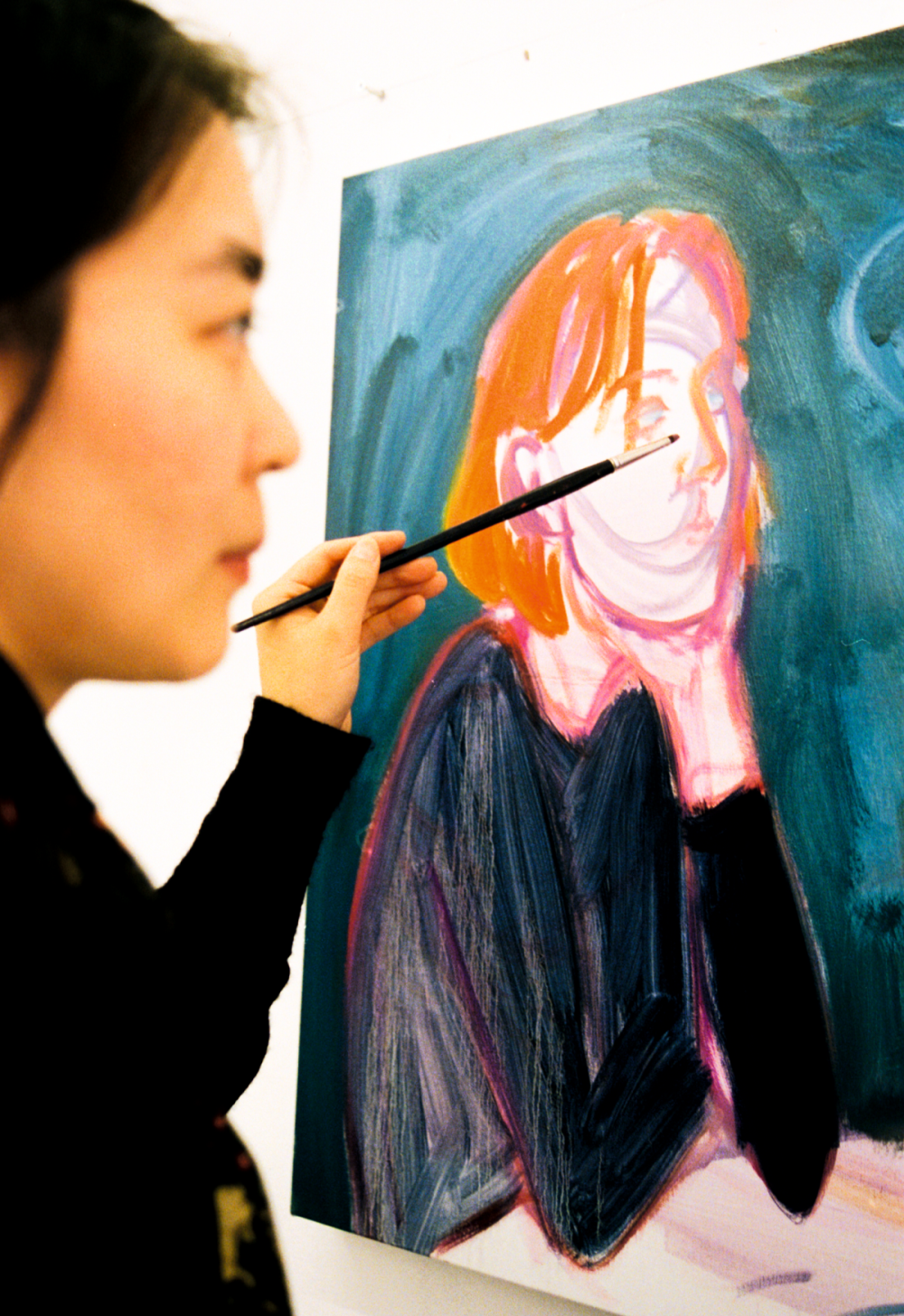
In his view, the symbols of painting are no different from the depiction of grand landscapes or beautiful portraits; all are visual games played between observer and object across different times and spaces. Artist Zhang Yuewei in the studio. Gallery: Pilar Corrias. The London gallery Pilar Corrias brought works by the Chinese post-1990s artist Zhang Yuewei. Born in Beijing and raised in Kenya, Thailand, and the U.K., she has had an unusual upbringing, and her painting consistently reflects a cultural fluidity: a record of self-understanding as it is built, broken, and remade in the course of growing up, and also a way of questioning the information age.
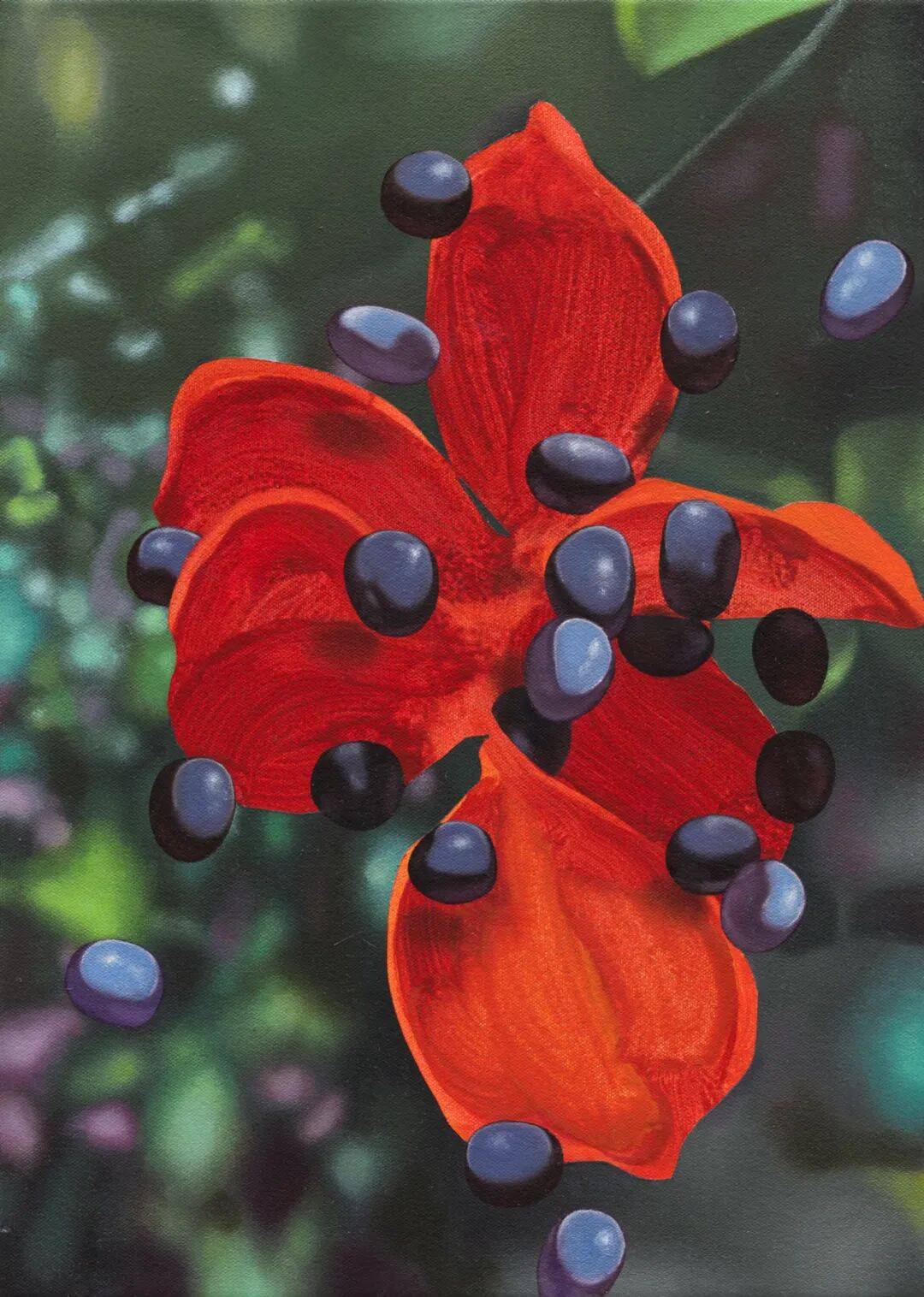
Zhang Yuewei, Geocalor, 2023, courtesy of Pilar Corrias. Her paintings are marked by collisions of color; purple and red are particular favorites. Geocalor, on view in the booth, is a new work from 2023, with a purple ground and red circular forms, based on an oceanic navigational map projection. Zhang Yuewei, Sterculia lanceolata (II), 2022, courtesy of Pilar Corrias. Her work overturns fixed perspectives and stable senses of space, and that method also appears in another new group of works included here.
In this group of botanical paintings, she grafts together flowers whose names carry prefixes such as “false” or “pseudo,” artificially breeding new hybrid species on the canvas. Artist Cheng Xinyi and her paintings. Gallery: Balice Hertling. Cheng Xinyi, born in Wuhan in 1989, is another younger Chinese artist attracting considerable attention at home and abroad. Now living and working in Paris, she has already had solo exhibitions at Lafayette Anticipations in Paris and Hamburger Bahnhof in Berlin.
SECTION 04 | VivienZhang
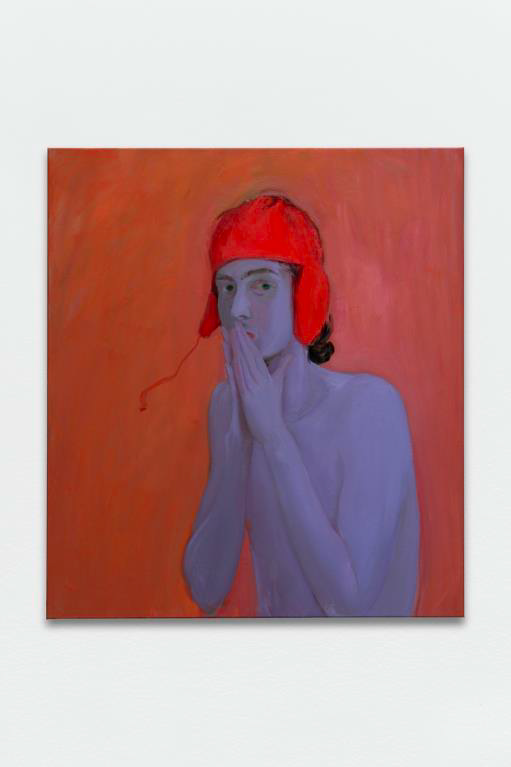
Her paintings tend toward the intimate and dreamlike, dwelling on interaction and moments of closeness between figures. She once said in an interview that when she first sees someone, she immediately begins to imagine whether that person belongs in a painting. The people in her pictures are close yet somehow distant, near and not near at once. She seldom uses highly saturated color, relying instead on large passages of white and gray. Installation view of Cheng Xinyi’s solo exhibition at Lafayette Anticipations, 2022; Cheng Xinyi, Wish, 2021, courtesy of Balice Hertling. The works she brought to this fair continue that familiar pictorial language, rich with implied story, their light and line making the figures quietly radiant.
Wish depicts a figure making a wish, gender ambiguous and expression unreadable. The orange background collides chromatically with violet-leaning skin, yet the presence of gray keeps the effect from becoming strident. Folded hands cover the mouth and with it the emotion. In Eastern and Western contexts alike, different parts of the face tend to carry feeling differently: for East Asian viewers, the eyes most often transmit emotion; for Western viewers, it is the mouth.
The figure in the painting has distinctly Western features, and the work arrives at a certain cultural unity through that fact. Pratchaya Phinthong, solo exhibition The Time of Others, Singapore Art Museum (SAM), 2015. Gallery: gb agency. The Thai artist Pratchaya Phinthong, born in 1974, may not be especially well known in mainland China, but he is already a mature and internationally noted Southeast Asian artist. He has had multiple solo and group exhibitions in Hong Kong and has shown work in Singapore and at the Diriyah Biennale in Saudi Arabia.
SECTION 05 | Artist Cheng Xinyi
Pratchaya Phinthong’s work is consistently interactive. He is adept at constructing a situation, a fictional story, or a stretch of time already in progress, then inviting viewers to sense and experience the work and enter into dialogue with it. Pratchaya Phinthong, The Organ of Destiny, 2022, courtesy of gb agency. In this piece, materials once used for ammunition, lead and tin, are recast, resized, and polished into the likeness of mirrors.
The work is positioned so that viewers can see their own legs from different angles. The artist made it this way to simulate the mirrors used in the treatment of phantom limb syndrome, the unbearable yet unreal pain experienced by many amputees. Through that device, he means to suggest the damage and recoil that war inflicts on human civilization. Artist: Haegue Yang. Galleries: Galerie Chantal Crousel, Barbara Wien. Haegue Yang, born in Seoul in 1971, is among the Asian artists who have gained the strongest international attention in recent years.
Although she now lives and works in Berlin, she has said that she is “living in the West, but not making Western art.” Her work is held by many of the world’s major institutions, including the Centre Pompidou in Paris, the Carnegie Museum of Art in Pittsburgh, the Los Angeles County Museum of Art, the Solomon R. Guggenheim Museum in New York, and the Museum of Modern Art in New York. Asian institutions with her work are similarly prominent: M+ in Hong Kong, the Leeum Museum of Art in Seoul, and the National Museum of Modern and Contemporary Art, Korea.
SECTION 06 | Prachaya Phinthong
Haegue Yang, Mesmerizing Two-Leaf Folding Screen - April Showers Soul Glyph #5, 2023, courtesy of Barbara Wien; Haegue Yang, Sonic Rotating Circle - Quadricolor #4, 2023, courtesy of Galerie Chantal Crousel. What is moving in her work is the way it uses ordinary materials, then joins them to a site to create an art that feels both enveloping and resonant.
One of the new works shown here, Mesmerizing Two-Leaf Folding Screen - April Showers Soul Glyph #5, from 2023, uses walnut wood, a material carrying an East Asian resonance, and reconfigures the structure of the folding screen. Sonic Rotating Circle - Quadricolor #4, also from 2023, combines spray-painted rivets, stainless-steel bells, and split circular rings, assembling on an aluminum round base an image resembling a pixelated video game from the 1990s.
SECTION 07 | Haegue Yang
“Sound waves” and “bells” are recurring elements in Haegue Yang’s work. With the faint bell tones and sound field suggestive of religious ritual, she considers the interactions and energies between people and things in a given environment; in the crossing of light and sound, a particular resonance emerges between the work and the viewer. Shinro Ohtake portrait. Gallery: Take Ninagawa. Born in Tokyo in 1955, Shinro Ohtake is now a globally celebrated Japanese artist whose work ranges across painting, sculpture, film, installation, writing, picture books, and even large-scale architecture.
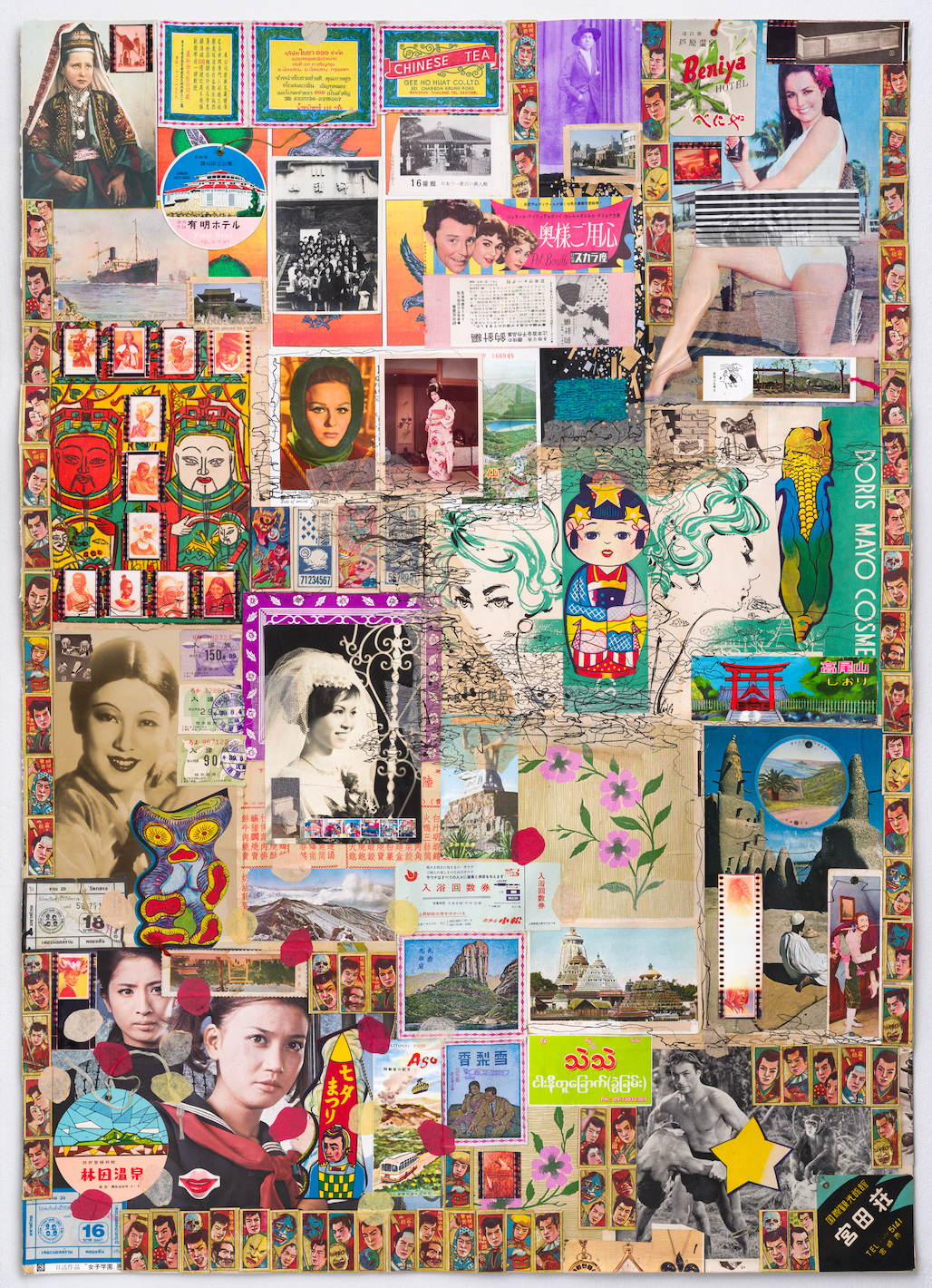
Last year, to mark the seventieth anniversary of the National Museum of Modern Art, Tokyo, the institution mounted a major exhibition built around more than five hundred works by Shinro Ohtake. Installation view of Shinro Ohtake’s large retrospective, National Museum of Modern Art, Tokyo, 2022-2023; Shinro Ohtake, Memory Edition 1, 2023, courtesy of Take Ninagawa. A first impression of Ohtake’s work is often one of accumulation and collage: intense color, immense density, different eras of memory layered repeatedly, as if time and recollection could be made tangible.
This time, Ohtake showed two works from his new series Memory Edition 1. These mixed-media collages likewise gather stamps, landscapes, wedding photographs, cartoon figures, and publicity images. Their details reflect the historical and cultural phenomena of the 1960s, inviting viewers to revisit with the artist the years of his own youth in the late 1960s. Artist Pak Sheung Chuen portrait. Gallery: gb agency. Pak Sheung Chuen was born in Fujian in 1977, moved to Hong Kong in 1984, and represented Hong Kong at the Venice Biennale in 2009.
SECTION 08 | Ohtake Shinro
The two paintings shown here are visually simple yet full of the suggestiveness and open space associated with Chinese xieyi painting, leaving room for endless and unexpectedly lively speculation. Pak Sheung Chuen, 1 Orange on the Plate or 1 Moon on the Lake, 2020, courtesy of gb agency. In a work like 1 Orange on the Plate or 1 Moon on the Lake, the title alone is enough to set thought in motion.
One cannot help wondering: if it is an orange, then what is that green brushstroke beside it? If it is the moon, are the marks around it ripples spreading across the lake? Pak Sheung Chuen, Burning with an Empty Square, 2020, courtesy of gb agency. As an artist, Pak may seem a little gloriously off-course; he graduated in 2002 from the Fine Arts Department at the Chinese University of Hong Kong, with a minor in theology.
Besides painting, he publishes a great deal of writing. He has written a Sunday column for Ming Pao in Hong Kong continuously from 2003 to the present. That sensitivity to language leaves his work with a narrative quality that seems to grow out of ordinary life. Its self-translation into visual language prompts reflection and gives the viewer a particular satisfaction, as reality, literature, and art are drawn into mutual acts of imagining. Chen Zhen, Le Produit naturel / Le Produit artificiel, 1991, photograph by Ela Bialkowska. Gallery: Galleria Continua. Chen Zhen is the most singular figure among these ten artists: he was born in 1955 and died in Paris in 2000.
Ahead of Art Basel Paris: Ten Asian Artists to Watch
The work shown at the fair is his famous Le Produit naturel / Le Produit artificiel. Artificial red roses are neatly arranged in a rectangular metal frame, inside which sits dried, hardened cow dung. A viewer unfamiliar with Chinese cultural context might take the piece simply as a meditation on the artificial and the natural. But anyone with some knowledge of Chinese idiom is likely to laugh: is this not, quite literally, “fresh flowers stuck in cow dung”?
Chen Zhen, Money Makes the Mare Go, 1997; Chen Zhen, Le Retour du fils prodigue sonore, 1995, photograph by Ela Bialkowska. Chen Zhen was among the earliest Chinese installation artists. He graduated from the Shanghai School of Arts and Crafts and the Shanghai Theatre Academy. In the early 1980s, he was diagnosed with a rare form of anemia and told that he had only five years left to live. Pursuing what he believed might be the final artistic dream of his life, he went alone to Paris.
He studied and later taught at the École nationale supérieure des Beaux-Arts and the Institut des Hautes Études en Arts Plastiques in Paris. Chen Zhen, Jardin-Lavoir, 2000, photograph by Nestor Kim; Chen Zhen, Crystal Landscape of Inner Body, 2000, photograph by Ela Bialkowska. He planted fresh flowers in cow dung, built houses out of candles, made chime stones from wooden barrels, created enormous beds and drumskins, and gave the organs tormented within his own body the form of glass vessels laid out across a table. The composer Tan Dun once wrote music for him.
SECTION 10 | Artist Chen Fei
Chen Zhen’s work is filled with reflections on travel, health, and home. By the time of his death in 2000, his large sculptures and installations had already been recognized across the global art world. More than thirty solo exhibitions devoted to him have since been mounted across Europe, the United States, and Asia. At present, a major solo exhibition of his has just opened at Galleria Continua in Paris. Images courtesy of Art Basel and the participating galleries.