Sora Takes Off: What Do the World’s Most Closely Watched Digital Artists Make of It?
For more than two weeks, discussion of Sora, the AI text-to-video model, has filled the conversation. Released without warning by OpenAI on the night of February 16, Sora has prompted visions of future human-AI collaboration—and stirred fear, resentment, and a sense of crisis, especially in film, design, and image-based art......
By / Xirui Huang · 17 min read
How did digital artists understand AI and artistic practice when Sora sparked debate in 2024?
Edited by Chen Youran and Xirui Huang, the 2024 report gathers responses from Beeple, Lu Yang, Tian Xiaolei, Chen Baoyang, Liu Jiayu and Fei Yining. Beeple describes using AI to refine existing images while distinguishing access to a tool from an artistic practice. Other contributors examine expression, medium and intention through their own work. Fei questions the category of AI art itself. These are historically situated perspectives, rather than a shared prediction about art or technology.
For more than two weeks, discussion of Sora, the AI text-to-video model, has filled the conversation. Released without warning by OpenAI on the night of February 16, Sora has prompted visions of future human-AI collaboration across industries—and stirred fear, resentment, and a sense of crisis, especially in film, design, and image-based art. In fact, using AI as an aid to artistic creation is hardly new among image-based artists, digital-media artists, and NFT artists.
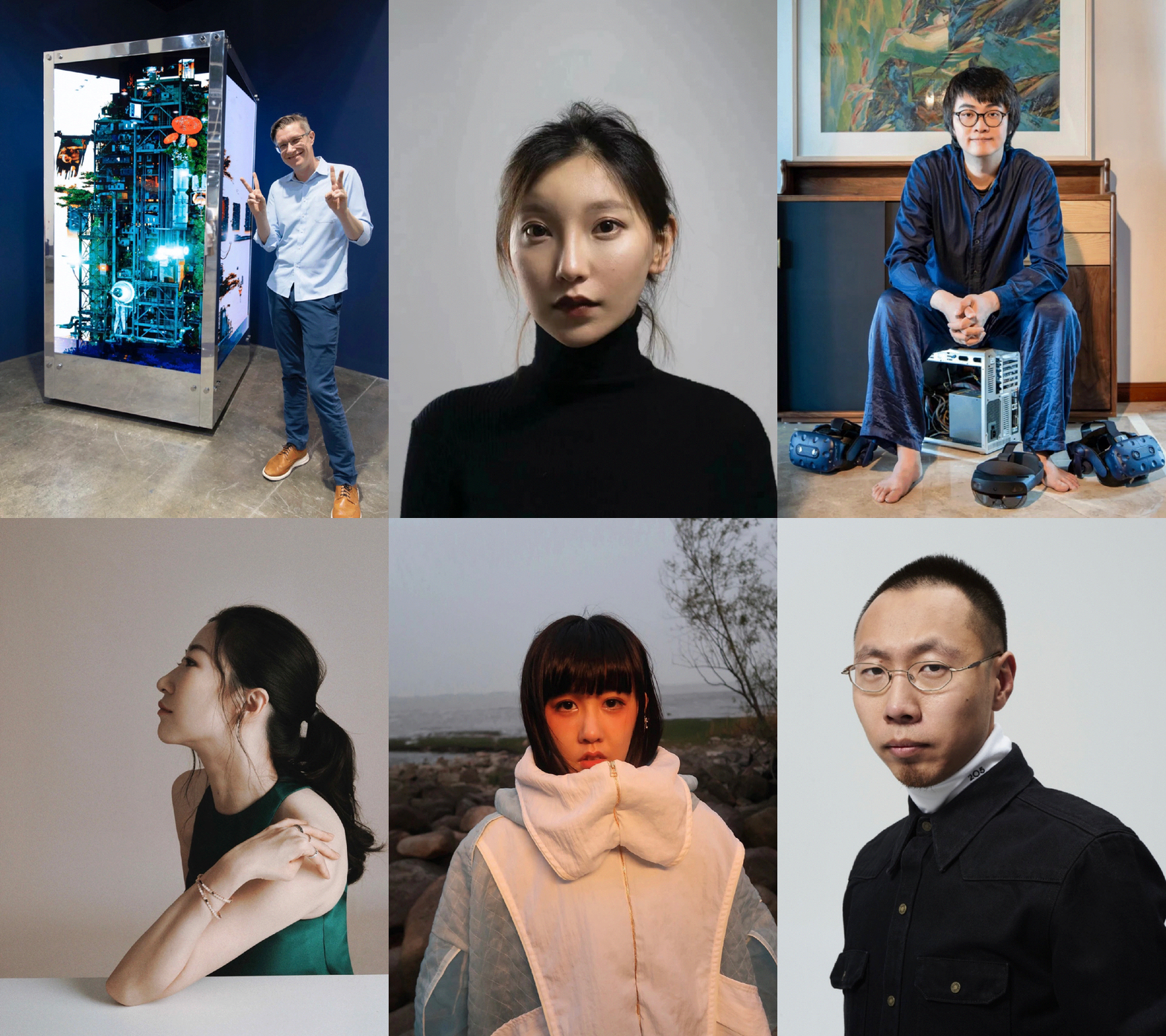
After Sora was released, we contacted six leading digital artists in China and abroad: Beeple, Lu Yang, Tian Xiaolei, Chen Baoyang, Liu Jiayu, and Fei Yining. Some had even taken part, three years ago, in testing OpenAI’s early video-AI models. Here are their views of Sora, their expectations for AI’s future, and their thoughts on the direction of artistic change.
Editors: Chen Youran and Huang Xirui
“Sora’s release will be a revolutionary upheaval”
Beeple, whose real name is Mike Winkelmann, is arguably the world’s most closely watched digital artist, particularly in the NFT field. He was also among the earliest artists to use AI in his daily practice. His best-known work, Everydays: The First 5000 Days, brings together one digital image made each day over the course of thirteen years. It sold at Christie’s for nearly $70 million in March 2021, marking a historic moment for NFTs at auction.
In recent years, he has also begun working with major international galleries, museums, and art institutions, including Lévy Gorvy and M+, Hong Kong’s museum of visual culture. He is reportedly scheduled to undertake a large-scale site-specific project at Deji Art Museum in Nanjing in the second half of the year. For more than a year, I’ve been experimenting with AI in my work, and recently I’ve found several different ways to incorporate it into my daily practice, adding detail to what I make. Rather than giving AI a single textual prompt, I directly input an image from my Everydays series. I’ve essentially completed 90 percent of the image myself, and then I ask the AI to develop the details based on my original conception.
The result is an image whose concept remains consistent with mine but whose details are more fully resolved—a degree of finish that would otherwise have required an enormous amount of my time. Beeple’s Everydays project has now reached 6150 days, and he continues to make The First 5000 Days every day.
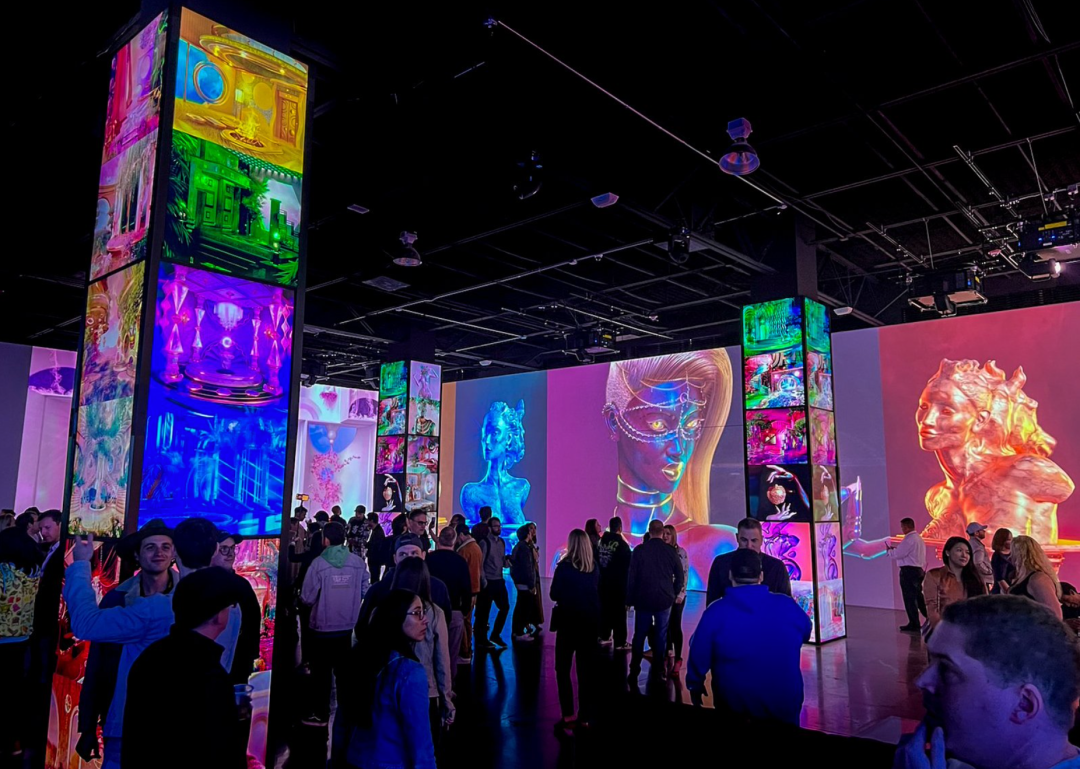
Heaven/Hell, 2023, kinetic sculpture, eight-channel video, polished aluminum exterior with an aluminum interior frame, non-fungible-token image. Courtesy of Lévy Gorvy.
BEEPLE STUDIOS opened in Charleston on March 11, 2023.
I do believe Sora’s release will be a revolutionary upheaval.
Revolution has been happening all along. YouTube and the internet are examples. Yet neither killed creativity; they propelled it. I think AI will do the same. Artists will still exist. The fact that everyone can use this powerful tool does not mean that everyone will become an artist. I think of the camera as an analogy: for a long time, only photographers had cameras.
Now everyone has a camera, and everyone takes pictures, but not everyone is a photographer. The world still needs photographers—people who are exceptionally good at taking pictures.
Beeple’s self-written, self-directed short film, MANIFEST DESTINY, 2019.
I believe AI will be the same. Everyone will use it, but that doesn’t mean everyone will use it in an “equal” way. There will still be outstanding artists working in collaboration with AI.
I firmly believe that AI represents both a major technological advance and a tremendous opportunity for exploration in art. I’m very optimistic about the continuation of new possibilities in digital art. It will allow human beings to express ideas further and communicate on more detailed, nuanced levels. I’m extremely excited by these possibilities and by the moments of change taking place in art.
“My dream is that whatever work I imagine in my head can simply appear”
Lu Yang is a young multimedia artist who has drawn intense attention in the international art world. In his characteristic video works, he turns himself into a digital person who moves through various virtual settings. The body is unrestricted: its form, gender, and appearance can shift at will. It feels no pain and is no longer bound by the limits of lifespan. Lu believes that such a digital person is more “useful” for making art.
Last year, his series of digital-person works, DOKU The Self, was presented at Art Basel Paris+, attracting considerable attention. This year, he is preparing another major solo project in Europe, moving, as he puts it, “without pause.” I began experimenting with AI a long time ago, but I still haven’t found a reason to rely on it completely for my work. Three years ago, when OpenAI was developing DALL·E, I joined its artist testing program, where I tested the words prohibited by the model.
After that, I also used tools such as Midjourney and Stable Diffusion. But the results immediately looked like they had been generated by a particular stylized AI; they couldn’t become my own style. Some forms of stylized training also raise ethical questions, since they use the work of other original artists to train the model. As a creator who cares deeply about originality, I didn’t particularly want to take part in this enormous karmic storm.
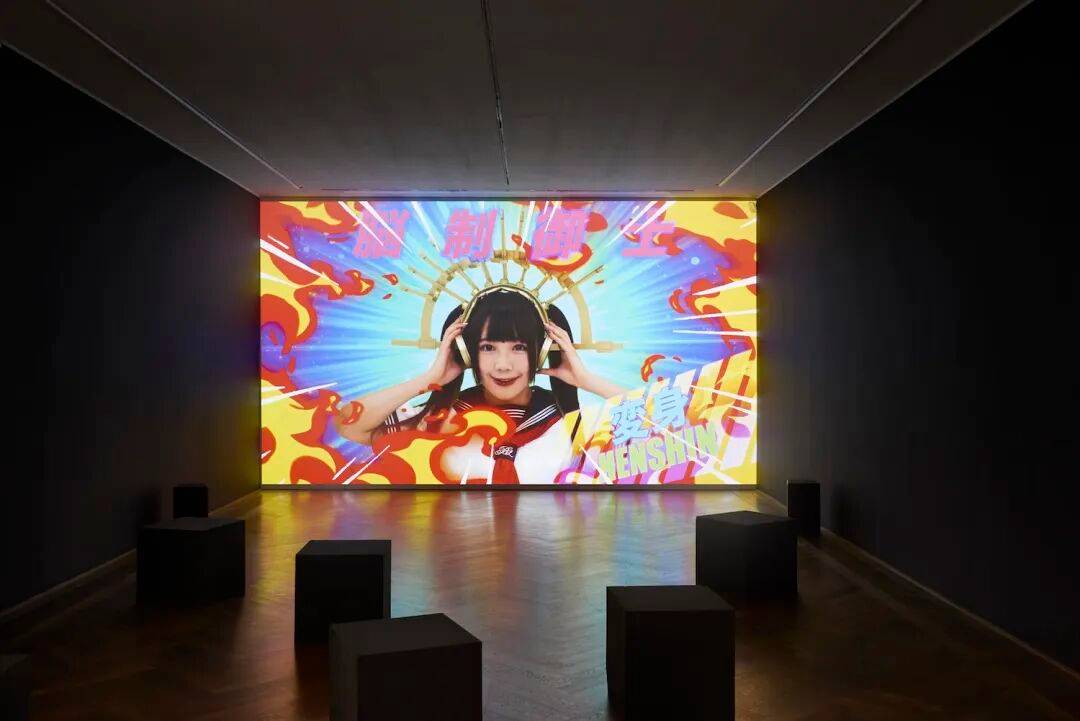
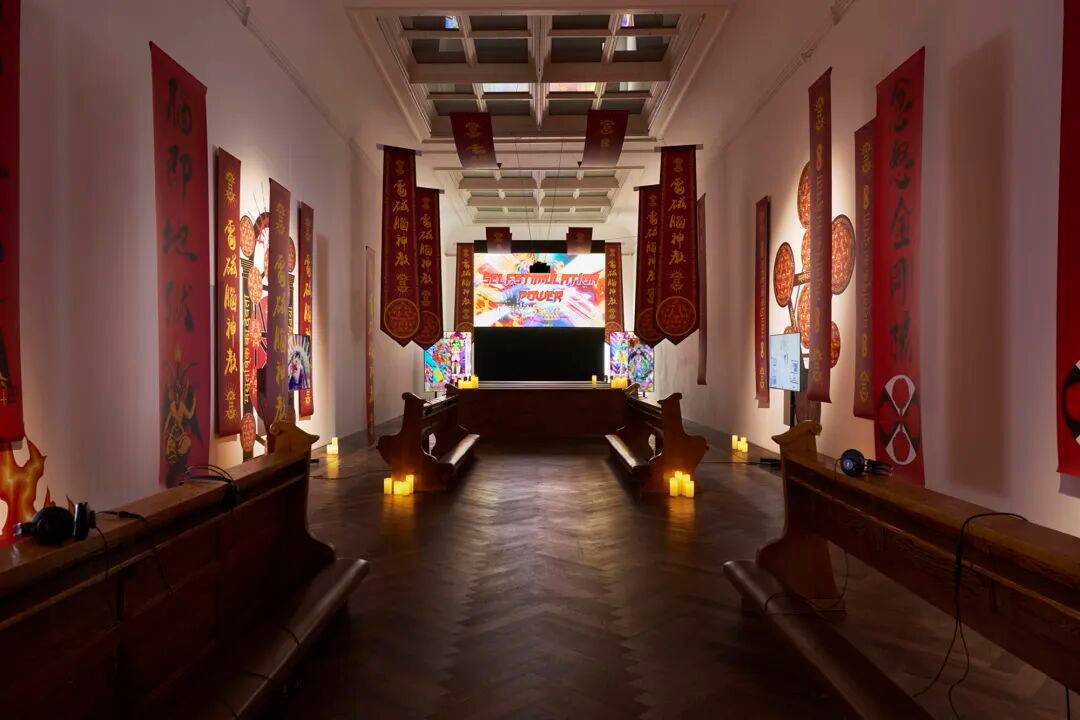
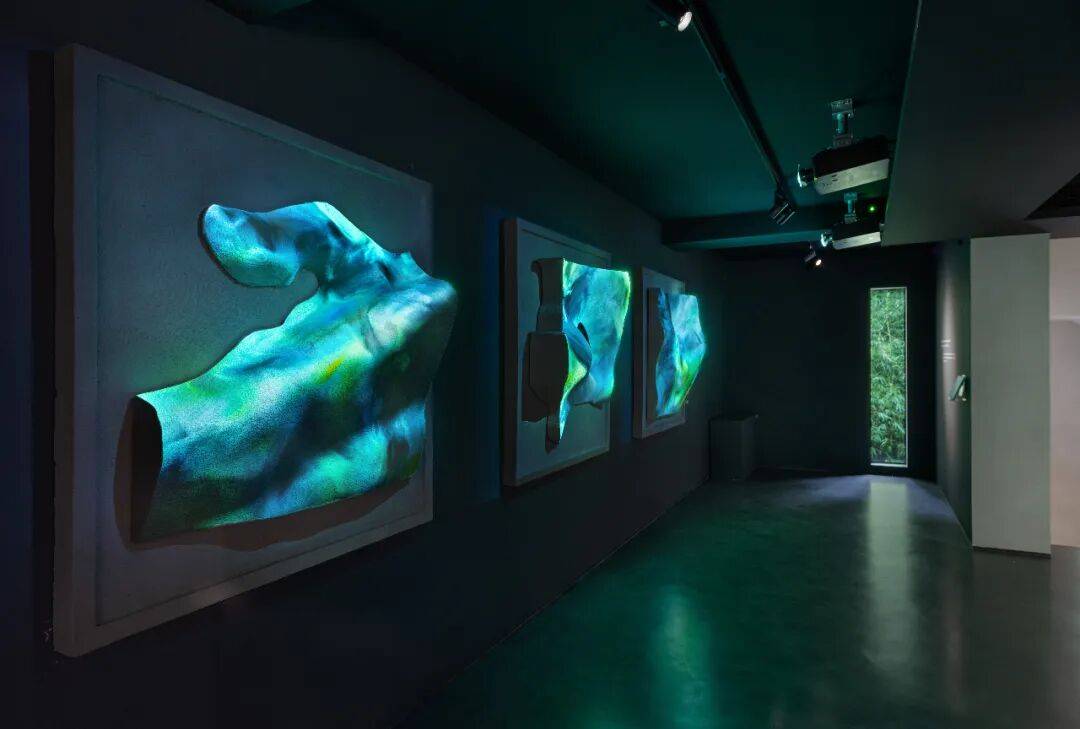
Lu Yang, exhibition view of “Vibration Field,” Kunstmuseum Basel, 2023. Photograph by Philipp Hanger.
Lu Yang, DOKU: Digital Reincarnation, Times Square, New York, 2023. Photograph by Michael Hull; image courtesy of the Times Square Arts Commission.
And when using these AI tools, you can’t make them generate exactly the image you imagine in your head. You have to compromise or make choices. That makes the limitations feel substantial. The results don’t fully meet my needs, and I wouldn’t feel entirely comfortable saying that the work was 100 percent my own.
I felt that earlier AI tools didn’t adequately express individual intention, which is why I never joined the rush of artists using them to release work. An artist has to consider an entire lifetime and ask whether he or she can create with a clear conscience. Maybe I’m a very “ancient” artist.
Lu Yang, exhibition view of “DOKU Experience Center,” Museum of Culture and Art, Milan, Italy, 2023.
Lu Yang, exhibition view of “LuYang NetiNeti,” Zabludowicz Collection, London, 2023.
So I use AI only to generate images for the storyboards of my work, and to communicate with the technical team.
But the final works are entirely developed by me, piece by piece. I haven’t used anything generated by AI in my principal works. I use GPT to reply to emails and things like that. If Sora or another tool could really be used freely, without any possibility of destroying your creativity, AI would be an extremely labor-saving tool. My dream is that whatever I imagine in my head can become a finished work—because over the years, most of my time has been spent on production.
Production gives me such a headache. You may be a wildly imaginative creator, but you still have to figure out budgets, collaborators, technical possibilities, and a whole series of other complications. You’re often on the verge of collapse.
Lu Yang, DOKU—Animal, still image, 2022. The digital person in the video work is modeled on the artist, Lu Yang.
We can’t use Sora yet. If it becomes available in the future, I very much want to try it. In the past, I’ve tried various tools and found that many were heavily hyped and nowhere near as capable as advertised. I hope Sora doesn’t disappoint us.
I don’t feel much anxiety about being replaced. I’m actually looking forward to having a useful AI tool. I think the people who function as tools may feel more threatened. Although people believe the threshold for creation has been lowered, I remain confident in my own creativity. After all, for so many years I’ve been making the core of the work: the ghost in the shell—ghost, as in Ghost in the Shell. The question of whether AI art is technology or art isn’t important to me. I don’t care whether what I make is art.
Tools have no inherent good or bad qualities; it is the human heart that uses them. If the human heart deteriorates, every supposed innovation can turn into a disaster. The most important task of artists—and of many people engaged in building the spirit—is to awaken the flashes of insight and wisdom deep within the human soul. It is not to tremble in the face of a technological revolution, afraid of falling behind and forgetting one’s original purpose.
Lu Yang interview section. Image courtesy of BANK Gallery.
“AI is increasingly understanding the laws of the human world”
Tian Xiaolei is an artist born in the 1980s. Since graduating from the Digital Media program at the Central Academy of Fine Arts, he has spent more than 20 years creating in virtual worlds.
His moving-image installations are expansive in their imagination, blending culture, technology, and the body to create dazzling, highly technological and futuristic visions of the “posthuman.” He is extraordinarily prolific, working almost year-round. At every exhibition, his work elicits the same astonishment from viewers: What an imagination. He began familiarizing himself with AI tools last summer and is still refining the way he works with them.
I probably began exploring AI tools last summer, focusing mainly on Stable Diffusion and MidjourneySD. I experimented with their functions and effects and found them astonishing and exciting.
But they weren’t easy to control. I kept thinking that a more usable version would soon be released, and I also had a lot of earlier work on hand, so I didn’t use them to make new pieces, though I continued to follow their development. At first I felt that their lack of control was a problem. Now I think that is precisely their advantage. There’s the thrill of drawing a lottery ticket; it’s like trying to control an imagination monster that doesn’t quite obey. Its imagination is frighteningly abundant, and indecision becomes a new problem.
As AI tools improve, I’ll try to make new works with AI as a tool this year. I’m still not studying it deeply enough to control this disobedient imagination “monster” very well. For now, I’m using some of its characteristics to stimulate ideas.
For example, I might generate spatial forms or concepts through keywords, or generate a section of video as if drawing from a blind box.
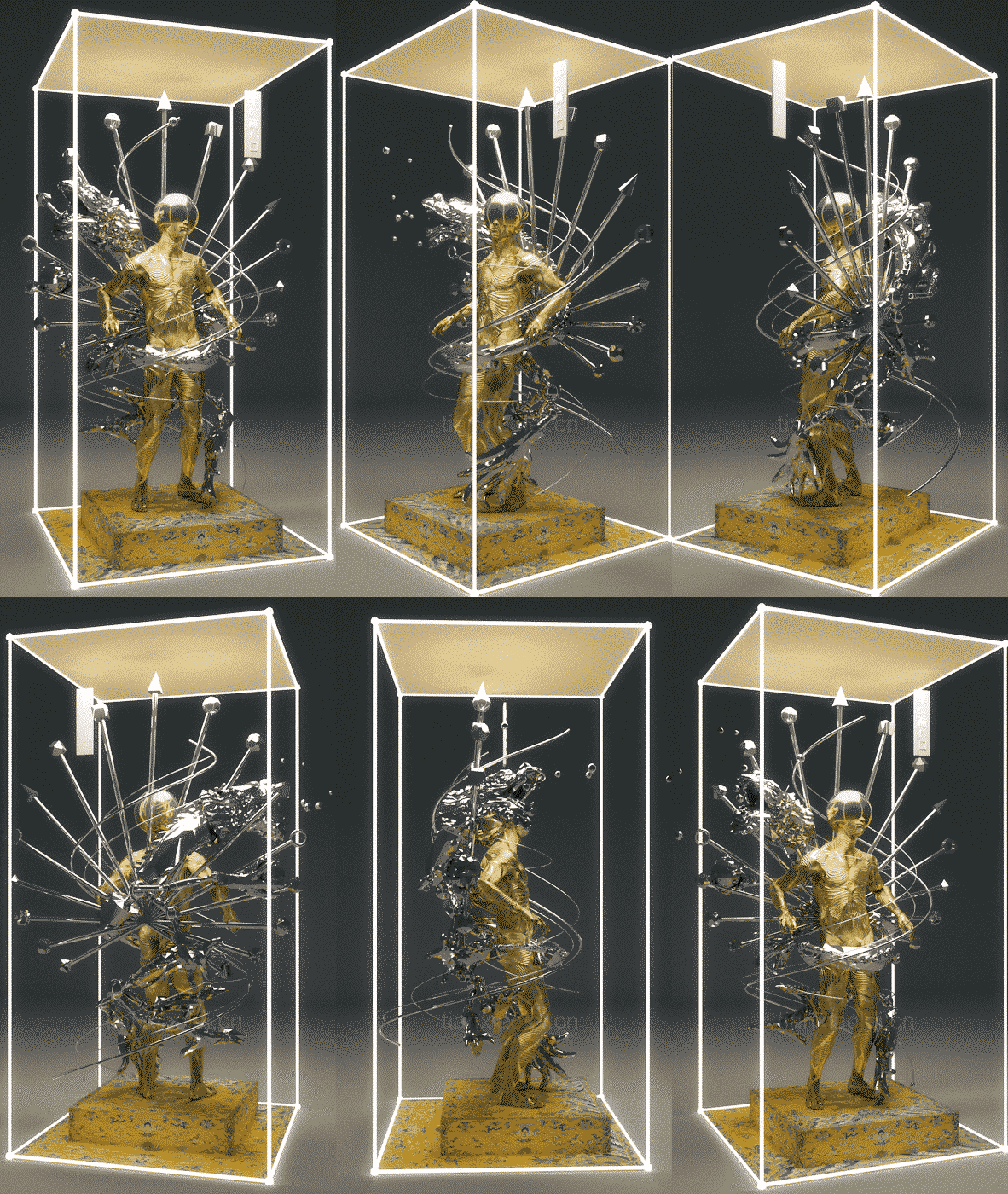
Tian Xiaolei, The Myth—The Revival of the Dragon, 2020.
I’ve also been following Sora’s release closely. The results are genuinely astonishing. It feels as if AI is increasingly understanding the laws of the human world. Video contains more information than text and images, and Sora seems able to understand and describe many details: physical laws, the experience of occlusion, and the common knowledge of daily life.
Some people say that Sora isn’t generating video so much as possessing the ability to generate a virtual world. If computing power becomes sufficient and it can generate three-dimensional models, then we really will be close to a metaverse. But Sora’s upper limit is closer to the human brain: imprecise and vague. It is not good at exact calculations, functions, or physics. It resembles the dream architect in Inception, offering only a rough simulation of surfaces. As with ChatGPT when it was first released, Sora has generated a strong sense of crisis in many related industries.
Looking back at the successive industrial revolutions, each began with fear in the industries concerned, because the interests of established sectors were challenged. Yet each also produced new industries and new kinds of work through the emergence of new technologies.
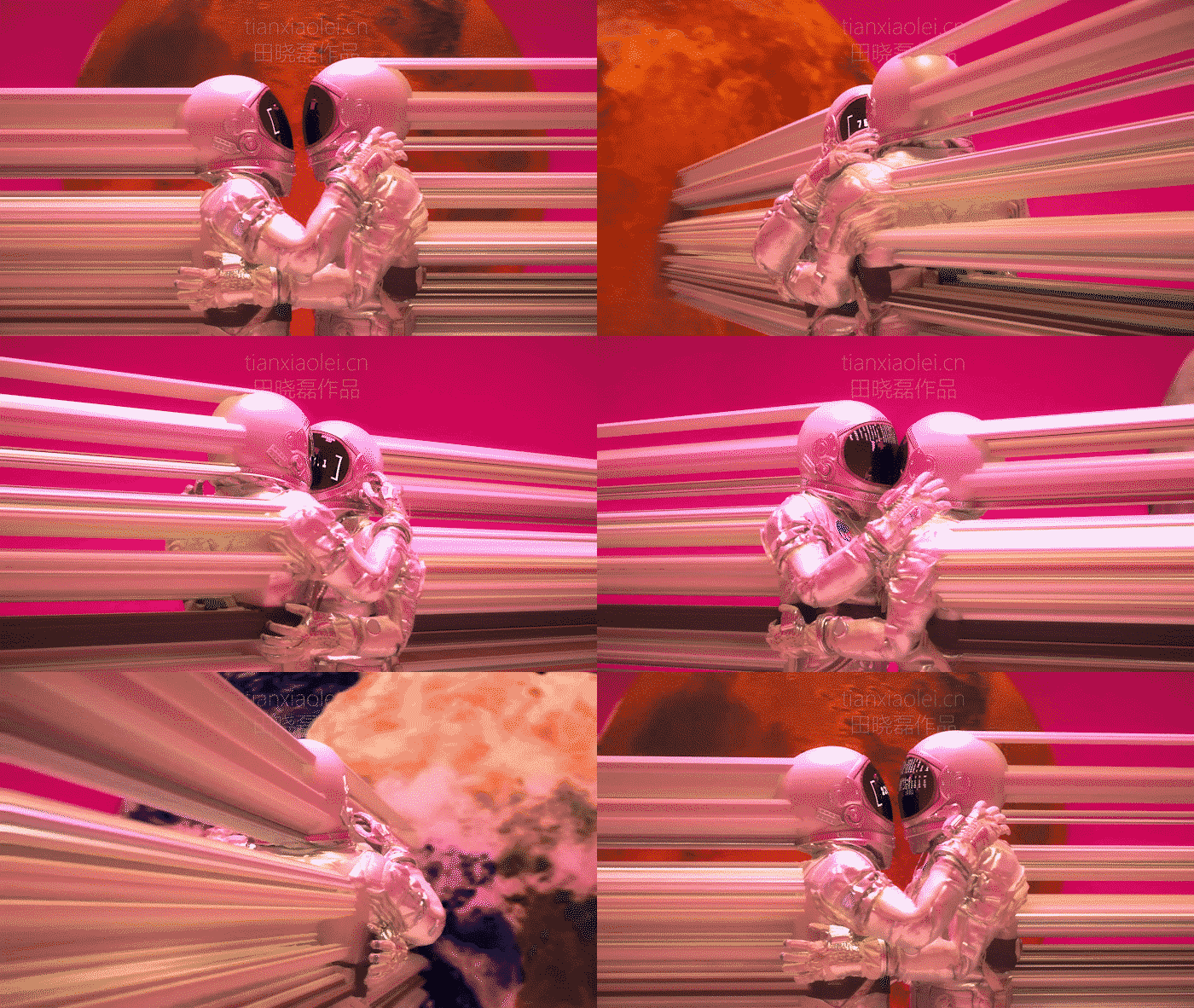
Above: Tian Xiaolei, Contact, 2019.
Below: Tian Xiaolei, Stable Thrill, 2020.
Usually, the need to relearn is what creates the sense of crisis and anxiety during technological change. Existing advantages suddenly disappear, and one has to compete again with young people full of curiosity.
The result is inevitable: some people will successfully transform, while others will be eliminated by technology. Sora’s evolution will make imagination and creativity more important basic abilities. An education centered on solving exam problems may not suit the next era’s way of thinking. AI will turn much of the knowledge based on rote memorization into something like a dictionary; people will only need to know how to call on it quickly through AI. A utopian age of universal creativity may be within reach.
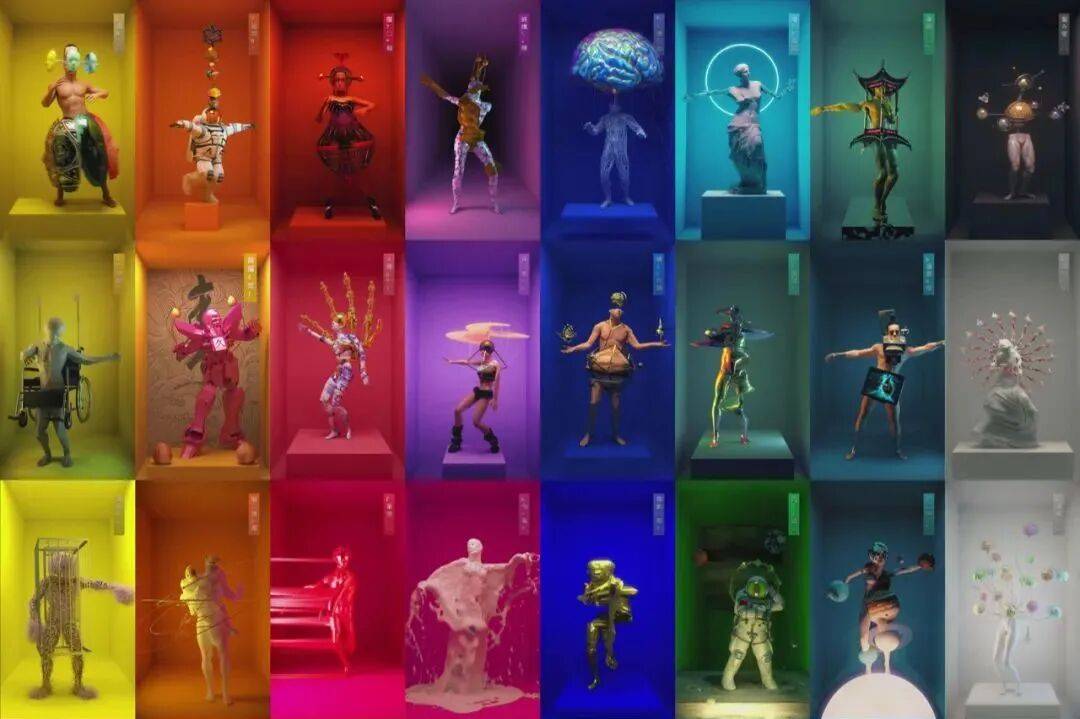
Tian Xiaolei, Posthuman Museum, ongoing project.
A few seemingly simple “spells” can make Sora generate a video, but once it is released globally, the results will quickly become homogeneous—much as most images of beautiful women generated by Stable Diffusion already are. The simpler the tool becomes, the weaker its personalization.
AI artists will therefore create all kinds of professional barriers, personalized plug-ins, and original code; they will study new algorithms and combine different tools, doing everything possible to produce distinctive effects and languages. They will form new artistic categories and establish a place for themselves in art history. AI art is art made by people using new tools. In the end, it is still humans who use and create it, and it circulates in a human art market. In that sense, advanced creativity will remain the work of a minority of artists, gradually returning to the Pareto principle.
“AI has become a trustworthy creative partner”
Chen Baoyang was born into an artistic family and earned master’s degrees from Columbia University and the School of Visual Arts in New York. He is now a teacher at the School of Experimental Art and Technology at the Central Academy of Fine Arts. His practice has always been closely tied to emerging technologies, and he was among the earlier artists in China to use AI in his work. In September 2023, he served as the lead author of the Chinese Institute of Electronics’ white paper AI+Art.
Beyond his artistic practice, his research has been widely published in academic journals and conference proceedings in artificial intelligence. For this interview, he carefully wrote a 15,000-character response. What follows is a selection.
I see three levels of influence from artificial intelligence on my artistic practice. The first is the generative work that is currently most prevalent. The second is AI-driven narrative and interaction, like early role-playing games: one establishes narrative rules, and the AI system interprets them into different outcomes. The third is an intelligent-agent system constituted by artificial intelligence. These systems will better help me make works concerned with a “digital Genesis.”
In 2014, the term AI still belonged to science fiction for most people. But AI was already capable of recognizing patterns and reorganizing and rearranging images. At the time, I used AI to create a group of static-image works, Reconstructing Landscapes, in an attempt to reinterpret and pursue the spirit of landscape painting from the perspective of modern technology. This was a generative-AI work: my algorithm searched for features in a dataset of traditional Chinese painting, then recombined those features to produce new images.
When Reconstructing Landscapes was first made, it received no recognition from the mainstream art world. I still remember a gallery owner telling me, “It would be great if you painted the generated content.” That advice remains consistent with the art market’s return to value, but as AI has become fashionable and NFTs have given it momentum, this older work has also attracted increasing attention. The generalizing capacity of generative artificial intelligence has significantly changed the way art is made.
While I remain astonished by the excellent results produced by various large models, my attention has gradually shifted from the images’ visual impact to the methods used to train the models. I’m no longer pursuing beautiful images as such; I’m learning how to create those images—how to master the AI model. Does this shift show greater respect for the value of the creator?
Chen Baoyang, AI Knowledge Graph, emotion-driven AI algorithm.
In 2018, I began to focus on “the problem of artificial intelligence’s creativity,” extending the Turing question “Can machines think?” into artistic creation and trying to answer the question “Can machines create art?” At the same time, I began treating AI as a creative subject and started two research projects: “knowledge graphs” and “emotion-driven calligraphy generation.”
I subsequently deepened my research into emotion-driven calligraphy generation. The series of calligraphic works presents not only the forms of characters but, more importantly, the artist’s emotions and style during creation. It can express different feelings, including euphoria, ecstasy, grief, and anger.
I am currently making a group of works on “artificial intelligence creativity,” a practical inquiry into whether machines possess a rudimentary “consciousness.” This will also become an important part of my solo exhibition at the end of the year.
The experiment uses the game structures of Werewolf and Undercover as its framework, providing a plausible setting for AI to lie and deceive. These games require participants to deceive and reason strategically, creating an ideal environment for studying AI’s linguistic expression and cognitive abilities.
Chen Baoyang, Chasing the Fog, 2020.
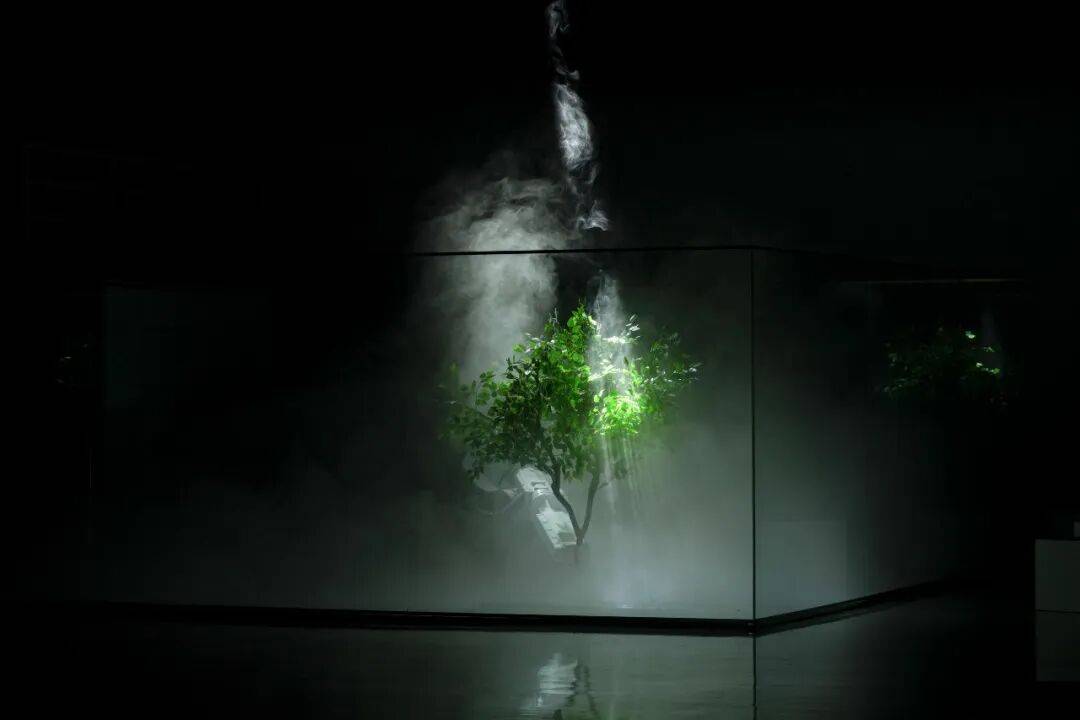
Chen Baoyang, The First Law of the Forest, 2021. Multi-agent AI installation: robotic arms, smoke, lighting, screens, and projection.
It has been a journey of sharp rises and falls. At the time, combining AI and art was still a marginal field of research, and everyone was asking: What is the significance of AI+Art research?
This is the unavoidable growing pain of intellectual cross-pollination, as well as the question of how humanistic concern and critical thinking can be coupled with rapidly developing technology. My response is to remain curious and attentive to technological development. For me, AI is no longer merely a tool or medium. It has become a trustworthy creative partner, because contemporary AI has shown a distinctive authorship in artistic creation. The inherent uncertainty of programming sometimes introduces new perspectives and forms of expression through error or confusion, stimulating a kind of unconscious creativity.
Sora Takes Off: What Do the World’s Most Closely Watched Digital Artists Make of It?
Chen Baoyang in his studio.
Since 19, I have often been asked questions such as “Will AI replace artists?” Beyond their value as media-industry gimmicks, these questions originate in our arrogance when dealing with the relationship between ourselves and our artifacts. Over the past ten years, creators and AI researchers have worked to improve algorithms’ capacity for innovation. They have tried to instill imagination and creativity in machines, bringing them closer to human beings. This has inspired some pride, but also some arrogance, because our creations are gradually learning to create as we do. If AI can also create, what exactly distinguishes us from it?
In the discussions of several years ago, I felt that the question “Will artificial intelligence replace artists?” was itself a false proposition. If we remove the three words “artificial intelligence,” will humans ultimately replace humans as artists?
“Human emotion and creative expression will always be there”
Liu Jiayu, an artist born in the 1990s, is one of China’s most sought-after new-media artists. She was the first student in Information Experience Design at the Royal College of Art. Over more than 10 years of practice, she has used the latest technologies, including artificial intelligence, three-dimensional projection, and augmented reality. Her subject is the animistic natural world. Liu’s work has often appeared in exhibitions at major institutions, including the Victoria and Albert Museum in London, the Guangzhou Triennial, and the Chengdu Biennale. In April 2022, she also participated in the Chinese Pavilion exhibition “Meta-Being” at the 59th Venice Biennale.
Liu Jiayu, The Side Valley, 2018.
My first attempt to create with AI came in 2018, when I made a deep-learning-driven projection installation called The Side Valley. The work was inspired by a research trip to the Rhone Valley in Switzerland. I chose the sky above the valley as the source material for the machine learning. The technical team stayed on site for two weeks and used a model type employed in GANs, or generative adversarial networks, which were highly popular in image generation at the time.
The work’s AI-generation process used 6400 photographs of the sky above the lakeside in the Rhone Valley. Based on the time they were taken, we divided the photographs into three groups to train three models. Each model was asked to generate a new image, with the trigger for each image controlled by the real-time wind speed and direction at the lakeside. At the time, the technology was not mature enough to generate moving images directly and apply the model as such. We therefore arranged the generated images as sequential frames, composited them, and then processed them with other visual software. As the data continually changed, the generated images changed gradually as well. Finally, we added subtle fluctuations so that the movement between frames appeared continuous and coherent.
Sora Takes Off
Liu Jiayu, Streaming Stillness, 2021.
Later, I experimented with different model types and layered images. I used a double-layer AI model to complete Streaming Stillness, beginning with the Helan Mountains. I used StyleGAN, pix2pix, and MIDAS to train different parts of the work and obtain different kinds of information, training the two-dimensional and three-dimensional elements separately before combining and layering them.
At the end of March, a new series, Floating Aura, will also be presented in a small solo exhibition at the Zhejiang Art Museum. The work places AI at the center of an inquiry into the aura contained in art, translating and recreating it in the age of modern technology.
The machine-learning process for Streaming Stillness.
I think individual human intention is always present in the use of AI. Using AI is not as simple as it may appear. In fact, reaching an understanding with AI takes longer than reaching an understanding with a technician.
Every change in a parameter affects the final result. Among the many parameters, finding the form of a personal creative language still requires the creator’s own experience and practice. Intuition and experience are crucial throughout the process. I prefer to use the word “timing” to describe the moments that are captured.
Liu Jiayu and her team’s newly released AI model download page.
The stream and flower field generated by the model.
A few days ago, we also released my own AI model. It learned from the sequential frames of all my previous moving-image works and, by combining them with tags, established a new AI worldview and conception of nature. It can generate artworks in my own style and language from prompts.
Sora, as a combination of transformer and diffusion, means that creators can use AI as an efficient auxiliary tool to realize complex creative ideas and perhaps even cultivate a “machine consciousness,” allowing it to generate works with greater vitality and emotional depth. Sora—or AI more broadly—will inevitably replace some work and labor in every industry, and the same is true for creators. But it is also like a small whip, urging us to learn and update ourselves.
Such tools should be understood as means of enhancing creative power, not as the endpoint of replacing human artists. As we approach a world in which everything can be generated from text, we will need human creativity and art more than ever.
The artist’s work practice at the Royal College of Art.
A few years ago, AI was not easy to use. It required specialized technical personnel, so it did not yet have such a powerful effect on creators. But art has always developed alongside technology, and innovation is inevitable. AI may lead to a new artistic movement, though whether it will be revolutionary remains to be seen. Traditional painting and sculpture will not disappear.
Whatever changes technology brings, the human core of art—emotion and creative expression—will always remain.
“My work is deeply entangled with AI.”
Future and apocalypse, technology and emotion collide in the work of Fei Yining, an artist born in the 1990s, whose narratives are distinctly personal. Her work has been exhibited at institutions including UCCA Center for Contemporary Art, Beijing Song Art Museum, and Fosun Foundation in Shanghai.
Fei Yining, By the Shore of the Moon II: Coordinates of You and Me, still image, 2022. Single-channel video—animation and Super 8 film, 4K, color, sound, 12 minutes 10 seconds.
My work is deeply entangled with AI because several of my videos begin from the perspective of artificial intelligence.
The video By the Shore of the Moon I unfolds in the voice and from the perspective of a fictional AGI, or artificial general intelligence. It tells a story set in a particular future: an algal toxin that causes mammals to lose their memories, and an “artificially intelligent caregiver” that assists human memory.
Fei Yining, By the Shore of the Moon I, exhibition view from “New Eden: The Transformation of a Science-Fiction Myth,” ArtScience Museum, Singapore. Image courtesy of ArtScience Museum; courtesy of Ng Wu Gang.
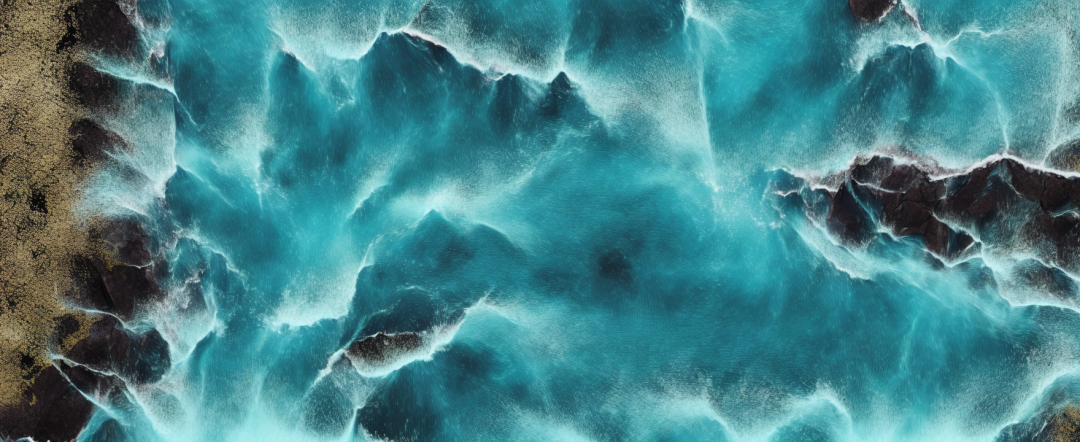
One sequence uses shifting images generated by a deep-learning model in 2021. Within the film’s context, the images resemble a model retrieving and grasping records of the “past” from the distant “future.” From the perspective of “nonhuman intelligence” in 2021, it “imagines” the relationship between algae and the seashore through the structure of algae.
The technology of algorithmically generated images is advancing rapidly, so using a model from that moment in the creative process also gives the images a certain quality of media archaeology. As the image above suggests, they are entirely different kinds of objects from the moving images generated by Sora.
Fei Yining and Guan Chenghan, Breakfast and Artificial Art, 2019. Two-channel 4K video, color, sound, 8 minutes 51 seconds.
In Breakfast and Artificial Intelligence, however, I used motion-capture technology to simulate the protagonist’s state between the anthropomorphic and the “nonhuman.” The process of imagining and simulating an alternative intelligence as a human being has an inherent performative quality. That part of the work exists precisely because of the labor I undertook as a human; similarly, I would not hand over tasks such as writing the script to AI.
Fei Yining.
It is still difficult to say what the future holds. Our ideas are continually changing as alternative intelligences develop. But the premise for collaborative creation is that it must be conceptually or narratively reasonable—even necessary.
“AI art” is a vague and deeply problematic term. How should we define “AI art”? The question bears on the essence of art itself: Is art simply humanity’s questioning and expression of its own circumstances and those of the world around it? If so, does alternative intelligence have its own circumstances, which humans cannot understand? This points to another question. In this context, do we still imagine AI as some kind of tool, or has it already become an “alternative intelligence” or “life form” that did not evolve in the same way we did?
If they are another form of life, would their civilization necessarily contain such a thing as “art”?