Lee Bul at M+ Hong Kong: Cyborgs, AI and Thirty Years of Art
At M+ in Hong Kong, a major exhibition of Lee Bul’s work since 1998 shows how uncannily her art anticipated the age of AI, engineered bodies, and cities forever being dismantled and rebuilt......
By / Xirui Huang · 12 min read
What does Lee Bul’s 2026 exhibition at M+ Hong Kong reveal about cyborgs, AI and the future body?
Lee Bul: Works from 1998 Onward at M+ Hong Kong brings together Cyborg, Anagram, Monster, Mon grand récit and Perdu, plus about 400 drawings and research works. The exhibition shows how Lee Bul has examined technological bodies, identity, architecture and failed modernist utopias since the late 1990s.
What would it look like if an artist had already foretold, thirty years ago, the world we inhabit now? Silver structures suspended in midair, like the ruins of a future civilization; headless cyborg bodies, at once beautiful and unsettling; scaffoldlike architectural skeletons climbing upward even as they seem ready to collapse at any moment. Step into M+ Hong Kong’s "Lee Bul: Works from 1998 Onward," and the answer is almost immediate.
In an age when AI is reshaping human identity, algorithms are steadily defining our lives, and cities are endlessly dismantled in the name of renewal, the questions we face now are ones the Korean artist Lee Bul was already pressing in the late 1990s.
SECTION 01 | Falling into the ruins of future civilization
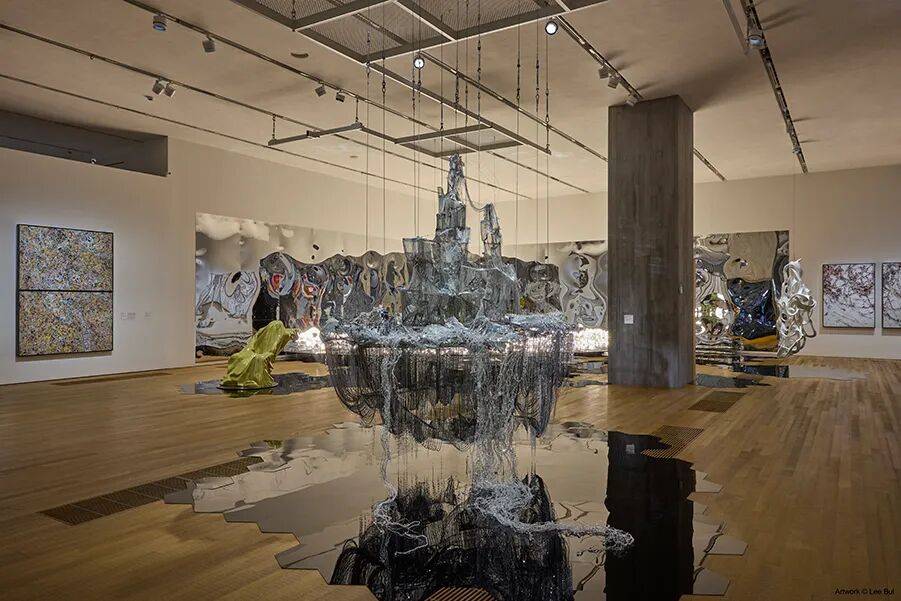
Installation view of "Lee Bul: Works from 1998 Onward," 2026. Photograph by Cheung Lok Tin. Courtesy of M+. The exhibition is one of the most comprehensive large-scale solo presentations of the past nearly thirty years of her work, and her name is written too deeply into the history of Asian contemporary art to be avoided.
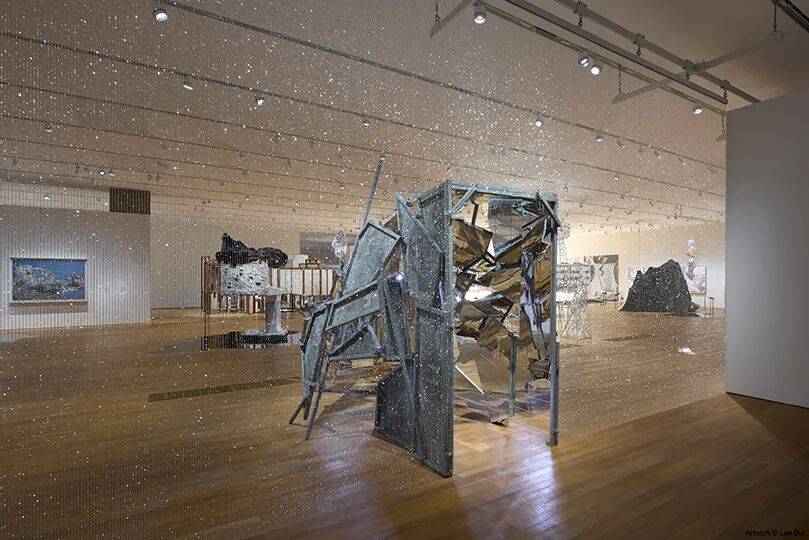
"As early as 1997 and 1998, she was already thinking about how technology would change the human body and human existence. Looking back now, these works do not feel dated at all." Before the opening, we spoke with Doryun Chong, M+ Artistic Director and Chief Curator and co-curator of the exhibition, about the show and the artist’s work over more than three decades. At the entrance to the exhibition, installation view of "Lee Bul: Works from 1998 Onward," 2026. Photograph by Cheung Lok Tin. Courtesy of M+. We first pass through a shimmering partition of silver bead curtains, then enter a warped, irregular mirrored corridor, the exhibition’s only point of entry.
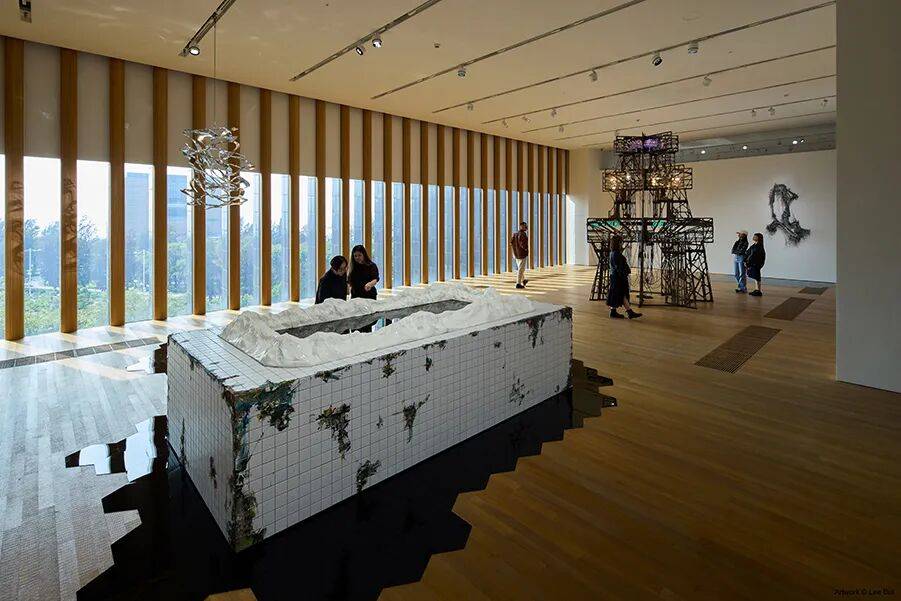
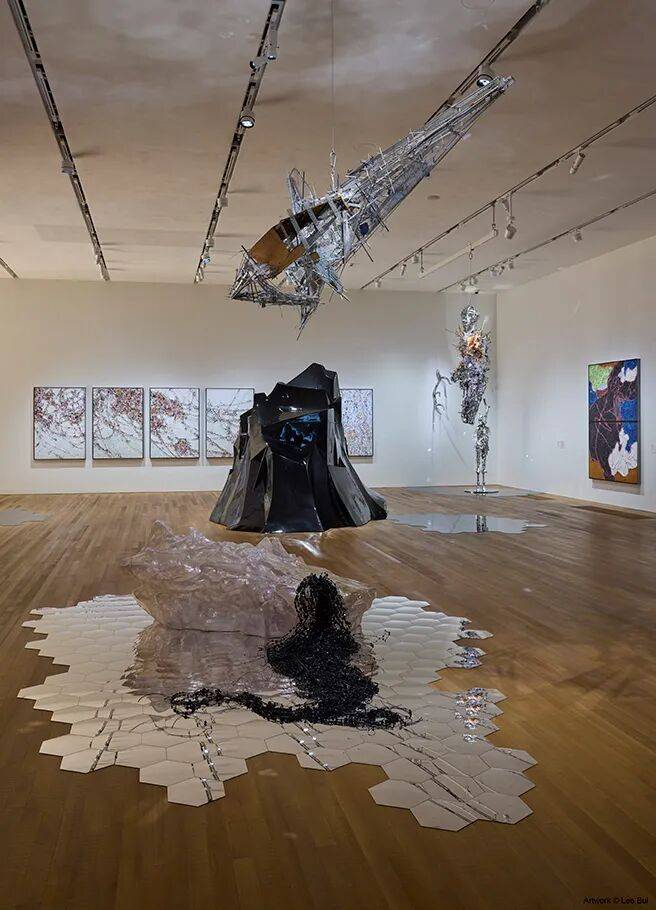
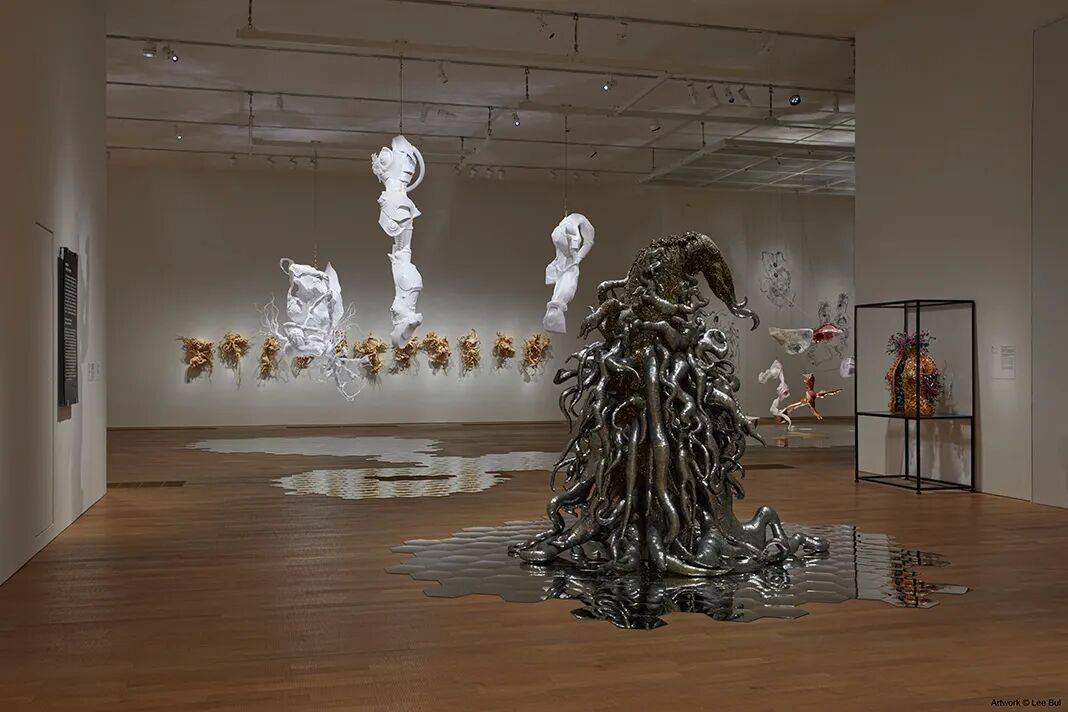
Emerging from the passage bent at the waist and with our heads lowered, we formally enter the other world Lee Bul has made. The first sensation is not of viewing an exhibition but of having suddenly wandered into a city floating outside time, surrounded by a feeling of weightlessness. Suspended structures, steel frames, mirrored surfaces, crystalline reflections, and scaffoldlike architectural fragments combine into a highly dramatic visual tension. The effect is almost dreamlike in its beauty, yet cold in a way that makes you uneasy.
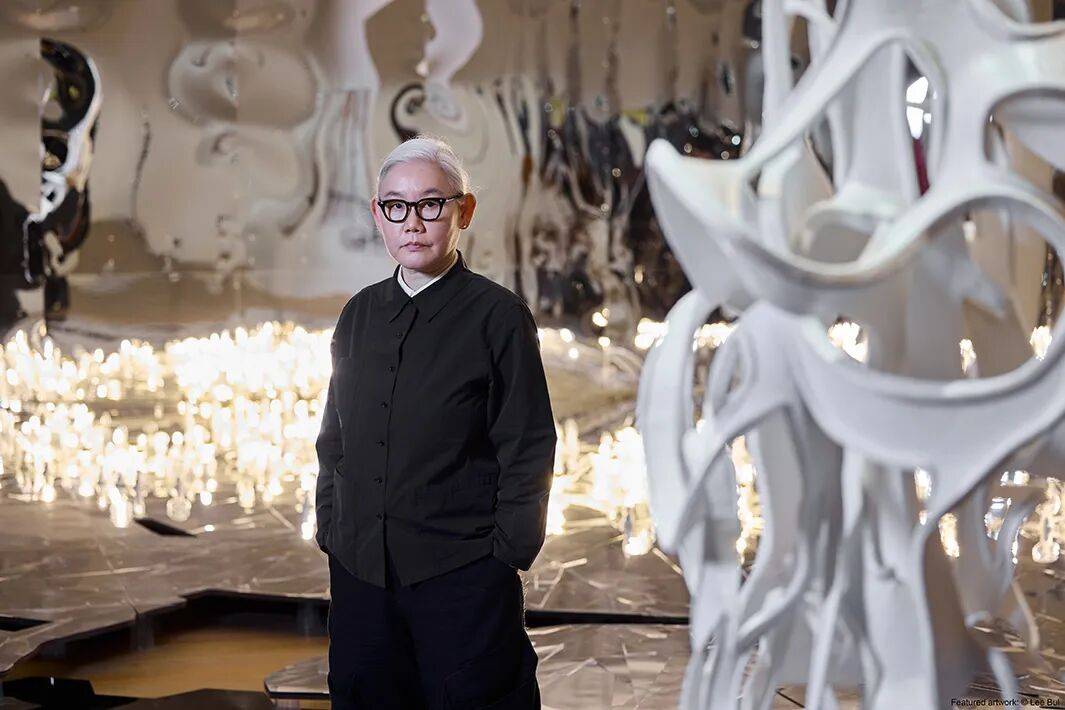
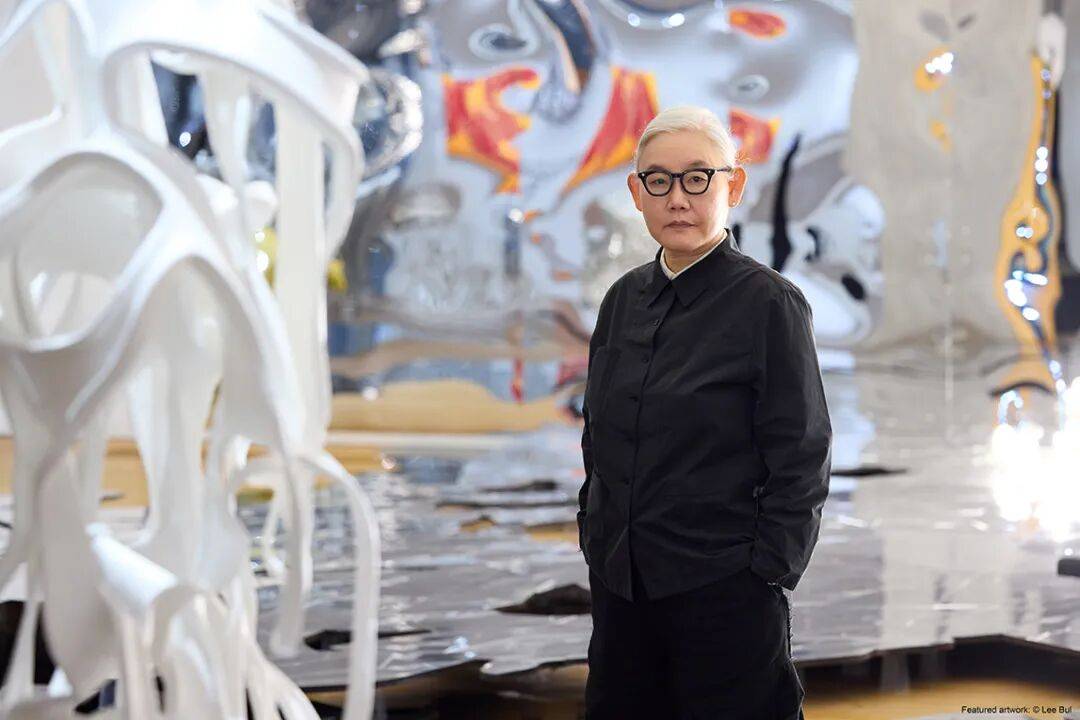
Installation view of "Lee Bul: Works from 1998 Onward," 2026. Photograph by Cheung Lok Tin. Courtesy of M+. Lee Bul at the exhibition. Photograph by Leung Yu Chung. Courtesy of M+. Chong describes it as "a fantastical landscape dotted with islands."
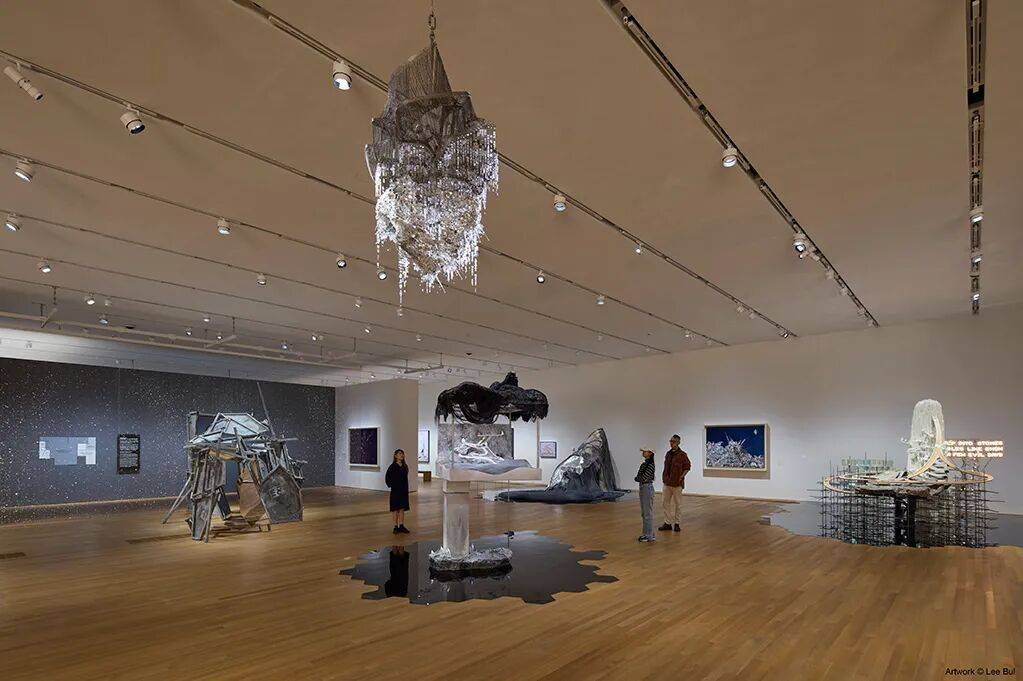
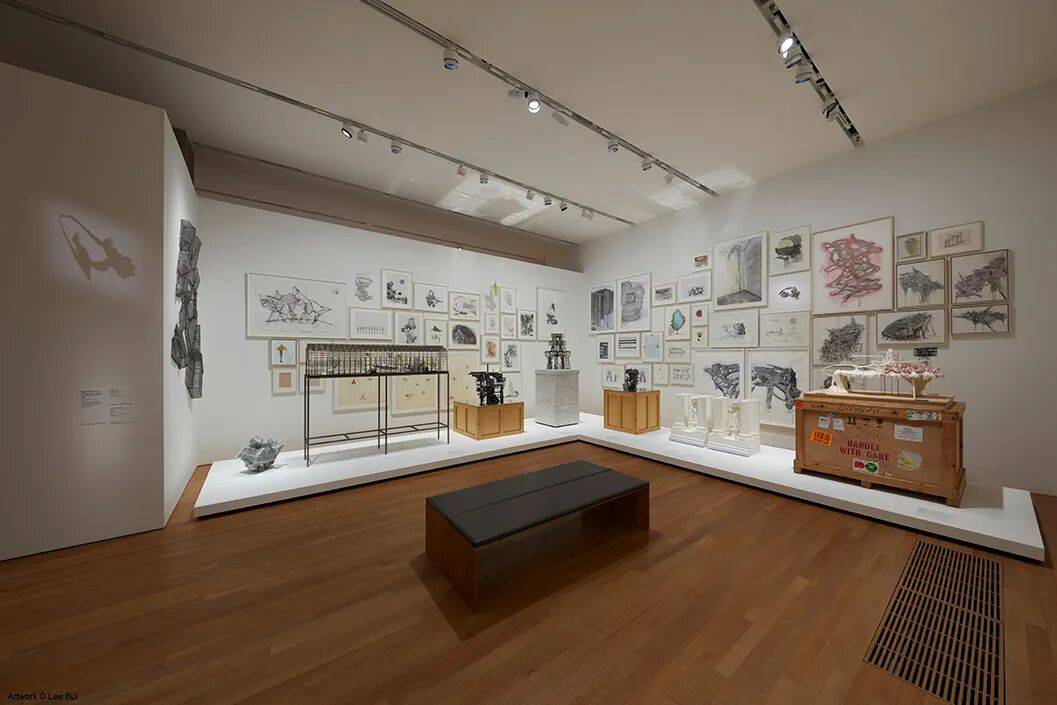
"We wanted to create an atmosphere that was both gorgeous and faintly threatening." That could almost stand as the central quality of Lee Bul’s entire artistic world. "Lee Bul: Works from 1998 Onward" occupies M+’s largest gallery, more than 1,600 square meters, yet instead of relying on the usual proliferation of partition walls and discrete sections, the curators have left the space largely open, with only one entrance and one exit, arranged as a circular route.
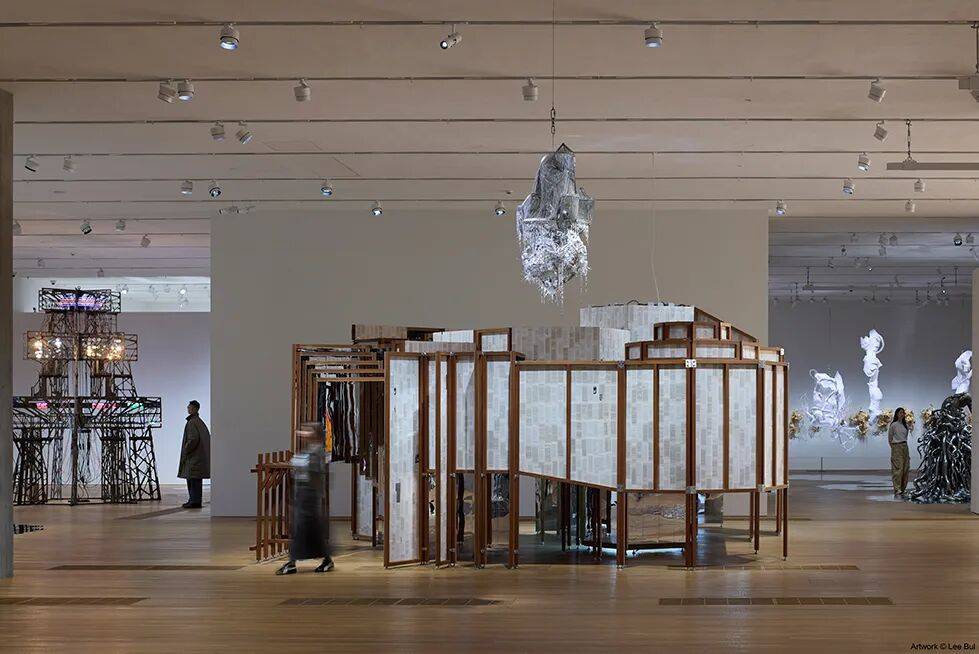
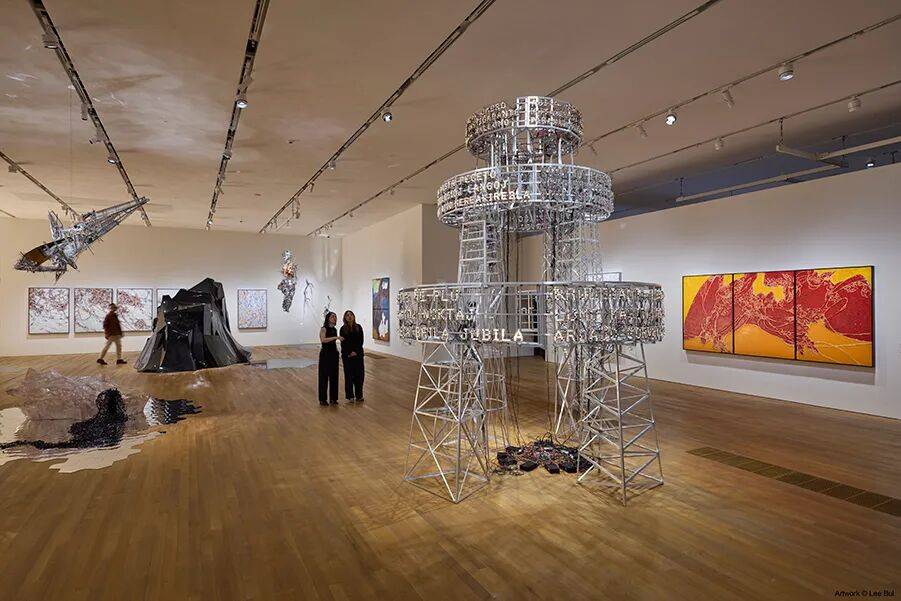
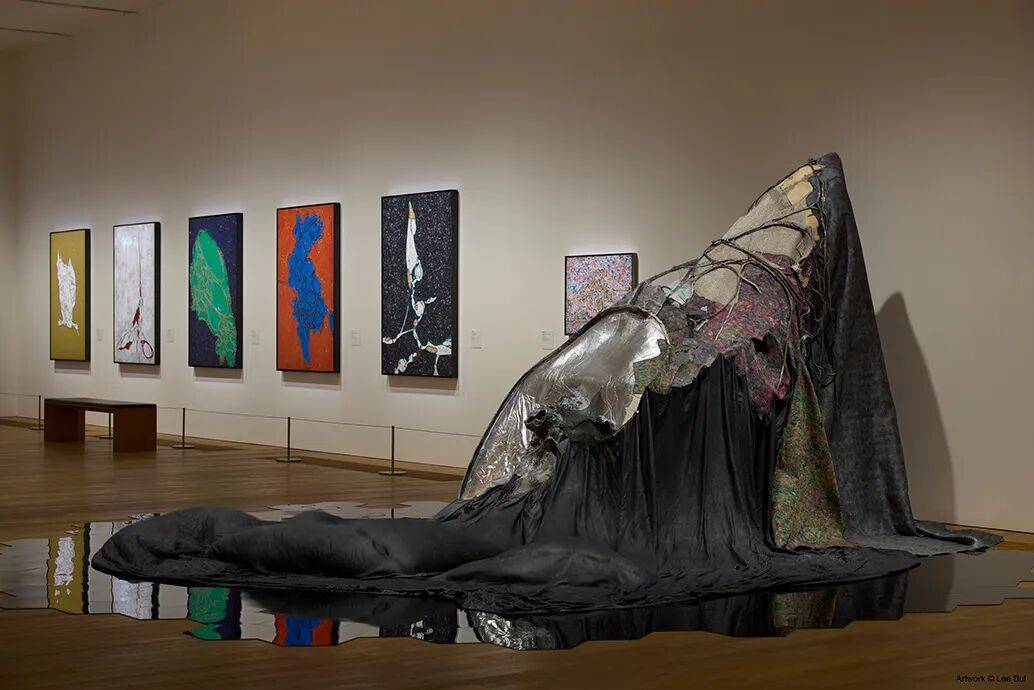
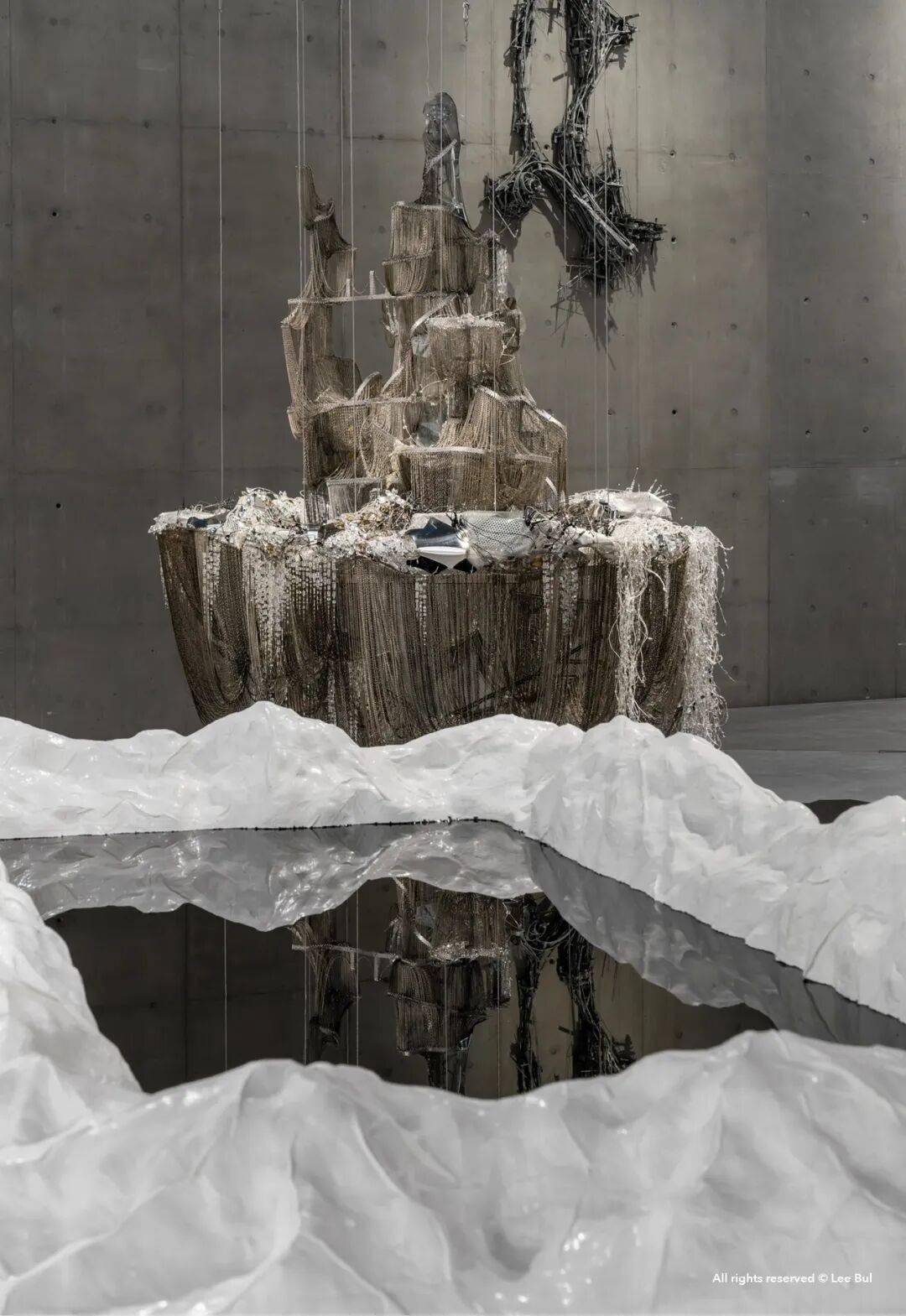
Installation view of "Lee Bul: Works from 1998 Onward," 2026. Photograph by Cheung Lok Tin. Courtesy of M+. Entering through the sole entrance, then, we are not guided into a linear narrative of time but first cast into this vast open landscape. The first part of the exhibition takes up roughly 60 to 70 percent of the gallery. It focuses mainly on two long-running bodies of work: the artist’s twenty-year cycle Mon grand récit, and Perdu, a series she has pursued from 2016 to the present, along with Willing To Be Vulnerable—Velvet.
Installation view of "Lee Bul: Works from 1998 Onward," 2026. Photograph by Cheung Lok Tin. Courtesy of M+. "This exhibition is not really a retrospective," Chong told us. "It focuses on the greater part of her mature work." Lee Bul entered the art world almost as if out of nowhere. In 1987, she graduated from the sculpture department at Hongik University, one of Korea’s most important art schools. Her early body art and performance pieces had an extraordinary impact on the art scene of the time.
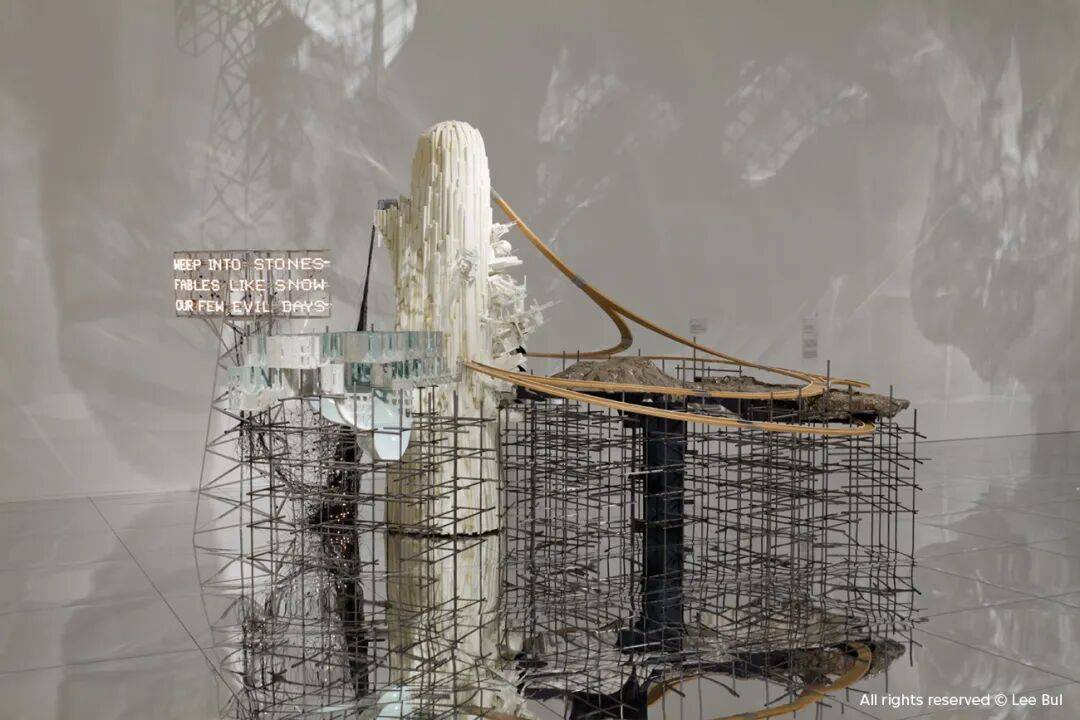
In interviews, the artist has said that around 1994 she began to realize that this phase of her work had reached its limit, and that she had to turn in a new direction. Then, around 1998, she arrived at another turning point in the fullest sense, which is precisely where this exhibition begins. Lee Bul, Mon grand récit: Weeping Rocks...
, 2005, installation view of "Lee Bul: From Me, Belongs to You Only" at Mori Art Museum, Tokyo, 2012. Photograph by Osamu Watanabe. Courtesy of the artist and Mori Art Museum. Lee Bul, Scale of Tongue, 2017-2018, installation view of "Lee Bul: Crashing" at Hayward Gallery, Southbank Centre, London, 2018. Photograph by Mark Blower. Courtesy of the artist and Hayward Gallery, Southbank Centre. If Lee Bul’s early work was concerned with the body, then in her mature period what she is really addressing is the ruin of modernist utopia.
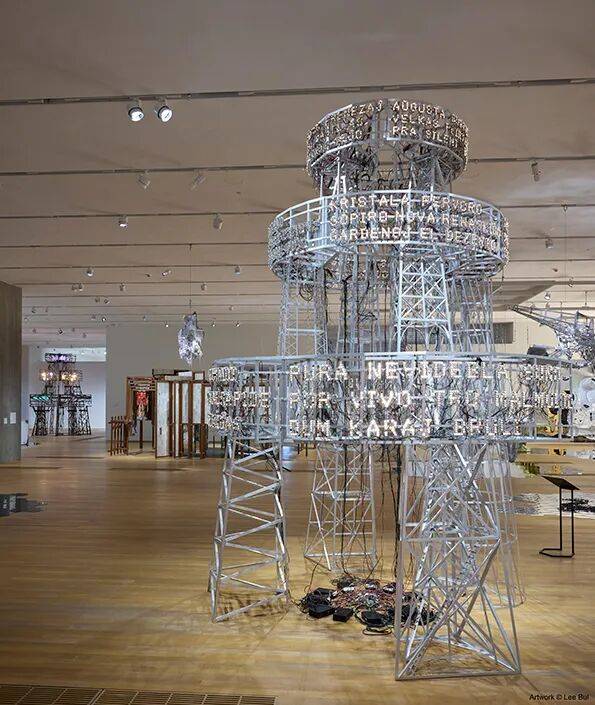
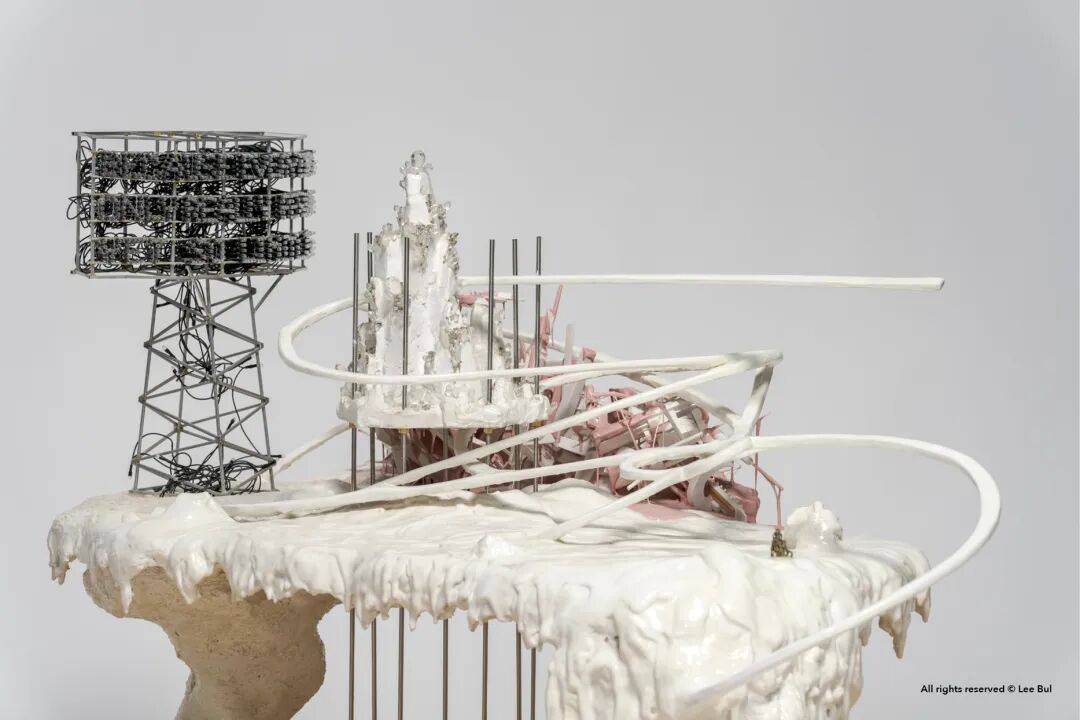
Mon grand récit is almost a visual allegory of the failed history of modernism. Throughout it, you see a dense architectural vocabulary: scaffolding, towers, domes, monumentlike structures. They call up Soviet avant-garde architecture, but also the Bauhaus, postwar modernism, and even the hyper-dense vertical cityscape of Hong Kong itself, where the exhibition is being staged.
"Rather than saying that we deliberately used the works in the exhibition to respond to Hong Kong’s urban character, it would be more accurate to say that we knew from the outset Lee Bul’s work would naturally resonate strongly with Hong Kong," Chong said. When Lee Bul came to the exhibition site herself, he added, she told him that it felt as if Hong Kong’s urban landscape had entered her work. Lee Bul, Mon grand récit maquette (detail), 2005. Photograph by Jeon Byung-cheol. Courtesy of the artist. Lee Bul, After Bruno Taut (Beware the Sweetness of Things), 2007, installation view of "Lee Bul, On Every New Shadow" at Fondation Cartier pour l’art contemporain, Paris, 2007-2008. Photograph by Patrick Gries. Courtesy of the artist and Fondation Cartier pour l’art contemporain. "That is especially true of Mon grand récit, which is deeply involved with architecture, engineering structures, and modernist fantasies of the city."
Hong Kong’s globally famous density and vertical urban structure naturally echo the architectural fantasy spaces in her work. So it is not that we inserted the experience of Hong Kong into the exhibition; it is more that the city itself entered the exhibition of its own accord and, in doing so, illuminated her work. A viewer may have just come from the actual skyline on both sides of Victoria Harbour; inside the gallery, another city appears, dismantled, suspended, and reimagined.
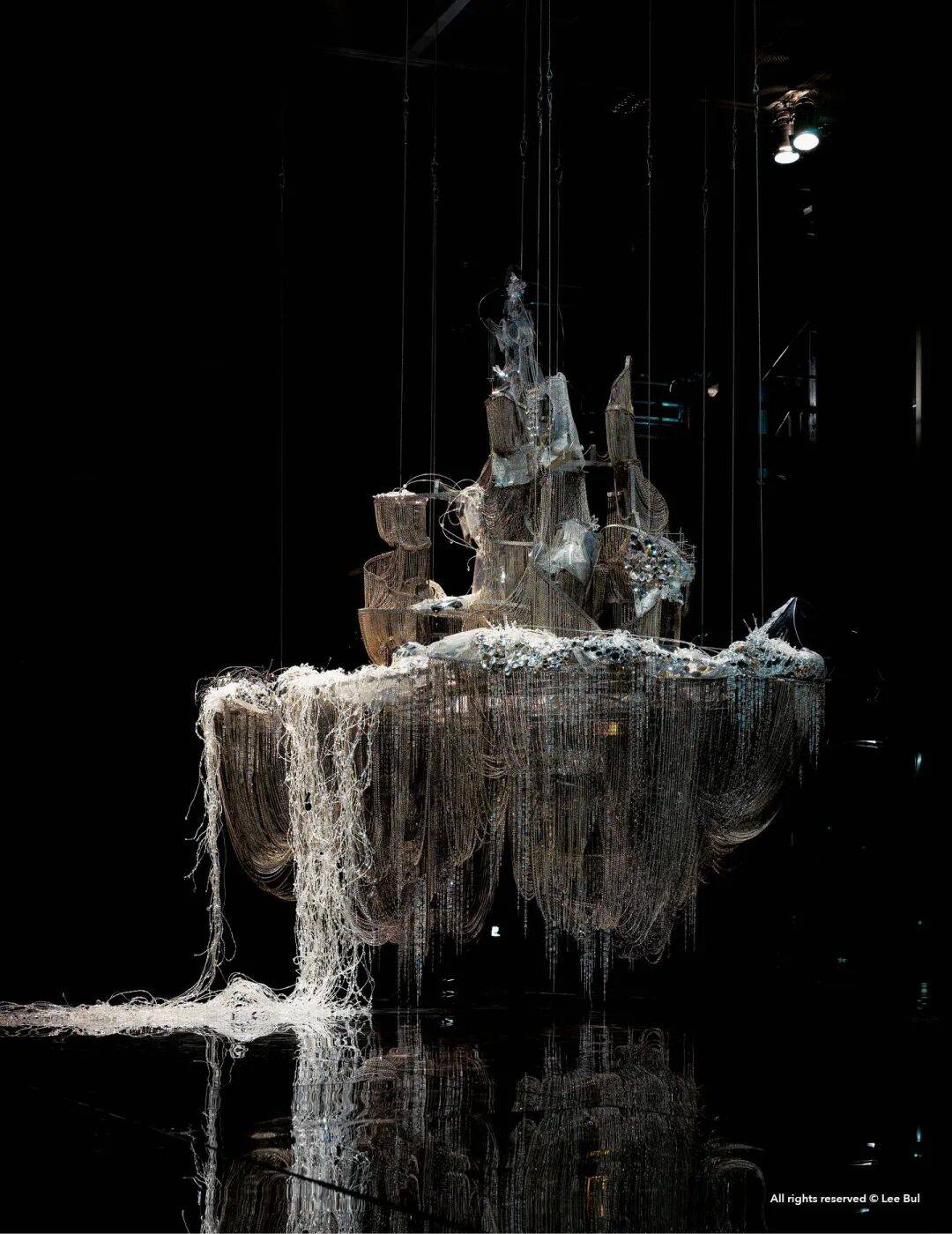
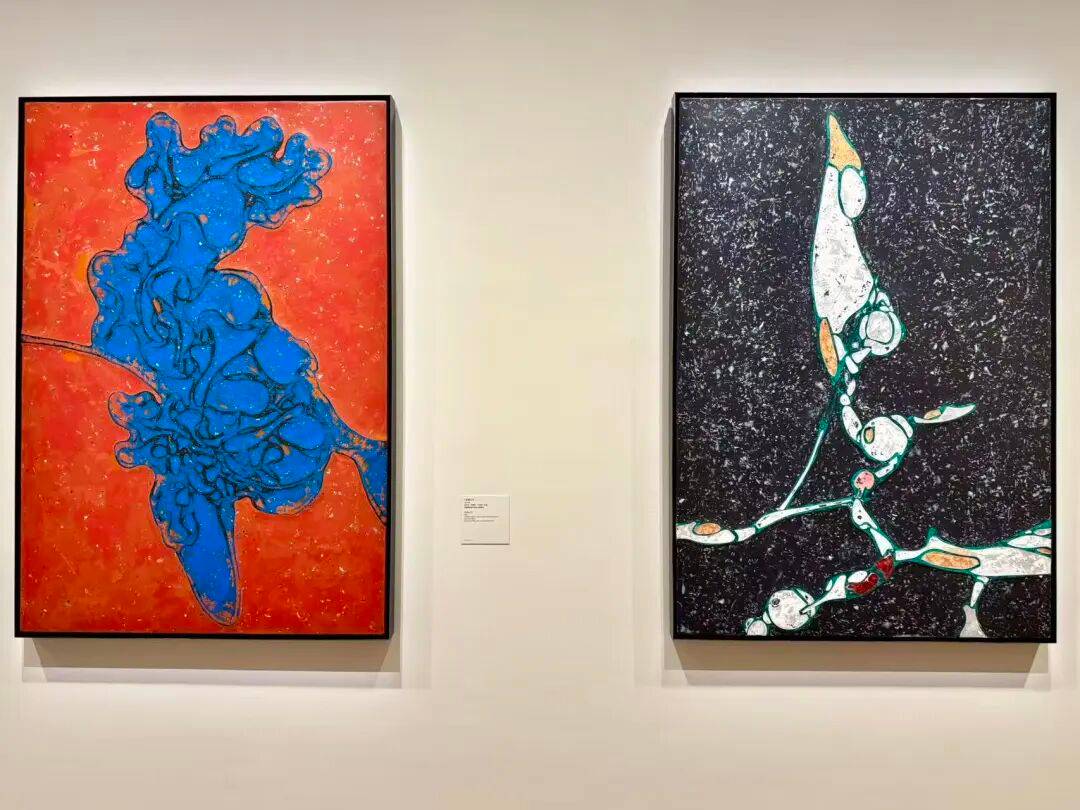
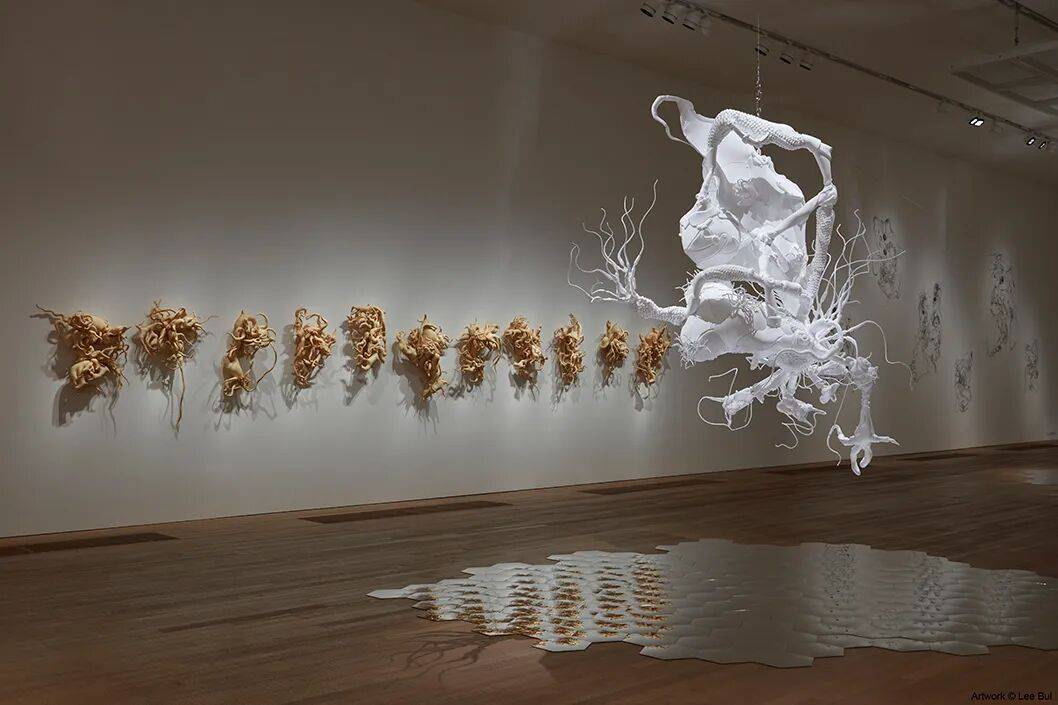
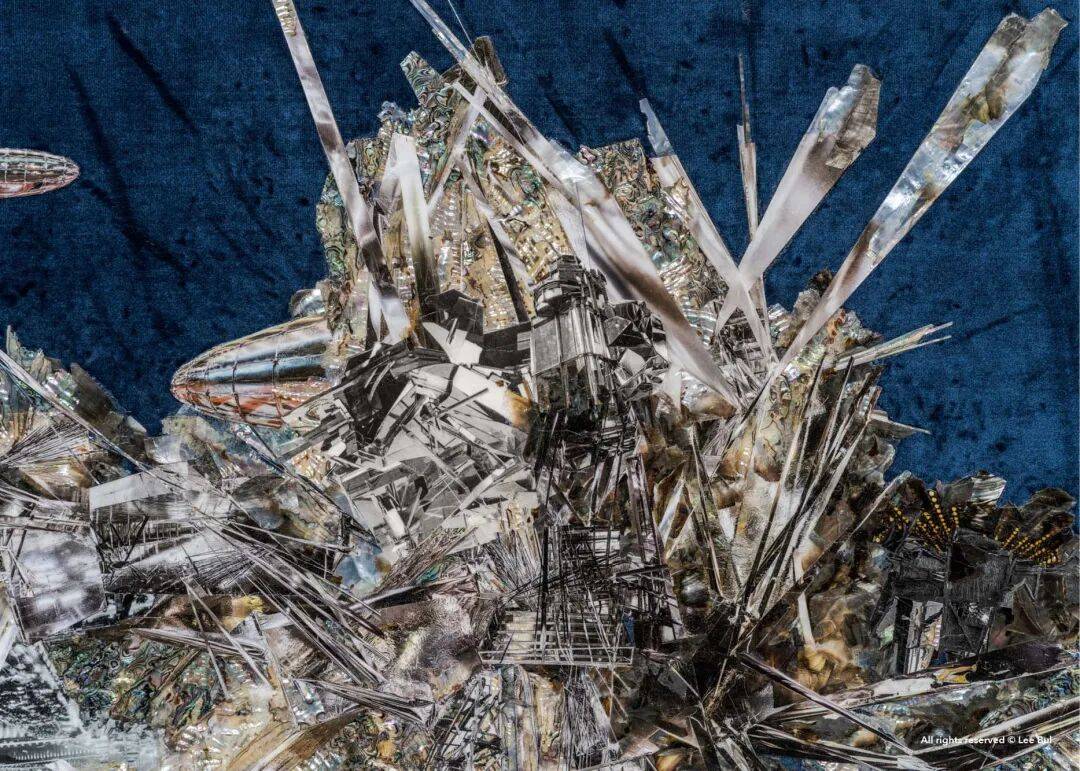
Installation view of "Lee Bul: Works from 1998 Onward," 2026. Photograph by Cheung Lok Tin. Courtesy of M+. Between these grand spatial installations, works from her Perdu series of the past decade are interspersed along the walls. Perdu, in French, means "lost," a word with a distinct poetic charge. Lee Bul grinds mother-of-pearl into powder and constructs the works on a two-dimensional surface. Their most arresting quality is the shell’s natural luster, which catches a different brightness from every angle.
Ripples, cracks, reflections, and mineral-like crystalline granules seem to swell and grow across the surface. Lee Bul’s Perdu series, 2021, installation view of "Lee Bul: Works from 1998 Onward," 2026. Installation view of "Lee Bul: Works from 1998 Onward," 2026. Photograph by Cheung Lok Tin. Courtesy of M+. The works are like paintings, but also like weathered walls, maps, or the skin of a city. They are two-dimensional in form, yet fundamentally sculptural.
This material and method are Lee Bul’s own invention. These traces, which resemble the marks left by wear and peeling, feel like the surface of memory after time has eroded it, and they answer perfectly to the architectural ruins of Mon grand récit. One is the collapse of space; the other is the shedding of time. Together they form the exhibition’s strongest first impression: the process by which ideals become relics.
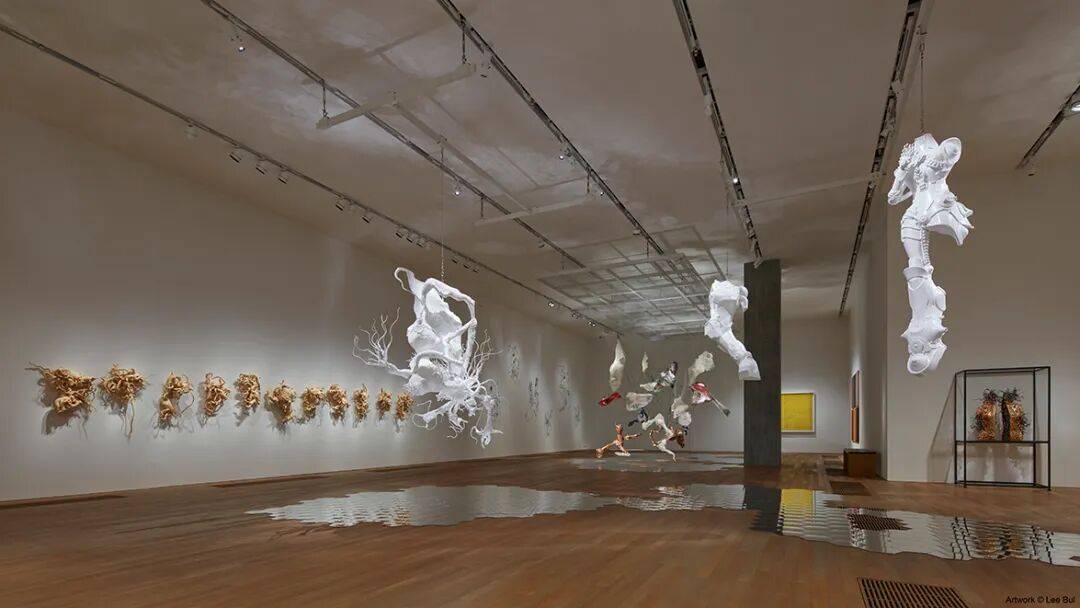
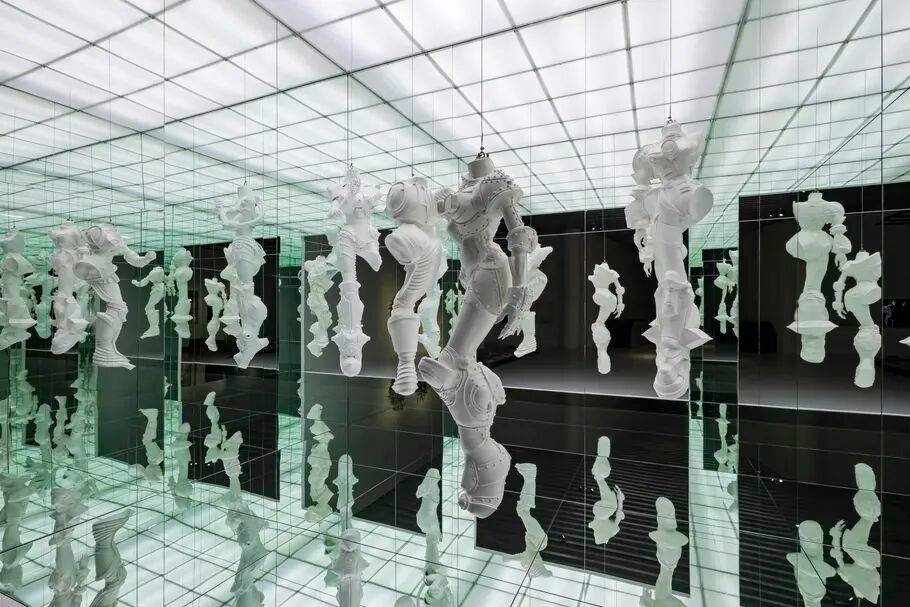
Installation view of "Lee Bul: Works from 1998 Onward," 2026. Photograph by Lam Wairan. Courtesy of M+. The second chapter concentrates on the body of work Lee Bul produced from the late 1990s into the early 2000s, a series that at the time felt explosive in its force: Cyborg, Anagram, and Monster.
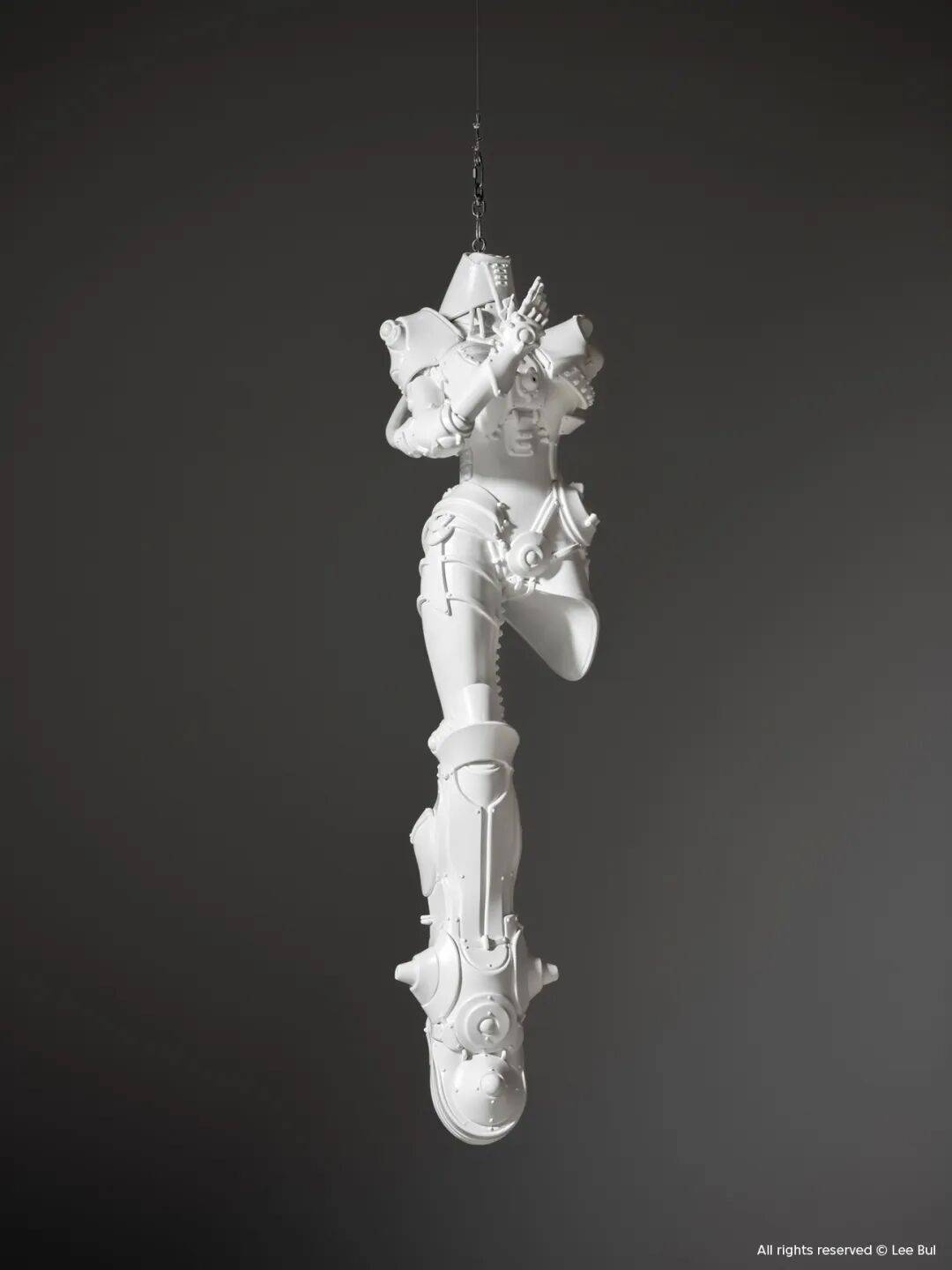
"When humans succeed in realizing what they imagine, the result can be a human-machine hybrid, a cyborg; when they fail, it becomes a monster." That is how the artist explained the original source of these works in an interview. Lee Bul, Cyborg W6, 2001. Photograph by Jeon Byung-cheol. Courtesy of the artist and Leeum Museum of Art, Seoul. These works were the first to bring the sharpness and originality of her ideas and artistic language to the attention of the international art world.
We leave the monumental installations and enter a zone closer to the scale of the body. These bodies are milky white, translucent, smooth almost to perfection. But they have no heads, no complete limbs. They resemble the Venus of classical sculpture, and also fragments of some future machine. We find ourselves astonished by their beauty while becoming uneasily aware that they are bodies that have been cut apart, mechanized, reassembled. They look so much like humans, yet are no longer human.
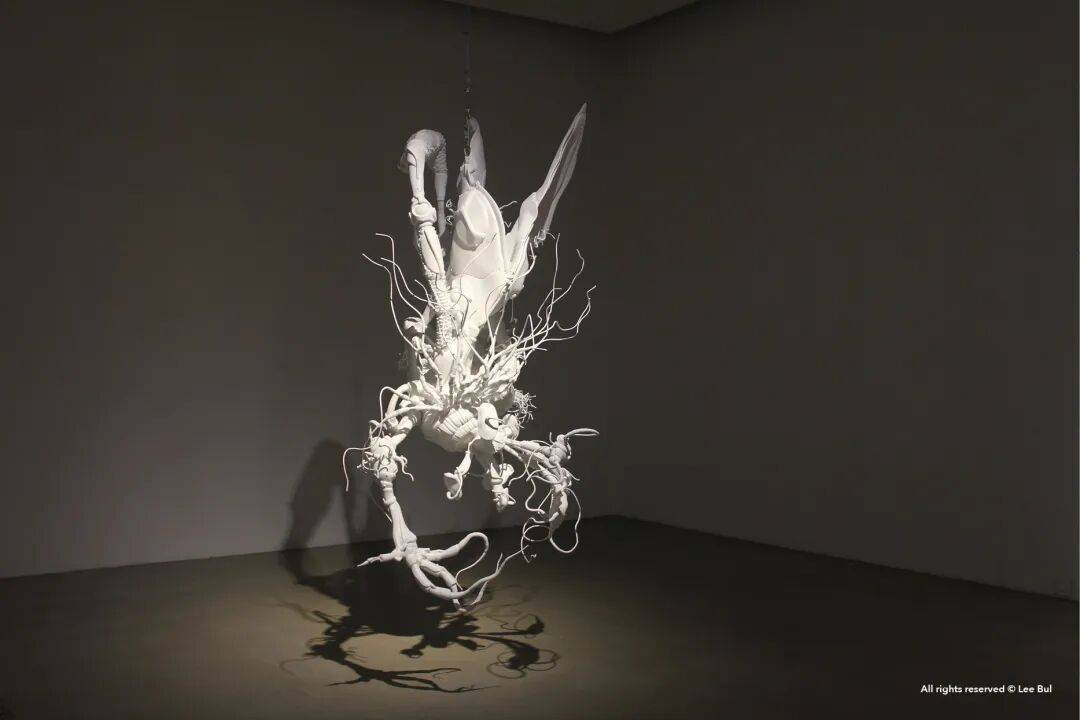
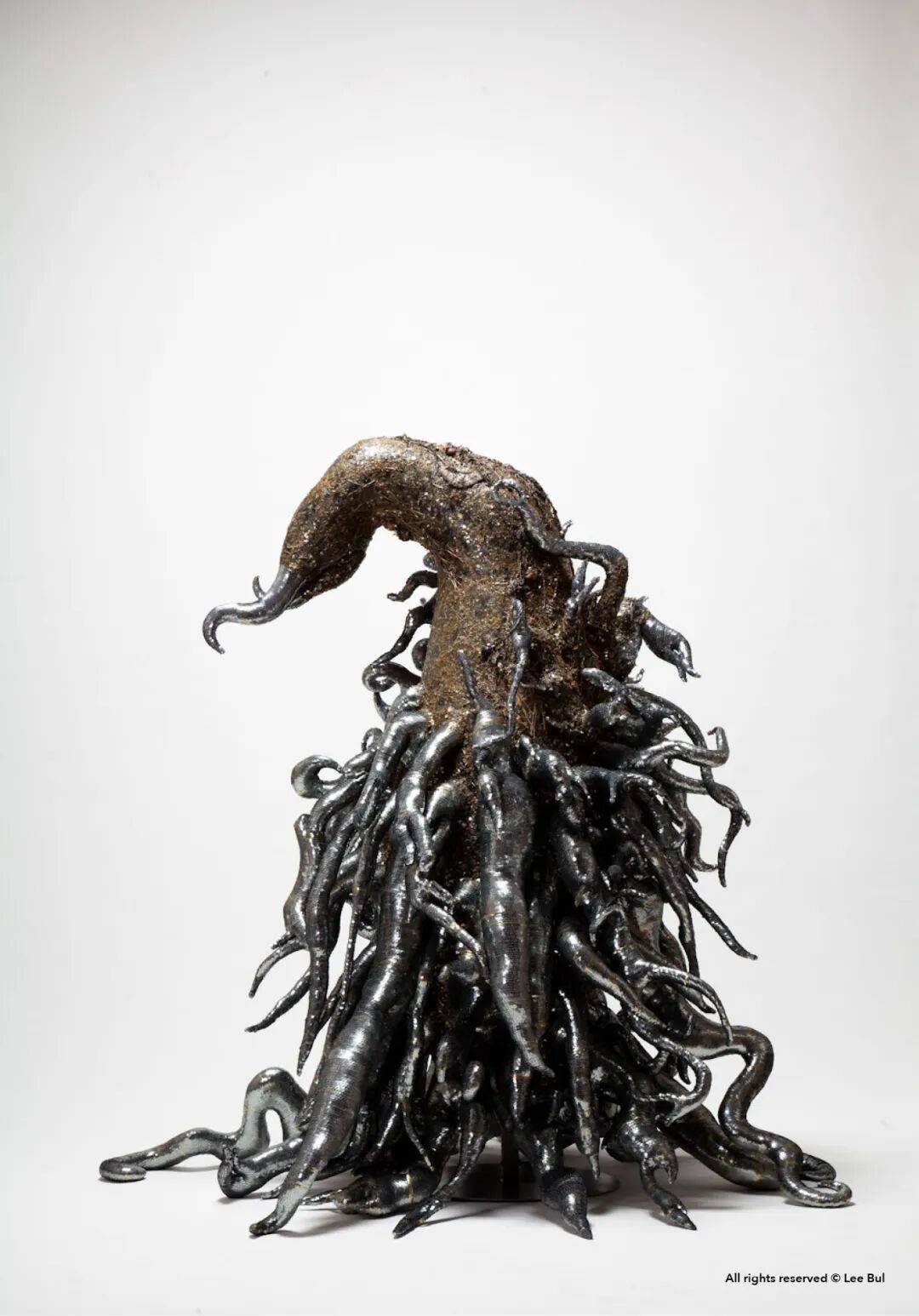
Lee Bul, Amaryllis, 1999. Courtesy of Arario Gallery. Lee Bul, Plexus, 1997-1998, installation view of "Lee Bul: Works from 1998 Onward," 2026. In the Anagram series, the cyborg body undergoes a further estrangement. Plants, insects, mechanical structures, bones, and robotic parts are spliced together anew, while the body’s nerves appear in the form of strings of beads. What we see is a life-form that resists naming.
"Lee Bul’s discussion of cyborgs and technological bodies in the late 1990s remains astonishingly relevant today. It is remarkable when you remember that this was 1997 and 1998, when the internet had only just begun to become widespread."
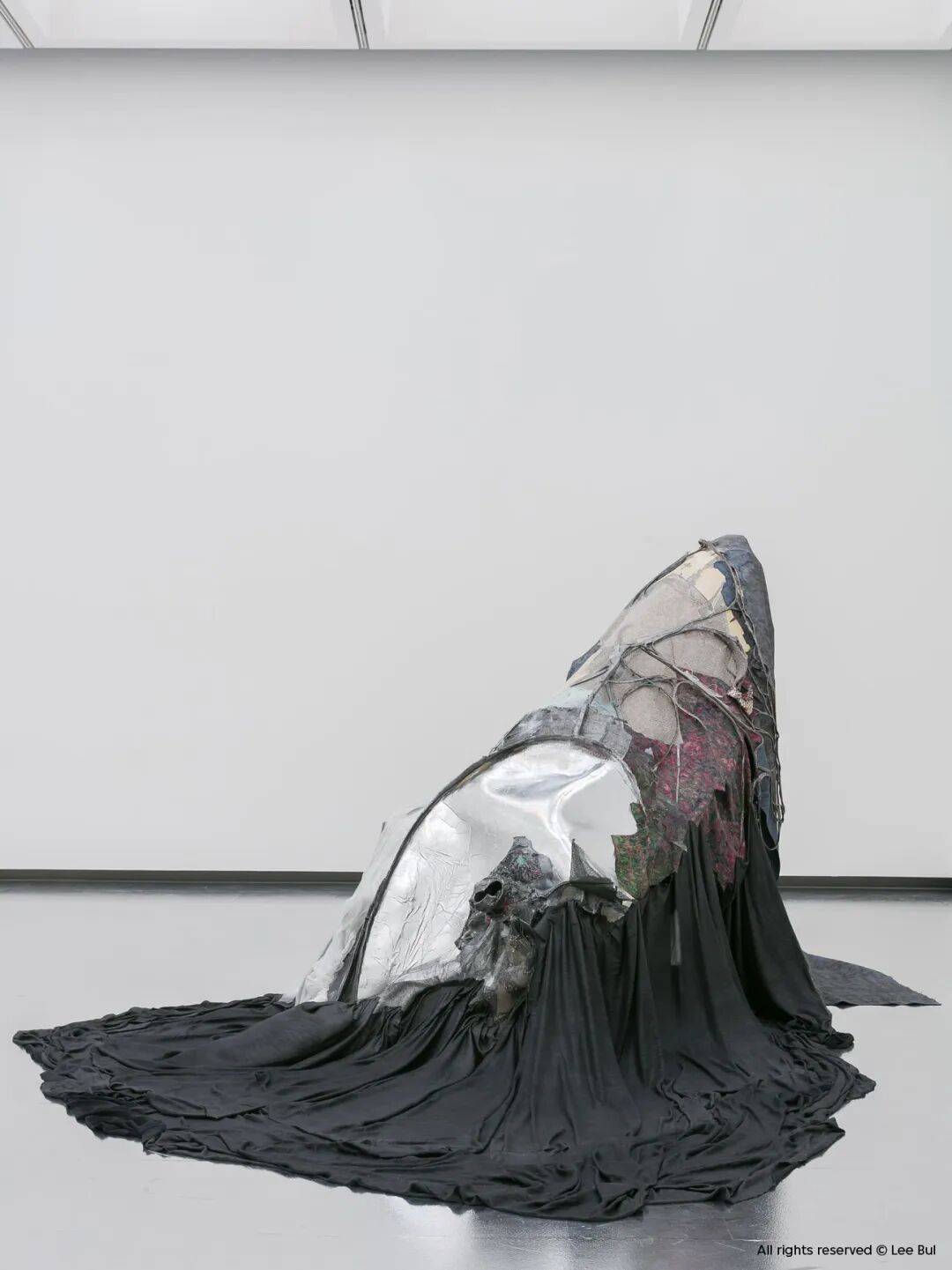
Installation view of "Lee Bul: Works from 1998 Onward," 2026. Photograph by Lam Wairan. Courtesy of M+. Lee Bul, Monster: Black, 2011 (remade from a 1998 version). Photograph by Jeon Byung-cheol. Courtesy of the artist. Chong marveled to us that, at that moment, ideas like artificial intelligence and cyborgs were still far from becoming subjects of broad public discussion. And yet this young artist from Asia was already thinking deeply about how technology would alter the human body and human existence.
SECTION 02 | Lee Bul Saw the Cybernetic Future Thirty Years Ago
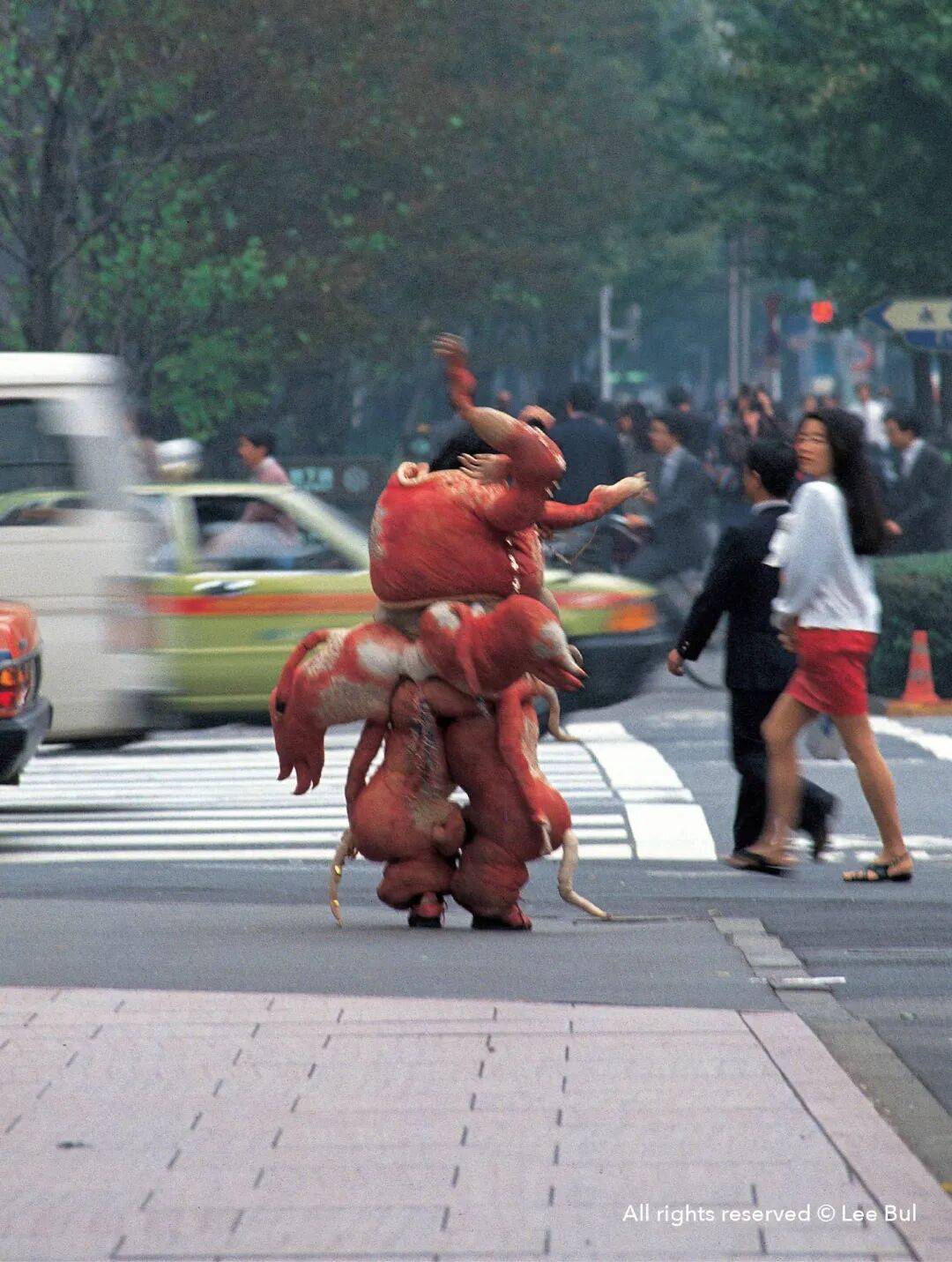
"Seen today, they still feel entirely contemporary. That is what is truly great about her." In the Monster series, the gleaming soft-sculptural bodies bristling with countless tentacles, with forms resembling soft tissue, internal organs, and everted skin, lead almost directly back to the bodily experience of one of her early works, Sorry for suffering–You think I’m a puppy on a picnic?
Lee Bul, early work, Sorry for suffering–You think I’m a puppy on a picnic?, 1990, a twelve-day performance during the 2nd Japan-Korea Performance Art Festival. Courtesy of the artist. In this 1990 performance piece, she wore a soft-sculpture costume that looked as if the body had been turned inside out, many-limbed, limp, monstrous, and also like an unfinished human form, and moved through public spaces including Gimpo Airport in Korea, Narita Airport in Japan, Meiji Shrine, Harajuku, Otemachi Station, Koganji, Asakusa, Shibuya, the University of Tokyo, and the Tokiwaza Theater in Tokyo over the course of 12 days, becoming famous in a single stroke.
SECTION 03 | Stepping Into the Artist's 'Brain'
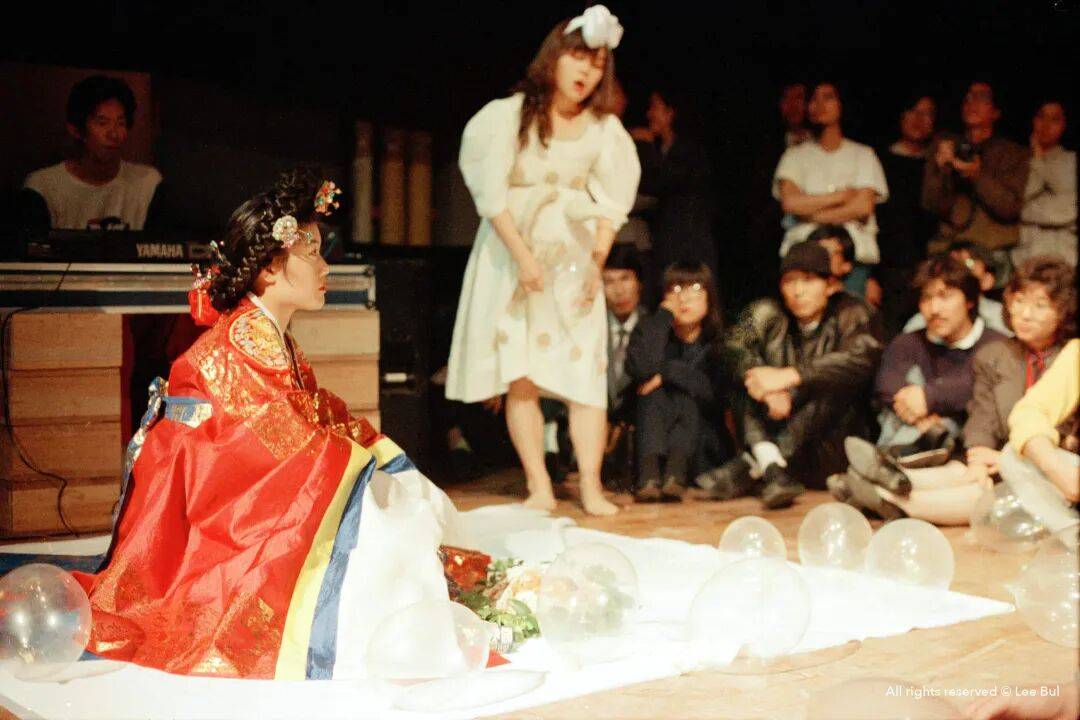
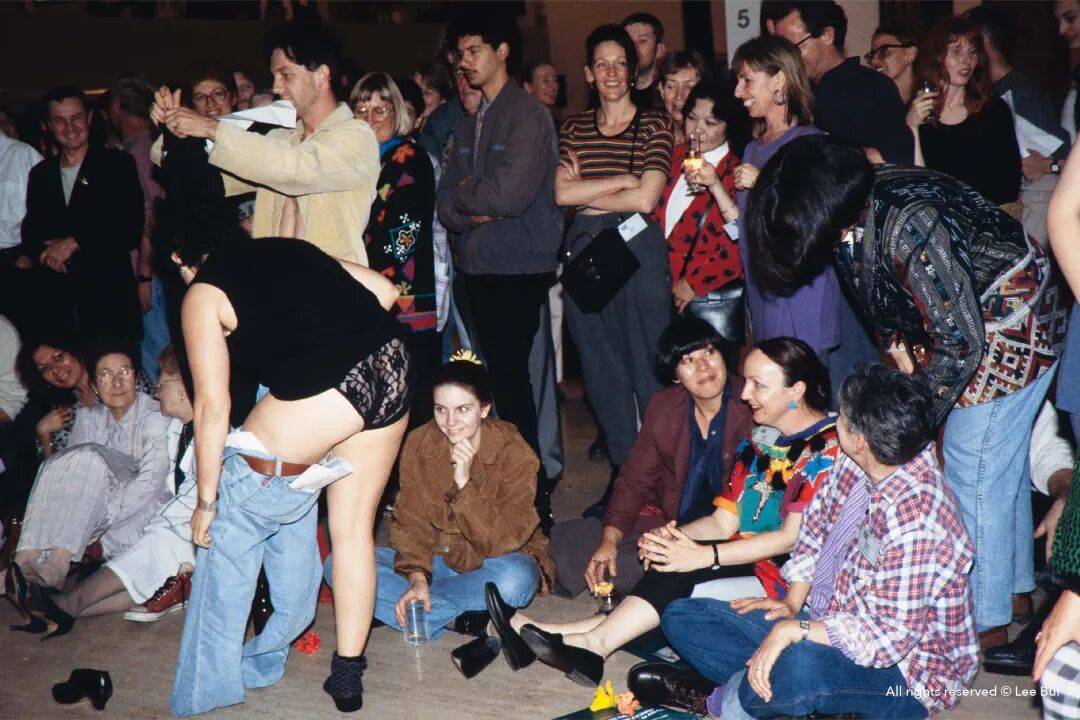
This mode of expression was, in fact, closely bound to her life experience, which meant that from the beginning she kept asking how the body is shaped by society, power, and technology. Lee Bul, Abortion, 1989, photograph of a performance during the 1st Korea-Japan Performance Art Festival, Seoul Dongsoong Art Center Small Theater. Courtesy of the artist. Lee Bul, Untitled, 1993, photograph of a performance during the 1st Asia-Pacific Triennial of Contemporary Art. Courtesy of Queensland Art Gallery | Gallery of Modern Art, Brisbane. Lee Bul was born in 1964, at what was almost the most turbulent moment of social transformation in Korea.
Both of her parents were dissidents, and so they lived for long periods under surveillance and at the margins. During the military government of Park Chung-hee in particular, moving house, relocating, and repeatedly leaving familiar surroundings were constants of her childhood. She has often said in interviews that because she grew up on the margins of society, she could not understand modernity from its center; instead, she saw from the edge how it was constructed, how it expanded, and how it ultimately collapsed. That perspective runs through nearly all of her later work: utopia, modernist architecture, failed ideals, bodily alienation.
Her work always contains a doubleness: it is drawn to the future and suspicious of it at the same time. Lee Bul, Magnificent Splendor, 1997, screenshot of the original installation. Photograph by Robert Pugliese. Courtesy of Lee Bul Studio. Lee Bul, Magnificent Splendor, 2016, remade from the 1997 version, SongEun Art Center. What first brought Lee Bul into the view of international art history was the nearly legendary exhibition incident at MoMA Projects 57 in New York in 1997.
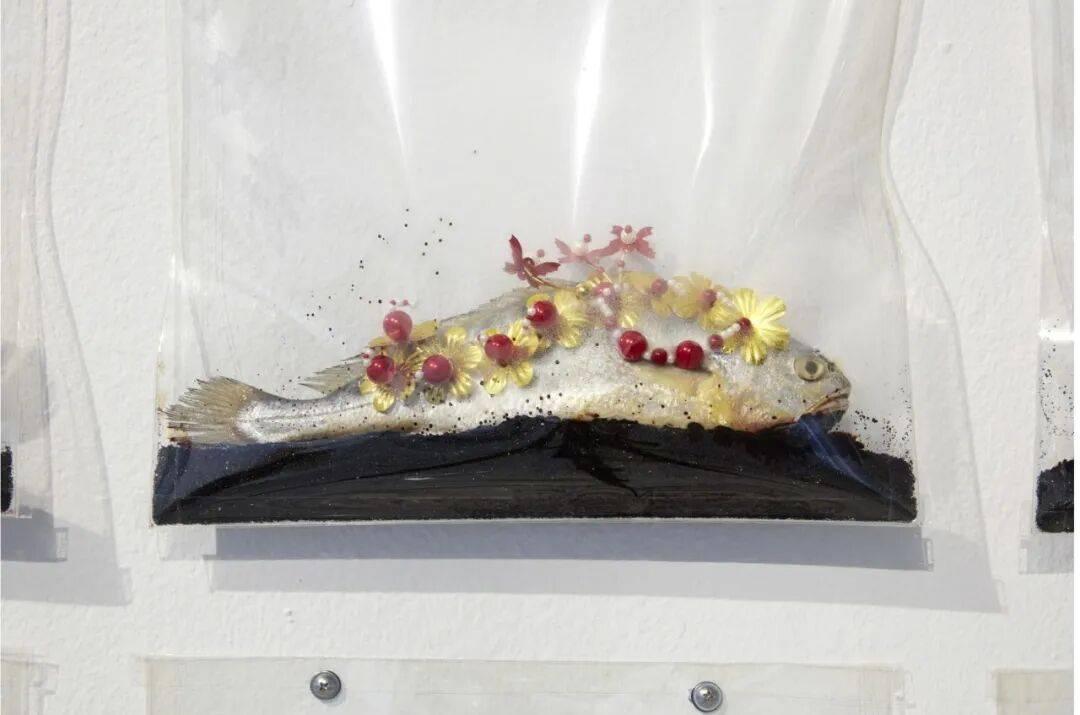
The work she brought was called Majestic Splendor. She made it from freshly dead fish, covering their bodies with sequins and beads, then sealing them in plastic bags.
"But because the odor of the rotting fish was simply too strong, the smell spread through the entire museum, and MoMA ultimately removed the work before the exhibition officially opened. At the time, that was no small scandal," Chong said. The episode involved more than the curiosity value of "a young Asian woman artist causing a museum crisis at MoMA." It also laid bare the core of Lee Bul’s early work: her wish to puncture assumptions about beauty, the female body, and ornament, forcing viewers to confront the decaying, unruly, undisciplined bodily reality beneath the beautiful surface, while directly provoking the limits of institutions.
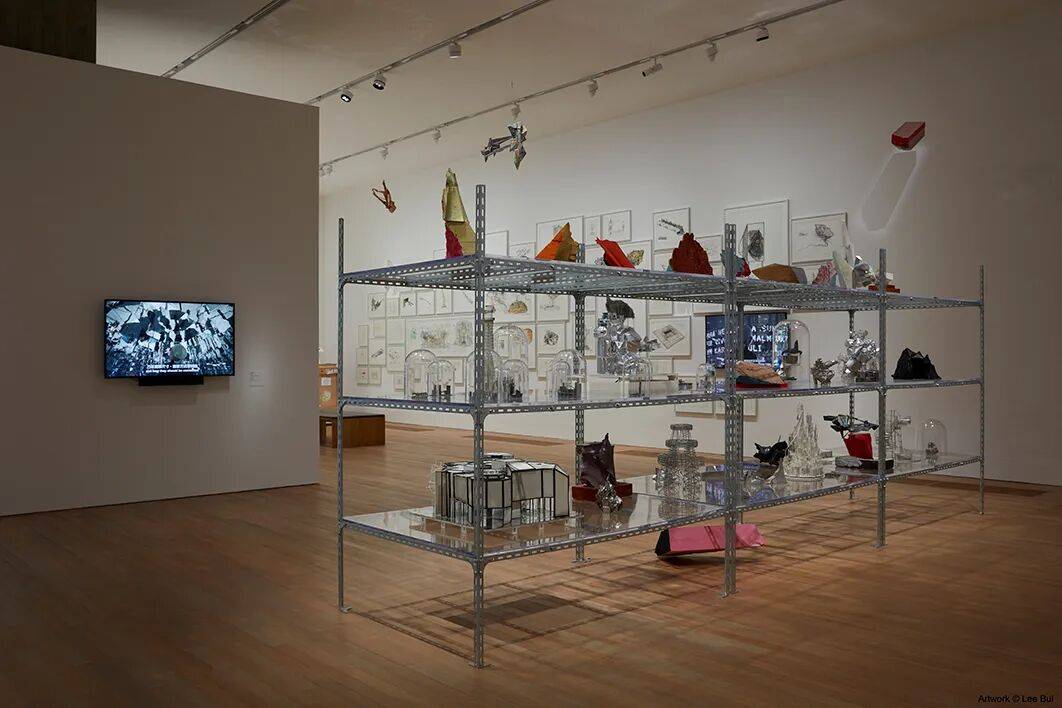
Installation view of "Lee Bul: Works from 1998 Onward," 2026. Photograph by Lam Wairan. Courtesy of M+. In the final part of the exhibition, we encounter the artist’s working universe, the most moving part of the entire show.
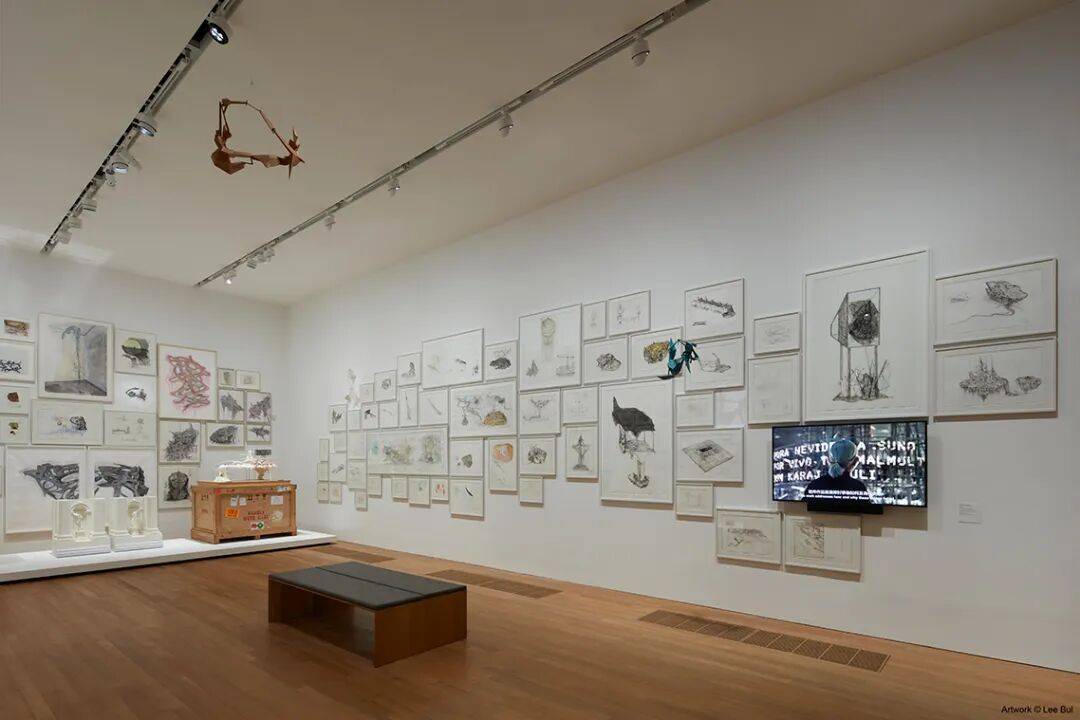
"There are about 400 manuscripts, sketches, research drawings, and several dozen models here, all brought in from the artist’s studio. To leave, viewers have to pass through the first two sections again. By then, they understand the works they saw earlier in an entirely new way." Chong again emphasized the exhibition’s circular structure. We were especially taken with his phrase for this chapter: "the most intimate inner sanctum."
Installation view of "Lee Bul: Works from 1998 Onward," 2026. Photograph by Lam Wairan. Courtesy of M+. Here it becomes clear that the monumental architectural ruins and cyborg bodies we saw earlier are not spectacles conjured from nowhere. They all emerge from these densely layered traces of thought. In the sketches, many buildings are already taking shape. Bodily structures are repeatedly dismantled and reassembled. Even many series that have since become canonical can be seen here in embryonic form.
"Showing viewers those unfinished parts requires enormous courage from the artist. Ideas still in the process of becoming, forms that are still fragile, are all opened up here. It is like jumping from a high platform into a swimming pool for the first time," Chong said with a laugh.
Installation view of "Lee Bul: Works from 1998 Onward," 2026. Photograph by Lam Wairan. Courtesy of M+. It is also in this small version of Lee Bul’s studio that we glimpse what truly concerns her: when technology keeps entering the human body, what remains of us? Seen from today, the question is almost sharper than it was thirty years ago: AI, algorithms, digital personhood, social-media identity, cosmetic technology, gene editing.
We are closer than ever to a cyborg age. For that reason, Lee Bul’s voice seems to speak almost for our past, our present, and our future. The art world’s increasing embrace of her only confirms the point. Lee Bul, Cyborg W1, W2, W4, W6, 1998/2001. Photograph by Han Doohee. Courtesy of the artist and Samsung Museum of Art. Installation view of "Lee Bul: Works from 1998 Onward," 2025. Photograph by Jeon Byung-cheol. Courtesy of the artist and Leeum Museum of Art, Seoul. The year after her work was removed, Lee Bul was shortlisted for the Hugo Boss Prize at the Solomon R. Guggenheim Museum in New York.
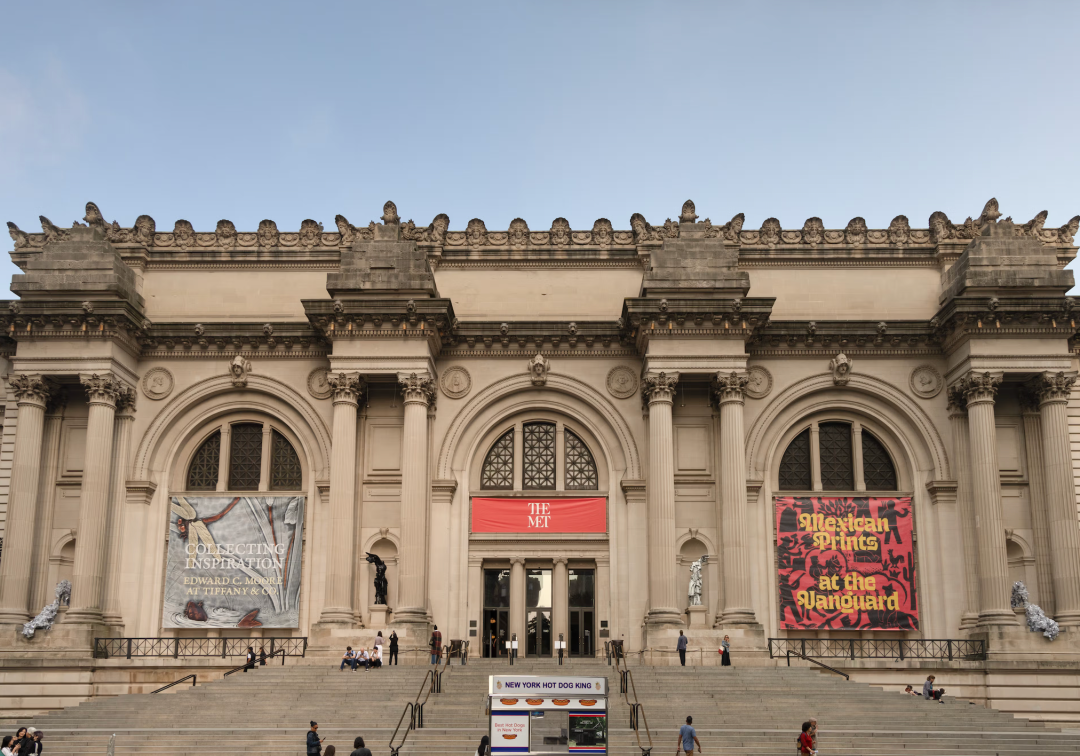
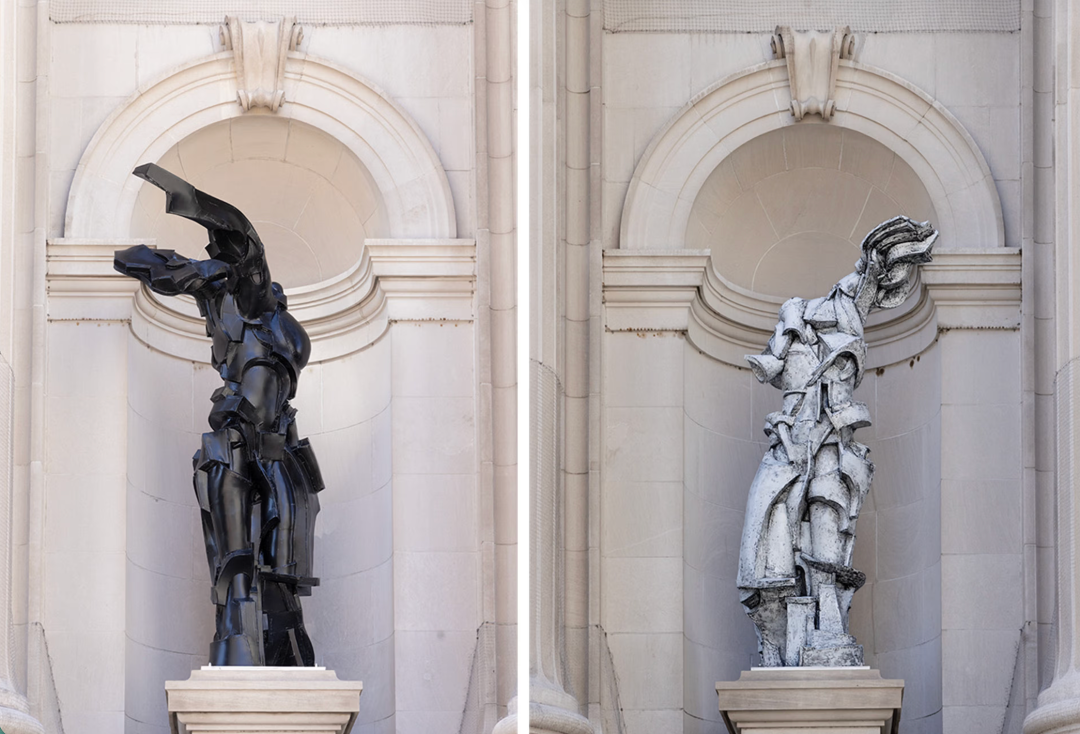
A year later, in 1999, she was invited to participate in the 48th Venice Biennale, the first time a Korean artist had received attention of such stature in the Biennale’s main exhibition hall. From there, her career advanced without pause: the New Museum in New York, Fondation Cartier, Mori Art Museum, Palais de Tokyo, Hayward Gallery. Lee Bul, Long Tail Halo, 2024. Courtesy of the artist and The Metropolitan Museum of Art. In 2024, Lee Bul was commissioned for The Metropolitan Museum of Art’s annual facade commission in New York, Long Tail Halo, with four towering sculptures installed in the signature niches at the Fifth Avenue entrance.
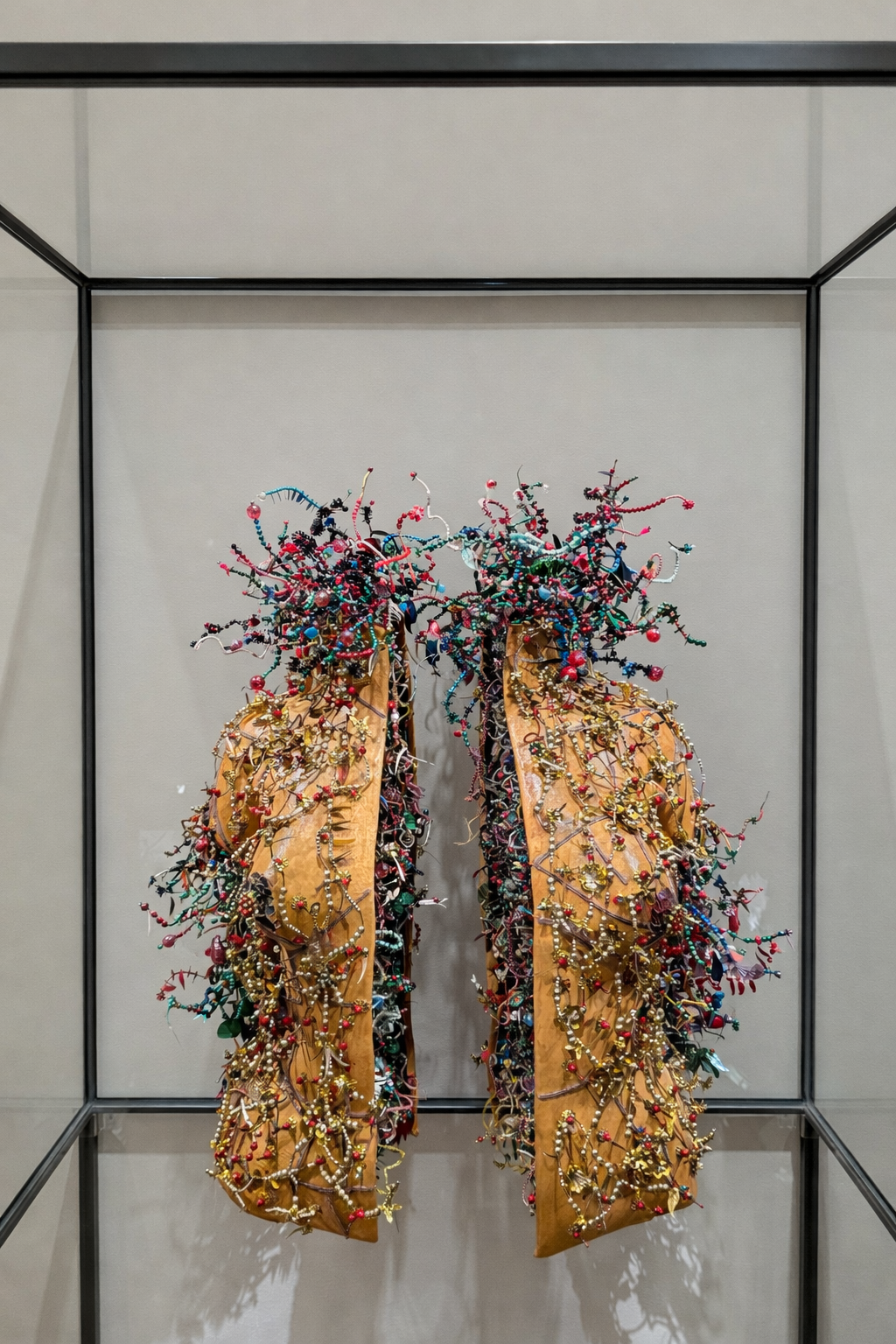
They look at once like classical statues and the remains of future machines, extending Lee Bul’s long-standing language of the body, architecture, and utopian failure. For any contemporary artist, to occupy the facade of the Met is to have one’s place in art history affirmed. Lee Bul, Untitled (Willing to Be Vulnerable—Velvet #12) (detail), 2020. Photograph by Jeon Byung-cheol. Courtesy of the artist. Lee Bul at the exhibition. Photograph by Leung Yu Chung. Courtesy of M+. "Utopian ideals are part of what makes us human."
"Human beings are always moving through a cycle of idealization, failure, and rebuilding. We know utopia will fail, yet we keep idealizing again. That cycle of expectation and failure is precisely what constitutes human history." Chong told us that before the exhibition, Lee Bul also spoke with him about the view of history held by the twentieth-century German philosopher Walter Benjamin.
"The present is never an isolated moment. The present always flickers together with the past, which keeps reappearing within it. We do not only look forward; we are always looking back as well. I think that almost sums up her entire artistic practice."