Shi Jinsong: Five Solo Exhibitions in One Year, Where Hard Edges Meet Tradition
“Mm, pretty good—kuoyi, kuoyi!” the artist Shi Jinsong says, laughing in standard Wuhan Mandarin. His work is tougher and more experimental than his easygoing manner suggests: metal mecha strollers, nail-studded pine trees, metallic bamboo, ruin gardens, wire-wrapped figures, dazzling disco balls, and monumental portraits. His practice moves restlessly among sculpture, installation, painting, performance, multimedia, theatrical experiments, and conceptual design......
By / Xirui Huang · 11 min read
Why does Shi Jinsong turn bamboo and motorcycles into a futuristic garden?
In Xirui Huang’s 2022 interview, Shi Jinsong connects his childhood interest in bamboo manuals with experiments combining plant forms, mechanical joints, metal surfaces and 3D printing. Motorcycles reconstructed with wood extend his exploration of relationships between nature and industrial objects. The resulting garden feels both familiar and strange, using hybrid images of plants, people and machines to question ideas of life and the future.
“Mm, pretty good—kuoyi, kuoyi!” the artist Shi Jinsong says, laughing in standard Wuhan Mandarin. His work is tougher, more forceful, and more experimental than his easygoing manner suggests: metal mecha strollers, nail-studded pine trees, metallic bamboo, ruin gardens, wire-wrapped figures, dazzling disco balls, and monumental portraits. His practice continues to move among and open up a range of forms—sculpture, installation, painting, performance, multimedia, theatrical experiments, conceptual design, and more.
SECTION 01 | Alternative garden: composed of cyber bamboo and magic motorcycle
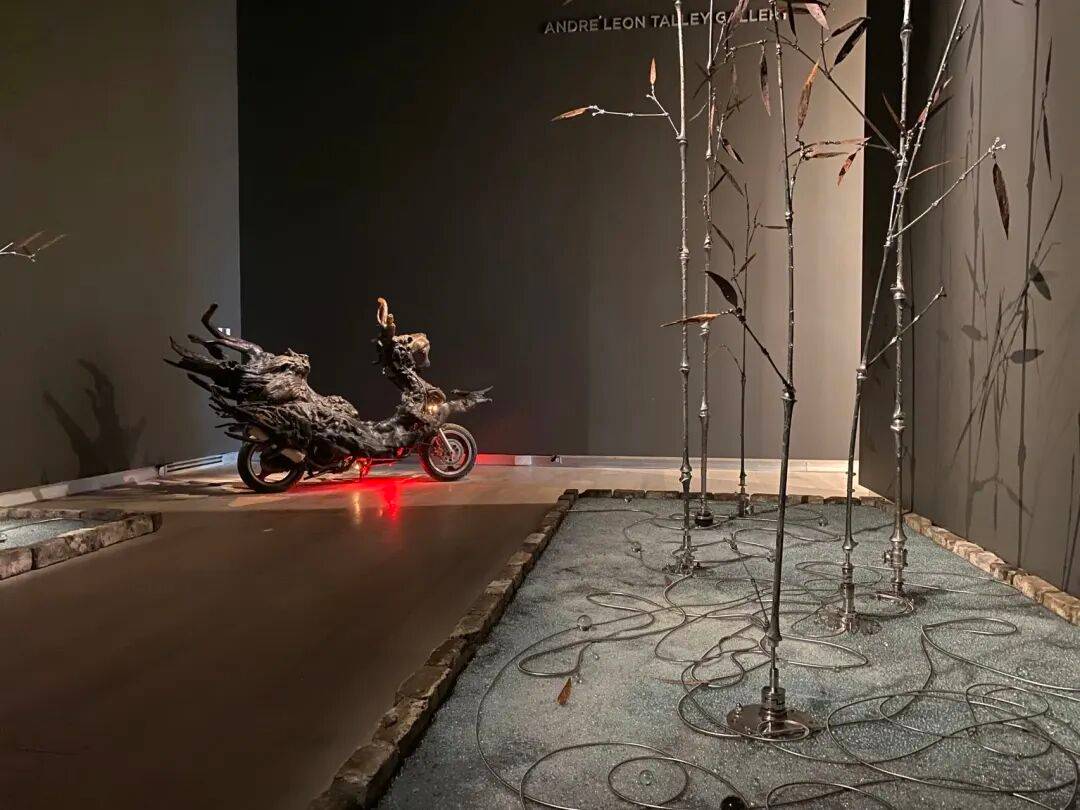
A member of the generation born in the 1960s, he remains as passionate about making work as any young artist, and this year has already seen him complete 4 entirely different solo exhibitions. As his 5th solo exhibition opened, I spoke with this “boy in his 50s” about his work and his life. Shi Jinsong, *Waiting for an Answer That May Never Come*, exhibition view, 2022. Entering the artist’s latest solo exhibition, one finds several metallic, mechanized bamboo plants; two motorcycles wrapped in glossy old wood; and bricks arranged in a matrix on the floor. Together they form a “cybernetic botanical” garden where art, machinery, and technology converge. Some have called it “wasteland style,” combining a sense of nature with one of the future.
These new works extend the artist’s familiar visual language while continuing and answering his earlier projects.
Each joint of the “bamboo” is fixed with metal screws. The texture of the veins and the surface of the stalks closely resemble real bamboo, while polished and matte finishes make one wonder whether the artist has simply coated actual bamboo. Shi Jinsong, *Future Poetics Research · Bamboo Manual—Ball-Jointed Eight-Stroke Flying Wild Goose Form 1#*, 2022. 3D printing, electroplated copper, electroplated nickel, stainless steel, paint, and other materials. Approximately 107 centimeters high (the leaves are adjustable). Price: RMB 36,000. Edition 3/9–9/9 available. Shi Jinsong, *Future Poetics Research · Bamboo Manual*, 2022. Every bamboo plant in this new body of work “grew” piece by piece in the artist’s studio.
“Around 2007, I had this idea: to turn bamboo into a complex future composite and examine the relationship among plants, people, and machines. How, exactly, should we define a new life-form?” Shi says he chose bamboo because of his childhood fascination with the “Bamboo Manual,” but 3D printing and related technologies were not yet mature, so those freewheeling ideas were shelved. Shi Jinsong, *Future Poetics Research · Bamboo Manual*, 2022. Shi Jinsong, *Future Poetics Research · Bamboo Manual—Point-Jointed Five-Stroke Golden Fish-Tail Form 1#*, 2022. 3D printing, electroplated copper, electroplated nickel, stainless steel, paint, and other materials. Approximately 87 centimeters high (the leaves are adjustable). Price: RMB 18,000. Edition 3/9–9/9 available. Last year, through a chance opportunity, Shi was invited to collaborate with the SCAD Art Research Laboratory. Working remotely, he established a multidisciplinary science-and-art laboratory in his own studio.
“I have a 3D printer, equipment for electrolytic copper, nickel plating, and painted finishes, as well as all kinds of other chemical materials. I felt I had become a contemporary alchemist,” Shi says with a laugh. He also told us that one day he might turn the entire process by which the works “grow” into a live exhibition. “That would be much more fun than simply showing the finished works.” Shi Jinsong, *Waiting for an Answer That May Never Come*, exhibition view, 2022. Shi Jinsong, *Waiting for an Answer That May Never Come*, exhibition view, 2022. The works that reconstruct motorcycles with trees date back to 2005 and have continued ever since.
At each exhibition, the series takes a different form and enters into dialogue with its surroundings. For the 2016 version, Shi invited a florist to “plant” flowers and grasses in the trees; a friend even brought over a pet macaw to complete the overall composition. Shi Jinsong’s early motorcycle work *Hakeldragon*, 2003–2006. By 2020, the trees on the motorcycle had become pure black, carrying a dark energy, as if they might swallow everything around them.
This time, he collected parasitic plants that resemble a horse’s mane and transplanted them onto the trees. Explaining the source of the series, Shi said that it projects an imagining of the future onto the present.
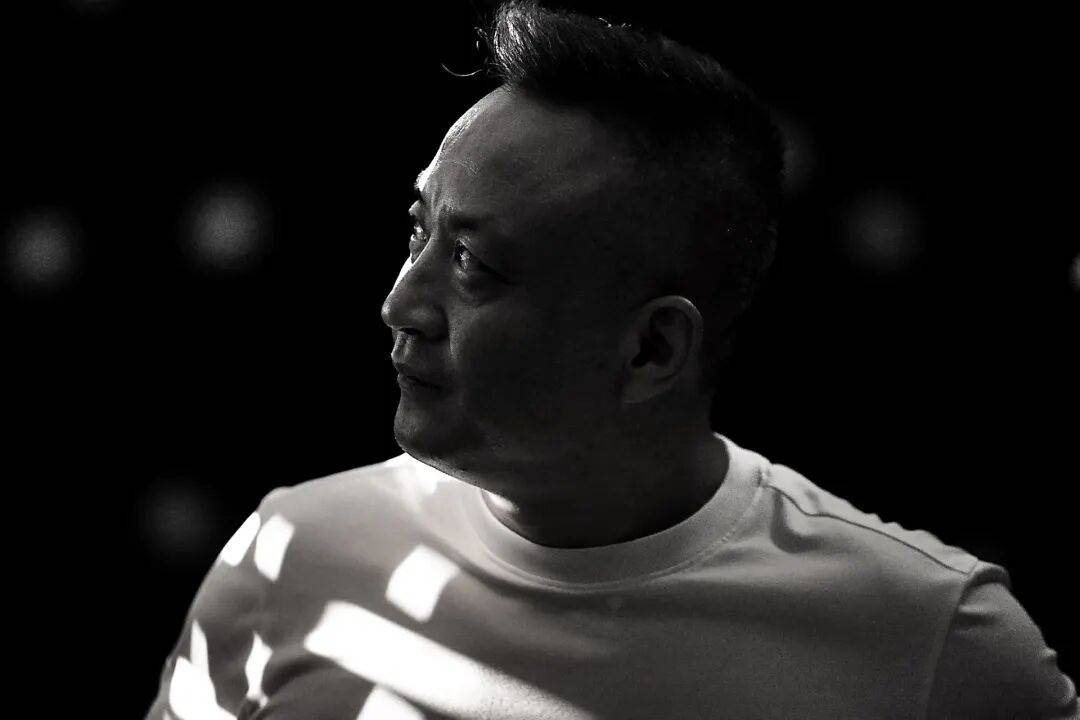
“In tradition, we speak of the unity of heaven and humanity; human beings and nature form a whole. In the future, might machines also belong to nature?” Shi Jinsong in his youth. The artist is a native of Hubei. In 2022, he held 3 exhibitions simultaneously in Wuhan, realizing with unusual thoroughness his original dream of exhibiting there.
SECTION 02 | Hold an exhibition in Wuhan and return to the place where the dream began
“My mother was from Wuhan. After she went to the countryside, she married my father, and then I was born. From childhood, I knew Wuhan was a place we would return to,” Shi says. “And at 17, that dream-filled age, all my ideas about art began in Wuhan.” Shi Jinsong, *Food Scene: Sweet Laboratory*, premiere at the Wuhan Zhimei Space Food Theater, 2022. Shi Jinsong, *Food Scene: Slime Mold Petri Dish*, premiere at the Wuhan Zhimei Space Food Theater, 2022. Shi Jinsong, *Food Scene: Sturgeon*, premiere at the Wuhan Zhimei Space Food Theater, 2022. Shi Jinsong, *Food Scene: Sensory Laboratory*, premiere at the Wuhan Zhimei Space Food Theater, 2022. Of the 3 exhibitions, one was the largest self-dialogue of Shi’s 36-year career; another was a moving-image installation exhibition addressing life and death; and the third, centered on food and growth, sought to “empathize with all things and move in rhythm with nature.” Together they reflected the diversity and breadth of his practice, as well as his sustained engagement with ordinary life.
Almost all the works in the 3 exhibitions were new, made “in the face of a new world, with new questions and new stimuli.” Shi Jinsong, *Wuhan 2022—Shi Jinsong Solo Exhibition*, exhibition view, 2022. At the Wuhan Art Museum, 3 groups of works responded to 3 different periods in the artist’s 36 years of practice. The exhibition was his largest, and a dialogue between the artist and his younger, adolescent and young-adult selves. The most conspicuous object in the gallery was a constantly rotating, glittering disco ball.
Photographs of the artist’s work and life over 36 years were cut into small fragments and affixed to the ball’s mirrored surface. Why a mirror? Shi recalls with a laugh: “When I was little, my parents were at work, and I was often locked alone in the house. It felt as if I had grown up with mirrors. Someone saw the work and joked, ‘It’s all you in the mirror. You must be so narcissistic.’” As viewers stand before the work, they too can see a “hallucinatory self.” For Shi, this is not merely his own universe. He wants to share the sensation of looking into a mirror together, confronting fragments of the self as time and space revolve.
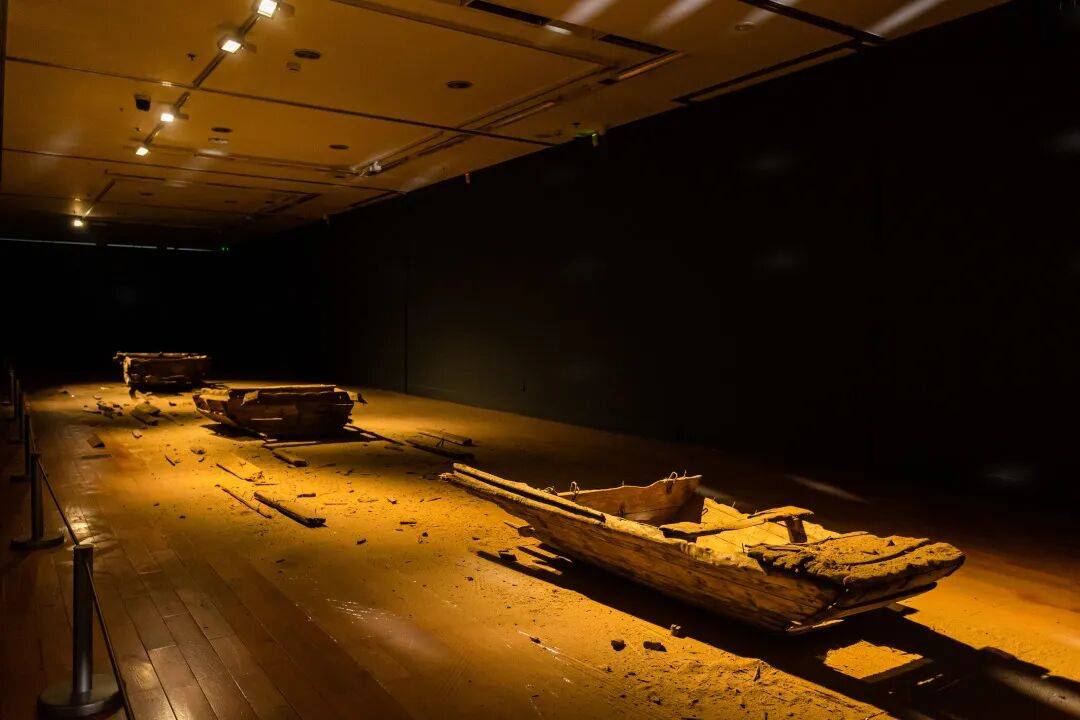
Shi Jinsong, *Wuhan 2022—Shi Jinsong Solo Exhibition*, exhibition view, 2022. Beside the disco ball stood an old wooden boat transported from Chibi. On-site, the artist invited viewers to help him sand the hull with a machine. The extremely fine dust gathered around the old boat, which seemed like a living organism passing through the vicissitudes of time amid the remnants of its own body. Shi Jinsong, *Wuhan 2022—Shi Jinsong Solo Exhibition*, exhibition view, 2022. In the first gallery, wires descended from the ceiling in the outline of a human body—the shape produced when the artist bound himself with wire and then broke free.
“Using machines, I make them swing back and forth at a particular rhythm, like a dance, telling of life’s entanglements and the fated cycles we cannot escape.” During the making of the work, both binding and opening were difficult. The artist had to wind the wire slowly, then slowly extricate himself. At times, the person and the net seemed to torment each other, twisting into a knot.
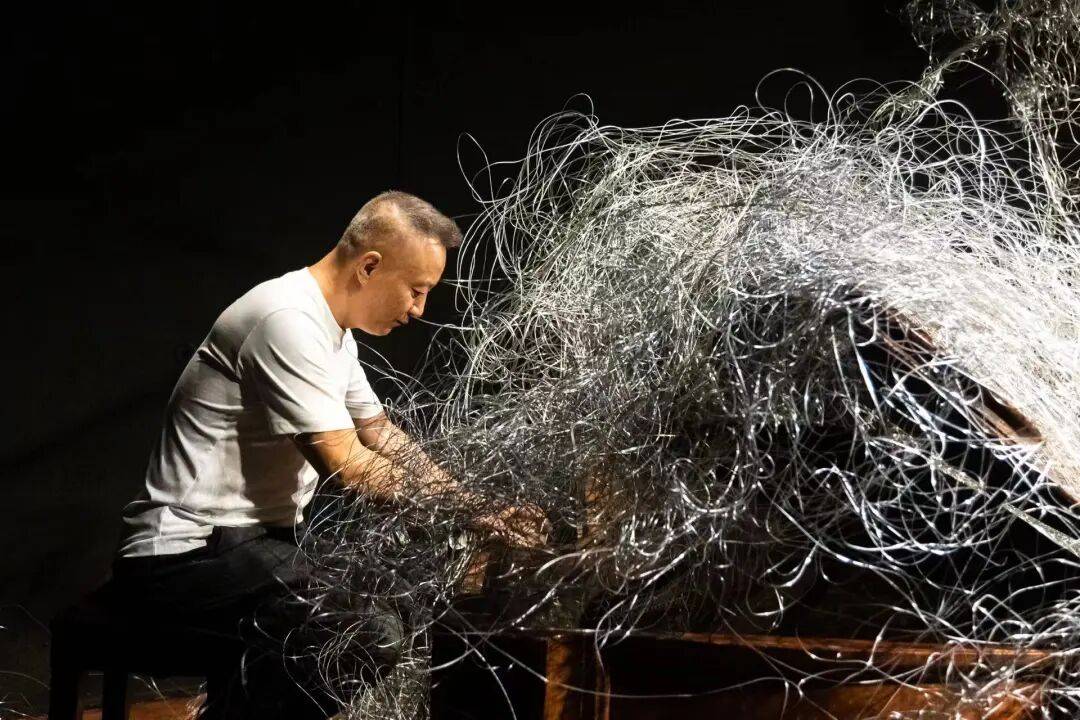
“You can also understand it this way: these nets are like the various constraints that invisibly coil around us—unstable, indistinct, seeming to be one thing and then another.” The exhibition also included an antique Steinway piano bound in wire, born in 1872. It, too, was closely tied to the artist’s upbringing.
“I grew up in a cultural center, watching people play the piano. I felt that the sound of the piano was always somewhere far away, but I could always hear it.” At the exhibition, Shi performed publicly for the first time on the piano wrapped in wire. Though he could not play at all, he struck the keys with such confidence and composure that he looked like a piano virtuoso. From his youth to the present, he has remained a romantic.
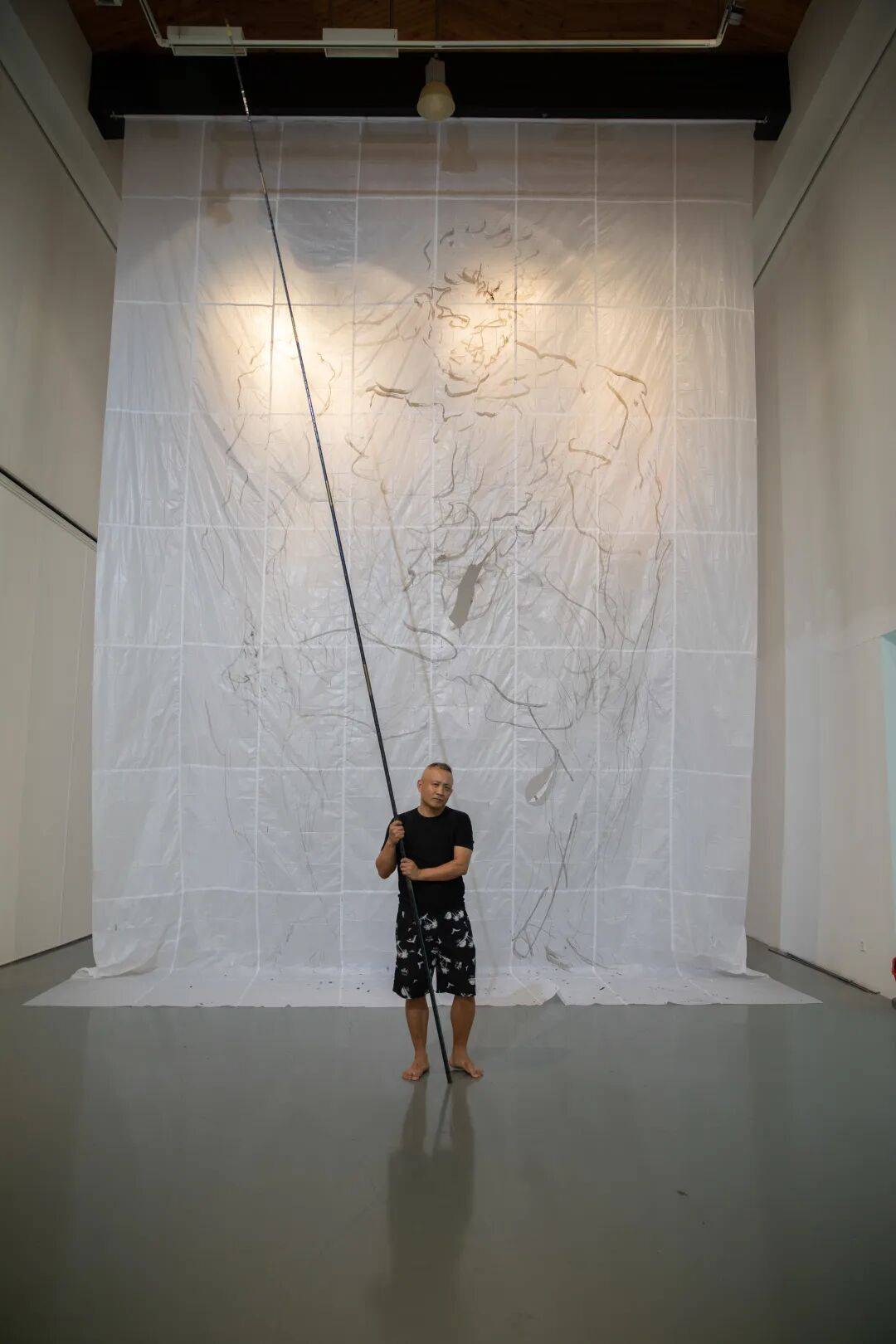
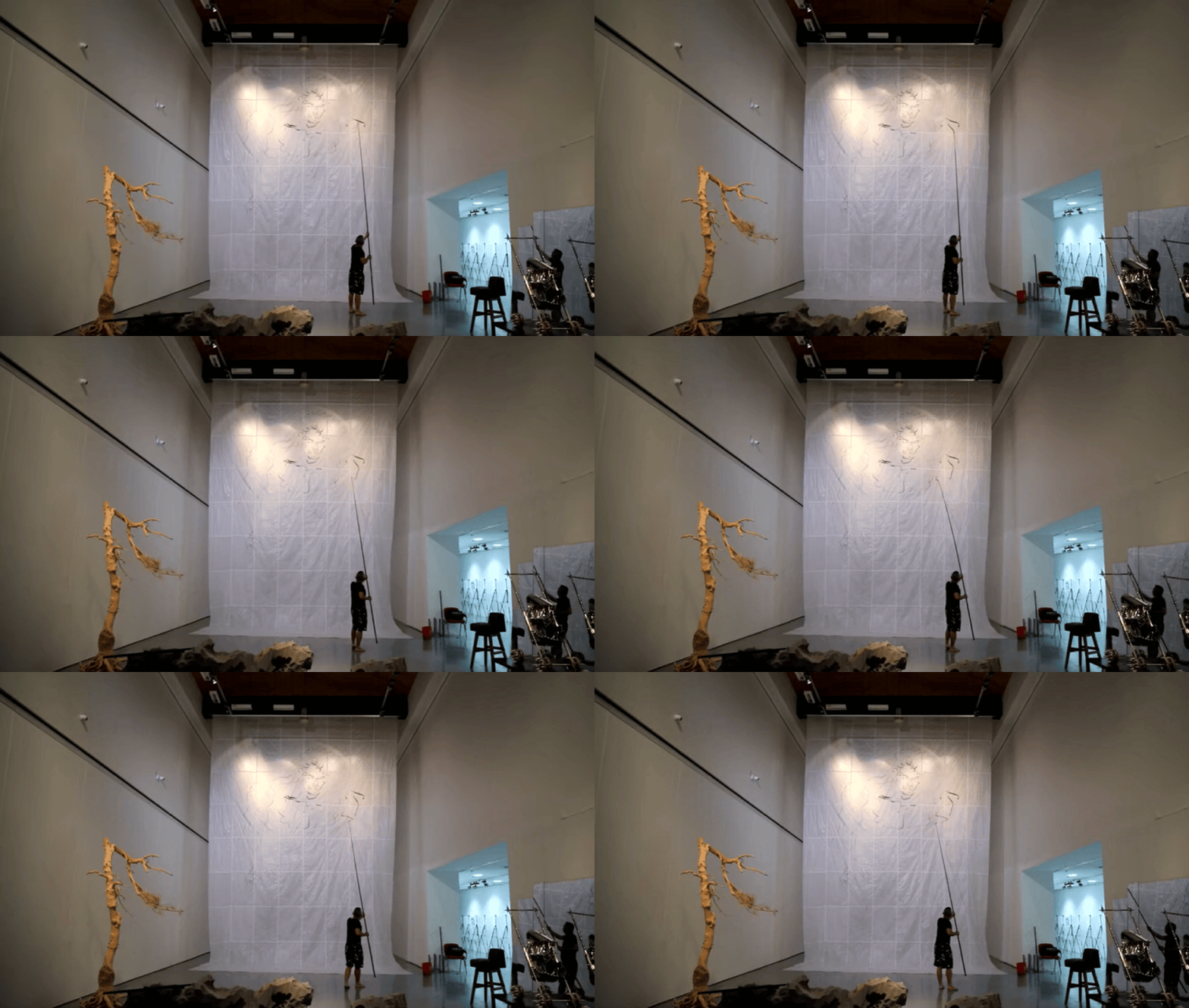
“When we were young, we sang every day: ‘Without colored lights, without intoxicating wine, we dance disco under the moonlight.’ Now we seem to have the colored lights and the wine, but we no longer dance under the moonlight,” the artist said. Shi Jinsong creating a self-portrait at the Wuhan Art Museum. The third gallery contained 2 enormous self-portraits made on-site, 7 meters wide and nearly 9 meters high. Constructed from the thinnest ordinary white paper, they looked extremely fragile, fluttering slightly whenever someone passed.
While making the self-portraits, the artist tied a stick of charcoal to the tip of a fishing rod and used it to touch the extremely thin paper.
“As I drew, the paper kept moving. It was a way of painting very close to the ‘body.’ What the painting became was beyond my control. I was trying to depict myself on a support floating in midair; that experience is what I wanted to express.” The method resembles the effort to define one’s shape within a crowd. Shi Jinsong, *Slide Show—Shi Jinsong Solo Exhibition 00:00:29:99* (excerpt), 2022. Wuhan Art Documentation and Art Center, *Slide Show—Shi Jinsong Solo Exhibition 00:00:29:99*, exhibition view, with visitors seated on transparent chairs, 2022. In another work closely connected to the artist’s personal history, he organized more than 600 photographs accumulated over 36 years of making art—the images that had stayed with him most.
He played them rapidly, one by one, layering them according to the rhythm of human breathing. The work echoes the “last 30 seconds” research familiar to us: during the final 30 seconds before death, a person’s important memories may replay before the eyes like a slide show. Many transparent chairs were arranged in the exhibition space, allowing viewers to watch this sample of the artist’s life with a sense of floating. Shi says, “It is an exercise in death.”
Shi Jinsong: Five Solo Exhibitions in One Year
Shi Jinsong, *6.2-Meter Welcoming Pine*, collected by the Powerlong Museum, Shanghai, 2005–2007. Shi Jinsong, *6.2-Meter Welcoming Pine* (detail), collected by the Powerlong Museum, Shanghai, 2005–2007. Shi Jinsong, *Pine Wind in Ten Thousand Valleys*, exhibition view, 2018. Asked why he chose to become an artist, Shi joked, “I seem to have been born to do this. I never chose it.” Shi has always loved nature.
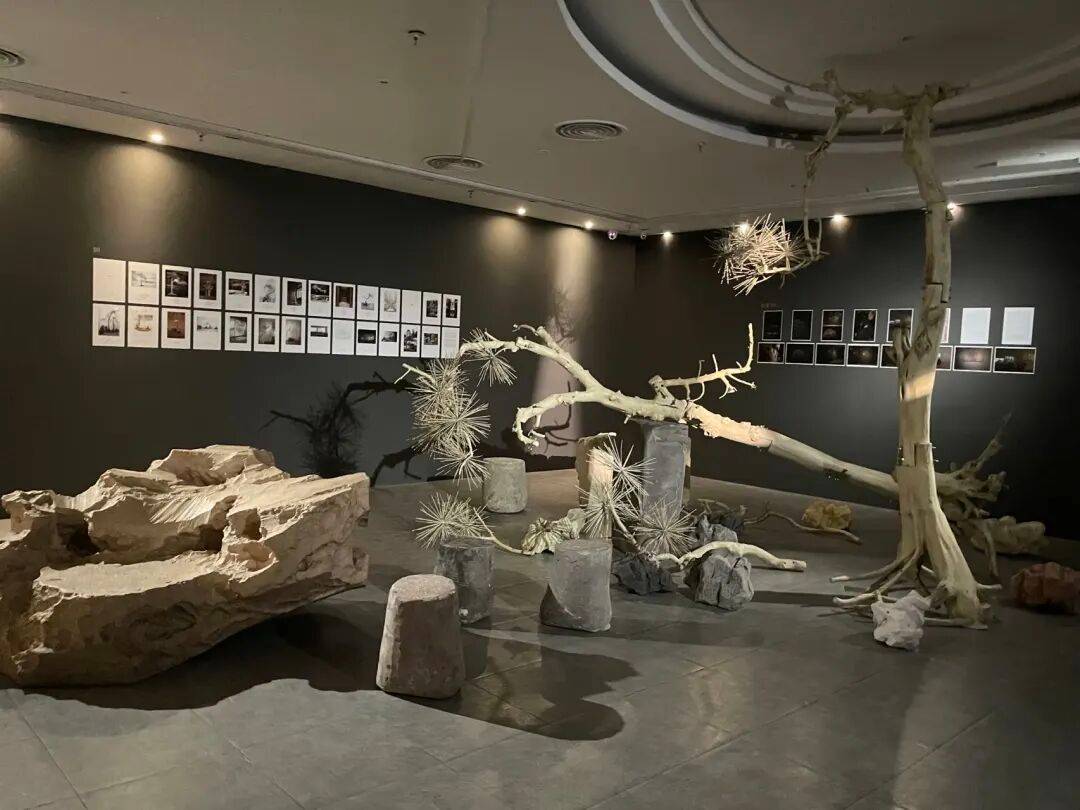
In 2005, he created the *Pine Wind* series, collecting the tree remnants he knew best and joining them with the simplest screws, assembling them into forms based on his memory of trees—forms resembling *Dawn Wind, Waning Moon* and *Painting of Two Pines*. He especially likes Ma Zhiyuan’s line “withered vines, old trees, dim crows.” “Put the most fitting objects and images together, and let them form a narrative and an emotion,” he says. He believes the art he makes operates on the same principle.
SECTION 03 | From grand narrative to personal and ever-changing artistic creation
Shi Jinsong, *Pine Wind*, exhibition view at 33 Contemporary Art Center, Guangzhou, 2022. There are not many works in the *Pine Wind* series, but it became unexpectedly popular, especially after one work appeared in a public space. The series has since become one of the most widely copied and imitated bodies of work; counterfeiters have even sold replicas openly in online shops.
“As an art worker, seeing so many people copy and imitate me, I instead feel it’s something quite ‘awesome.’ If many people have improved their lives because of it, that could also be considered ‘boundless merit.’” He remains notably calm and open-minded about the situation. Photographs of Shi Jinsong visiting factories that reproduce the *Pine* series. In the years that followed, Shi visited many such factories in person, and the results of his research genuinely frightened him. One factory in a city in Guangxi, in particular, produced more than 4000 imitation trees a year.
Across China, there are now at least 100 factories, large and small, making “pines,” forming a complete production chain. Some companies specialize in wood wholesaling, parts assembly, or kiln-drying; others have their own designers. Shi Jinsong, *Pine Wind in Ten Thousand Valleys*, exhibition view, 2012. In response, Shi mounted a solo exhibition at an art museum, *Pine Wind in Ten Thousand Valleys—The Third Kind of Reproduction*. He selected 8 of the most representative manufacturers, and the exhibition’s works came from the various pine-related products made by these copycat factories.
The exhibition did not condemn them or seek to create confrontation. It simply presented a complicated state of “coexistence.” Through the exhibition, the artist created an entirely new public space and hoped that new forms of creativity would emerge there.
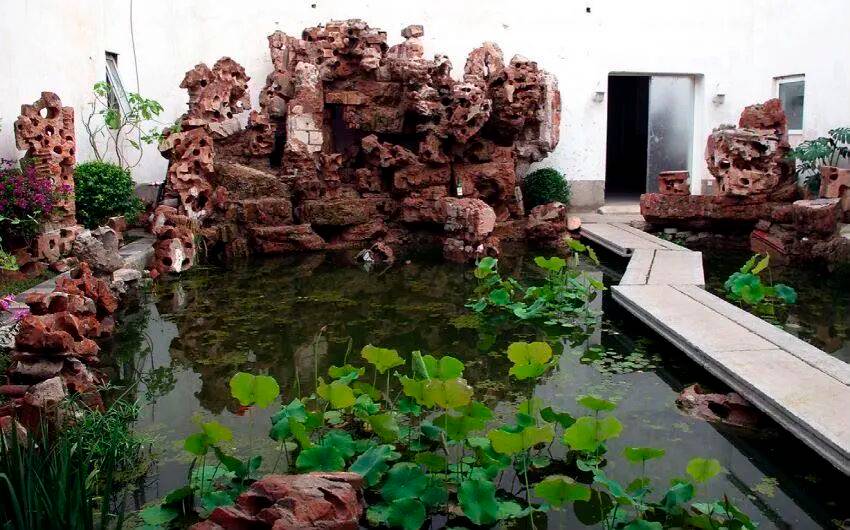
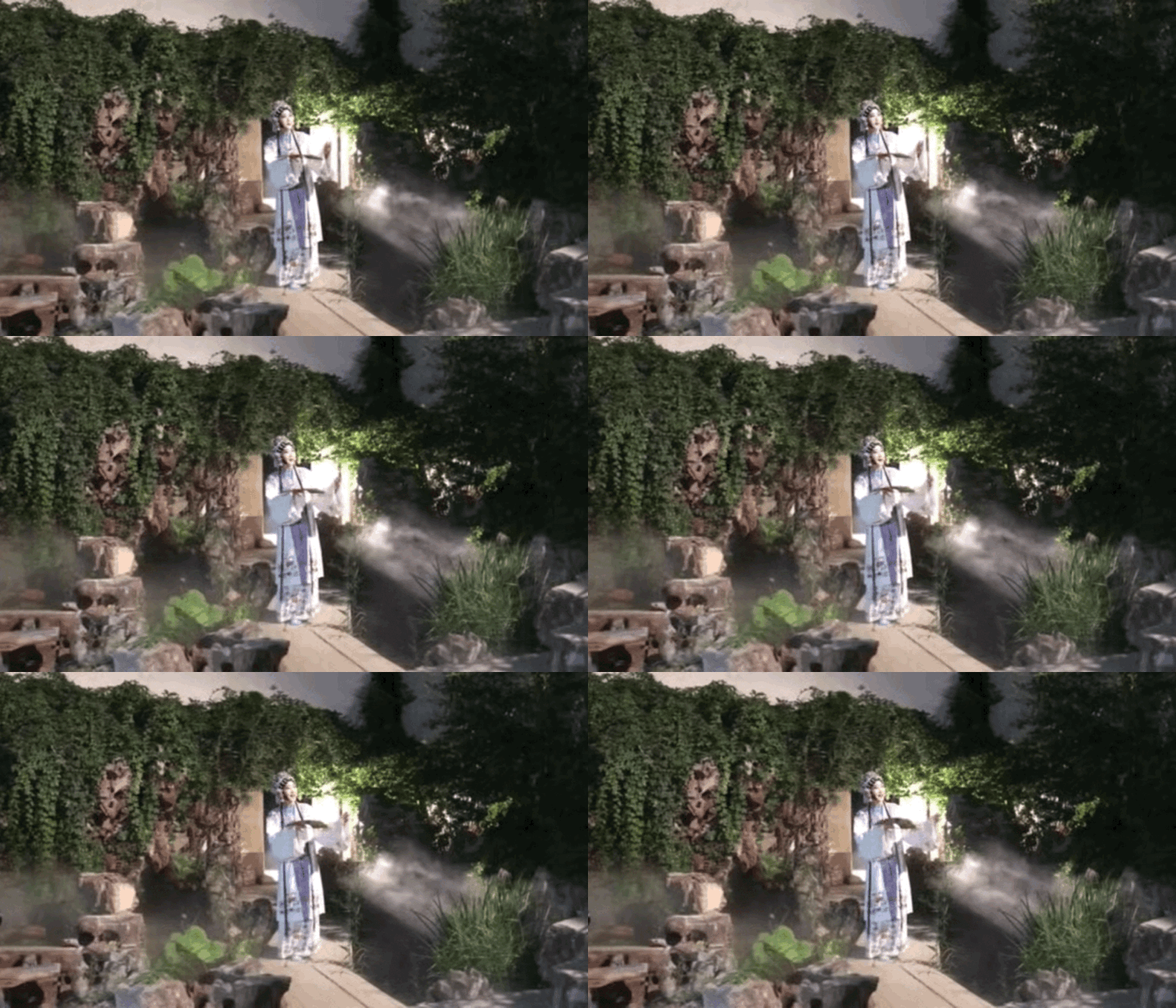
“As an artist, at least I can present these problems and phenomena, so that people can face them and discuss how to improve the relationship between ‘me’ and this world.” Shi Jinsong, *Garden* series. Kunqu performer Bingbing performing Kunqu opera in Shi Jinsong’s studio. Later, after visiting the classical gardens of Suzhou, he found another source of inspiration. He took the broken stones left over from dismantling his studio, repaired them, and made a new garden—a new studio.
His friends also enjoyed coming to play in the newly built courtyard. One Mid-Autumn Festival, a friend even sang Kunqu opera there.
“Looking back, it was pretty ‘rock ’n’ roll,’” Shi recalls with a laugh. Shi Jinsong, *The Sweet Life*, exhibition view at the Centre Pompidou, France, 2003. Around 2000, Shi shifted the focus of his practice from grand narratives to specific personal ones. He used amber-colored sugar to make a series of household objects—pots, bowls, basins, shampoo bottles, small toys, and more. At exhibitions, children would sometimes pick up the works and eat them, filling the entire space with a sweet smell.
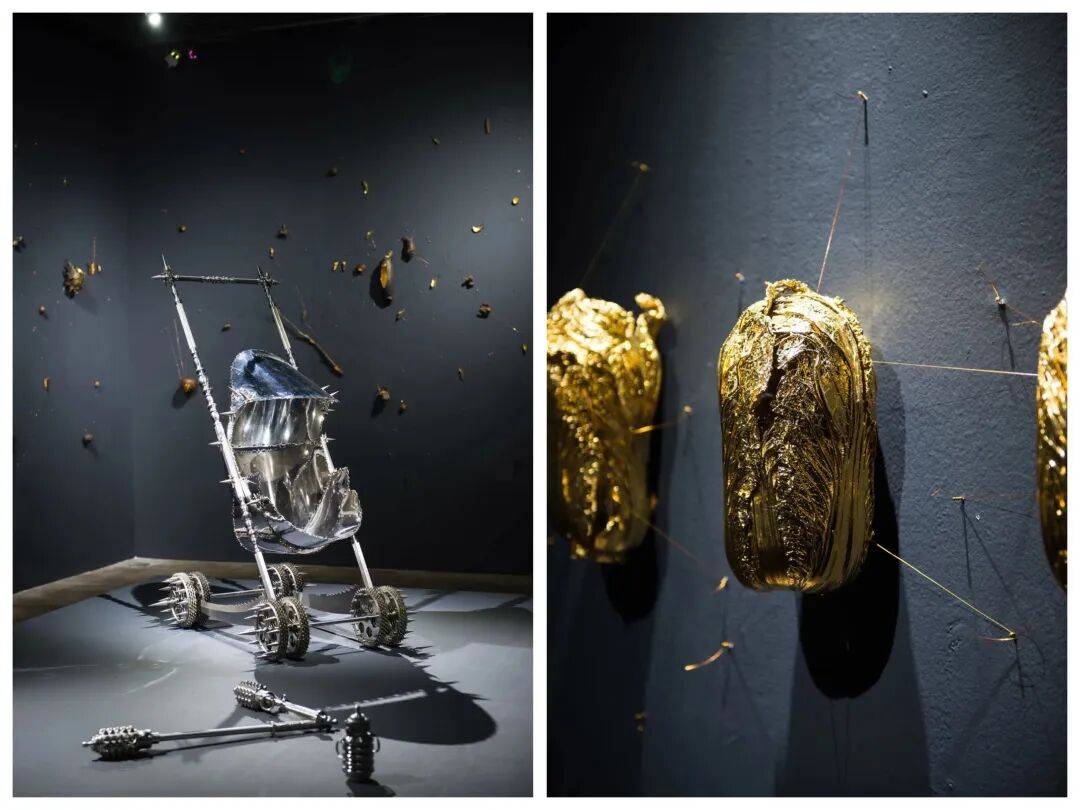
Shi Jinsong, *Sky*, exhibition view at HOW Art Museum, Shanghai, 2021. Shi Jinsong, *Personal Design Expo*, exhibition view, 2016. After becoming a father, his work clearly acquired more “dad” elements, though in a more hard-core form that viewers understood as “aesthetics of violence.” He turned a baby stroller into armor, for example, because armor can protect and intimidate, shielding a child from every kind of attack. Shi Jinsong, *Sky*, exhibition view at HOW Art Museum, Shanghai, 2021. “After my daughter was born, I kept thinking about the kind of environment in which she would grow up and how I would educate her.”
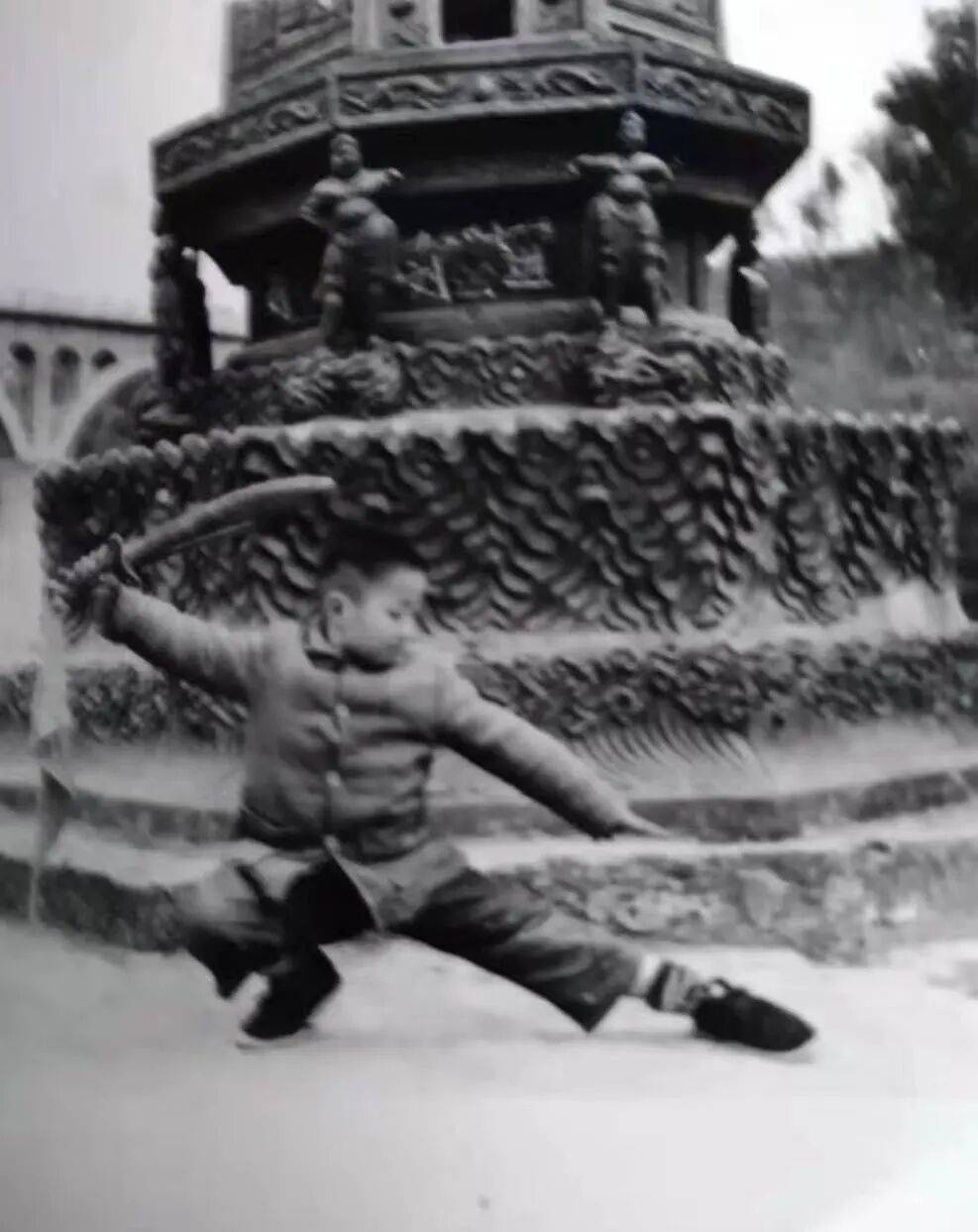
He also collected secondhand toys that babies had outgrown and made *Cicada Shedding Its Shell*. He does not expect his child to become some “world-conquering hero”; he only hopes she will grow up happily. Shi Jinsong as a child. The artist Shi Jinsong practicing boxing. In conversation, Shi told us that he is also something of a “martial artist.” Born premature, with a large head and small body, he was often bullied by other children. Later, in order to strengthen his body, he learned extensively from one of his father’s students. He has continued practicing martial arts ever since.
In recent years, he has continued discussing with friends in professional martial-arts circles how to create newer, more interesting competitions related to combat arts. This, presumably, is another form of his exploration of art-making—and of his increasingly open attitude toward it. He now spends long periods in Beijing. He deliberately chose a studio relatively far from home; as he drives slowly through the city, he enters a state of thoughtfulness, which is important to him.
Shi Jinsong, *2 Minutes 56 Seconds*, 2008. At the suggestion of an automotive expert, the artist carried out a series of destructive modifications and adjustments to 2 old four-cylinder carbureted engines. He posed the question to viewers: “This personalized machine, or scientific experiment with no universal significance—don’t you think that is, in fact, art?” His working method requires a wealth of vivid, abundant ideas, which he then communicates to factories through countless rounds of discussion and revision until the work finally takes the form he wants.
For that reason, he must remain acutely responsive to the circumstances of the present.
“Just as a fighter in martial arts has to remain constantly alert,” Shi says, offering a particularly apt metaphor. He says he has no desire to become an artist who merely preserves what already exists, remains trapped in old habits, or continually looks back. He keeps changing his angle of address to the world and repeatedly saying goodbye to familiar versions of himself. He often jokes with friends, “I’m a boy in my 50s. A strange ‘boy’ who keeps setting out and refuses to grow up.”
Shi Jinsong, *Personal Design Expo*, exhibition view, 2016. Wuhan, a city in central China, remains relatively peripheral within the contemporary-art world. What qualities do Wuhan artists possess? Shi offered a particularly down-to-earth comparison: “They’re like Wuhan cuisine. It’s hard to see exactly what makes it most distinctive in terms of form. When people ask me, ‘What do you eat when you go to Wuhan?’ I can only think, ‘Something delicious.’ I really can’t name a particular dish.