The artist Shen Yuan was born in 1959 into a family of artists and became one of the leading figures among the Chinese avant-garde who settled in France, one of the first generation of Chinese women artists to win an international reputation. In the 1990s, she and her husband, the artist Huang Yong Ping, also an artist, arrived in France, and the barriers of language and the rupture of culture became a wellspring of inspiration for her......
By / Xirui Huang · 12 min read
Who is Shen Yuan, and how do her installations explore migration, women and memory?
Shen Yuan is a Chinese artist born in Fujian in 1959 who moved to France in 1990. She transforms everyday objects into installations exploring language barriers, migration, women’s experiences and personal memory. Fragments of Memory uses a giant comb to carry memories, while Feminine Garden combines a corset with a garden. In this 2023 interview, Xirui Huang speaks with Shen around Angling at Beijing’s Red Brick Art Museum about how lived experience becomes material for her art.
The artist Shen Yuan was born in 1959 into a family of artists and became one of the leading figures among the Chinese avant-garde who settled in France — one of the first generation of Chinese women artists to win an international reputation. In the 1990s, she and her husband, the artist Huang Yong Ping, arrived in France, and the barriers of language and the rupture of culture became a wellspring of inspiration, driving her to make a body of work about the predicament of the immigrant, work that drew considerable attention and discussion.
Shen Yuan: Woman, Artist, Mother, Wife
Huang Yong Ping's sudden death in 2019, followed by three years of pandemic, made for a difficult stretch that nonetheless produced a run of new work. Shen, back in China from Paris for the first time in years, brought the pieces she had made over the previous two or three years to the Red Brick Art Museum in Beijing. Early this year, we talked with her about the work, and about what she has lived through, thought about, and felt in the years since. Her installation Feminine Garden (2017) was also on view at the Red Brick show, in 2023. The last time Shen had a solo show in China was "Wall-less" at the Minsheng Art Museum in Beijing in 2017 — five years had passed since then.
"This show had barely opened when the museum had to close for the pandemic, and then it was Spring Festival, and on top of that people these days feel like they've seen a whole exhibition once they've looked at some coverage and a few photos — there just seem to be fewer people actually coming to look," Shen said, laughing.
SECTION 01 | An exhibition, is it a memory or a farewell?
"But I'm glad I was able to make this show happen in such a particular moment. It has to do with the three extraordinary years we all just lived through together, and it's also a way of setting down my own memory of them." Her installation Mattéo and I, 2019–2021 was shown at Red Brick in 2023, alongside a photograph of Shen with Huang Yong Ping. The show, titled "Angling," contained only six works, but it mattered enormously to Shen. These six large-scale installations, made between 2019 and 2021, trace her path back, as she put it, "into the world of the living."
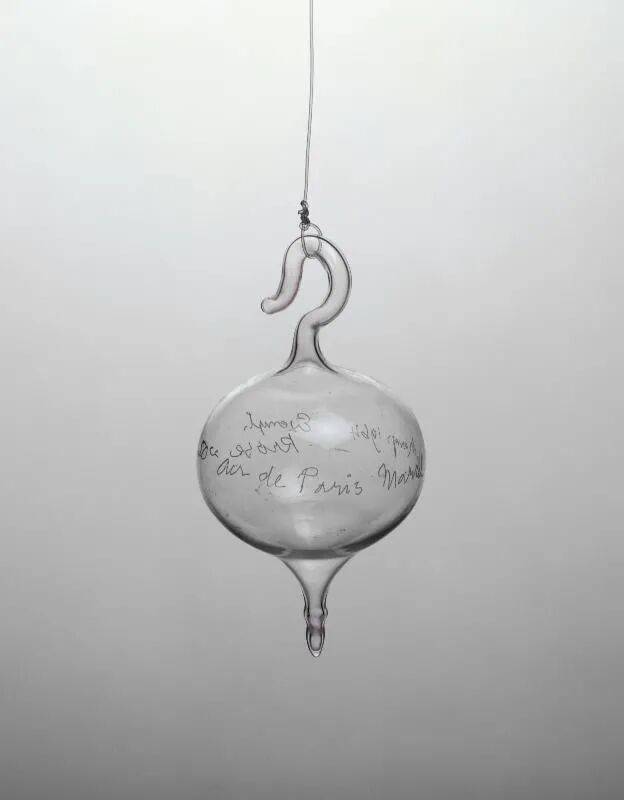
Each piece tells its own story. Angling for the Air of Paris, 2020 was shown both at the offices of ADAGP, the French visual-artists' copyright society, in Paris in 2022, and later at Red Brick in 2023. The piece runs like a thread through the whole exhibition, and gave the show its title. An old green wooden window frame, weathered enough that spiders have been busy spinning webs across it, holds a length of bamboo poking out through a gap, from which hangs a transparent glass pot.
"It's a metaphor — the theme of the show has to do with Paris, and with my own experience there," Shen told us.
"This piece feels like it was made by three people: me, Yong Ping, and Duchamp." The appearance of Marcel Duchamp, the father of conceptual art, might seem incongruous here, but it isn't. Duchamp, Shen says, was critical to Huang Yong Ping's path into contemporary art, and invoking him in this piece is also her way of remembering her husband. The strange notion of "the air of Paris" comes from Duchamp's 1919 work Air de Paris, one of his earliest readymades.
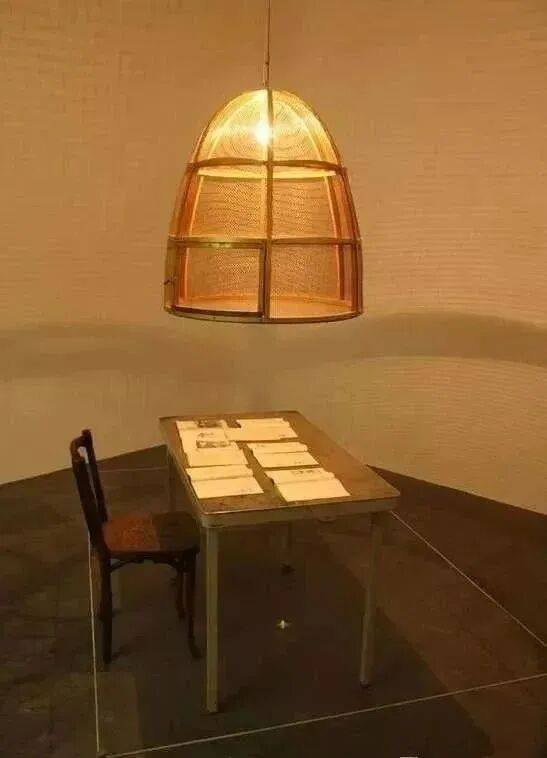
Duchamp had bought a glass pharmacy ampoule in Paris, emptied it, sealed fifty milliliters of Parisian air inside, and carried the bottle with him to the United States. In his own 1994 piece The Sage Learns to Weave From the Spider, Huang Yong Ping used a photocopy of an interview with Duchamp — Duchamp's earliest filmed interview, in which he laid out many of his ideas about art and about being an artist, ideas that went on to shape all of contemporary art and that left a deep mark on Huang. So once Huang and Shen arrived in Paris, Huang made this piece as a kind of tribute to Duchamp.
In another Duchamp piece, Fresh Widow (1920), Duchamp played a pun, changing just a few letters to turn "French window" into "Fresh Widow" — a reference to the women who had lost husbands in the First World War. The green window in Angling for the Air of Paris, 2020 clearly picks up the window, one of the central images in Duchamp's own work.
Shen cast herself as the spider spinning its web — using Duchamp's window to "angle" for the air of Paris during the frightening early days of the pandemic. The act of angling itself implies a kind of stillness in time, a way of stepping outside of reality for a moment.
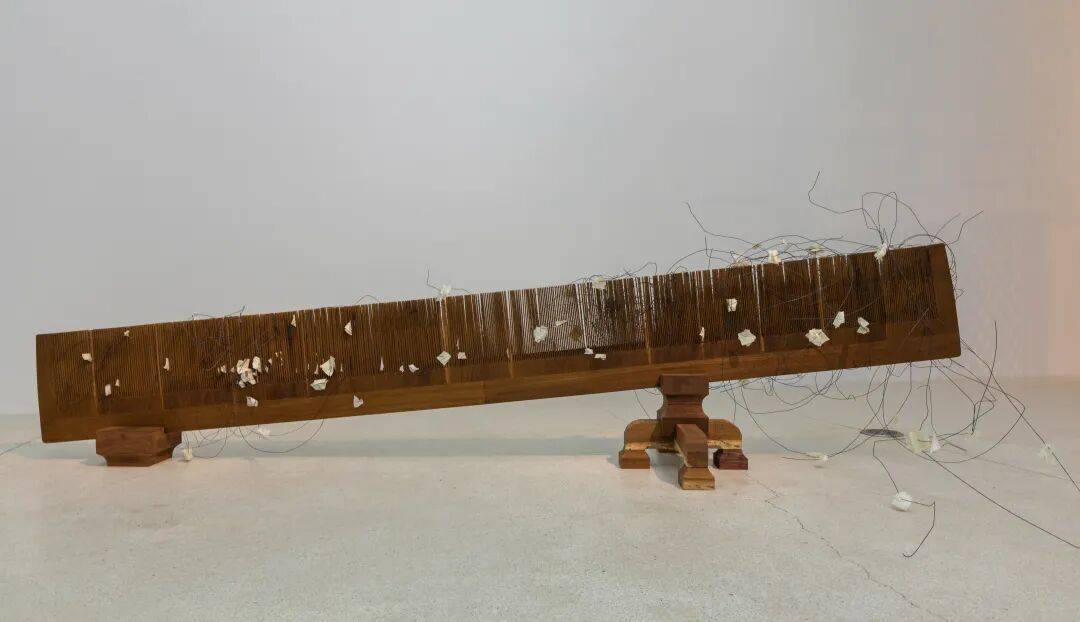
"A lot of Duchamp's work actually has to do with women, and I happen to be a woman artist. So this piece closes a kind of loop: Yong Ping and Duchamp, Duchamp and women, me and Yong Ping," Shen said. Another work in the show, Fragments of Memory, 2019, shown at Red Brick in 2023, drew particular attention: an enormous hair comb, five meters long. Wire is wound irregularly through its teeth, and yellowed scraps of paper are scattered across it, as if it were telling a story no one else knows.
For Shen, the comb is about memory, and about the small, overlooked details of daily life.
"I think a comb is actually a very private object, especially for a woman — something you carry with you. When someone close to you is gone, all you have left is your memory of the conversations you had with them," she said. She used the whole comb as a vessel for memory, with the wire standing in for the strands of hair that fall out when you comb your hair. Whenever we comb our hair, a bit of scalp always comes loose with it, and each fleck is like a fragment of memory flaking away; Shen used the scraps of paper as a stand-in for that scalp, and as a symbol for the fragments of memory themselves.
"I used some letter paper from the eighties — the kind we used to write letters on, back then," Shen said. Look closely and you can see the paper is ruled in green, faintly translucent, tinted slightly yellow now with age — a fit, almost by accident, with the idea of "fragments of memory."
"The truth is, as time passes, our memories do flake away. We dream up all kinds of images, and they're both real and invented, the way a work of art is. In the morning, as you comb through the residue of a dream, you gradually settle down — and that, too, is a kind of memory shedding itself." Another piece, Gazelles, 1990–2020, shown at Red Brick in 2023, reads almost like a lover's murmur on the pillow.
The title comes from the name of a student residence in Provence — the first place Shen and Huang Yong Ping settled after arriving in France in 1990. She cast a milky-white double pillow in wax, with a single bedspring frame reclining behind it. At the center of the iron frame, a woman's hand, hammered out of copper sheet, holds a gesture as if plucking a flower, on which a copper-wire dragonfly has alighted; several more dragonflies flutter around the frame.
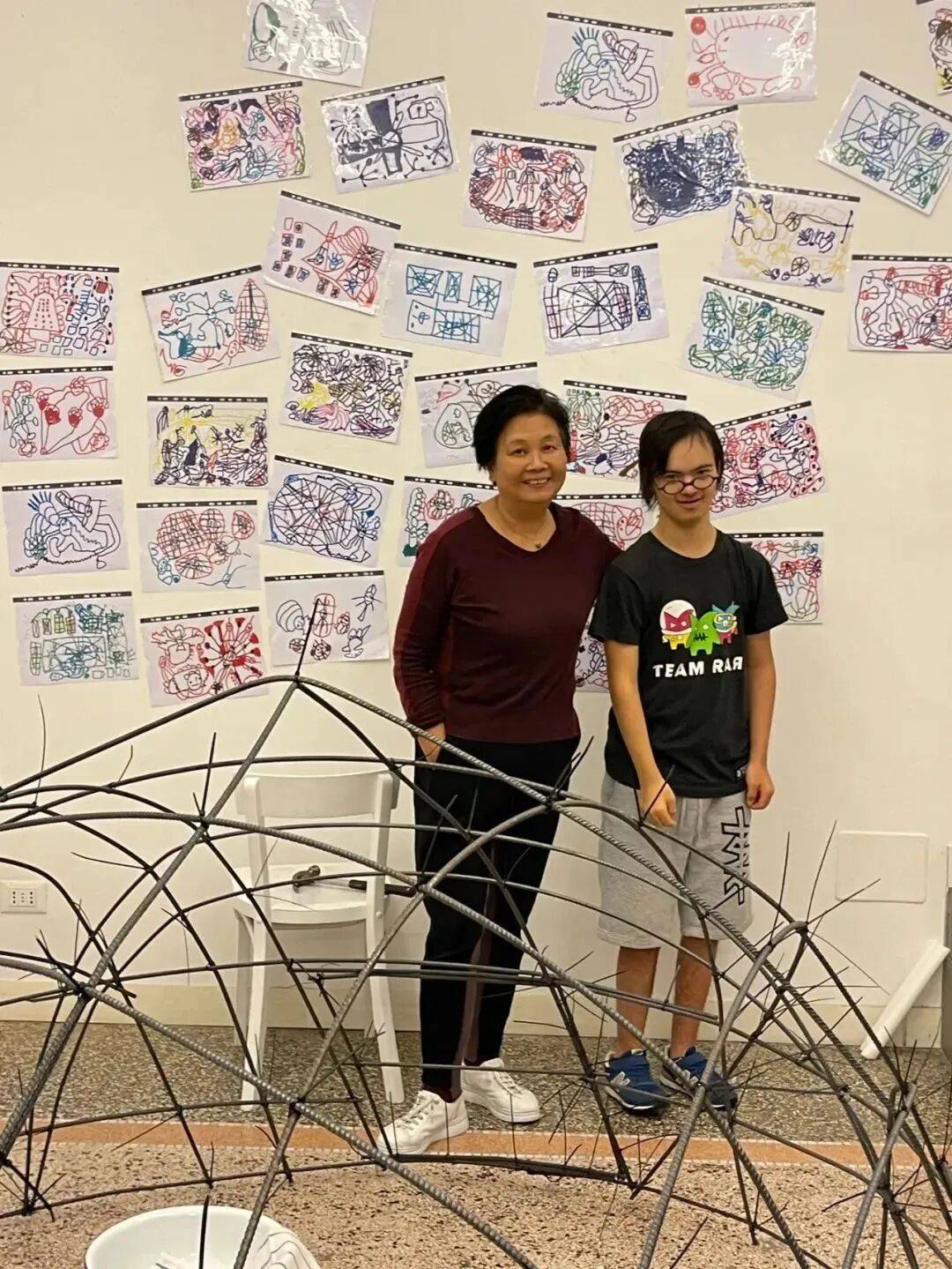
"What I really wanted was to tell a story from the past through the piece — the thirty-year span is the time in which the story unfolds," Shen said. We asked what the story actually was. She smiled faintly. "That's mine, a very private story, and it has to stay with me." Another installation, Mattéo and I, 2019–2021, shown at Red Brick in 2023, includes, pasted to the gallery wall, photographs Mattéo took of Huang Yong Ping at work alongside Mattéo's own graffiti drawings, next to a photograph of Shen with the teenage Mattéo, from 2020. The piece captures a period during which the artist and Mattéo were, in a sense, "locked down together."
Mattéo is the fourteen-year-old son of friends of Shen and Huang's. When he first came to visit their home with his parents, he was withdrawn and wouldn't speak, but he gradually relaxed, and it turned out he had an unexpectedly distinctive, unconventional eye for photography. Shen invited the teenager to photograph Huang Yong Ping at work, hoping to see her husband differently through his unusually unguarded eye. Then, in 2019, Huang died suddenly — a blow so severe that Shen spent more than a year in a kind of self-imposed isolation, refusing contact with other people, talking to herself.
SECTION 02 | My works are very close to life
A screen in the gallery played footage of a performance Shen gave at an exhibition in Rome. There, she built an enormous cage, based on one that kept recurring in Mattéo's drawings, and shut herself inside it in the gallery, scrubbing and wiping at the bars with cloth.
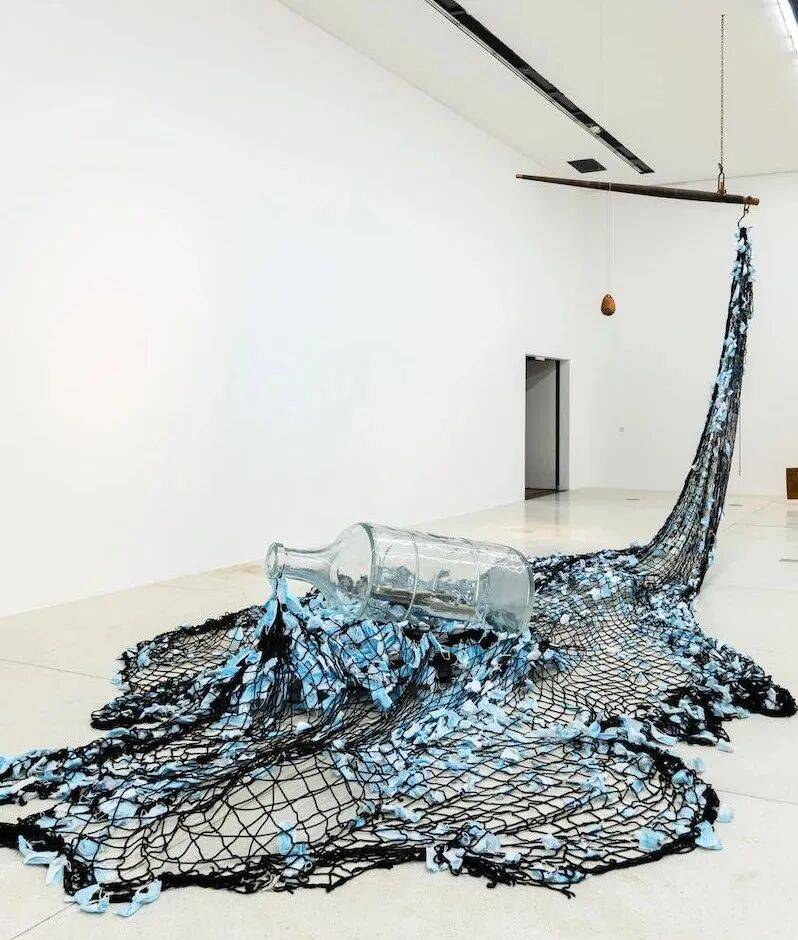
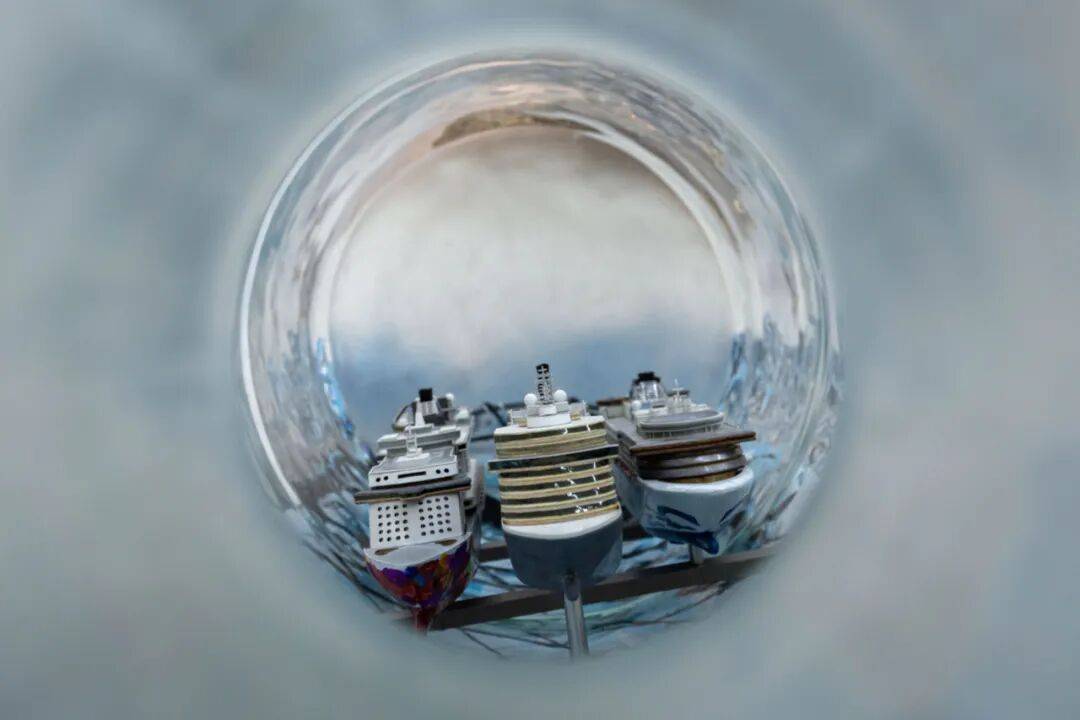
"I think artists always turn their work into a kind of transfer, a place to put their feelings. When I made that performance, it was a way of looking back at that period of self-isolation — letting out the feelings I'd been holding inside, releasing myself, bit by bit. Finish one piece, and you've taken another step forward." In another piece, Drifting, 2020, shown at Red Brick in 2023, transparent glass bottles, fishing net, an iron frame, and a scale's counterweights and beam combine into an enormous drift bottle, trapping three ships inside.
The reference was to three large international cruise ships, stranded at sea in the earliest days of the pandemic, unable to make port — all their passengers swept up into a vast historical vortex that no individual could do anything about.
"What I wanted to capture was how, under extraordinary circumstances, the relationships between people change: fear, rejection. A life can also change direction at any moment," Shen said. A photograph from that era shows the young Shen Yuan with Huang Yong Ping. The direction of Shen's own life was, perhaps, decided once and for all in 1990, the year she left for France with her husband. She was thirty-one when the two of them moved from China to France. The sheer scale of the cultural shift, the financial precariousness, and the silence forced on her by her status as an immigrant pushed her artistic language to grow at tremendous speed.
"I never studied in France, formally — I judged the work by eye, by feeling," Shen said. Born in 1959 into a family of artists in Fujian, she tested into the traditional Chinese-painting department at the Zhejiang Academy of Fine Arts. She was supposed to follow the standard path of ink painting, but instead found herself staying up all night in the school library, poring over foreign art books, discovering how much wider the possibilities of art could be, and developing more subversive ideas of her own. That hunger to overturn tradition led her, alongside her husband, into the experimental activities of the "Xiamen Dada" group, just as the wave of avant-garde art known as the '85 New Wave was breaking across China.
Members of the Xiamen Dada group. Her installation Water Bed appeared in the 1989
"China/Avant-Garde" exhibition in Beijing. Her first real breakthrough as an installation artist came with Water Bed, shown at the landmark "China/Avant-Garde" exhibition in 1989: a plain metal bed frame holding a transparent waterbed mattress, inside which a few live fish swam contentedly.
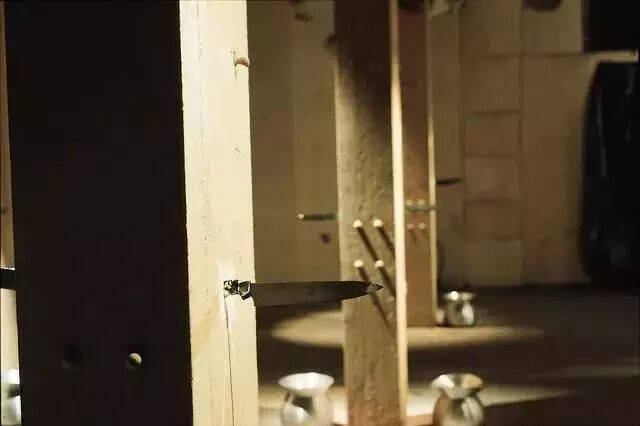
"After that show, I moved gradually toward installation art. I never really worked in painting or video, partly because of my own temperament — my pieces tend to be narrative, and I like working with things in three-dimensional space, and honestly I don't think I'm all that gifted a painter," Shen said, joking modestly. In a piece called Wasted Words (1994), a tongue made of ice melts to reveal a blade hidden inside. For her first four years in France, Shen didn't manage to produce a single work she felt good about.
Wasted Words was the eruption that followed those four silent years in a foreign country. A block of ice shaped like a tongue melts slowly at room temperature until it reveals the blade concealed inside — like the violence hidden in language, laid bare the way a dagger appears at the end of an unrolled scroll. Another piece with the same image of the tongue, Urgent Words, shown at UCCA in Beijing in 2008, had a hair dryer set up to switch on every three minutes; each time it kicked in, the machine let out a tremendous roar, and beneath it a mass of "tongues" thrashed wildly in the wind, as if locked in furious argument — the whole piece playing out like a chaotic, overheated farce.
"That image of the tongue really comes out of my own experience as an immigrant, and my thinking about language," Shen said. In Zero Degree of Space (2008), her status as an immigrant left her work with a lasting sense of distance from the core of Western culture, whether near or far. In Paris in 2008, Shen enclosed herself in a room built entirely from a wall of ice. On opening day, she sat inside the room on one side of the ice wall, stitching phrases about the relationship between private and public space onto an old cotton quilt she had once slept under, while, on the other side, visitors filing past could glimpse the artist at work through the ice but had no way to enter the space she occupied.
As the ice wall slowly melted and collapsed, visitors were finally able to enter, the following day, the space where Shen had done her stitching — only to find it empty, the artist long gone, leaving behind just the embroidered quilt and video footage from the day before. That same image of the "wall" reappears in 1/2 Bowl (2017). Here the wall becomes a chain-link fence, through which visitors can see a miniature shantytown, packed into an enormous bowl — a symbol of food, of livelihood, of shelter — that has been crudely split in half and laid bare for anyone to look at.
SECTION 03 | Woman, Artist, Mother, Wife
It can be seen, but it remains cut off, because no one can truly enter into another person's suffering. Shen has given that separation a physical form. In another work, Cold-Blooded Animal (2008), "this piece has to do with immigration, and with the body. I put a fish inside a transparent thermometer — a fish's nature is that it can change its own temperature to match the water around it, to adapt to its environment, and a thermometer is an object bound up intimately with our own bodies,"
Shen said. In an untitled 1995 work, Shen is known for using large-scale installations to take on questions of migration and culture, but her sense of life and the body often comes through in small things — everyday objects that speak quietly about life. A pair of golden-yellow soft cloth slippers holds, inside, clippings of the artist's own fingernails. The shoes stand for personal identity, while the nail clippings, part of the body's ongoing metabolism and growth, are a record both of time and of life itself. In Fingerprint (1999), Shen embroidered her own fingerprint, in gold thread, onto a slice of Spanish ham.
It leaves the viewer with an odd question: what, exactly, is that slice of ham lying quietly on its plate? Skin that has fallen away? A living thing whose growth has stopped?
"I'll admit that my husband, Yong Ping, had a real influence on how I found my way into contemporary art. But if you're asking what actually shaped the work directly, it's really my own life — my pieces stay very close to lived experience," Shen said. Her installation Feminine Garden (2017) was shown again at Red Brick in 2023. For Shen, her life has always turned around a handful of roles: woman, artist, mother, wife. Those identities are what give her work its feminist undertone, and its strong current of maternal and humanist concern.
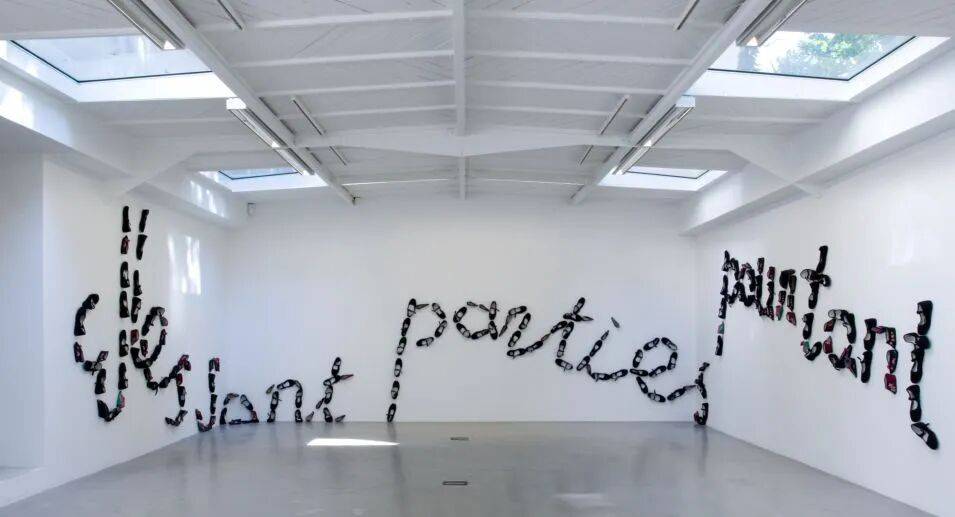
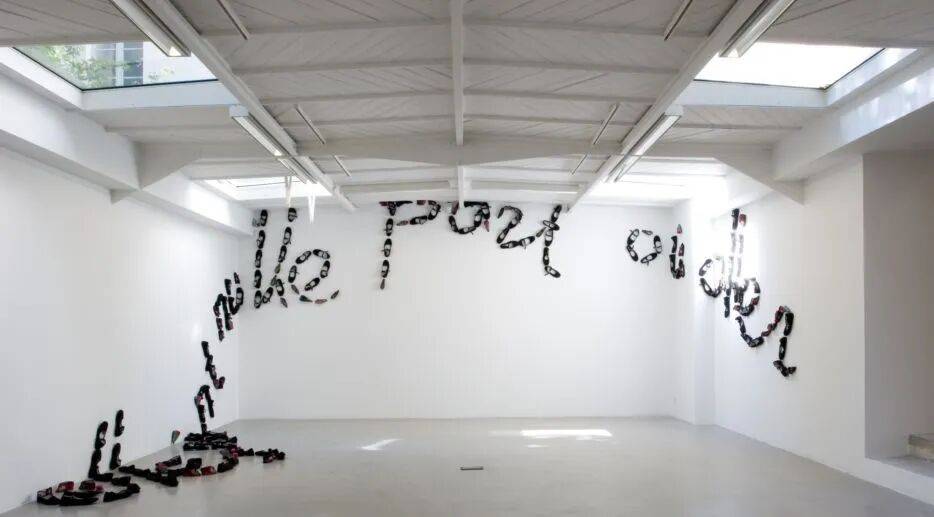
Feminine Garden was the largest installation in the Red Brick show: an enormous women's corset, six meters tall, standing guard over a half-enclosed garden. Inside, soft green plants and a lively fountain collide, almost violently, with the iron framework and cast-iron material around them. Like the artist herself, the piece is both hard and soft, both a concession to circumstance and a form of resistance. In Uncomfortable Shoes (2008), a French sentence — "they left home, and now they have nowhere to go" — is spelled out across a field of embroidered Chinese-style shoes, their soles a stark black and white, their uppers stitched with colorful flowers.
Forced to bend and warp their letterforms, blocked at every turn, the words nonetheless stubbornly cover the entire wall. Embroidered shoes are an intensely feminine image, and the piece reads as a kind of cruel metaphor for the constricted space in which women are made to live — forced to remake themselves to satisfy some notion of "universal values," bending over backwards to accommodate. And yet, even so, flowers keep blooming on the shoes, a bright note that refuses to go out. In Classwork (2011), a workbench for making firecrackers appears to defy gravity, fixed to the wall, with strings of red firecrackers and dimly glowing bulbs hanging down, the whole precarious arrangement seeming to strain, silently, toward an explosion.
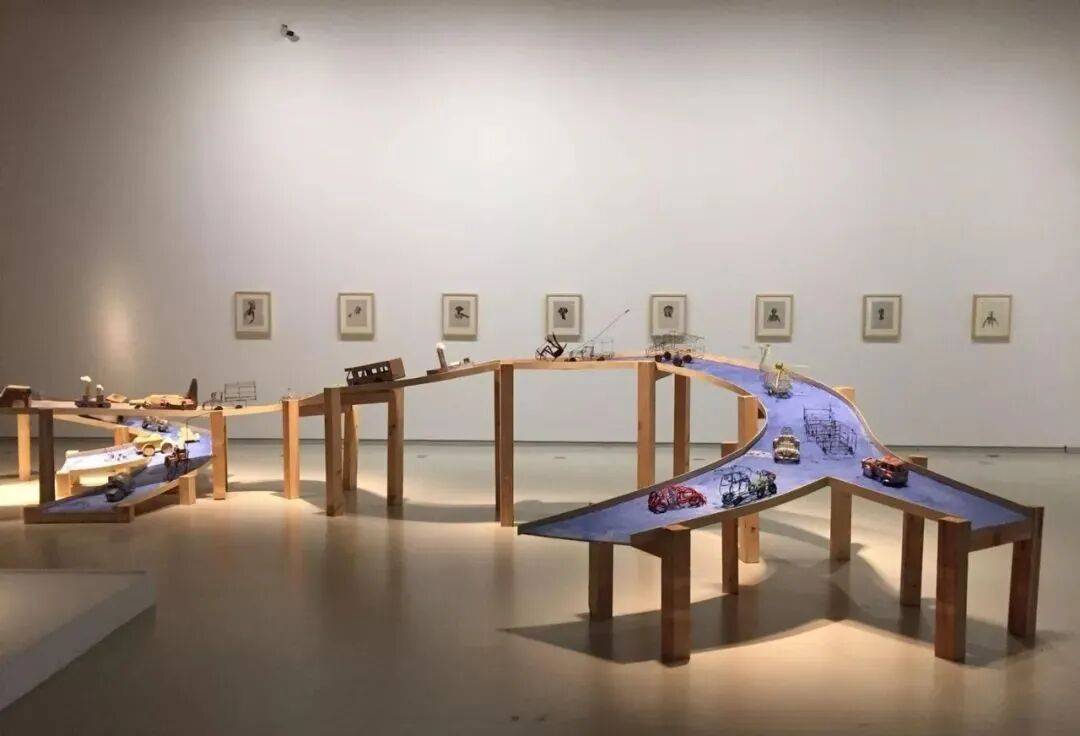
"I once read a newspaper report about children at a rural elementary school who were making firecrackers, and there was an explosion that caused terrible casualties. That's when I started paying attention to the subject of child labor," Shen said. She collected the actual firecracker-making workbenches used in the piece from villages along the border of Hunan and Jiangxi provinces, incorporating them directly into the work. In another piece, Blue Road (2003), Shen spent more than a month in 2002 as an artist in residence in the Congo.
The poverty she encountered there was shocking — there were no real shops, and local children had to fashion their own toys out of discarded bottle caps and tin cans. She felt, deeply, how that reality was shaping the children around her, who had no access to education and struggled daily against hunger and illness. Back in Europe, she showed Blue Road, hoping that these children in the Congo might one day travel that "blue road" out of the country, toward a better world.
The small vehicles made of wire, the cardboard boats and airplanes in the piece were all made by hand, together with local children. In Black Diamonds (2017), Indian women, following religious custom, cut off their hair at the end of the year; because the hair is of such high quality, it is known in the wig trade as "black diamonds." At the exhibition, Shen recreated a wig workshop, placing finished, glossy wigs alongside wigs still in the process of being made, producing an odd, theatrical effect.
Two more of her pieces, I Am Seen, I Am Not Shown (2017) and Shadow of a Hat (2015), were also on view. In 2019, the Centre Pompidou in Paris acquired a monumental carpet piece of hers, spanning more than a hundred square meters, woven entirely from thick cotton cord.
"I didn't have a sketch for it — just a rough pattern in mind, and I figured out each next step as I wove. I don't like to plan things out; that's just how I am," Shen said. Her work always tends to surprise, and one piece often looks completely unlike the next in form. She believes that holding on to a signature style is a risky business — it might make your work easy to recognize, but the cost is that your creativity can dry up. And Shen, true to her word, has never wanted to be confined.
Some images courtesy of the Red Brick Art Museum and the artist.