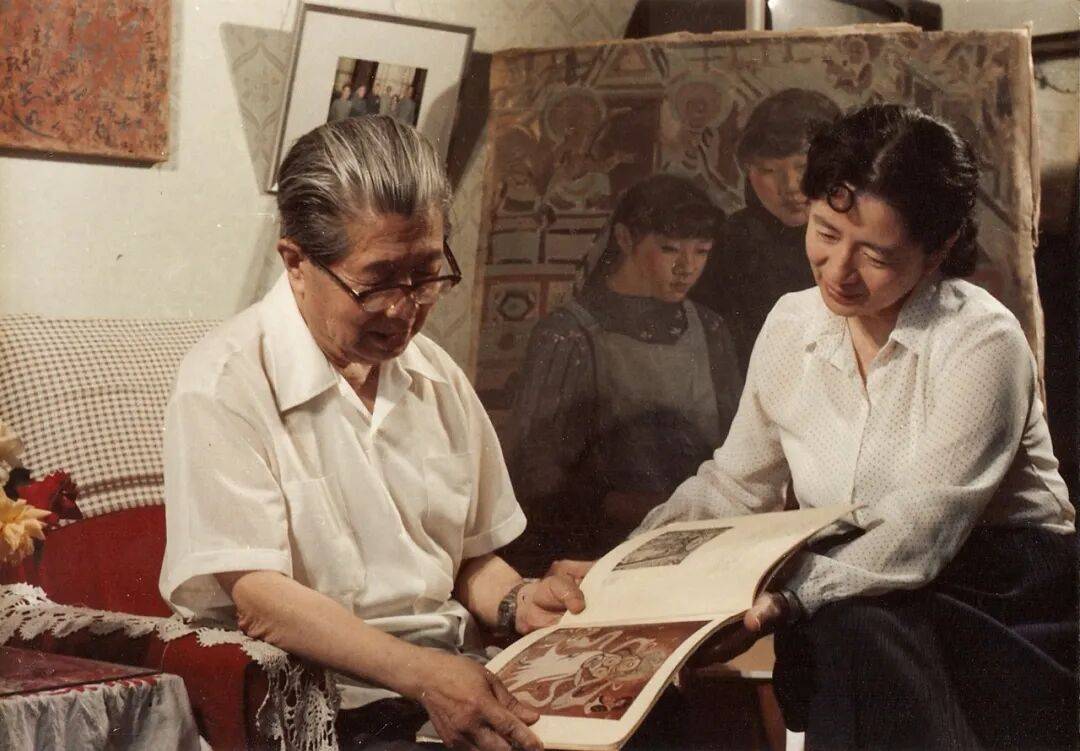

Chang Shana is the daughter of Chang Shuhong, known as the guardian spirit of Dunhuang; she was Lin Huiyin's most devoted student; and she designed New China's first state gift. In the public imagination she has never stopped being the "Dunhuang girl." In 2025, at ninety-four, she still lives among the colleagues of her studio and keeps working on projects tied to Dunhuang culture. Last year she and her team designed the pattern for the costume piece "Nian Jin" for the Spring Festival Gala stage, mounted a major retrospective of her work in Beijing, and launched a new book in Hangzhou.


"At my age, every extra day I get, I'll spend it talking about Dunhuang, telling people about Dunhuang, for as long as I can," Chang Shana told us. At the start of the new year we reached her in Beijing by phone and talked about the past year's work and the convictions she has never let go of. Photo: Chang Shana at her book launch in Hangzhou, 2024.) Hangzhou was the hometown of Chang Shuhong, the guardian spirit of Dunhuang, and it was also the hometown of Lin Huiyin, the teacher Chang Shana reveres above all others — which is why it is a city she has always longed to return to.

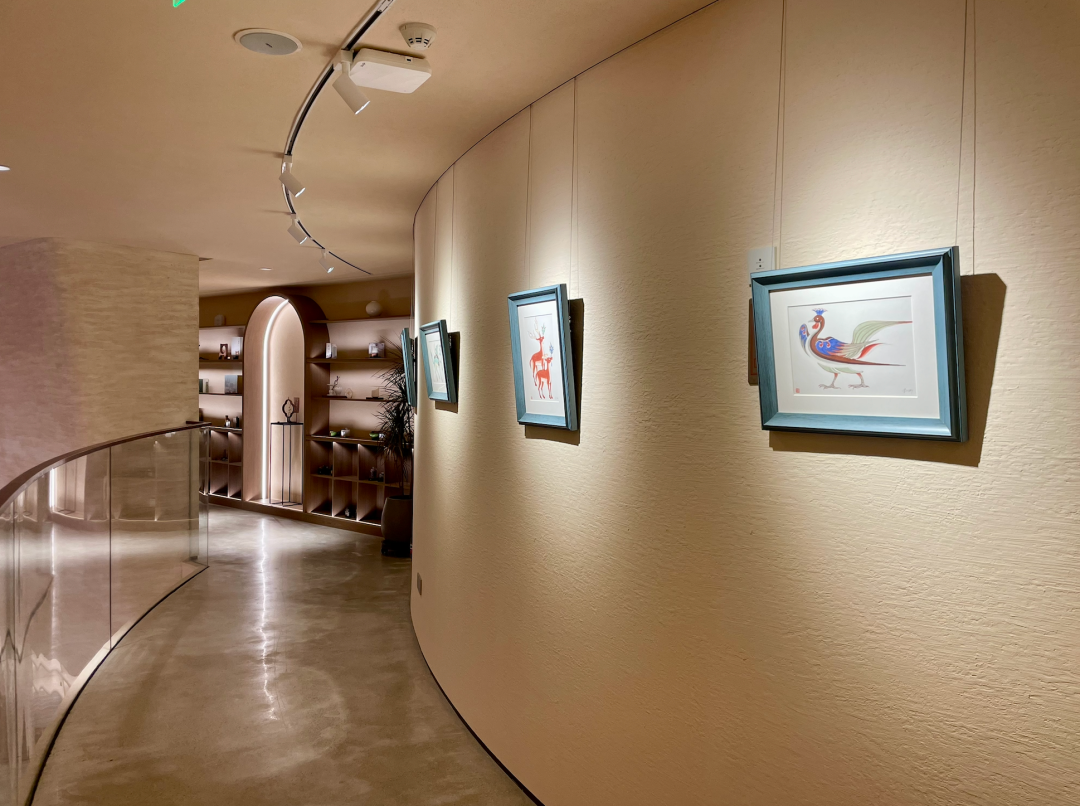
At the Hangzhou launch of her new book, "The Chang Shana Art Series: Dunhuang Paintings," the gallery showed seven rarely seen and precious hand copies — paintings Chang Shana made in the Dunhuang caves at fourteen or fifteen, working alongside her father. (Photo: Chang Shana's work on display in Hangzhou, 2024.) "Whatever grounding I have in painting or design, it all comes from Dunhuang — that much is certain. I was only twelve when I first got there, still a child. Wherever my parents went, I went.

I didn't go to Dunhuang thinking I'd make art. But because of my father, copying the Dunhuang murals became something I was simply born into." She says the influence of Dunhuang runs through everything she has made, though of course a creator brings her own thinking to the work as well.

"Neither my design work nor my painting has ever been pure flights of fancy. Everything has to be grounded in the logic and the discipline of the classical tradition — whatever the technique, whatever the image, there's always a Dunhuang element in it. It's a natural absorption, never forced." (Photo: Chang Shuhong with his two children at the entrance to a Dunhuang cave, 1940s; a restored view of Chang Shuhong's old residence at Dunhuang, photographed by Sun Zhijun.) Life at Dunhuang, in those years, was a hardship young people today can barely picture — no real food, housing in a converted, crumbling temple, a trip into the county town for supplies that took at least a day and a night each way by ox cart.

To make things worse, after a year at Dunhuang, Chang Shana's mother could no longer bear the hardship. She said she was going to Lanzhou to see a doctor, and she never came back to the Mogao Caves.
A child without a mother grows up early. Chang Shana still remembers her father's fury after her mother left — his sense that she had abandoned the family — mixed with a helplessness at watching it fall apart. Sometimes he lashed out at his son and daughter for no real reason, and once he'd calmed down he felt terrible about it. He even asked his daughter to leave school and come home to look after the family: "Shana, come back from Jiuquan — otherwise what happens to your little brother? What happens to this family?" "I didn't understand it then," Chang Shana recalls, "but now I understand completely what he was going through. The pressures of family and work were both crushing him. It wasn't easy for him at all."
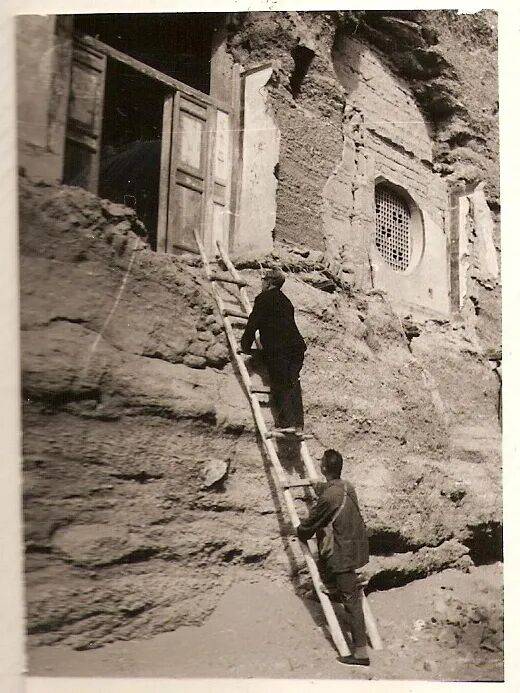

(Photo: Chang Shuhong climbing a ladder into a cave to survey it, Mogao Caves, 1942; Chang Shuhong at work studying the Mogao murals.) But that expanse of desert and drifting smoke set the course of Chang Shana's entire creative life.
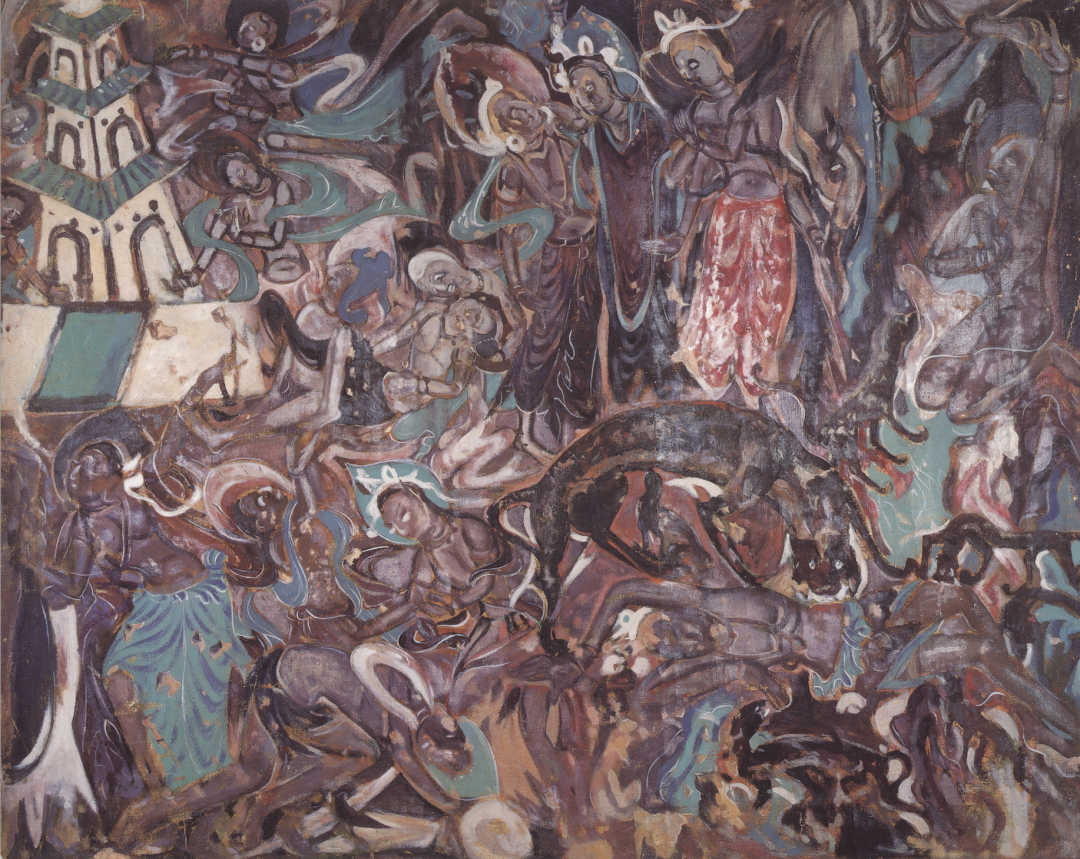
"To protect the caves, my father insisted on abandoning Zhang Daqian's method of nailing tracing paper to the walls. He required that all copying be done free-hand, by eye, with nothing pressed against the murals. We trained ourselves to take in a wall painting purely by looking. It was a hard way to learn, but it sharpened my eye and built up my sense of form. That's how I ended up copying the key murals from caves representing every dynasty — Northern Wei, Western Wei, Sui, Tang, Five Dynasties, Song, Yuan."

(Photo: "The Self-Sacrifice to Feed the Tiger" mural from Cave 254, Northern Wei, copied by Chang Shuhong in 1944.) By the time she'd been at it a while, the adults around her were saying, "Shana really can paint." Before she left to study in the United States in 1948, Chang Shana says she'd lost count of how many caves she had copied. If Chang Shuhong took a liking to a mural, he had his daughter copy it, guiding her hand himself.
"Dunhuang was the garden I grew up in. All those mythic figures, the soft, swirling apsaras — they were my companions growing up. The patterns carved into the caisson ceilings were the leads in my dreams. The stories in that garden have stayed with me my whole life, like a shadow, and they've kept me warm my whole life too." Chang Shana told us she thinks every subject she studied mattered, but flowers were always her favorite.


"I think I love flowers because of my father. The environment at Dunhuang in the early years was harsh — nothing but rolling yellow sand, not a speck of color anywhere. My father, Chang Shuhong, was a romantic at heart, and even out there he insisted on making something beautiful for himself. He brought cosmos seeds all the way from Sichuan to Dunhuang. He said cosmos could take the desert, that they were tough enough to survive there. I watched him scatter the seeds and watched them bloom, and naturally, I came to love flowers too."


(Photo: a Chang Shana sketch, photographed by Wu Huang and others.) Later, when she was sent to the countryside, she ran into all sorts of hardship, but every time she saw a wildflower by the roadside turning its face to the sun in the wind, so vivid, so full of will — that will was what gave her own life its energy. Wherever she went, she carried a small notebook and sketched whatever flowers she saw. Later, teaching at the Central Academy of Arts and Crafts, she created a course specifically on Dunhuang pattern design, in part because so many of the decorative lines in Dunhuang ornament follow the logic of the natural world — decorative pattern is inseparable from the endless variations of flowers. So whether for teaching or simply for her own pleasure, she was always watching how flowers changed shape, and it became a lifelong habit, in both her life and her work.

(Photo: Chang Shana painting outdoors in Boston with her friend Ruth, during her years studying there.) Chang Shana stayed at Dunhuang until she was sixteen. A benefactor, Ye Lihua, offered to fund her studies in the United States, specializing in painting. In 1948 she enrolled at the Museum School of the Museum of Fine Arts, Boston, for formal training in Western drawing and form.
Drawing, perspective, color, painting, design, human anatomy, art history — under the discipline of traditional Western training, her childhood memory of copying the Dunhuang murals didn't fade into the distance. If anything it was reinforced, seen now from a more rounded, more integrated vantage point. (Photo: Chang Shana during her years studying in the United States.) "During my time studying in America, I discovered that beyond Dunhuang there was Greece, Rome, Egypt — all this other art and culture. I realized then how big the world was, that it wasn't just Dunhuang.
The art and culture of different places around the world share things in common even as each keeps its own particular strengths — each beautiful in its own way. And the Silk Road was a road of many cultures meeting each other, with Dunhuang sitting right at one of its crucial junctions. The Mogao murals are like a treasure box, holding the great fruits of Buddhist and folk art together." (Photo: copies Chang Shana later donated.) After the founding of New China, everything needed rebuilding. Many students studying abroad were eager to come home and throw themselves into the new nation's construction. Chang Shana was one of them.
Back in China, she helped her father organize a Dunhuang exhibition at the Meridian Gate of the Forbidden City, and it was there that she met Lin Huiyin and Liang Sicheng.

"Lin Huiyin was already gravely ill by then. Almost every morning, from 9:30 to 11:00, I sat by her bedside and took lessons from her. Under her influence I researched Dunhuang art dynasty by dynasty, by subject, and applied it to crafts and design work — the design for the Great Hall of the People, one of the Ten Great Buildings, cloisonné, textile printing and dyeing, costume design, and more. The idea, always, was to take the culture of Dunhuang, the lineage of its patterns, and put it to work in the modern world, in ways that answered modern needs."
After all these years, when Chang Shana is asked which of her works she finds most interesting, the one that has stayed with her most, she still points to New China's very first state gift: the design for the peace-dove platters and silk scarves. She had just returned to China then. She was twenty-one.

"When New China was newly founded, it hosted the Asia-Pacific Peace Conference. At the time, the most famous artist in the world was Picasso, and his dove of peace was known internationally. My teacher Lin Huiyin said to me, 'Shana, why should it only be Picasso's dove of peace? Don't we have our own dove of peace — a Dunhuang dove of peace?' The moment she said it, the idea came to me at once. I designed the state gift using a dove taken from the Dunhuang murals. I remember it as clearly as if it happened yesterday, and to this day that design is still in use. It proves that Dunhuang art, once you know how to use it, once you truly understand it, never grows tired to the eye no matter how much time passes — it holds up."


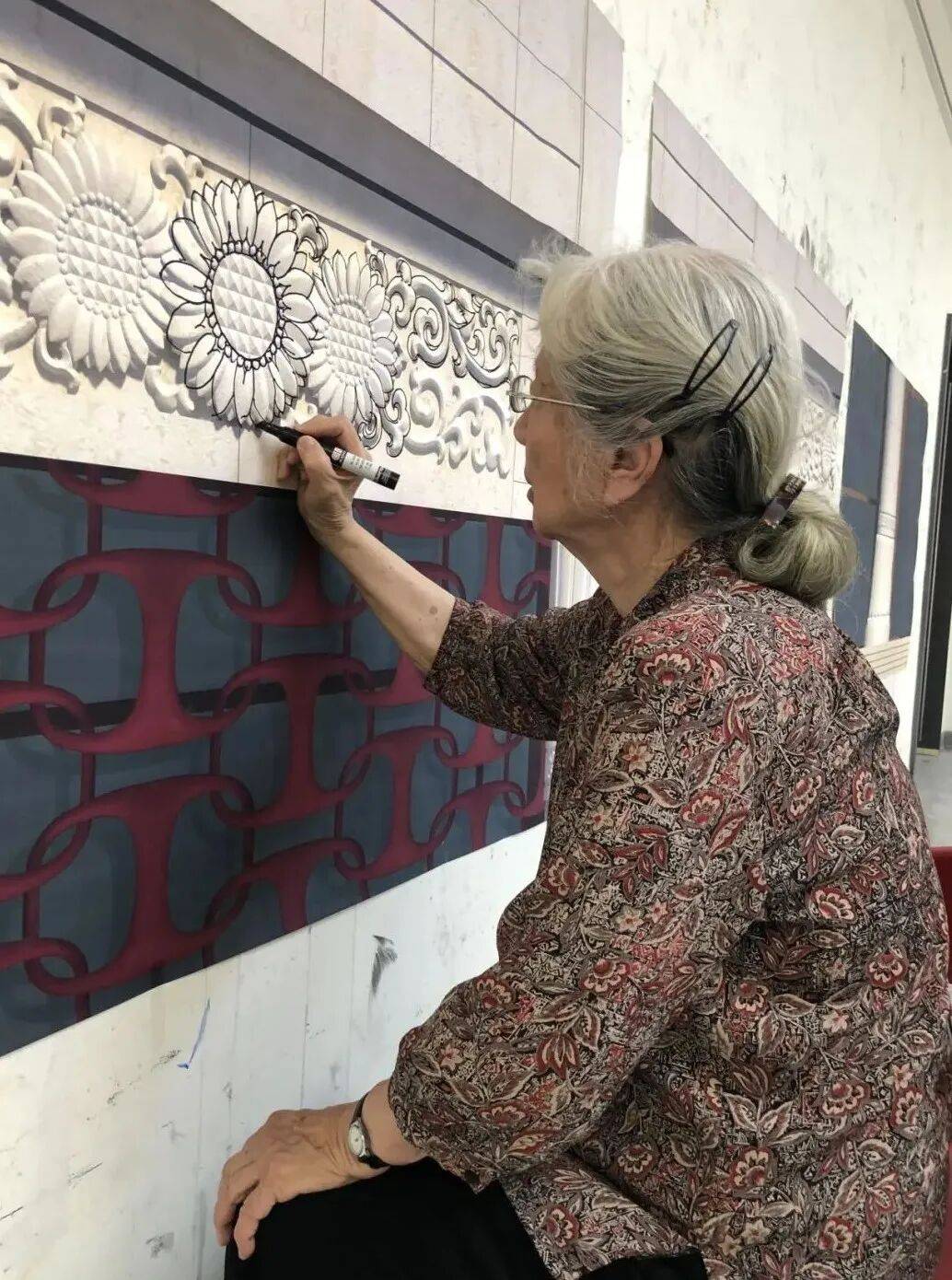
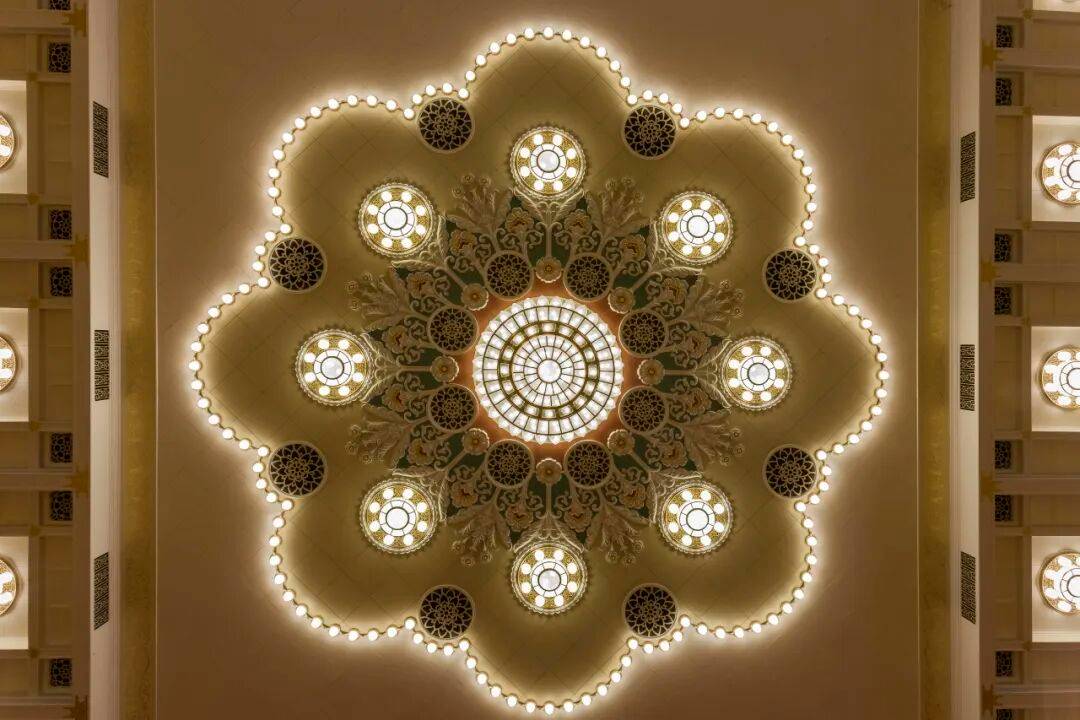
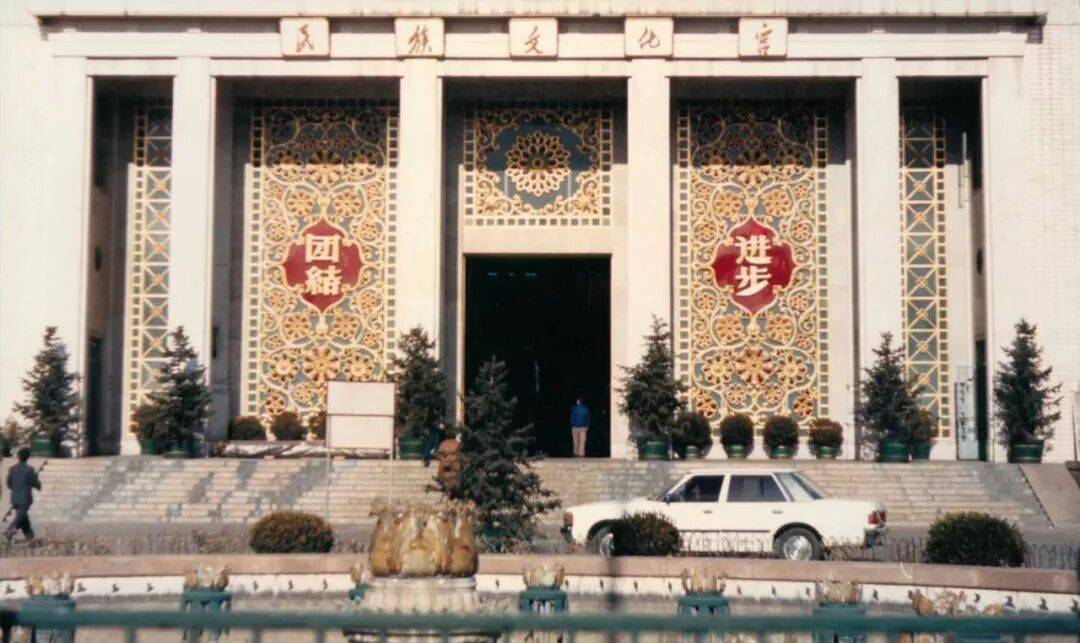
(Photo: Chang Shana revising a design for the Museum of the Communist Party's History; her drawing for the ventilation grille on the ceiling of the Great Hall of the People's banquet hall.) After that she took on one design project after another: the commemorative badge for the War to Resist US Aggression and Aid Korea, the ceiling lights in the Great Hall of the People's banquet hall, the Cultural Palace of Nationalities, the emblem of the Communist Youth League, the "Bauhinia in Eternal Bloom" sculpture in Hong Kong. Even at ninety, the Party's Publicity Department came looking for her, asking her to lead a team from Tsinghua University's architecture school in designing the exterior of the Museum of the Communist Party's History.
"The elements matter, and so does the lineage they come from. Put the old to use for the new, keep what's national, scientific, and of the people alive and passed down — I feel lucky to have been able to be one of the people carrying that forward." (Photo: the lotus ceiling light Chang Shana designed for the Great Hall of the People; her 1946 copy of the Amitayus Sutra transformation tableau from Cave 172, high Tang dynasty.) There is no counting the number of pieces Chang Shana has copied, created, or designed over her lifetime, but she says she can pick her own work out of a crowd at a glance.

"I don't have favorites among my own work — it's all mine, all part of me. The early copies mean the most to me, though, because so many of them were done with my father and the first generation of Dunhuang scholars guiding my hand, one stroke at a time. There's nothing quite like that period, nothing that could replace it. Even now, seventy or eighty years later, that work is still an important reference for Dunhuang studies." To us, it seems clear that her research into Dunhuang culture, after seventy or eighty years of steady accumulation, has become an enormous body of work in itself — and beyond what she's doing now, there must be a great deal still planned for the future.

But she told us otherwise: "The work on Dunhuang doesn't need planning, as far as I'm concerned. My father told me never to forget that I am a person of Dunhuang. That's carved into me. It's simply how I respond, without thinking about it." (Photo: Chang Shuhong's oil painting "The Painter's Family.") Throughout the interview, Chang Shana kept returning to her father, Chang Shuhong, and to her teacher Lin Huiyin. Much of what has let her sustain this research for so long comes from an emotional bond — with her father, and with Lin Huiyin, who was as much a mother to her as a teacher.
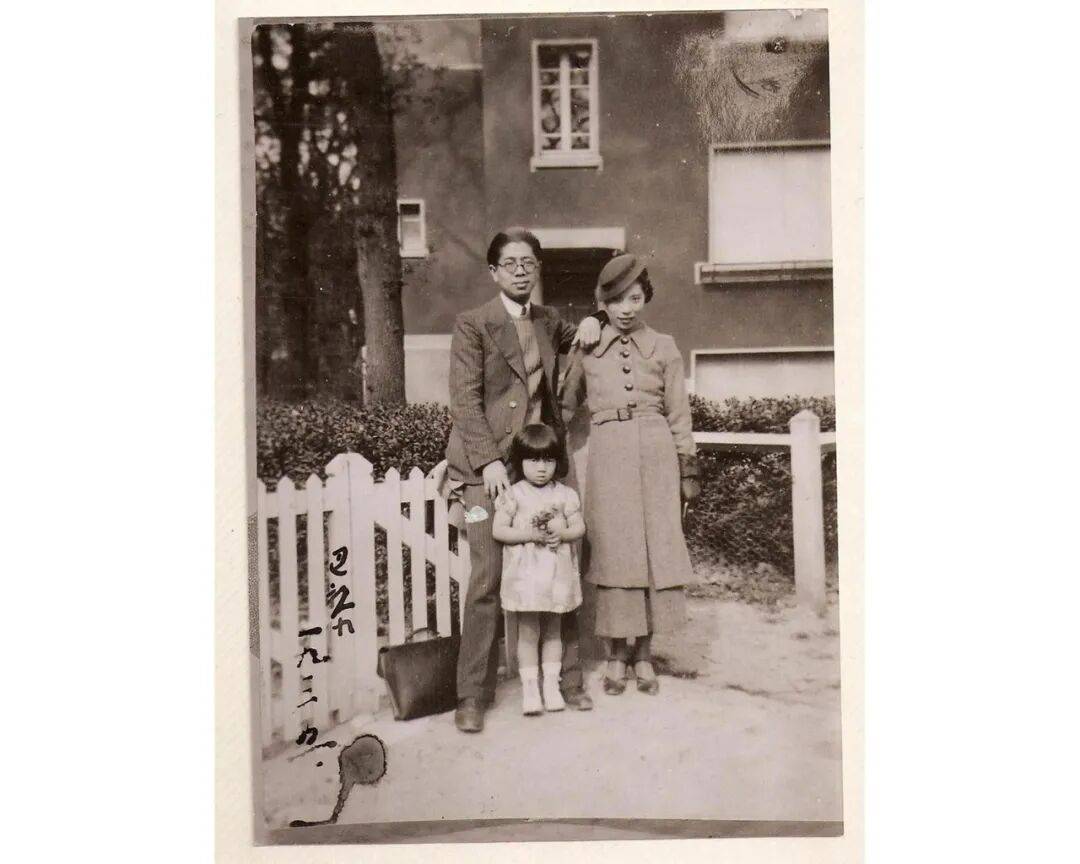
"My whole working life carries my father's hopes and my teacher Lin Huiyin's charge to me. In my girlhood, Lin Huiyin stepped into the role my mother had left empty, teaching me, giving me a different kind of warmth and a different kind of nourishment for my career. The love those two elders gave me is what let me face every setback in life with more courage. I wouldn't say I'm simply continuing their work, but doing my own work well is the truest way I know to repay what my father and my teacher gave me." (Photo: the Chang family of three in Paris, 1935.) When she talks about her father, she doesn't seem like a woman of ninety-four at all — she seems like a delighted little girl.
She was born in Lyon, France, and spent the years before she turned six there.

"I was an obedient, well-behaved daughter, and my father cherished me deeply. Whether in France or after we returned to China, there are many portraits of me in his oil paintings. Those paintings were also his way of showing his love for me. None of those works are with me now, but they're the memory my father left me — a link to him that will never change." (Photo: exterior of Chang Shuhong's old residence, photographed by Sun Zhijun.) Looking back, Chang Shana says, she can feel at every turn how much love her father gave her.
"Even in the hardest years at Dunhuang, my father worried I had no toys, no playmates. In the bitter Dunhuang winters, he'd build me an ice sculpture in the shape of a chair outdoors, pad it with a thick cloth, and let me play there with the local farmers' children. Sitting on that ice chair my father made with his own hands, I found it wonderful — in that kind of winter I never felt the cold, only curiosity and delight. I was my father's daughter, and I was also his comrade in the Dunhuang cause.

It was only after I grew up and became a mother myself that I really understood how hard it must have been for him, and that made me respect him even more." (Photo: the "Nian Jin" costume pattern Chang Shana designed for the 2024 Spring Festival Gala.) To her, carrying her father's spirit forward is, at its core, the same thing as copying the Dunhuang murals and then going on to create something new. From birth, human beings learn everything they know about living by copying their parents, and only later does something like their own soul take shape out of that.
"It's the same in painting. Copying and creating are one and the same thing. There has to be a period of learning before there's anything you could call creation. The two feed each other — they're a process you can't skip, and there's really no line between them, nothing to compare against the other." The studio that bears her name is itself a way of carrying the spirit of Dunhuang forward.
"Dunhuang mural art ran unbroken through ten dynasties of Chinese history, from the Northern Liang at the very start through to the end of the Song and Yuan — a thousand years that trace and record the whole transformation of everyday Chinese aesthetic culture. Dunhuang art even shaped court culture as late as the Ming and Qing. Take the empress's coronation robe, embroidered with the entwined lotus pattern that symbolizes the unbroken continuity of the imperial line — that pattern already existed at Mogao in the Tang dynasty. Most people don't know that. They assume it was something invented for the court."
Listening to Chang Shana talk so fluently about the patterns and aesthetic shifts of one Chinese dynasty after another, we couldn't help wondering: in an age that moves this fast, why do the young people in her studio still bother studying something as "ancient" as Dunhuang culture?
"A lot of people assume Dunhuang art is just old stuff. But look closely and you'll find elements of Dunhuang pattern all through our contemporary life — some of the geometric patterns in modern design, for instance. You just don't realize they trace back a thousand years to Dunhuang. And because you don't know, of course you're not interested. But once you do know, you find yourself marveling at how forward-looking, how sophisticated that aesthetic really is. Dunhuang aesthetics didn't just shape China — they exist side by side with the aesthetics of the Western world too." (Photo: the entrance ornament Chang Shana designed for the Cultural Palace of Nationalities.) She believes that only through deeper study can we make proper use of this thousand-year-old art, understand its lineage and its substance, and let it help us make better work of our own.
To use it without studying it first is to work off nothing but a surface impression — easy to get wrong, and liable to mislead the next generation's understanding of Dunhuang art.
"So many young people today, chasing quick money, skip the research entirely — they see the surface and slap something together and call it Dunhuang design. I flatly disagree with that. If you're going to work in Dunhuang art, you need the right understanding first, or you can't carry the lineage forward. Otherwise, don't call it Dunhuang art design — call it your own design. That's a different thing, and the difference matters a great deal." (Photo: Chang Shana showing a student how to paint a Buddha figure.) Near the end of our conversation, looking at Chang Shana — so full of energy still, with the desk in front of her piled high with research materials and drafts — we couldn't help asking: does she ever worry that she's running out of time?
Chang Shana was entirely at ease. "I had breast cancer in 2008, and I had it removed right away. Personally, I've long since made peace with life and death. But when it comes to Dunhuang, my time is definitely not enough. Dunhuang belongs to the world — it doesn't belong to any one person. So much of this can't rest in any one pair of hands. The young people have to take up the baton, or it won't pass down through the generations." Advertisement