At Ninety-Four, Chang Shana Is Still Working for Dunhuang
The daughter of Chang Shuhong, the star pupil of Lin Huiyin, and the designer of New China’s first state gift, Chang Shana has spent a lifetime carrying Dunhuang forward. In 2025, living and working with her studio team, she remains absorbed in the culture that shaped her......
By / Xirui Huang · 11 min read
How does Chang Shana translate her study of Dunhuang murals into modern design?
In Xirui Huang’s 2025 interview, Chang Shana traces her design practice to copying Dunhuang murals with her father, Chang Shuhong, as a young girl. After her return to China, Lin Huiyin encouraged her to study historical ornament and adapt it to modern life. Close observation of flowers also informs her understanding of patterns. Chang stresses research into historical context and form before adaptation, alongside passing these methods to younger generations.
Chang Shana is the daughter of Chang Shuhong, the "guardian of Dunhuang," the star pupil of Lin Huiyin, and the designer of New China’s first state gift. To many, she remains forever the "Dunhuang girl." In 2025, at the age of 94, she is still living with the colleagues in her studio and continuing to work on projects related to Dunhuang culture. Last year, she and her team designed Nianjin for the Spring Festival Gala stage, mounted a major exhibition of her work in Beijing, and launched a new book in Hangzhou.
SECTION 01 | "Dunhuang Girl" returns to her hometown
"At my age, as long as I live one more day, if I can talk about Dunhuang, speak for Dunhuang, I will do my best to keep speaking," Chang Shana told us. At the start of the new year, we spoke with her in Beijing about the past year and about the work she has pursued with unshaken conviction. At the launch of her new book in Hangzhou in 2024, Hangzhou held special meaning for her: it was the hometown of Chang Shuhong, the "guardian of Dunhuang," and also of her teacher Lin Huiyin, making it a place she has always longed to return to.
At the Hangzhou launch of the new book Chang Shana Art Series: Painting Volume (Dunhuang), seven manuscripts were shown, rarely seen and extremely precious. All were drawings Chang made in the Dunhuang caves as a girl of fourteen or fifteen, copying murals alongside her father. At the Hangzhou exhibition in 2024, her works were on view. "The fundamentals of my painting and design all came from Dunhuang; that is absolutely clear. I was only twelve when I first arrived in Dunhuang, still a child. Wherever my father and mother went, I went."
"I didn’t go to Dunhuang because I meant to pursue art, but because of my father, copying at Dunhuang became my natural condition from the start." She said that Dunhuang’s influence on all her work was inevitable, though any act of creation, of course, also carries the creator’s own subjective ideas.
"Whether in design or in painting, I have never worked from pure fantasy. There has to be a rationality and a scientific grounding within the classical lineage. In technique and in vision alike, elements of Dunhuang are there. They enter naturally, not by force." The days she spent in Dunhuang were harder than most young people today could imagine: there was little to eat; they lived in a dilapidated temple that had been converted for use; and to buy anything in the county seat, one had to ride an old ox cart, a round trip of at least a full day and night. At the Mogao Caves in the 1940s, Chang Shuhong stood with his son and daughter at the entrance to a cave. A restored interior view of his former residence in Dunhuang was photographed by Sun Zhijun.
Worse still, after only a year in Dunhuang, Chang Shana’s mother, unable to bear the hardship, left on the pretext of going to Lanzhou for medical treatment. She departed the Mogao Caves and never returned.
A motherless child learns early. Chang Shana, precocious even then, still remembers that after her mother left, her father was furious that she had abandoned the family, yet he was also full of helplessness over the family’s collapse. At times he would vent his anger on his daughter and son for no reason, then, once calm, feel deeply sorry toward them. He even asked his daughter to leave school and return to Dunhuang to care for the family: "Shana, come back from school in Jiuquan. Otherwise what will happen to your younger brother? What will happen to the family?" Chang recalled, "At the time I didn’t understand, but now I completely understand my father’s pain. He was under immense pressure from both family and work. It was terribly hard for him."
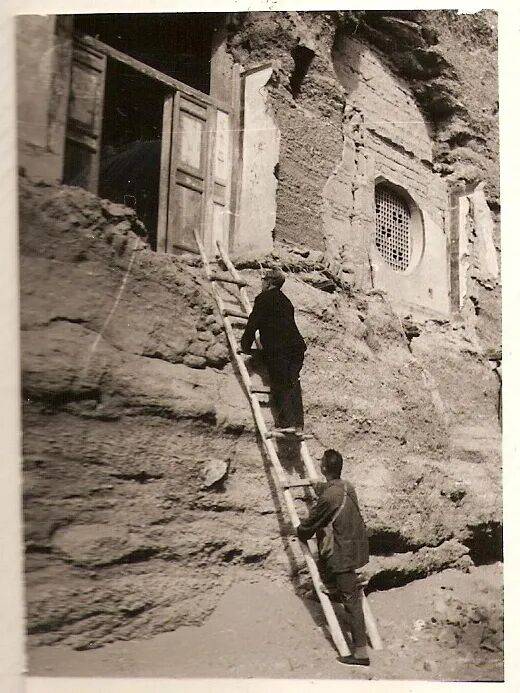
At the Mogao Caves in 1942, Chang Shuhong was climbing a ladder to inspect a cave. He was also engaged in the study of the Mogao murals. Yet it was this desolate, smoke-hazed desert that determined the direction of Chang Shana’s life’s work.
"My father wanted to protect the Mogao Caves, so he insisted on abolishing Zhang Daqian’s method of driving nails into the wall. He required that all copying be done by direct observation; no draft rubbing on the wall was allowed. We used our eyes to respond directly to the works on the cave walls. It was a difficult method of training, but it sharpened my eye and strengthened my ability to model form. In this way, I systematically copied the key murals from representative caves of the Northern Wei, Western Wei, Sui, Tang, Five Dynasties, Song, and Yuan periods."
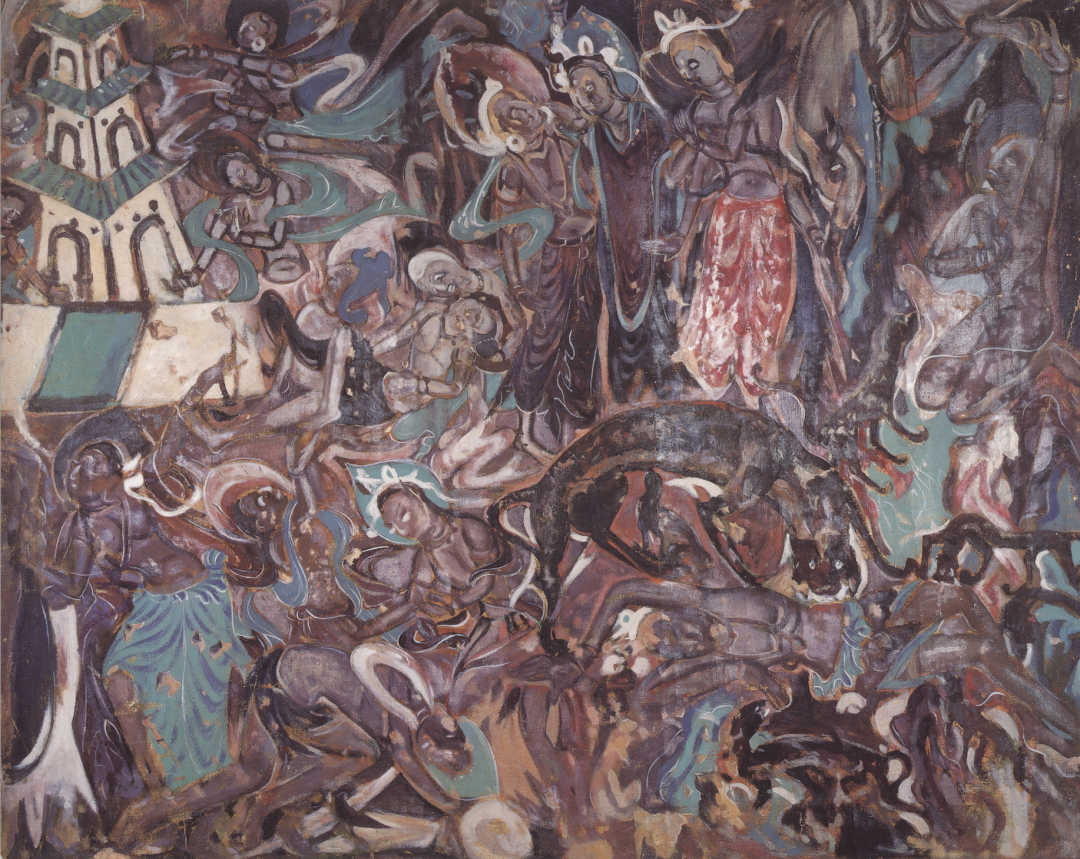
Among Chang Shuhong’s 1944 copies was the mural Sacrificing the Body to Feed the Tiger from Cave 254 of the Northern Wei at Mogao. When Chang Shana first arrived in Dunhuang, and as she kept drawing, the adults all praised her: "Shana really draws well!" Before leaving for the United States in 1948 to study, she said she could no longer count how many caves she had copied. Any mural that Chang Shuhong "took a liking to," he had his daughter copy, guiding her hand himself.
"Dunhuang was the back garden of my childhood. All those mythic figures, the supple and graceful flying apsaras, were my companions as I grew up; the motifs painted in the caisson ceilings were the leading characters in my dreams. The stories in that back garden stayed with me like a shadow all my life, and they warmed my whole life as well." Chang Shana told us that she believes study in every category is important, but that what she especially loves is flowers.
"I think my love of flowers was probably influenced by my father. In the early years, Dunhuang’s ecology was very poor: rolling yellow sand, with not a bit of color to relieve it. My father, Chang Shuhong, was very romantic. Even in a place like Dunhuang, he wanted to create a good environment for himself. So he brought many cosmos seeds from Sichuan to Dunhuang. He said cosmos could endure the desert and survive fairly well there. I watched him sow them and then watched them bloom, and naturally I developed an affection for flowers."
At Ninety-Four, Chang Shana Is Still Working for Dunhuang
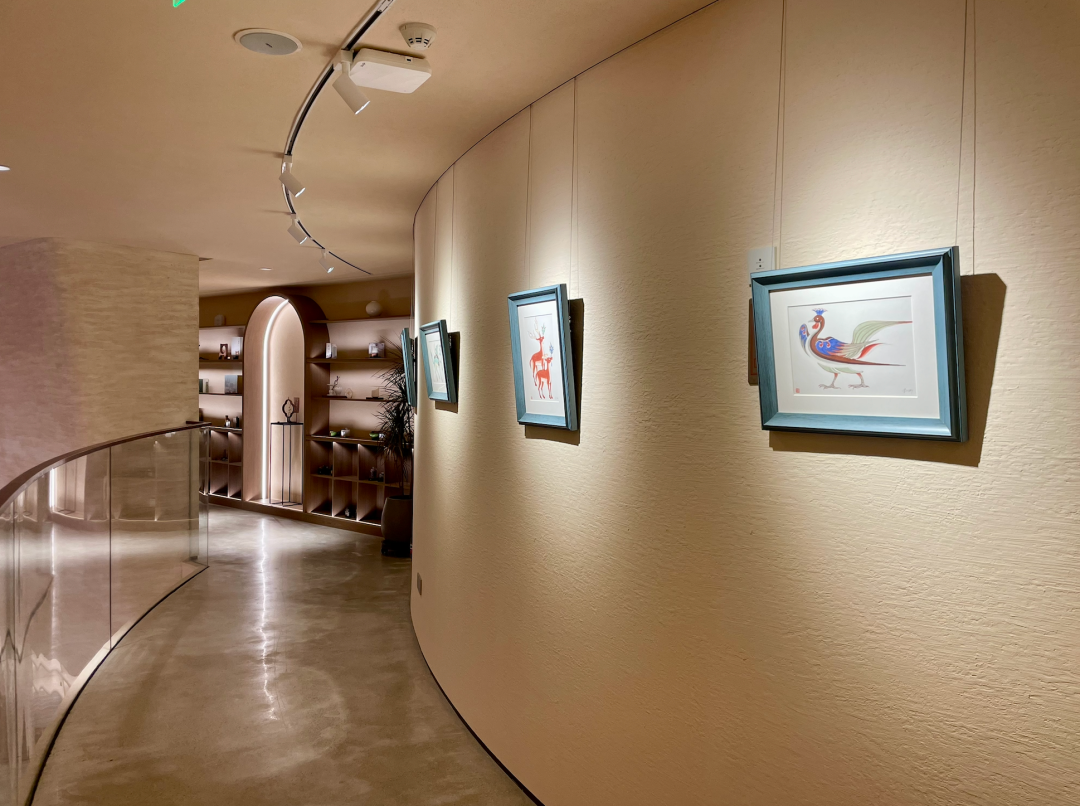
After she was sent down to the countryside, she encountered many practical hardships. Each time she saw small flowers by the roadside facing the sun in the wind, looking so beautiful and so vigorous, it was that vitality that gave force to her own life. Wherever she went, she carried a small notebook and sketched the wildflowers she saw. Later, when she taught at the Central Academy of Arts and Crafts, she specifically offered a course on Dunhuang patterns. Because so many of the formal principles in Dunhuang decorative motifs are tied to the ecology of the natural world, and because decorative pattern cannot be separated from the many transformations of flowers, she was always observing changes in floral form, whether for teaching or for pleasure. It became a lasting habit in both her life and her work. A manuscript by Chang Shana was photographed by Wu Huang.
Chang Shana remained in Dunhuang until the age of sixteen. Mr. Ye Lihua was willing to support her advanced studies in the United States, where she would specialize in painting. In 1948, she enrolled at the Boston Museum School-Department of The Museum of Fine Arts in Boston and received formal Western training in painting and draftsmanship. During her student years in Boston, she painted on site accompanied by her friend Ruth.
At Ninety-Four, Chang Shana Is Still Working for Dunhuang
Drawing, perspective, color, painting, design, human anatomy, art history: the memories of copying Dunhuang murals in childhood did not recede under the discipline of traditional Western painting. Instead, they were strengthened, and absorbed into a fuller, more integrated perspective. Speaking of her time studying in the United States, Chang Shana said, "While I was there, I discovered that beyond Dunhuang there were also the artistic cultures of Greece, Rome, Egypt, and others. At the time I felt that the world was very large, that there was not only Dunhuang."
"There are likenesses and points of connection among the world’s art cultures, but each also has its own particular cultural strengths, each beautiful in its own way. And the Silk Road was precisely a road of many cultures, with Dunhuang as one of its crucial crossroads. The murals of the Mogao Caves are like a treasure chest, preserving the great fruits of Buddhist and folk art in combination." Works she had copied were later donated by Chang Shana. After the founding of New China, the country faced reconstruction on every front. At the time, many students studying overseas urgently wanted to return and contribute to the building of the new nation; Chang Shana was one of them.
After returning to China, she helped her father organize the Dunhuang exhibition at the Meridian Gate of the Palace Museum, where she came to know Lin Huiyin and Liang Sicheng.
"At the time, Ms. Lin Huiyin was gravely ill. Almost every day from 9:30 to 11:00 in the morning, I went to her bedside to study with her. Under Lin Huiyin’s influence, I undertook topic-by-topic research into the art of Dunhuang across the dynasties and worked in arts-and-crafts design. In addition to the design work for the Great Hall of the People, one of the Ten Great Buildings, I also worked on cloisonne, textile printing and dyeing, clothing design, and more. The basic idea was to bring Dunhuang culture and the lineage of Dunhuang patterns into modern society in ways that met modern needs."
So many years later, when Chang Shana speaks of the work she found most interesting and remembers most vividly, she still returns to the first state gift of New China that she designed: the Peace Dove platter series and silk scarves. She had only just returned to China then and was only twenty-one.
"When New China had just been founded, China convened the Asia-Pacific Peace Conference. At the time, the most famous artist in the world was Picasso, whose peace dove was celebrated internationally. My teacher Lin Huiyin said to me, ‘Shana, should there not be not only Picasso’s peace dove, but also our own Chinese peace dove, a Dunhuang peace dove?’ The moment she said that, I had an inspiration. I used the doves from Dunhuang murals to design this state gift. It remains unforgettable to me. Even now that design continues to be used, which also proves that if one truly understands how to use the content of Dunhuang art, and uses it well, it remains endlessly worth looking at no matter how many years pass. It can stand the test of time."
SECTION 03 | Human time is limited. It’s a pity that we can’t go further with Dunhuang.
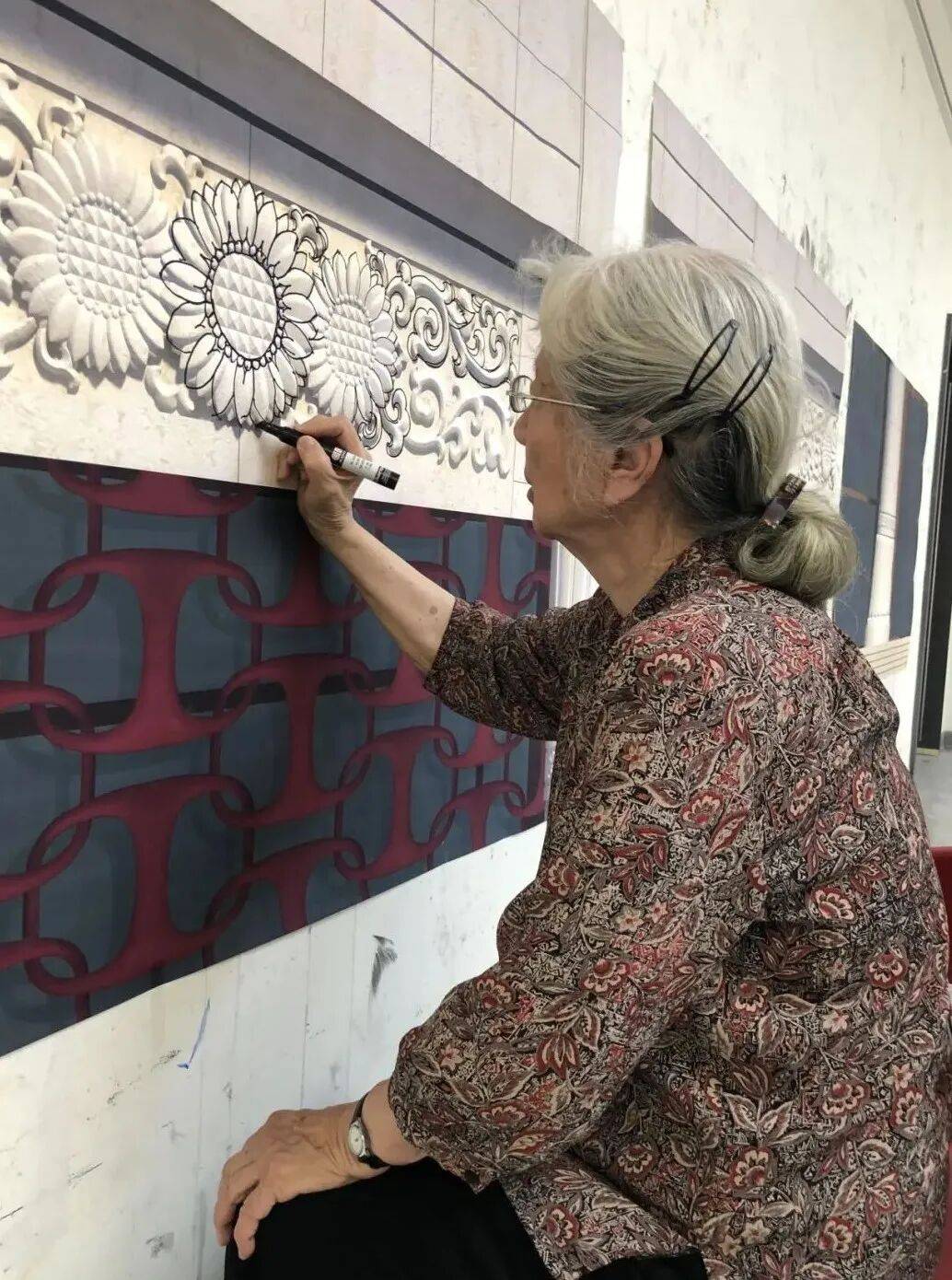
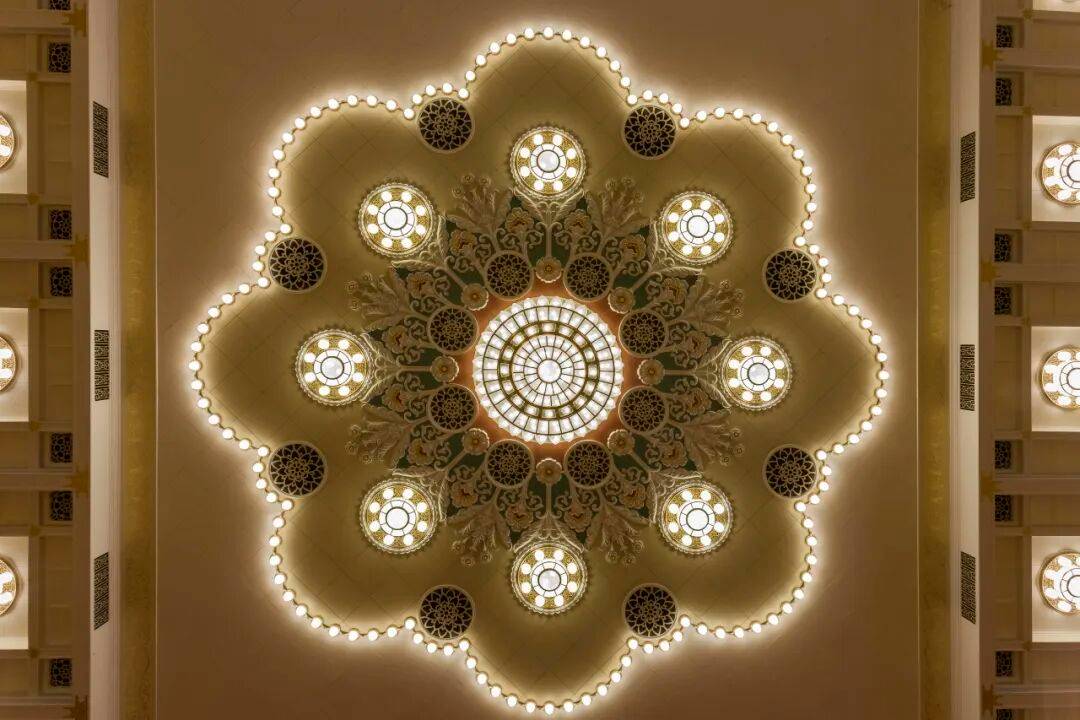
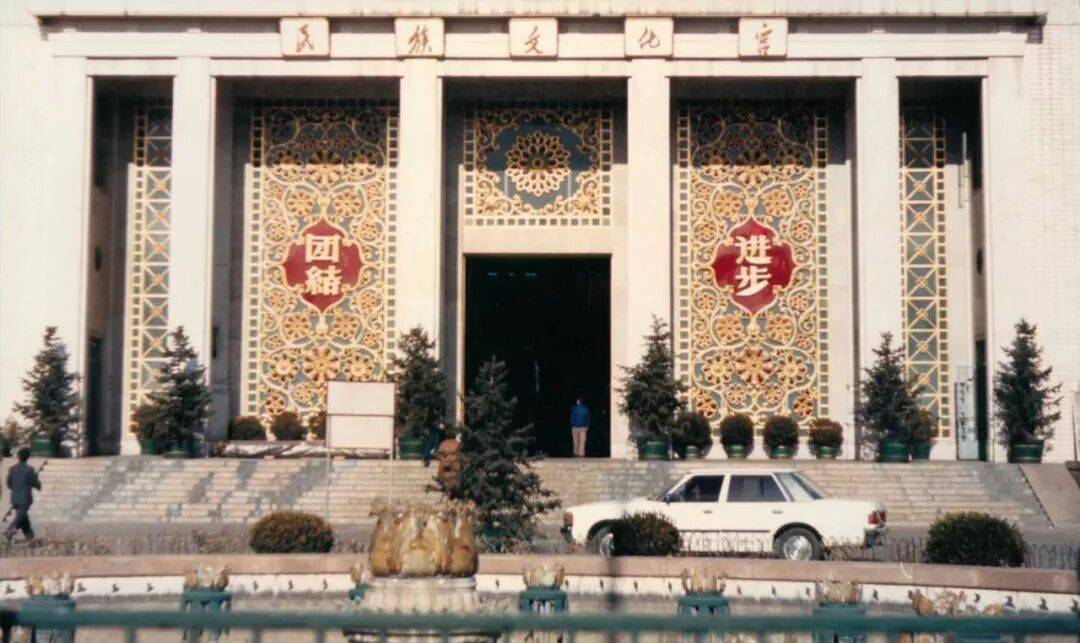
Chang Shana later took part, one after another, in many design projects: the commemorative medal for the War to Resist U.S. Aggression and Aid Korea, the ceiling lights of the banquet hall of the Great Hall of the People, the National Cultural Palace, the emblem of the Communist Youth League, the sculpture Forever Blooming Bauhinia in Hong Kong, and more. Even when she was ninety, the Publicity Department still sought her out and asked her to work with an architectural team from Tsinghua University on the facade design of the Museum of the Communist Party of China. She is also seen revising a design drawing for the Party History Museum and preparing a draft for the ventilation opening in the banquet hall ceiling of the Great Hall of the People.
"Elements matter, and cultural lineage matters too. To make the past serve the present, to carry forward national culture that is national, scientific, and for the people, and to pass it down continuously. I feel fortunate that I have been able to serve as that kind of transmitter." Among her designs is the lotus ceiling lamp for the Great Hall of the People. Also among her works is her 1946 copy of the Amitayurdhyana Sutra transformation mural from Cave 172, High Tang. Chang Shana has copied, created, and designed countless things in her life, but whenever she sees something she made, she can recognize it at once.
"I have no special preference among my works, because they are all my creations. The early copies are especially precious to me. Many were taught to me hand by hand by my father and by the first generation of Dunhuang elders. The work of that period is beyond words and cannot be replaced. Looking back now, after seventy or eighty years, it remains an extremely important reference for the study of Dunhuang art." To us, her research into Dunhuang culture, after seven or eight decades of accumulation, has already become a vast system; beyond what she is doing now, one imagines there must be many plans ahead.
Yet she told us, "For me, work on Dunhuang does not require a plan. My father said I must never forget that I am a person of Dunhuang. That is something carved into my bones. It comes out altogether naturally." During the interview, Chang Shana repeatedly brought up her father, Chang Shuhong, and her teacher, Lin Huiyin. That she has sustained her research on Dunhuang for so long has much to do with the emotional force she invested in her father and in Lin Huiyin, who was both teacher and, in some sense, mother. The painting Family of the Painter is by Chang Shuhong.
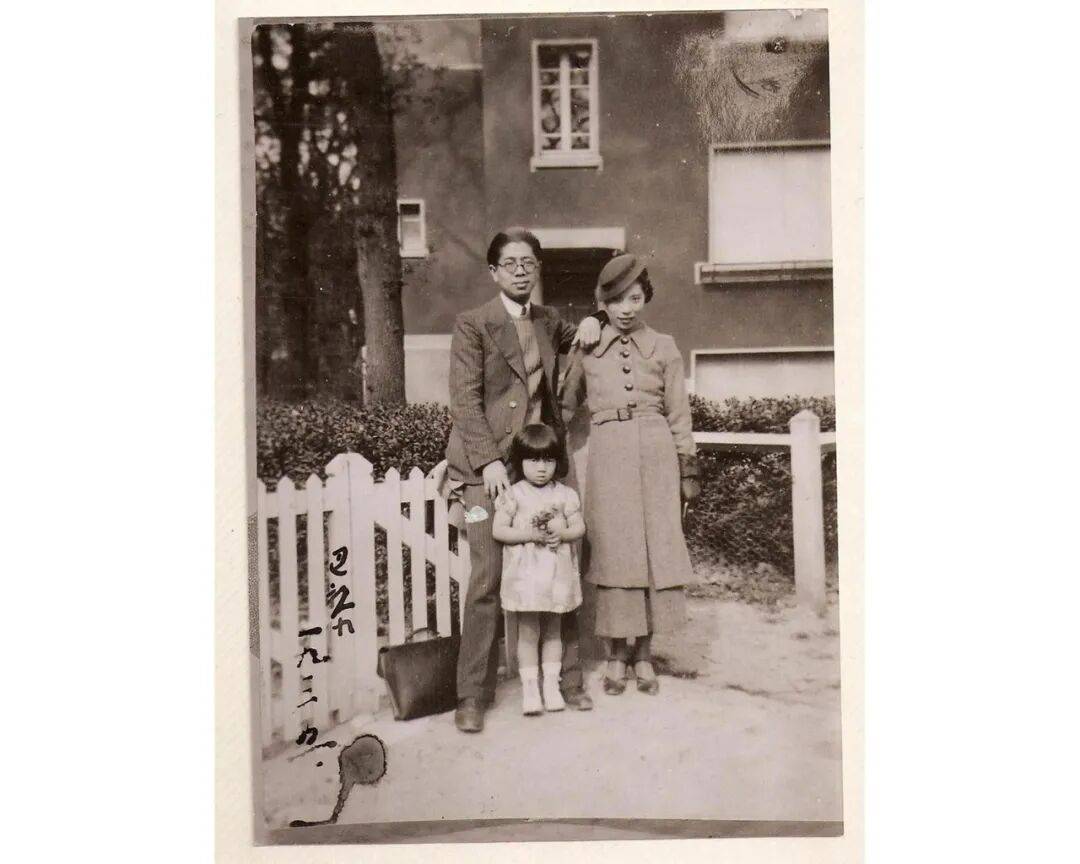
"My life’s work carries my father’s hopes and also the charge entrusted to me by my teacher Lin Huiyin. In my girlhood, Ms. Lin took the place of my mother in guiding me, and gave me a different kind of warmth and nourishment for my work. The love I received from these two elders gave me greater courage to face the many setbacks of life. I would not dare say I am continuing them, but if I do my work well, that is the best way to repay my father and my teacher." She spoke of her father not like a person in her mid-nineties, but like an innocent and lovable girl. In 1935, the three members of the Chang family were in Paris.
She was born in Lyon, France, and so the years before she turned six were spent there.
"I was an obedient and well-behaved daughter, and my father cherished me very much. In his oil paintings from the years in France and after our return to China, there are many portraits of me. Those portraits are also one way my father expressed his love for me. Although those paintings are no longer with me now, they are my father’s memory given to me, a bond that will never change." The exterior of Chang Shuhong’s former residence was photographed by Sun Zhijun. Looking back, Chang Shana said, she can always feel that Chang Shuhong gave her an abundance of love.
"Even in the very difficult conditions of Dunhuang when I was little, my father worried that I had no toys and no playmates. In the bitter winter there, he would make ice-carved chairs for me outdoors, put a thick cloth on them, and let me play with local farmers and children. Sitting on the ice sofa my father made with his own hands, I found it especially amusing. In such winters I did not feel cold; what I felt was curiosity and delight. I am my father’s daughter, and also a comrade in his work for Dunhuang.
"Especially after I grew up and became a mother myself, I understood even more how difficult things were for my father, and so I respect him all the more." Chang Shana designed Nianjin Tu for the 2024 Spring Festival Gala. To her mind, this inheritance of her father’s spirit shares the same core as copying Dunhuang murals and then going on to create. From the moment they are born, human beings learn the ways of survival by imitating their parents, and at last something of their own soul ferments from that process.
Interview | At Ninety-Four, Chang Shana Is Still Working for Dunhuang
"The same is true in painting. Copying and creation are one. There must be a process of learning before there can be what we call creation. The two support each other; it is a necessary path. You cannot meaningfully separate them, and there is no line between them." The studio that bears her name is itself a form of transmitting the "spirit of Dunhuang."
"The art of Dunhuang murals continued without a break across ten Chinese dynasties, beginning with Northern Liang and ending in Song and Yuan. Over that thousand-year span, it records and bears witness to transformations in the history of Chinese everyday aesthetics and popular culture. Dunhuang art even influenced court culture in the Ming and Qing periods. Take, for example, the phoenix robe worn at an empress’s coronation, with its scrolling lotus-branch motif symbolizing an unbroken imperial line: those patterns already existed in the Tang murals of the Mogao Caves. Many people do not know this and assume they belonged only to the court."
Listening to Chang Shana speak with effortless fluency about the patterns and aesthetic changes of China’s various dynasties, we could not help wondering: in today’s accelerated age, why are the young people in her studio still willing to devote themselves to studying the "old stuff" of Dunhuang culture?
"Many people mistakenly think Dunhuang art is something old. But if you look carefully, there are many elements of Dunhuang patterning in our contemporary lives, including certain geometric motifs in modern aesthetics. You simply do not know their connection to a thousand years of Dunhuang. And if you do not know, of course you take no interest. But once you do know, you will marvel at how forward-looking and advanced its aesthetic ideas are. Dunhuang aesthetics have not only influenced China; they also coexist in the Western world." She also designed the door ornamentation of the National Cultural Palace. In her view, only through deeper study can we truly make good use of this thousand-year-old art; only by understanding its lineage and inner meaning can we create better work.
To use it without study is merely to rely on the shallowest surface impressions of one’s own eye. It is easy to misuse, and to mislead the next generation in its understanding of Dunhuang art.
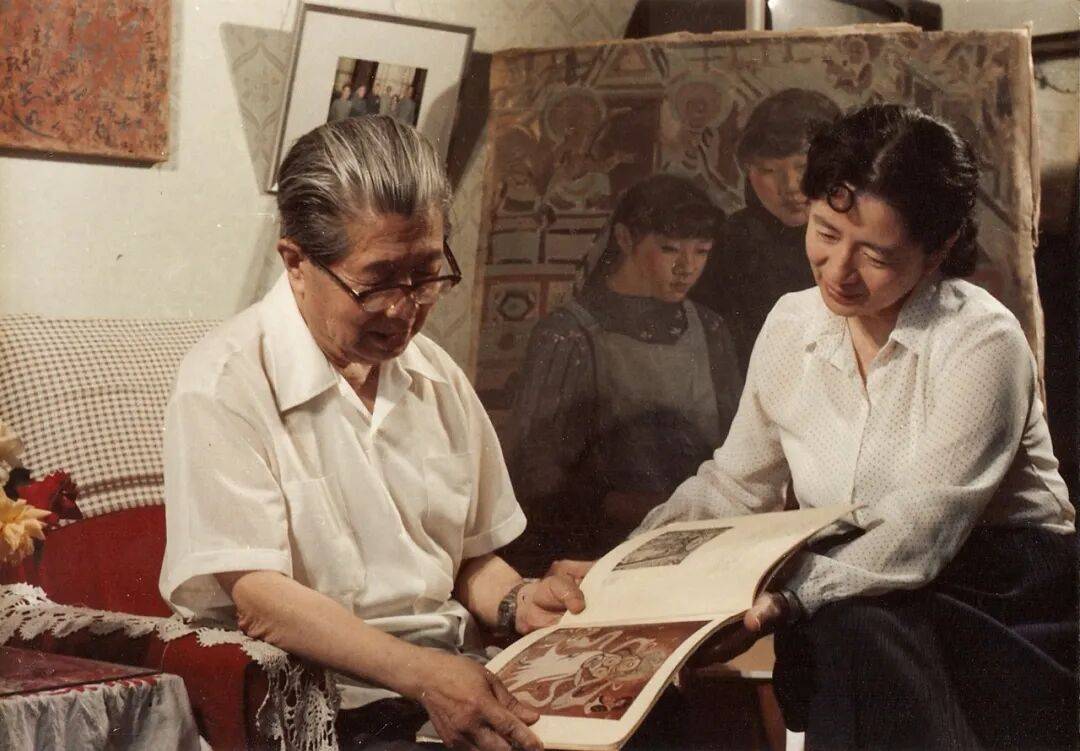
"Many young people today, for the sake of economic return, want quick money and do no research. Based only on superficial appearances, they piece things together casually and call it Dunhuang design. I absolutely do not agree with that. To make Dunhuang art, one must have a correct point of view in order to pass on its cultural lineage. Otherwise, one cannot call it Dunhuang art design; one can only call it the designer’s own design. That is a very great difference." At one point, Chang Shana demonstrated for students how to apply color to a Buddhist figure. As the conversation drew to a close, looking at the still-vigorous Chang Shana and at the desk piled high with materials and manuscript pages, we could not help asking: did she ever worry that her time might run short?
Chang Shana was entirely calm. "In 08, I had breast cancer, and I had my breast removed right away. Personally, I have long taken life and death very lightly. But where Dunhuang is concerned, my time is certainly not enough. Dunhuang belongs to the world; it does not belong to any one person. Many things cannot be kept in one person’s hands alone. Younger people must take over, so that it can be passed down from generation to generation." The cover image is courtesy of the China National Arts and Crafts Museum. Advertisement.