At Seoul’s Amorepacific Museum of Art, more than forty works trace Mark Bradford’s personal history, migration, and resistance through painting, sculpture, installation, and video......
By / Xirui Huang · 11 min read
What is Mark Bradford: Keep Walking at Amorepacific Museum of Art about?
Keep Walking is Mark Bradford’s largest Asia-Pacific exhibition to date, bringing together more than forty paintings, sculptures, installations and videos. From End Papers, Merchant Posters and Train Tables to the commissioned Here Comes the Hurricane, it connects migration, Black and queer history, social pressure and resilience.
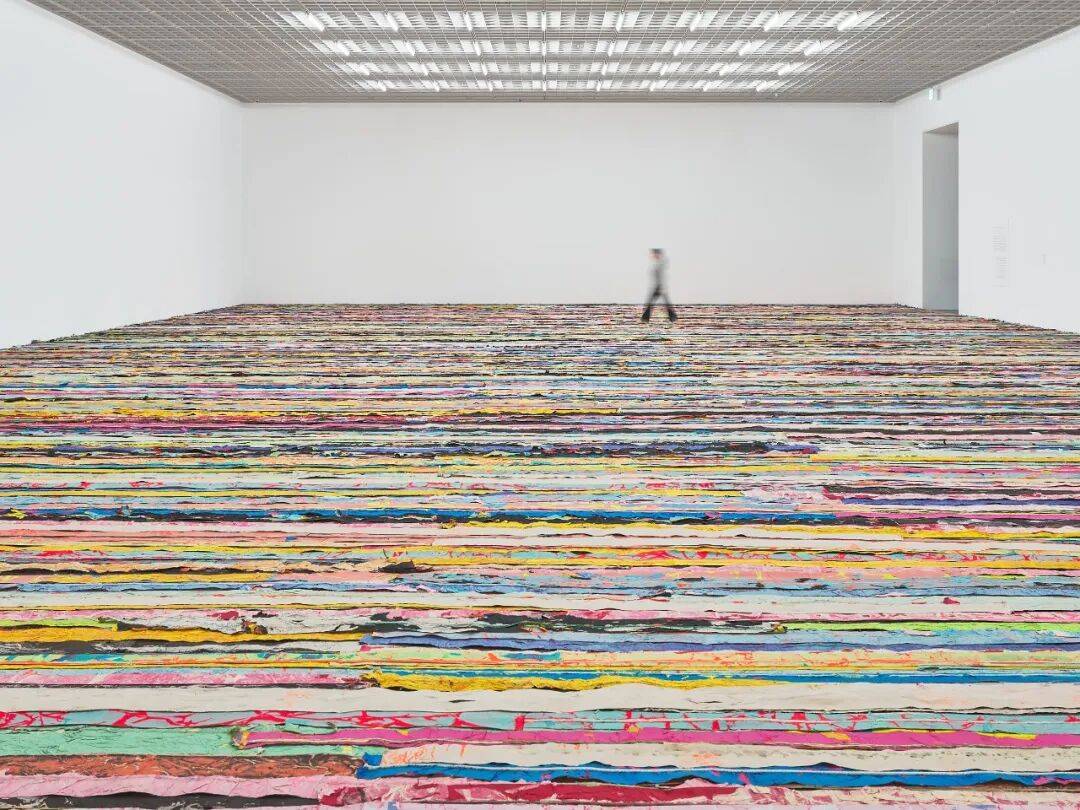
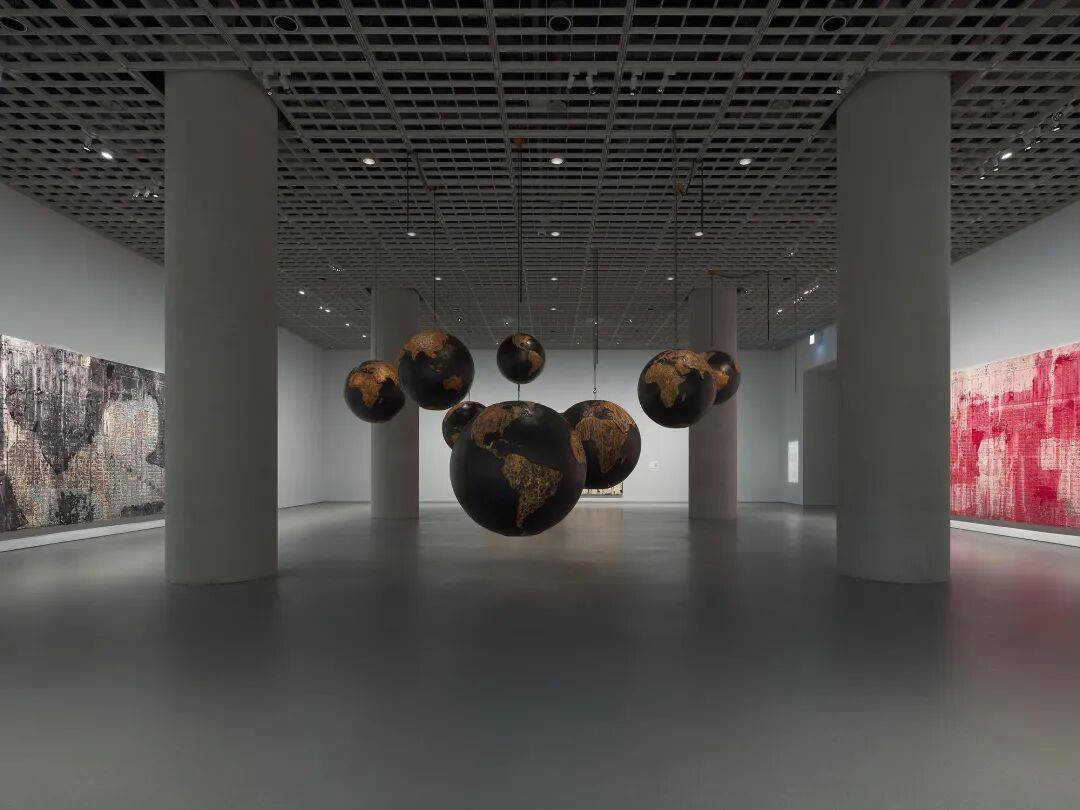
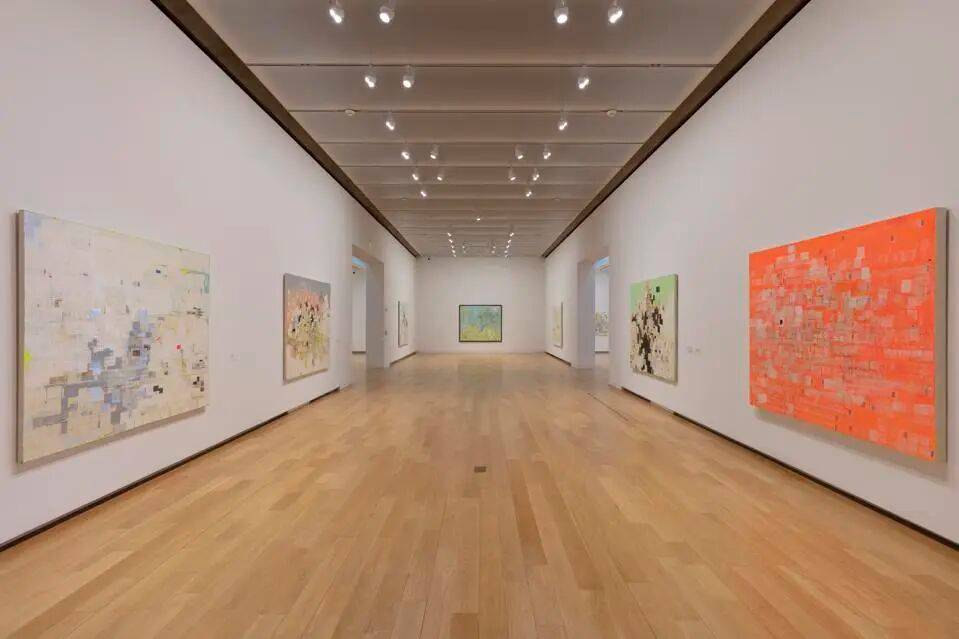
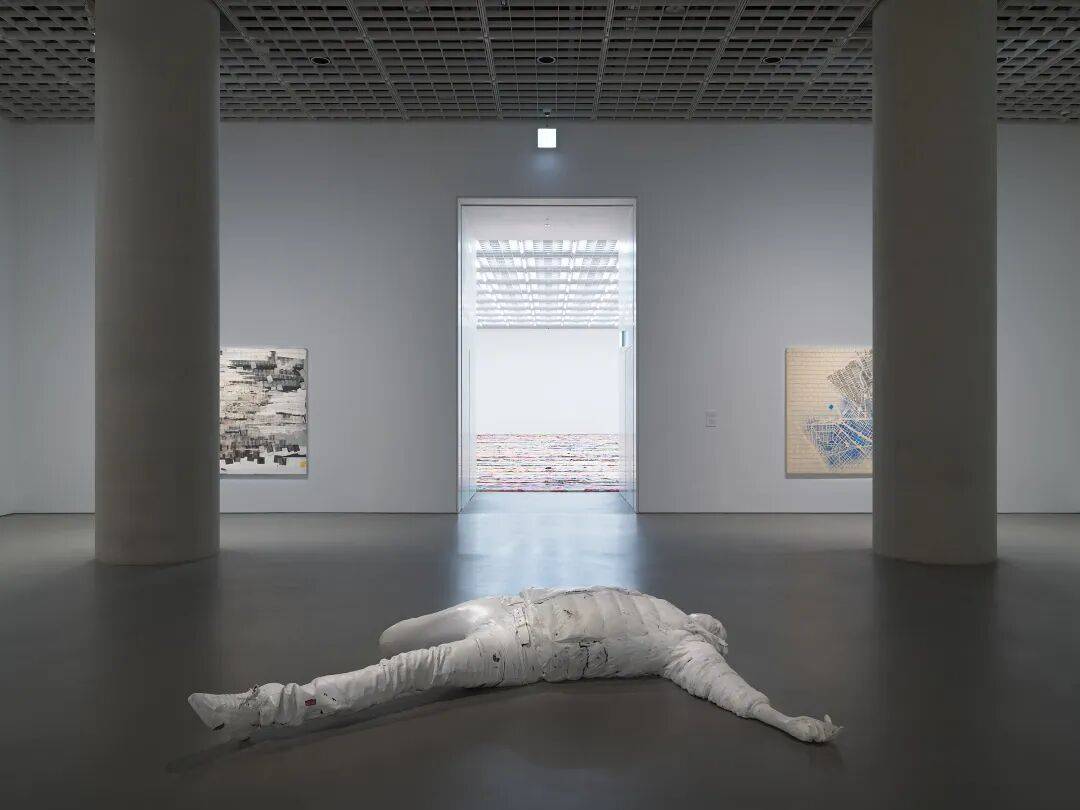
A giant “planet” suspended in midair, a gallery covered with more than 600 square meters of colored paper, a “person” lying on the floor and splashed with white paint, towering “columns” several meters high, and abstract collages: in the white spaces of Seoul’s Amorepacific Museum of Art, Mark Bradford tells a story about personal experience, movement, and resistance.
The renowned American contemporary artist was born in 1961 in South Central Los Angeles. The neighborhood where he lived shaped his artistic language. He builds canvases from end papers, posters, advertisements, plastic, and cardboard—the materials found everywhere on streets, in hardware stores, and in barbershops. He layers the papers, soaks, tears, and sands them until they become topographical surfaces—at once material and social.
“The first thing he did when he came to the museum was shake hands with and hug everyone—truly everyone, from our museum guards, interns, and cleaners to our director and chair of the board,” Sarah Yoon, the exhibition’s curator, told us. After “Keep Walking” opened, we spoke with Sarah and Bradford about the exhibition, and about the artist’s work and life.
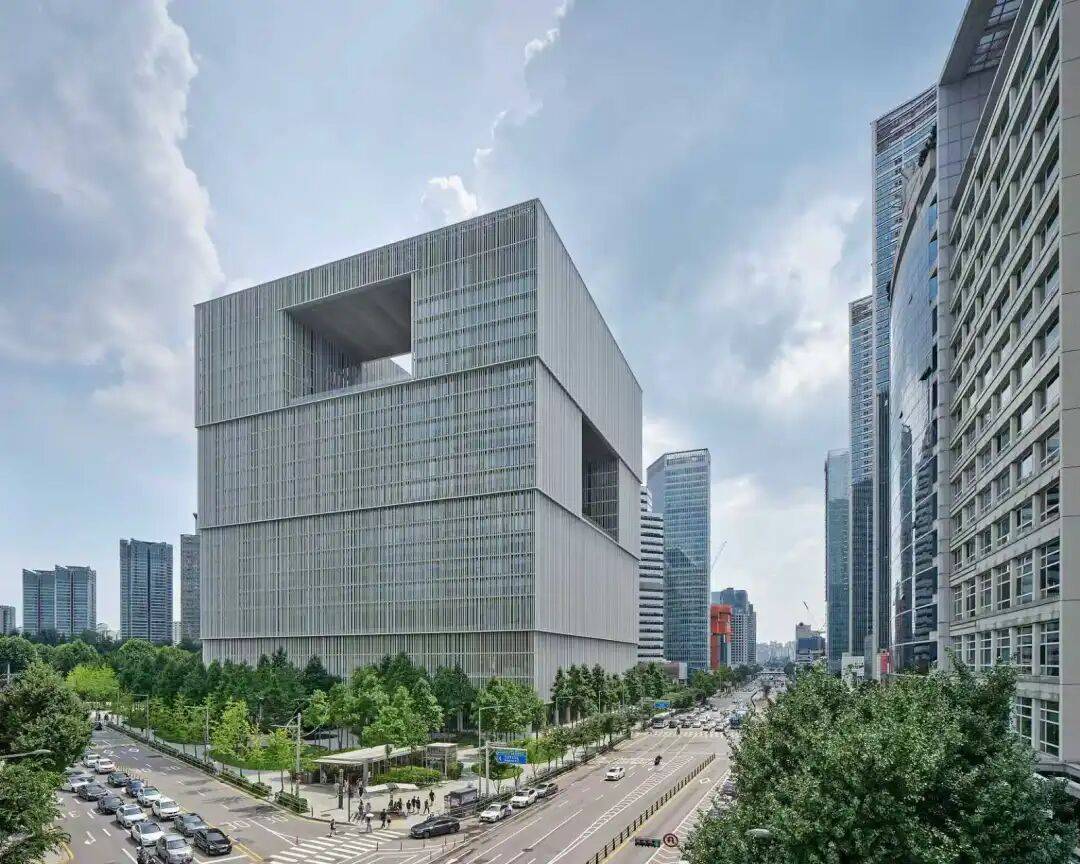
Amorepacific Museum of Art, Seoul. Photograph by Kyung Roh. In autumn in Seoul, we descended the gently sloping stairs into the Amorepacific Museum of Art, entering a windowless, white, silent world. The renowned architect David Chipperfield designed the museum as a ship buried underground. Sarah described the staircase leading to the galleries: “When you reach the lowest level, the sunlight is completely cut off, as if you have left the earth.”
“It feels like a floating ship, and every step the audience takes is like breathing underwater.” At that moment, the space became a metaphor for Mark Bradford: carrying the weight of history, individual trauma, and social memory, he peels and layers them until light can enter again.
“Mark Bradford. Keep Walking,” installation view, Hamburger Bahnhof–Nationalgalerie der Gegenwart, Berlin, 2024–2025. Photograph by Jacopo LaForgia. “The title ‘Keep Walking’ continues the title of the earlier exhibition at Hamburger Bahnhof in Berlin, because no matter how the location changes, it always addresses a shared theme—migration, and human resilience in movement.”
Sarah, the curator, told us. The exhibition likewise asks viewers to “keep walking,” and many of the works have a pronounced physical presence.
SECTION 02 | Art creation, starting from the chaotic neighborhood
“Whether you walk on the works, through them, or around them, we are actually using the audience’s movement as a metaphor and comparing it with people’s histories of migration,” Sarah said.
At the same time, it can be a gentle encouragement, carrying the sense of “hold on.” This is Bradford’s largest exhibition to date in the Asia-Pacific region, bringing together more than forty works across painting, sculpture, installation, video, and other media. The exhibition ranges from Bradford’s early “end papers” series to a new immersive commissioned installation inspired by Hurricane Katrina and created for the museum.
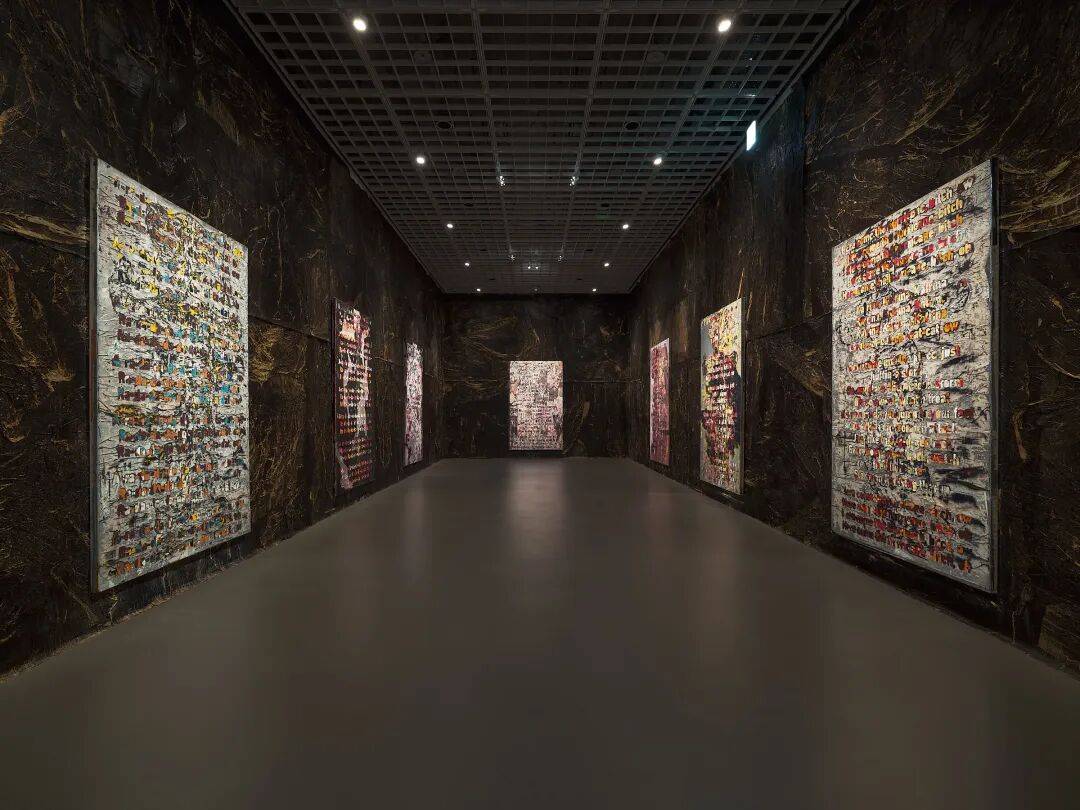
“They were specially commissioned for the museum’s space and completed at the beginning of this year.” Sarah told us that Bradford immediately liked the gallery after seeing its floor plan. Although the entire museum is sunk underground, the space has very high ceilings, close to 5.7 meters. Bradford therefore made a series of long, vertical paper paintings that stand like columns. The wallpaper consists of carbon test paper purchased from a paper mill; after being soaked in adhesive, it takes on a flickering golden sheen.
Sarah explained: “This paper was originally industrial waste—the backing paper used to test carbon powder. But Bradford discovered that when it is combined with glue, fine golden cracks appear on the surface, like ruins lit by a storm.”
“We also wanted to create a huge, cave-like environment, and finally decided to add this wallpaper at the back. All the elements came together in that space. The final effect is of one painting hanging over another, which is visually very powerful.” As Sarah put it, the gallery became a vast cave. Visitors move between sheets of paper as if walking through the fissures of history.
These works resemble chapters in the artist’s life, moving from the dust of the street to the center of a storm, from individual skin to the coordinates of society. In the Black community of South Los Angeles where Mark Bradford grew up, his mother ran a barbershop. The salon later became the source of his artistic ideas.
SECTION 03 | Pay attention to life, and pay more attention to historical and cultural phenomena
“That shop contained my strongest color memories from childhood,” Bradford recalled. “End papers, posters, advertisements, plastic, sound—I saw the language of life in those materials.”
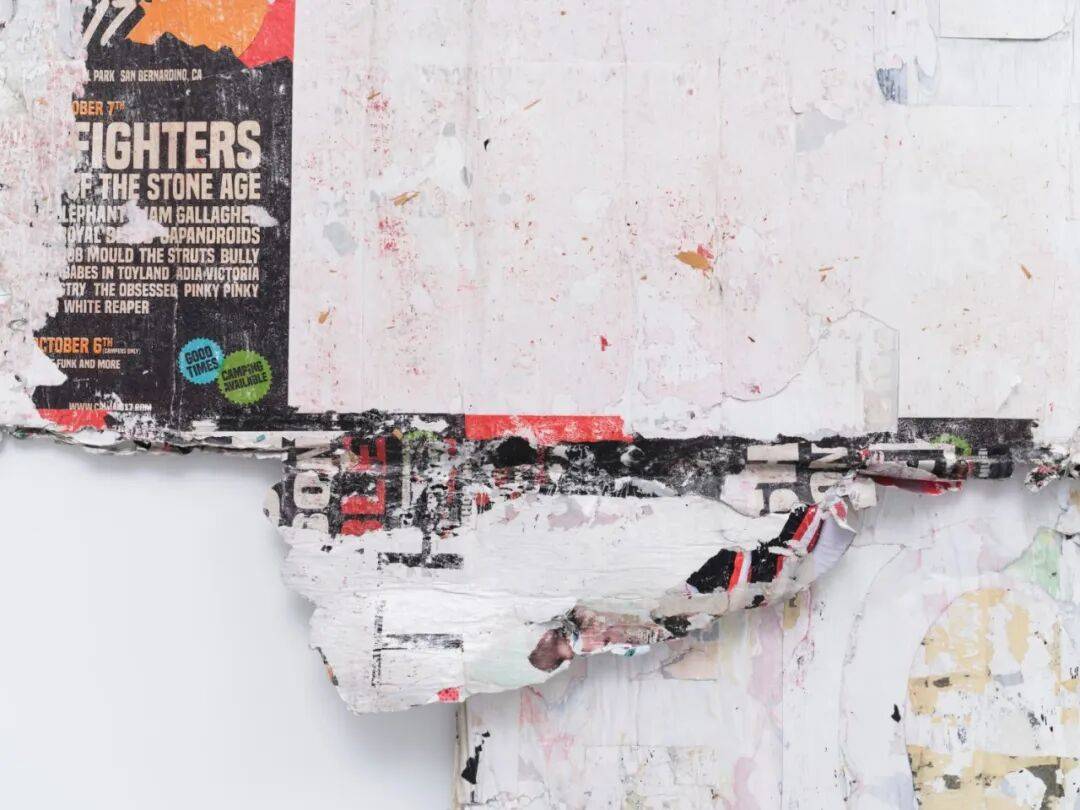
We can also see new works from the same series made between 2022 and 2024. Viewed together, the early and recent works create a charged tension. Bradford often says, “My canvases never begin on canvas, but on the street.” He walks past Los Angeles billboards, piles of wastepaper, and the alleys behind barbershops, tearing down sheets that others no longer need and bringing them back to the studio. These papers carry the language of society: neighborhood promotions, political slogans, religious leaflets. Each layer contains a glimmer of its time.
It is as if the body were performing and dying at the same time. The artist told us: “This sculpture grew out of my connection to ballroom culture, and it also carries my memories of the violence of the AIDS epidemic when I was young. I have always been reluctant to use my own body, but this time there was no alternative. Violence can sometimes be so literal. That is why I insisted on using my body rather than someone else’s.”
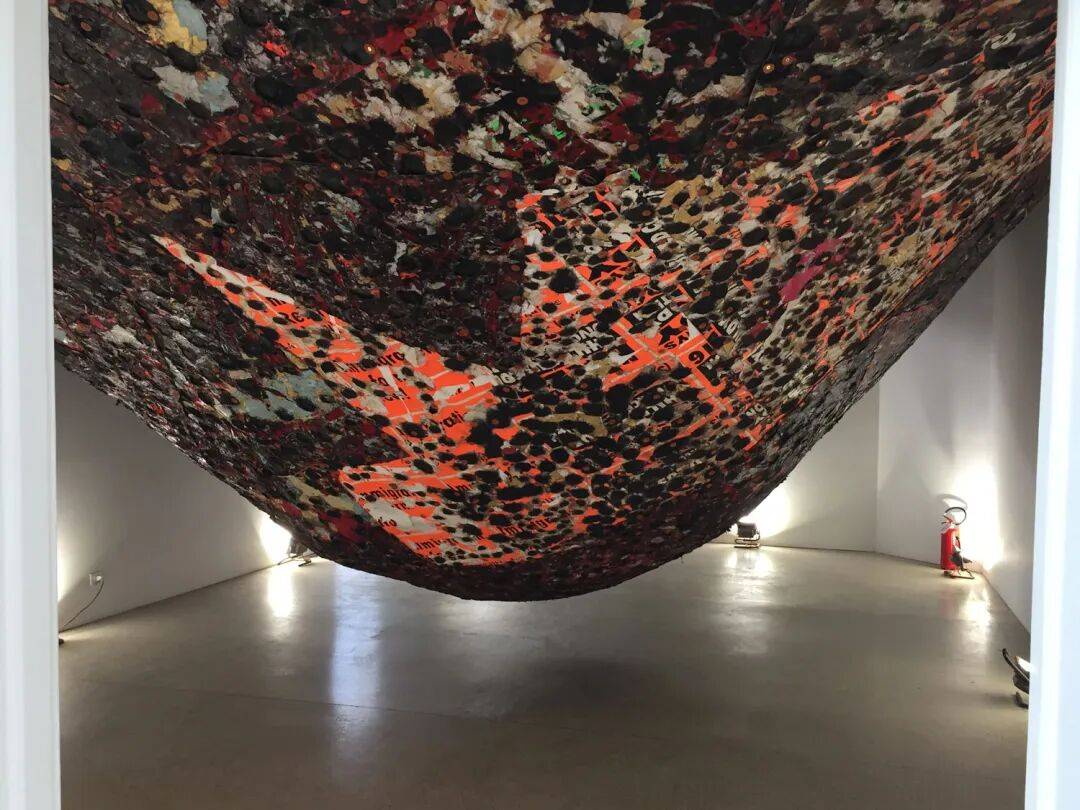
“Mark Bradford. Keep Walking,” installation view, Amorepacific Museum of Art, Seoul, 2025. Photograph by Kyoungtae Kim. Courtesy of the artist and Hauser & Wirth. The Merchant Posters series that follows is more overtly political. Bradford began collecting shop advertisements, apartment-for-rent notices, and announcements from Black neighborhoods, collaging them into enormous images.
Bradford collected these original printed posters in neighborhoods of downtown Los Angeles. The brightly colored local advertisements precisely targeted the area’s vulnerable, low-income residents. For Bradford, they are both formal foundations for his works on paper and conceptual ones. These collage and décollage works engage with the pressures of the urban landscape, offering a metaphor for the city’s economy and social classes: the advertisements call out opportunity while also revealing the anxieties of marginalized groups.
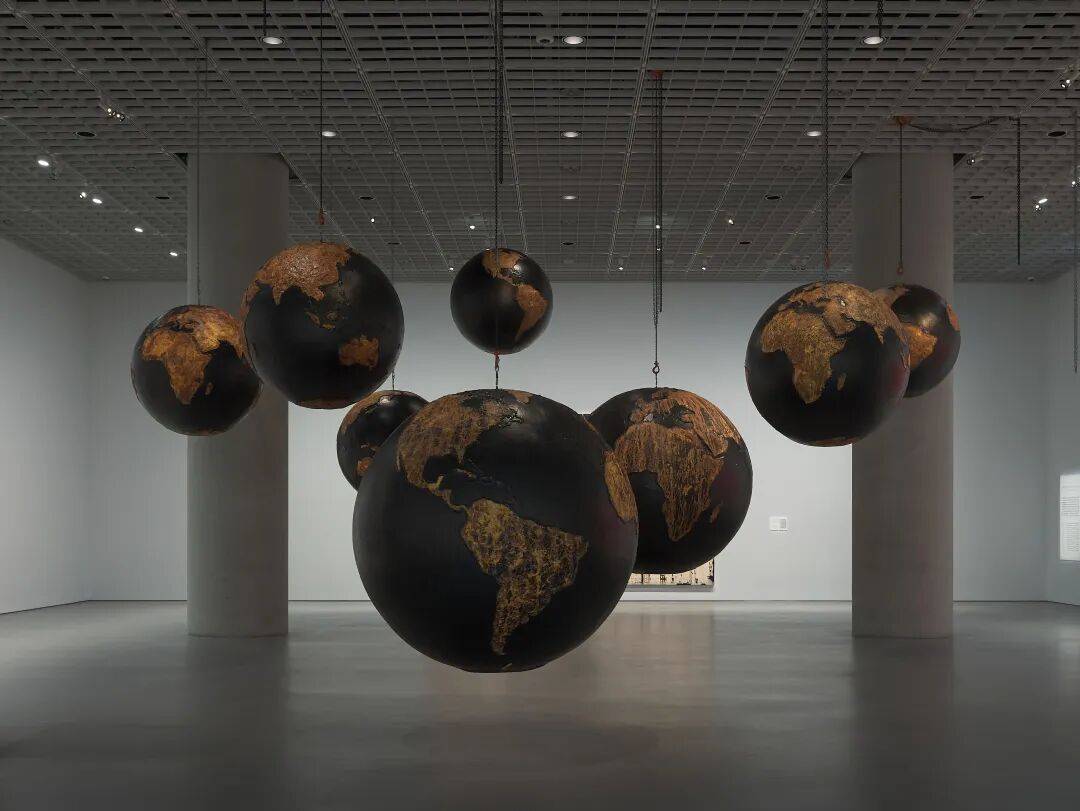
“This is a subject the artist has been investigating for the past three or four years. Mark usually likes to spend a long time researching different histories or materials before actually executing them in painting,” Sarah told us. The eight charred-earth installations suspended in midair were the most time-consuming and difficult part of the exhibition.
“One day during the installation period—we called it ‘execution day’—Mark, his exhibition director, and I began hanging them. We had to keep walking back and forth through the room, observing from different positions to see whether it felt right. In the end, we arrived at the slightly concave V-shaped arrangement you see now, somewhat like a cradle.”
The series centers on the devastation of Hurricane Katrina, while also drawing a comparison with American drug culture and placing William Dorsey Swann—now widely recognized as a historic figure who was among America’s earliest drag queens—at the heart of the work. Bradford has long been attentive to history and social phenomena, particularly the lives of minorities and people on society’s margins. This concern is also connected to his experience of being bullied as a child.
“Mark Bradford: Scorched Earth,” installation view, Hammer Museum, Los Angeles, 2015. Photograph by Brian Forrest. “When I was six, the label ‘sissy’ landed on my shoulders,” Bradford recalled. “People called me a sissy, which meant you could not find shelter within the group. My mother told me, ‘You have to learn how to navigate the schoolyard, but I will always be your solid support.’”
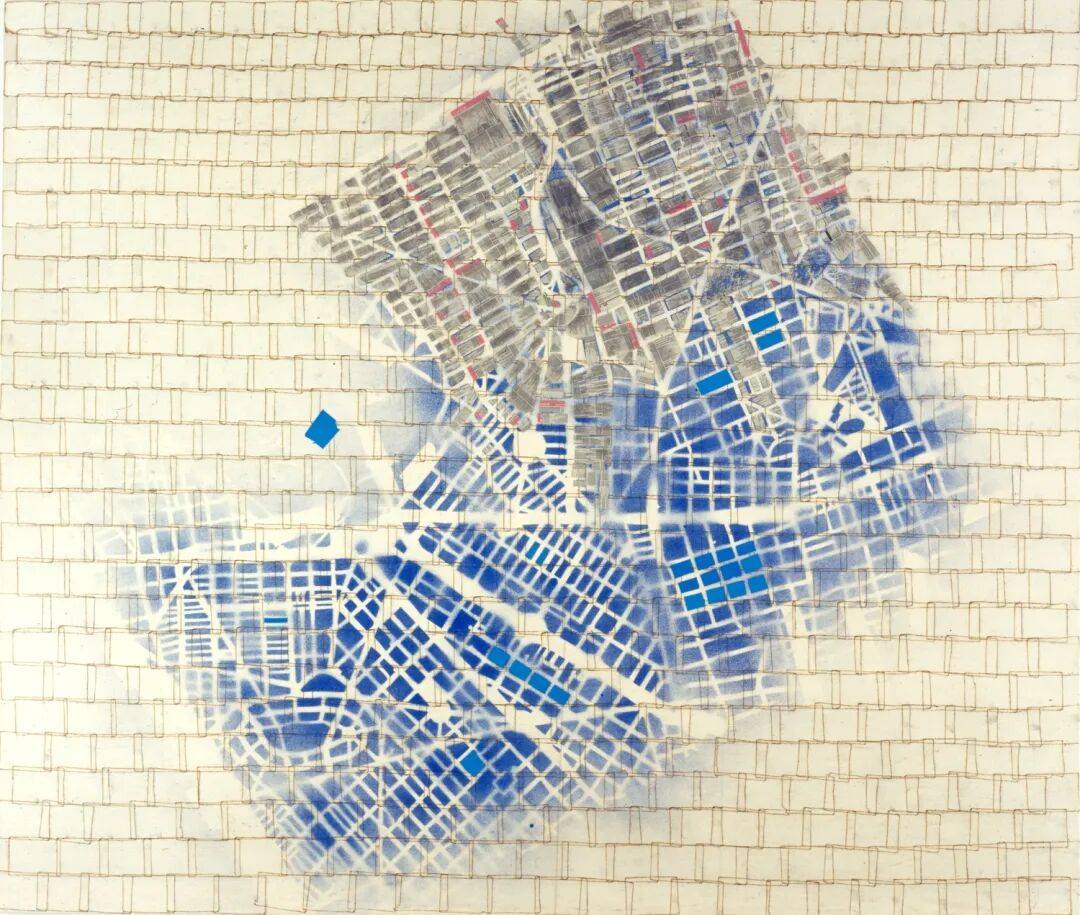
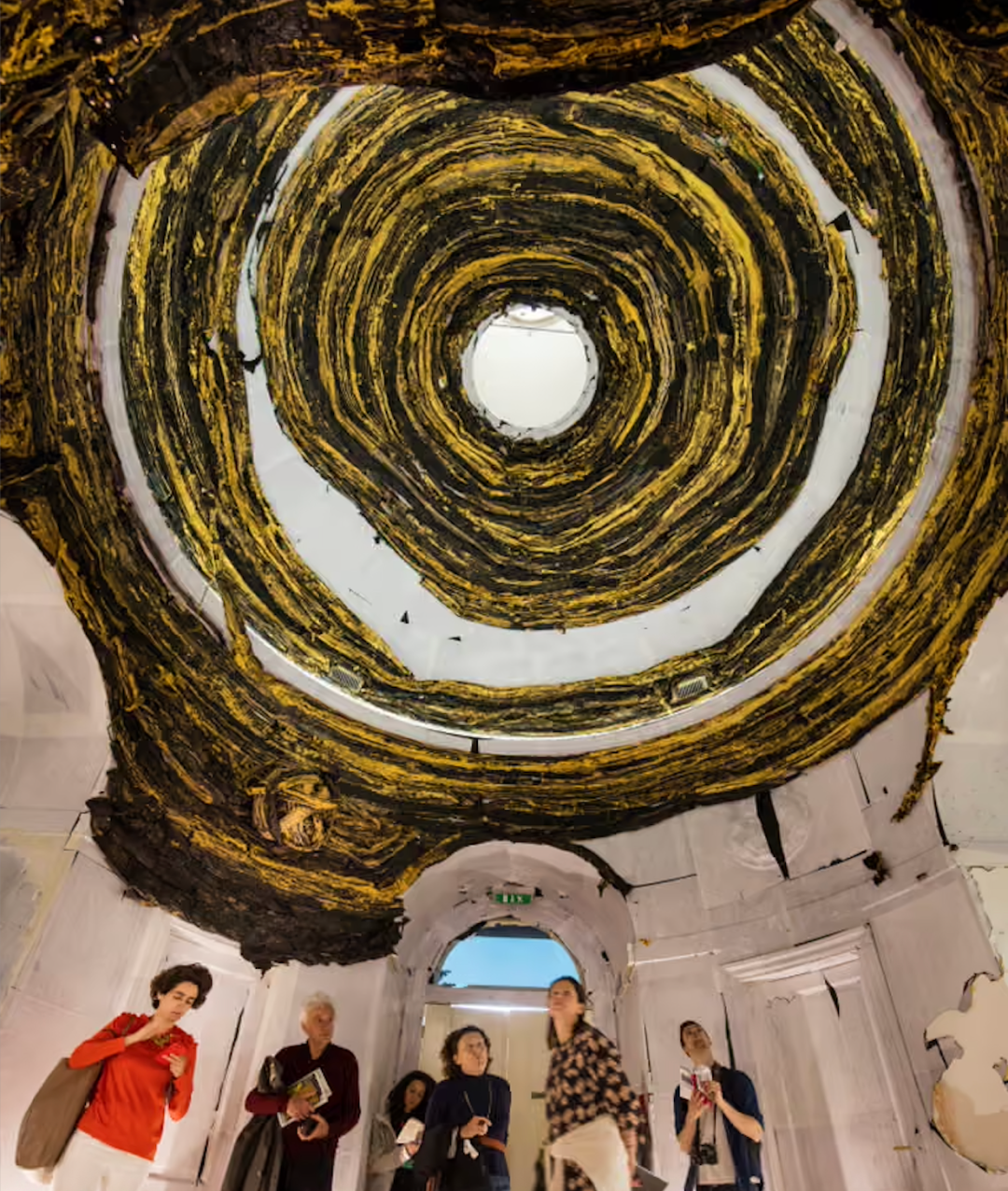
This was precisely the difficult condition in which Black LGBTQ people in the United States had to survive. In 2006, Bradford exhibited the Scorched Earth series at The Board in Los Angeles, taking the Tulsa massacre as its subject—the event in 1921 when a Black community in the United States was burned down. In the artist’s paintings, it becomes a set of layered geographic traces. Black, gray, ocher, and gold interweave like charred maps, or memories submerged beneath the earth’s surface.
“Mark Bradford: Tomorrow Is Another Day,” installation view, United States Pavilion, Venice Biennale, 2017. Photograph by Joshua White. At the high point of his career, when he represented the United States at the Venice Biennale in 2017, he exhibited the large-scale installation Tomorrow Is Another Day.
The work reconstructs Black American history in abstract form: mottled layers of paper on the walls resemble wounds, while a sculpture in the center of the gallery collapses in a spiral. The artist responds to the inequalities of his time through the form of the scar. He says, “Every tear is a rebirth.”
“Mark Bradford: Tomorrow Is Another Day,” installation view, United States Pavilion, Venice Biennale, 2017. Spoiled Foot is a monumental red-and-black papier-mâché sculpture suspended from the ceiling, taking over the visitors’ space completely. To get around it, you have to press yourself against the wall.
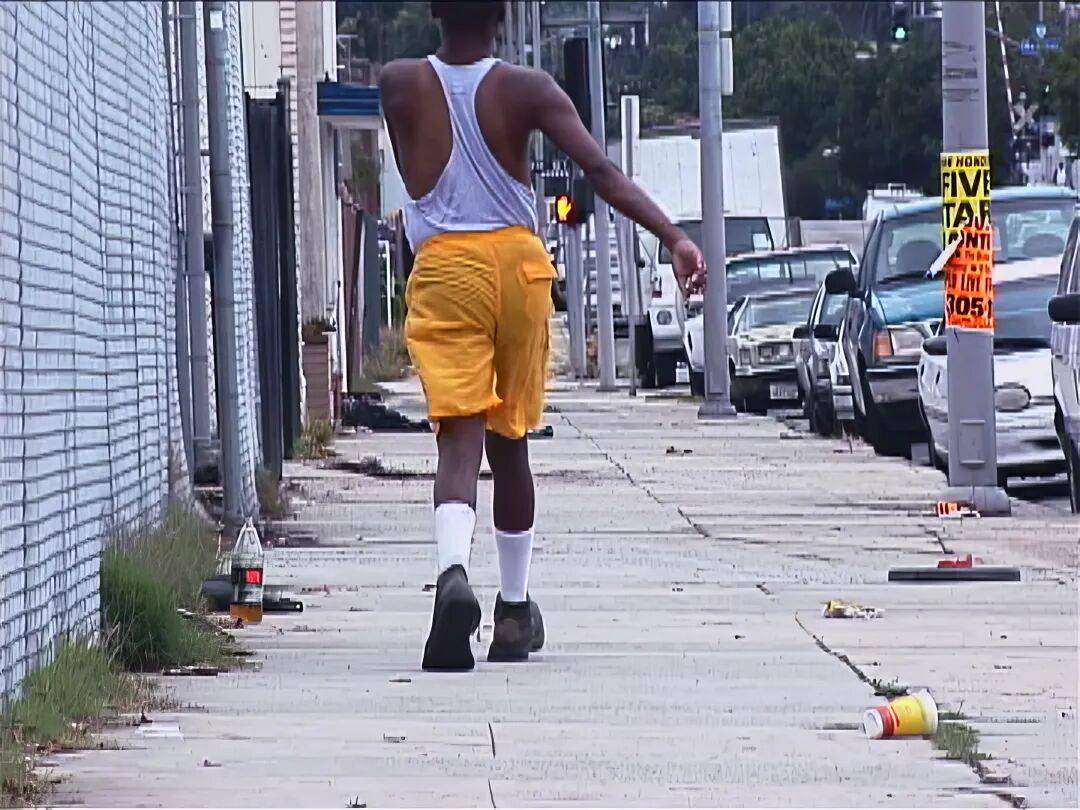
In the image, a boy named Melvin walks slowly away with his back to the camera. Sarah deliberately placed this early work at the end. “He does not look back; he simply keeps walking. The figure is sad, but also exhilarating—that is the soul of this exhibition,” she said. As Bradford himself told us, “If this exhibition conveys some kind of calling, I think it is a reminder that, as an individual, you always have the choice of how to navigate power structures, crises, and storms.”