From Low-Paid Worker to Internationally Acclaimed Artist
Huang Bing, the Hong Kong artist and 2025 Hick Award winner, makes vivid, flickering animations about social relations, personal shame, and unspoken desire. Through dark humor and irony, he subjects both everyday life and himself to an unsparing examination......
By / Xirui Huang · 9 min read
Who is Wong Ping, and why did he win the Sigg Prize 2025?
Wong Ping is a Hong Kong-born animation and video artist known for vivid imagery, dark humour and self-narrated stories about desire, power and social contradiction. He and Heidi Lau jointly won the Sigg Prize 2025 with the M+-commissioned video installation Debts in the Wind. This interview also traces his path from low-paid television post-production work to exhibitions at the New Museum, Centre Pompidou and Kunstmuseum Basel.
Figure | Wong Ping: Many Personas
Huang Bing, a Hong Kong artist born in the 1980s, was named the 2025 Hick Award winner at the end of 2025. In recent years, he has become one of the most sought-after young artists working locally in Hong Kong. His animations are vivid, flickering, and lively; they often take up social relations, personal shame, and desires that most people find difficult to voice. With a distinctly dark humor and a taste for irony, he subjects everyday life—and himself—to an almost ruthless examination. Together with animation-related environments and installations, the work repeatedly and unexpectedly challenges our expectations of what a “simple” animated work can be.
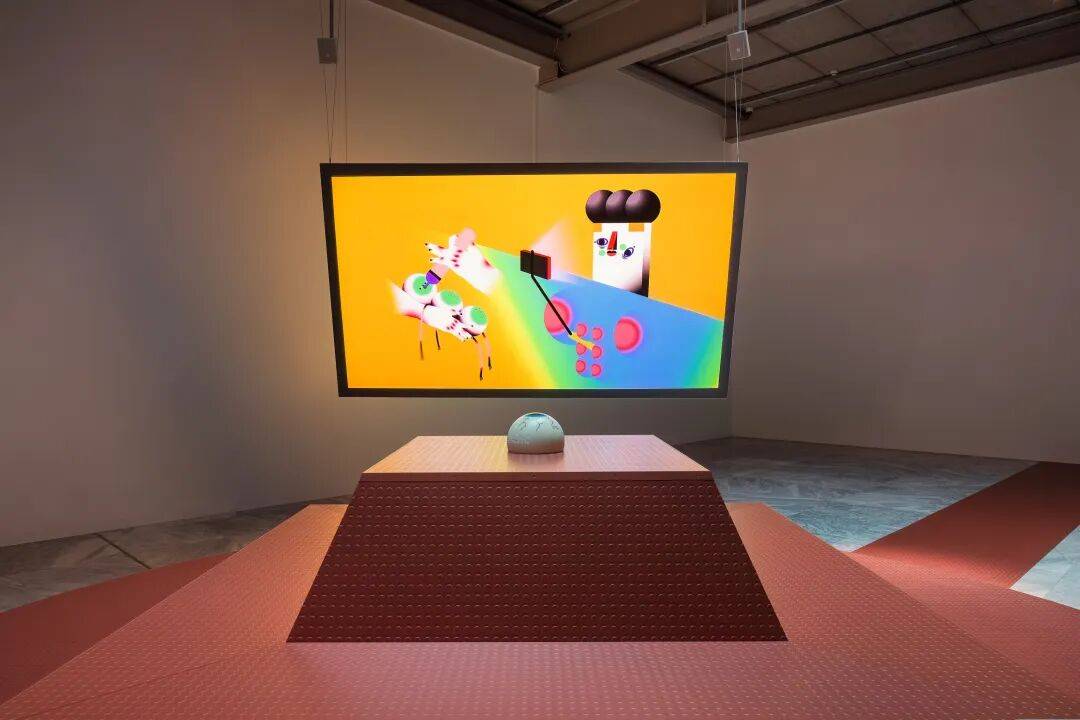
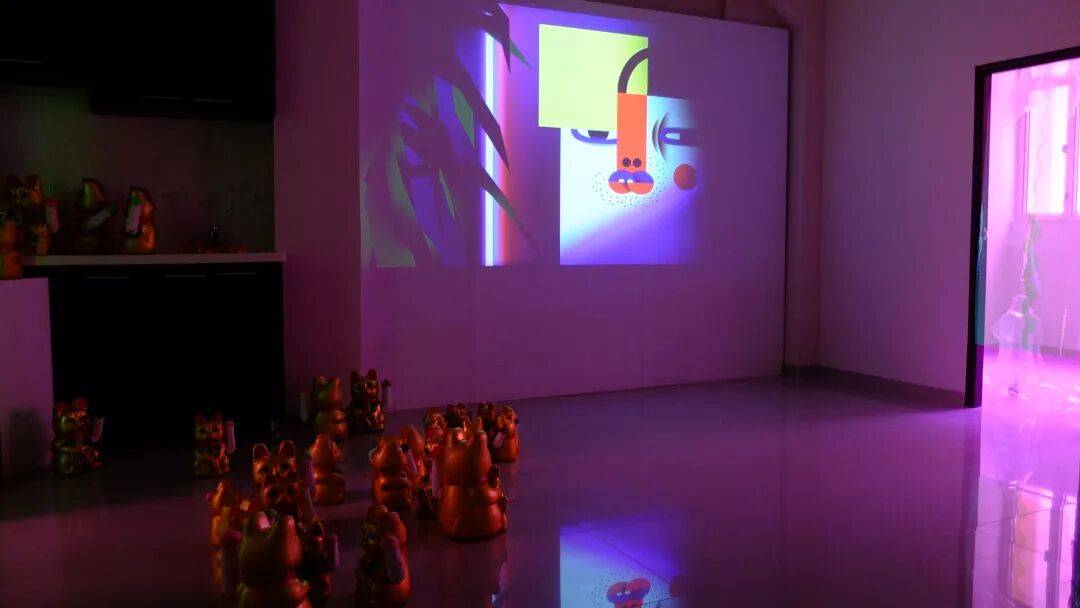
Huang Bing, solo exhibition “Edging,” installation view, MAK, Museum of Applied Arts, Vienna, 2023. In strict terms, he only entered the professional art world in 2015. Within 10 years, he had mounted solo exhibitions at major institutions including the New Museum in New York, the Centre Pompidou, the Institute of Contemporary Art, Miami, Camden Art Centre, and Kunstmuseum Basel. His work has also entered the collections of leading institutions including the Centre Pompidou, Hong Kong’s M+ Museum, the Guggenheim Museum, and Samsung Museum of Art, while exhibition invitations have continued to arrive.
SECTION 01 | Stories from the Golf Course
“I didn’t come from an art background, and even now I haven’t completely figured out what drives me to make work. But it’s fine not to understand everything. The feeling after finishing a work is ‘so satisfying,’ and for me, that’s enough,” Huang Bing told us with a laugh. After he received the Hick Award, we spoke with him about the ideas and work that have shaped his accidental journey into a professional art career. He learned that he had won while traveling in Japan, sitting in a used bookstore and debating whether to buy an expensive book.
“I suddenly got the call telling me I’d won, and I was so happy that I went straight back into the shop and bought the book, because there was prize money—ha ha,” Huang told us. He said it lightly, as if describing an ordinary incident from daily life. There was no “acceptance speech,” no grand emotion. Instead, the book became the witness to this event, which in worldly terms was a “major thing.” This way of entering reality through the everyday and through oblique details runs through nearly all of Huang’s work—including the piece that made him the 2025 Hick Award winner, Wind Avoids Gambling Debts.
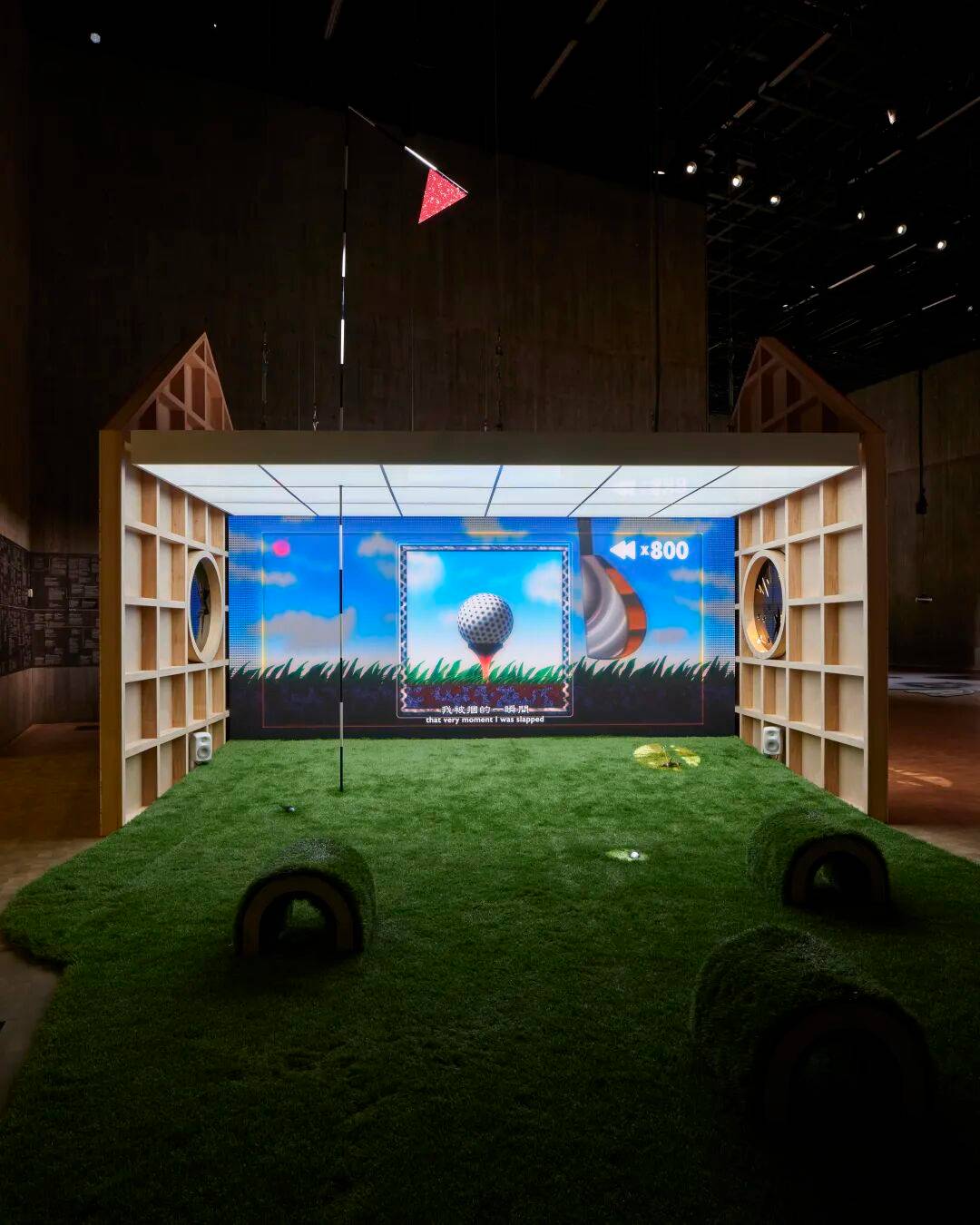
Huang Bing, Wind Avoids Gambling Debts, 2025, installation view, M+, Hong Kong, 2025. Wind Avoids Gambling Debts is a video installation set in something like a toy house: artificial turf, a roof, a flagpole, and a golf course that appears tranquil but is charged with tension.
“At the beginning, I actually hadn’t written anything yet,” Huang said. “M+ wanted me to submit the installation for the image-based environment very early, but I usually write the story first and then develop the exhibition space from it.” This time, he was forced to work in reverse.
“When I arrived at the site, the space felt incredibly tall, but I wanted to press it down and create a contrast—when you close your eyes, to see a little house hiding in a corner.” He was reminded of images involving golf from a photographic project several years earlier: the ball, the hole, the body, and the strange sensation of “hitting it in.” This time, he wanted to put the elements together almost “casually”: the grass, the little house, and the golf ball.
Huang Bing, Wind Avoids Gambling Debts, 2025, installation view, M+, Hong Kong, 2025. But behind the “casualness” Huang describes is an exceptionally clear judgment.
“Golf is a strange sport to begin with. Especially in Hong Kong, such a small place, and yet a huge piece of land has to be reserved for it. It is public space, that’s true, but poor people can’t get in,” Huang said. During his research, he was repeatedly drawn to the contradictions of golf. On the one hand, it is exclusive, expensive, unfair, and emblematic of class division. On the other, because “no one can simply walk in,” the golf course preserves precious species of bats, butterflies, and trees, as well as a very old building.
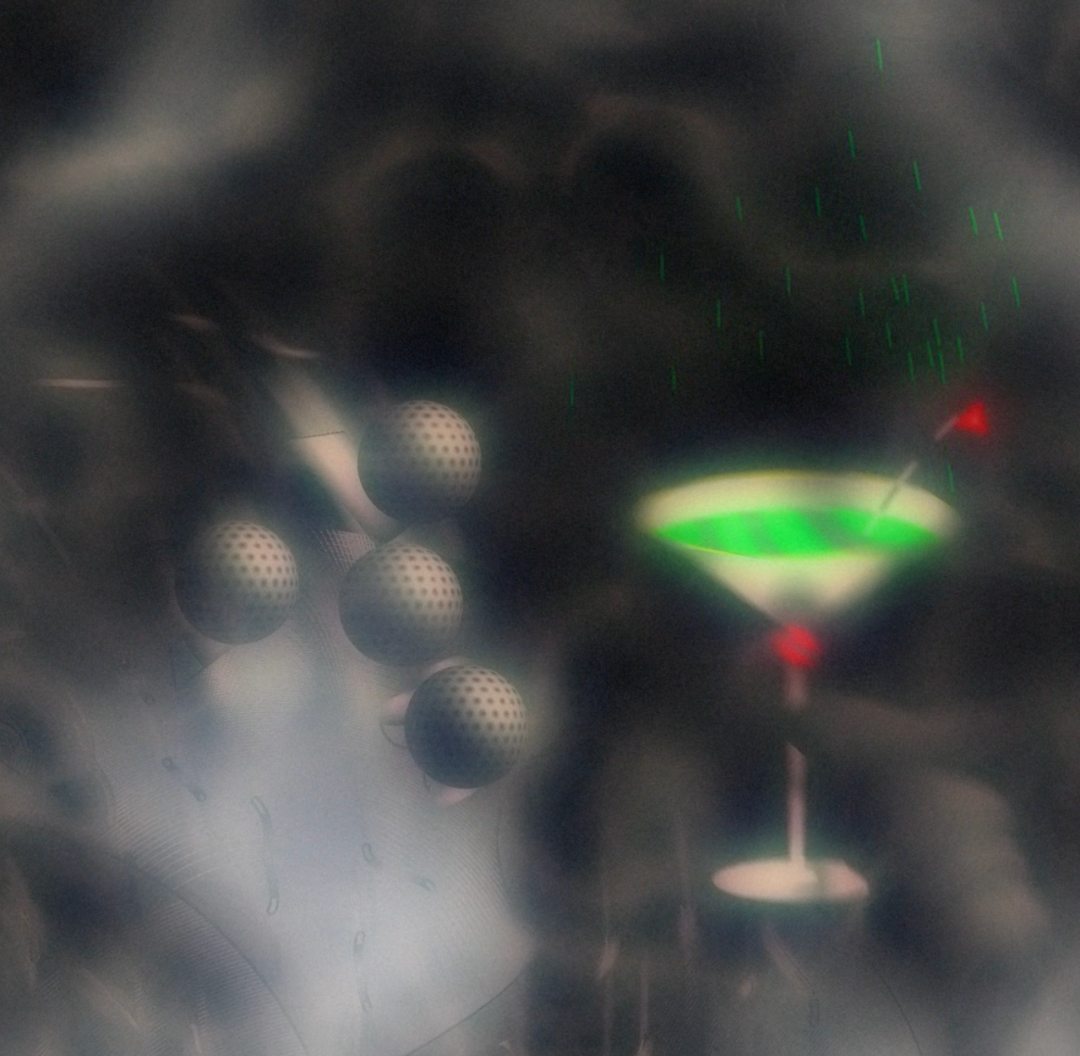
Huang Bing, Wind Avoids Gambling Debts, 2025. These contradictions are not “stated” directly. Instead, they become the voices of ten characters: a tycoon, a golfer, a secret lover, an old tree. They have no clearly defined narrative thread, but in the same wind they begin to speak; once they finish a sentence, they are blown away.
SECTION 02 | I didn’t want to be an artist from the beginning.”
“…Today the weather is unusually calm. Golf is one of the few sports that needs to cooperate closely with the wind. Golfers all think it’s their own ability, when in fact it’s just the wind causing trouble. As long as the wind has bets riding on it, the course will certainly be full of strange gusts that day.” This is one line from Wind Avoids Gambling Debts, and a characteristic slice of Huang’s style. Huang Bing, Wind Avoids Gambling Debts, 2025. It is worth noting that Huang himself voices all ten characters in the film, as he has consistently done in his work.
“I actually tried using AI voices this time, but I didn’t like the result very much. Then I thought, people seem to like my voice,” he said, smiling.
“I can play both men and women by myself. There’s something nice about slightly objectifying my own voice.” Huang Bing, Wind Avoids Gambling Debts, 2025, installation view, M+, Hong Kong, 2025. Huang Bing, Wind Avoids Gambling Debts, 2025. More than that, over the years, when his work has been exhibited in places where Cantonese is not spoken, he has felt that his voice functions more like a background sound effect. He has therefore become less inclined to introduce it explicitly, pushing his own dubbing further into the background, even when it is almost overwhelmed by the other sound effects.
Another new experiment this time was a gradient lighting installation brought into the space. “The effect is a little like someone adjusting the stage lights during a performance. They flicker as the story changes, light and dark, and also resemble shadow puppetry inside a box. I wanted to create a connection between the stage and reality.” Born and raised in Hong Kong, China, Huang was not a child who dreamed of becoming an artist.
“At first I was just a low-paid worker. I did postproduction at a television station, and I was paid very little,” he told us with a self-mocking laugh.
“My work was extremely repetitive: removing wires, filling in bullet holes, adding smoke, retouching frames. Every day I sat in front of a computer and performed the same set of actions hundreds of times.” Because the job was so draining and dull, he wanted to write something when he got home. Put simply: while other people went out to play sports or drink after work, he went home to write for amusement. He wrote for more than a year before suddenly thinking that perhaps these things could move. So he used the simplest shapes and colors, paired his written passages with rough images, and voiced them himself.
Not to publish them or exhibit them, but simply because it seemed fun. Huang Bing’s early work, Guangzhou Foot Massage One Night, 2012, music video for the band my little airport. Things began to “veer off course” when a friend asked him to make a music video.
“A friend of mine played music and said, ‘Why don’t you make an MV for us?’ So I took the images I’d already made, moved them around a little, and turned them into an animation.” Later, an artist saw the work online and asked him to make a video for an installation. After that, people began finding him directly through social media and telling him, “Why don’t you make an exhibition of your own?”
“I genuinely didn’t know what a solo exhibition was, and I didn’t really understand what the art world was doing. I was still working then, and somehow I started making exhibitions while holding down my job.” Looking back, that state of “not knowing the rules” became an advantage. He had no burden of art history and no idea what constituted the “right” subject to address. He simply approached the world as an ordinary person might. Huang Bing, Desire Jungle, 2015. If he had to identify the most important turning point in his practice, Huang pointed to his first genuinely solo exhibition, held in Sham Shui Po, Hong Kong, in 2015.
SECTION 03 | Opening an antique shop and selling specimens, what the hell am I doing?
Beginning with Desire Jungle, his work shifted from personal narratives toward subjects connected with social news. Huang Bing, Paparazzi Love, 2015. Huang Bing, Kissing Daddy Passionately, 2017, installation view, Galerie Edouard Malingue, Hong Kong, 2017. But he is not worried that audiences will fail to understand his work, because people of our generation have long grown accustomed to montage and “incoherence.”
“I really enjoy writing this way. It’s a little like stand-up comedy: in one night you can come up with 50 ideas, but they don’t necessarily have anything to do with one another. The best part of writing is that feeling of being on autopilot in your head, the pleasure of leaving logic behind. Even when I can’t understand it myself, it feels more right.” Huang later offered a comparison closer to the present.
“When people scroll on their phones now, within a minute they’ve already experienced happiness, war, death, and entertainment. My writing is basically a way of stringing together the state of scrolling on your phone for twenty minutes.” Huang Bing, One-Handed Clapping, installation view, Solomon R. Guggenheim Museum, New York, 2018. Huang Bing, Organic Smuggling Tunnel (Chunk 2), installation view, Heart Digger, 2019, Camden Art Centre, Cork Street, London, 2019. In only his third year in the art world, he was invited by Kunstmuseum Basel to mount a solo exhibition. He even worried that he did not have enough work to fill its enormous five or six galleries.
After that, exhibition invitations arrived one after another, including “Chimney” and a second space in central London at Camden Art Centre. Huang Bing, Heart Digger, installation view, 2019, Camden Art Centre (Chimney), London, 2019. Huang Bing, Your Silent Neighbor, installation view, New Museum, New York, 2021. Later came an invitation from the New Museum in New York, an institution long known for its commitment to the avant-garde.
“I’m especially fond of the museum itself, but because of that unusual period, I wasn’t able to go and see the exhibition in person.”
“To be honest, one characteristic of my work is that it talks relatively little about emotion. In terms of feelings, I think people everywhere are more or less the same. The sadness and sweetness-and-bitterness of love can’t really escape a few basic things. What usually catches my attention are contradictions, absurdity, and disorder. I use extreme metaphors to transform them into another absurd story, raise questions, and hope to approach the truth through conflict.” Huang Bing with BŪ BŪ BŪ, his antique shop. BŪ BŪ BŪ antique shop. Anyone who has followed Huang’s work closely may have noticed that he opened a shop two years ago.
That’s right—not a studio, not a salon, but a bona fide antique shop called BŪ BŪ BŪ.
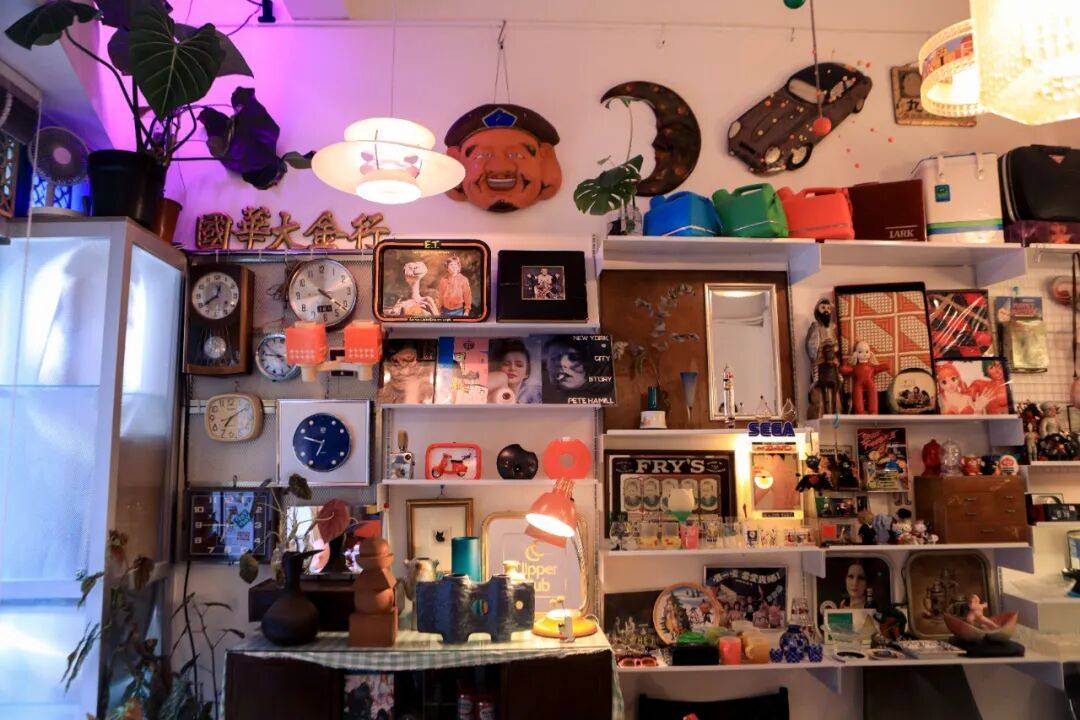
“I’ve always liked design and collecting furniture—chandeliers, chairs, tables, things like that. When I travel, I specifically seek out antique shops. I feel that Hong Kong is missing this kind of offbeat shop devoted to strange old objects. There may have been more of them 10 years ago, but they’ve all gone out of business. So I wanted to open a store selling underground film culture, furniture, and small objects. Most important, I wanted to sell inexplicable things: sculptures of uteruses, records of train sounds in various models, remnants from Hong Kong nightclubs of the 1980s, that sort of thing.”
Huang Bing said with a laugh. He ran the shop for two years out of his studio in a factory building before returning, in the second half of 2025, to the factory buildings where Hong Kong artists congregate.
“I may have gone crazy at the time. I rented a street-level shop to sell things, but street-level shops in Hong Kong are incredibly expensive. I lost a lot of money over these two years, but it was so much fun that, if I have the chance, I really want to keep it going.” He said he would work on pieces and exhibitions in the shop around the clock, and that anyone could come in and talk with him. Huang Bing in his studio. Huang describes himself as “cold-blooded” when he is making work: he may sit in front of a computer for four or five consecutive months without speaking.
But once a work is finished, it is the constant contact with people—making plans with friends, going out, traveling everywhere—that makes him feel alive and excited. Those feelings eventually find their way back into his work.
“Reality is important to me. Without a connection, I have no motivation to keep making work.” Huang Bing at BŪ BŪ BŪ antique shop. The person interacting with Huang here is Simon Liu, an experimental video artist from New York. People from the art world often came by, and Huang found running the shop “especially fun.” Over those two years, he met many different people; some became friends, and he still sees them regularly.
“A lot of the people I met then made me feel that their stories were unbelievably crazy. They were much more interesting than artists. All I can say is that reality is more substantial than art, and it holds my attention more.” Huang Bing as a guide, taking foreign visitors hiking in the hills. The contradictions, absurdities, and extreme states of the real world are what genuinely interest Huang. He believes that anything he writes must come from reality: people have to “be alive” before they can write. That is why he recently found himself a new “job”—working as a guide and taking people hiking in Hong Kong.
“Hiking in Hong Kong is actually a lot of fun, because 40–50% of the territory is countryside, yet it’s very close to the urban areas. I wanted to introduce that to foreign visitors. Even if you’re in Lan Kwai Fong or Central, I guarantee that within an hour you can find yourself in a completely different landscape. And then, somehow, these people absolutely have to be back in Lan Kwai Fong within three hours.” Huang told us that once he has spent enough time in real life, he can make his next good project. Writing and making art, for him, are merely the by-products.
Huang Bing while traveling. He would also very much like to make work somewhere entirely different from Hong Kong, China, in its environment.
“In some countries, the crowds are dense and things are more chaotic. That’s where the stories and accidents are. And I like accidents, because accidents create conflict, conflict creates stories.” This is close to the impulse behind his shop: opening the door was like having the “world” come in search of him, while traveling was the feeling of going out in search of the “world.” Huang Bing while traveling. Speaking about the future, Huang said that the arrival of AI has made him feel that he should appreciate human incapacity instead.
“Because a robot calculated by AI can shoot a basketball more accurately than we can, and it doesn’t get tired or sweat.” Humans, by contrast, have to practice repeatedly while accepting failure and the limitations of the body.
“My friends often complain that many of the things I say are ‘crooked logic.’ I joke with them, ‘Crooked logic’ has two characters, and one of them is ‘logic.’” At the end of the interview, Huang finished the sentence and laughed first.