On the Ground in Basel: Five Chinese Galleries Arrive With Their Sharpest Work
Every June, the art world slips into Basel time. This year’s Art Basel in Basel brought together 291 galleries from 42 countries and territories, including five from mainland China in the main sector: ShanghART Gallery, Beijing Commune, Antenna Space, Vitamin Creative Space, and Magician Space, appearing in the main Galleries sector for the first time......
By / Xirui Huang · 14 min read
What were the major sales and Chinese gallery highlights at Art Basel 2025?
Art Basel 2025 brought together 291 galleries from 42 countries and territories. Mainland Chinese exhibitors in the Galleries sector were ShanghART, Beijing Commune, Antenna Space, Vitamin Creative Space and first-time main-sector participant Magician Space. Liang Shaoji joined Parcours, while Cao Fei and Pan Daijing received inaugural Art Basel Awards. Major reported sales included works by David Hockney, Ruth Asawa, Gerhard Richter and Zeng Fanzhi.
News | Art Basel 2025 in Basel: A Market Holding Steady and Moving Forward
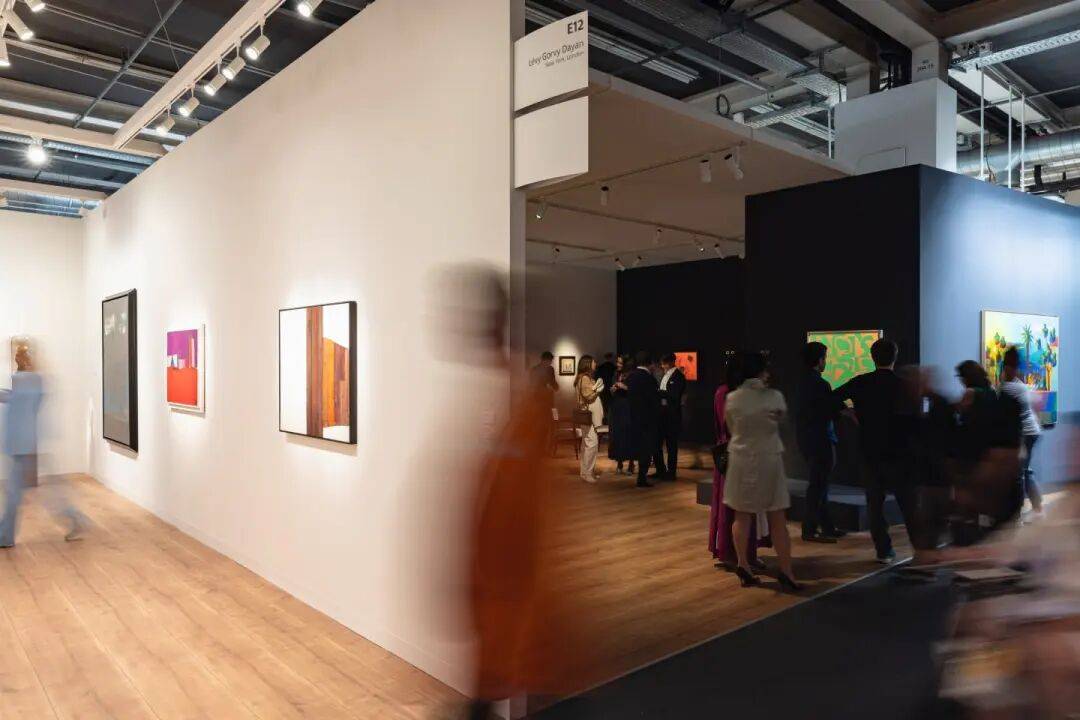
Every June, the art world slips into what might be called Basel time. This year’s Art Basel in Basel brought together 291 galleries from 42 countries and territories. In the main sector, there were five galleries from mainland China: ShanghART Gallery, Beijing Commune, Antenna Space, Vitamin Creative Space, and Magician Space, participating in the main Galleries sector for the first time.
In Parcours, the section titled "Parcours," there was also, for the first time, a commissioned work by the familiar Chinese artist Liang Shaoji. Installed in a darkened space, it combines video with silk, a medium he has used for more than 30 years. At Art Basel in Basel, 2025. This year also saw the launch of a new prize, the Art Basel Awards, in which two Chinese artists won honors: the artist born in the 1980s Cao Fei was named an Artists Established laureate, and the artist born in the 1990s Pan Daijing was named an Artists Emerging laureate.
SECTION 01 | The calmer the market, the more conservative the taste
It is not hard to see that, even as the global art market remains under a cloud, the force of Chinese art is still not to be underestimated. As the only Chinese media outlet invited, we went directly to Basel, bringing back the latest sales figures while also speaking with the five mainland galleries about their reasons for coming and their impressions of the fair; we also spoke with Liang Shaoji, Cao Fei, and Pan Daijing about their work and their future plans. At Art Basel in Basel, in the Unlimited sector, 2025. Although the VIP days for the main fair did not begin until the 17th, by 4 p.m. on June 16, crowds that had already been waiting outside surged into the 16,000-square-meter Unlimited sector.
Many people even feel that Unlimited, the section devoted to museum-scale installations, is where Basel’s spirit truly resides. At Art Basel in Basel, in the Unlimited sector, 2025. Founded in 2000, Unlimited is celebrating its 25th anniversary this year. Though its scale and the size of its works have continued to grow, it has remained a Basel-only feature. The first work visitors encountered this year called to mind the steel neon structure atop the Moulin Rouge in early-20th-century Paris, preparing viewers, with total conviction, to descend into the fair: "It’s Show Time."
At Art Basel in Basel, 2025. David Hockney, Mid November Tunnel, 2006. In the main Galleries sector, which opened on the 17th, the highest-priced sale by the second VIP day was David Hockney’s 2006 work Mid November Tunnel, priced between $13 million and $17 million, or more than 93 million renminbi.
Works selling for more than $1 million were hardly rare, though they were concentrated among the blue-chip galleries. At Art Basel in Basel, at the Hauser & Wirth booth, 2025. Hauser & Wirth had all but sold out its booth: two Mark Bradford works sold for $3.5 million each, one to a private American collector; two George Condo works sold for $2.45 million each, one of them to a European institution. A work by the Chinese artist Zeng Fanzhi was also acquired by a European art institution for $1.6 million.
At Art Basel in Basel, at the White Cube booth, 2025. At White Cube, a work by Michael Armitage sold for 325 million, and the Chinese artist Cai Guo-Qiang’s 2022 work Red Birds was acquired by a European institution for $1.2 million. George Baselitz, whose work was everywhere last year and in heavy demand, remained strong this year: the work White Cube brought sold for 2.2 million euros, while two oil paintings shown by Ropac sold for $1.8 million and $1.2 million, respectively.
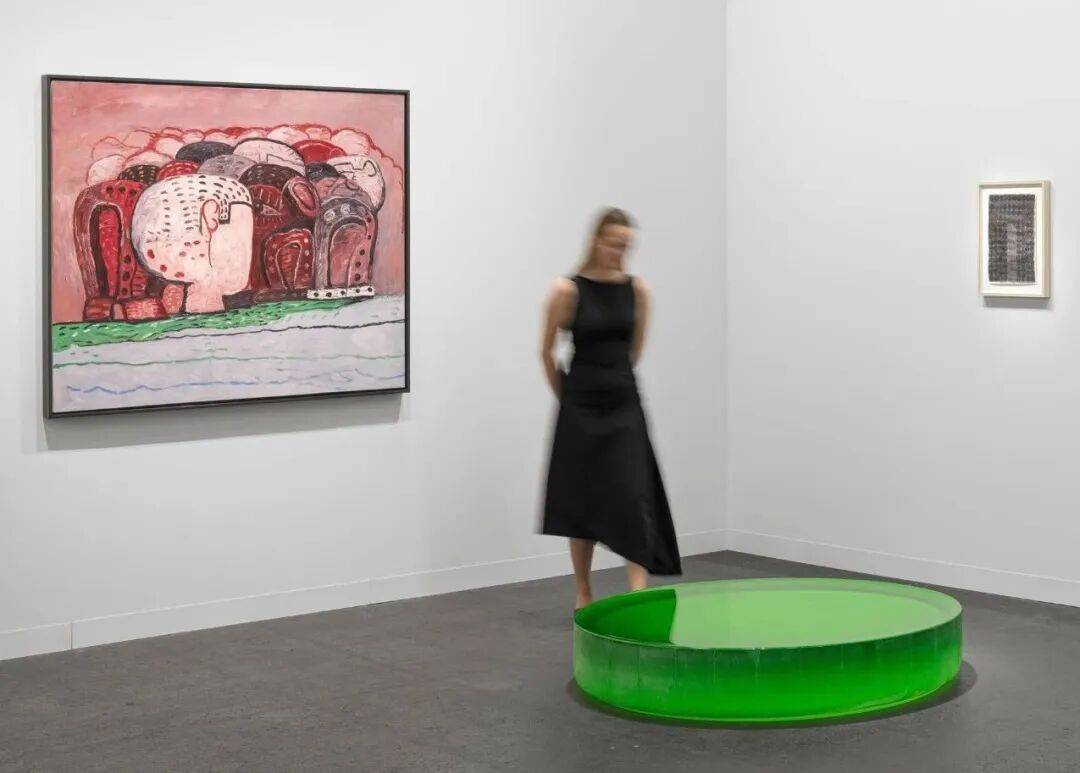
At Art Basel in Basel, at the David Zwirner booth, 2025. At David Zwirner, a sculpture by Ruth Asawa sold for $9.5 million, a painting by Gerhard Richter for $6.8 million, a diptych by Yoko Ono for $1.3 million, and two paintings by Dana Schutz for $1.2 million and $850,000. At Xavier Hufkens, works by Tracey Emin and Alice Neel sold for £1 million, while a work by the Chinese artist Qiu Xiaofei sold for $350,000.
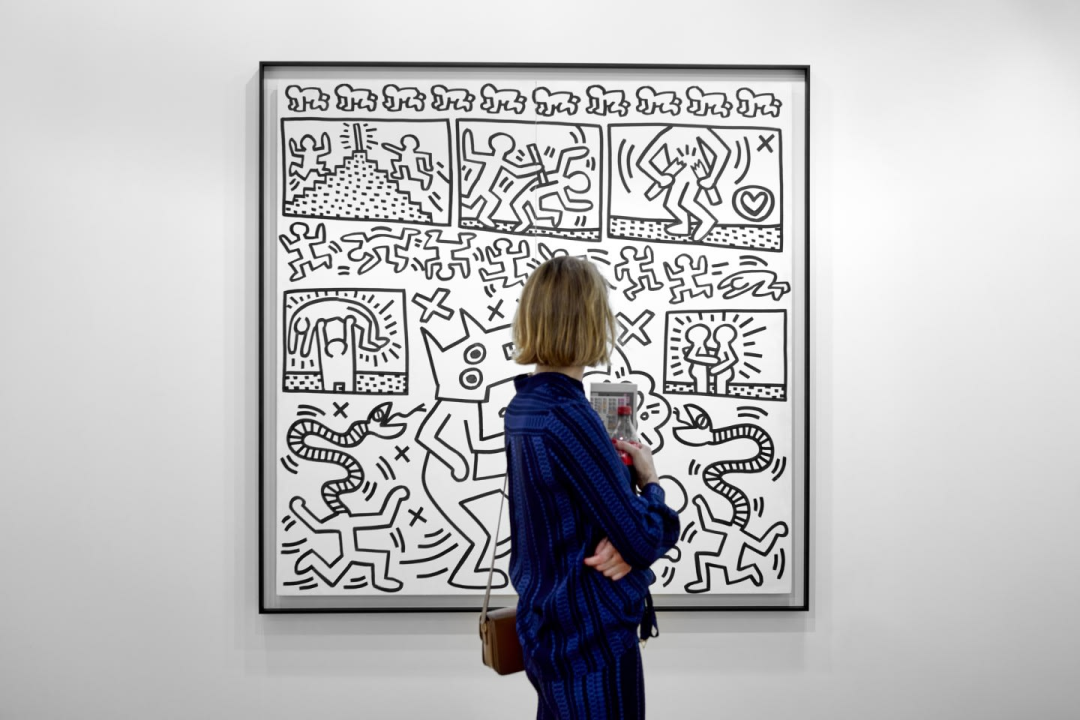
At Art Basel in Basel, at the Gladstone booth, 2025. At Karma, a work by the Chinese American artist Mading Huang also climbed to the lofty price of $1.2 million. Gladstone sold a Keith Haring for $3.5 million and an Alex Katz for $1.2 million. At Art Basel in Basel, at the Pace booth, 2025. At Art Basel in Basel, at the Perrotin booth, 2025. Pace’s strategy this time was a pronounced price range: among its sales were a Louise Nevelson at as much as $850,000 and a Loie Hollowell at just over $20,000.
Perrotin and Almine Rech pursued the same strategy. At Art Basel in Basel, at the Kukje Gallery booth, 2025. Among galleries from Asia, the strongest sales appeared to belong to Korea’s Kukje Gallery, whose booth was nearly sold out within the first two days. It was not hard to see that in a cooling market, European collectors’ tastes have become more conservative, tilting toward artists already validated by both the market and history, artists thought capable of outlasting the cycle.
At Art Basel in Basel, at the ShanghART booth, 2025. ShanghART, the earliest mainland Chinese gallery to establish itself at Art Basel in Basel, was participating for the 25th time this year. The gallery’s founder, Lorenz, told us that it has come every year since 2000, without missing even the mask period. One of the most closely watched artists was the senior-generation artist Liang Shaoji, who had a small solo presentation in the booth and also a solo project in this year’s Parcours.
Other long-term gallery artists included Yang Fudong, who brought his signature photograph The Pheasant, as well as Yu Youhan, with abstract works. At Art Basel in Basel, at the ShanghART booth, 2025. The booth made room for artists across several generations, old, middle, and young. Lorenz believes that beyond the artists everyone already knows, it is equally important to look back at artists who have been overlooked over the past nearly 30 years.
"We’re doing two things now. First, we’re trying to find new artists. Second, we’re trying to look back and ask what we missed over the past 30 years. Take the artist Hu Xiangcheng. He started studying art very early. Once China opened up, he went abroad, to Japan, Africa, the Americas, and finally returned to China." At Art Basel in Basel, at the ShanghART booth, 2025. Lorenz told us that the most asked-about works on-site were still two striking large installations: Zhang Ding’s "battery," mounted on a giant steel framework, and Gao Lei’s parallel bars, positioned at the center of the booth.
On the Ground in Basel: Five Chinese Galleries Arrive With Their Sharpest Work
"I think European collectors have very distinctive taste. Every work has its own audience. They don’t buy something because someone else says it’s good, and they don’t walk in, look for two minutes, and place an order by email. They talk with us. They discuss. They really try to understand the story behind the work." At Art Basel in Basel, at the ShanghART booth, 2025. Even after so many editions of Basel in Switzerland, Lorenz still feels that the task ahead is a heavy one.
"For us, there are many purposes in continuing to come here. We can learn what is happening in the art world, speak with more collectors, accept challenges, and keep learning all the time. And for people in the art world, this place is like heaven, because you can see more than 200 of the best galleries in the world," Lorenz said. At Art Basel in Basel, Liang Shaoji’s solo project, Parcours sector, 2025. Outside the fairgrounds, Liang Shaoji’s work was installed in a basement space along the section’s main route.
In a completely dark room, Liang Shaoji’s video work Silkworms Murmuring echoed the silk installation placed before it. The artist told us that because transporting live silkworms abroad is difficult, the curator chose this work, which is easier to exhibit. At Art Basel in Basel, Liang Shaoji’s solo project, Parcours sector, 2025. "This is also my first time being invited to do an individual project in this section. The work conveys the illusion that arises from gazing at silkworms spinning silk into long foil-like coils, as though the lens itself were producing visions of spring, summer, autumn, and winter."
As for why the work is called Silkworms Murmuring, he said that in the five elements, silk belongs to water; observed at a microscopic level, the flow of silkworms carries both a vigorous energy and the endless transformations by which silkworms become butterflies.
"The similar sounds give it a sense of flow, like the ceaseless surge of silkworm movement," Liang Shaoji said. At Art Basel in Basel, at the Beijing Commune booth, 2025. This time, Beijing Commune’s Basel presentation was overseen in person by Leng Lin, who told us that it was the gallery’s second time in Basel. "The first time must have been around 2013," he said. Interestingly, the gallery’s previous appearance included work by Hu Xiaoyuan, who had not yet fully emerged at the time.
This time, too, they brought work by Hu Xiaoyuan in the Kabinett sector, an extension of her breakout solo exhibition this year at Tai Kwun in Hong Kong. As expected, it sold quickly within the first few hours of the opening. At Art Basel in Basel, at the Beijing Commune booth, Hu Xiaoyuan Kabinett project, 2025. The booth also included works by artists from multiple generations, among them Song Dong, Liang Shuo, Liang Yuanwei, Liu Jianhua, Ma Qiusha, Mao Yan, Shi Jiayun, Wang Guangle, Xie Molin, Yan Bing, Yang Xinguang, Yin Xiuzhen, Zhang Xiaogang, and Zhou Yilun.
"There’s been a lot of interest in some of the older artists, for instance Mr. Song Dong’s work, because a European museum previously acquired a very large window installation of his, and also Mr. Zhang Xiaogang, Ms. Yin Xiuzhen, and Wang Guangle," Leng Lin told us. A private museum in Brussels, the Vanhaerents Art Collection, recently acquired a work by Wang Guangle, and people from the museum also came by the booth to speak with them.
At Art Basel in Basel, at the Beijing Commune booth, 2025. Although the art market keeps changing, he believes that Basel in Switzerland has always maintained extraordinary vitality and quality, making it something absolutely singular.
"The fair in Shanghai is very good, and the fair in Paris is also very good. But Basel is special because, during the fair, the concentration of art within the city’s activities is the highest. Basel is not a thriving commercial center, and it isn’t a tourist city either; unlike other cities, it doesn’t have so many places for eating, drinking, and entertainment. People come here only because of their relationship to art. It’s a very strong and intimate connection," Leng Lin said.
At Art Basel in Basel, at the Beijing Commune booth, 2025. Asked how it felt to come from so far away to exhibit, he joked modestly: "In any fair, anywhere, every sale comes with pressure. We just work hard and try to have some development on the basis of staying alive." In fact, within just a few hours of opening, seven works had already sold, a very solid result. But for Beijing Commune, coming to Basel is by no means only about moving inventory: "It’s enough if art can circulate on a larger platform and audiences can get to know us."
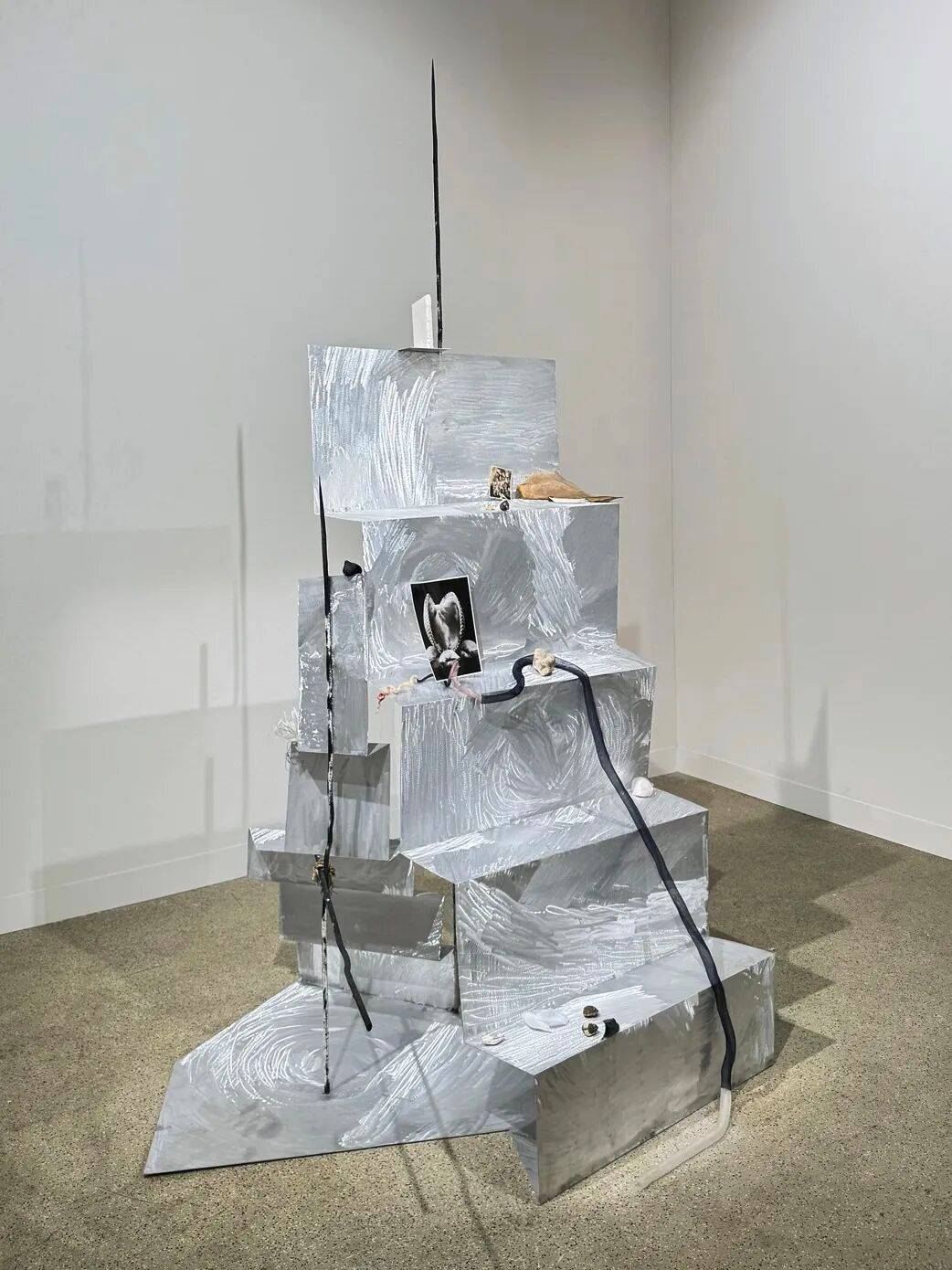
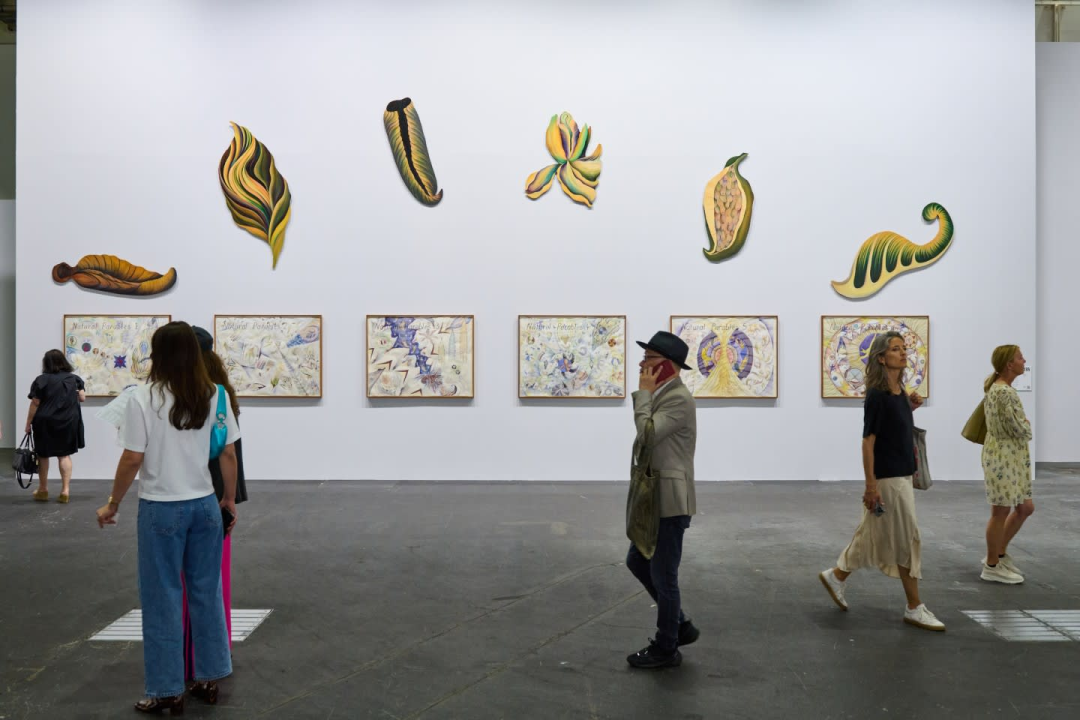
At Art Basel in Basel, at the Antenna Space booth, 2025. Wang Zi, the founder of Antenna Space in Shanghai, told us that this was the gallery’s sixth time in Basel. As in past years, he believes that European collectors still love to discuss the work itself. Particularly memorable in the booth was Open Wound by the Korean artist Mire Lee. Metal chains hung down from the ceiling, suspending worn pink fabric charged with the metaphor of skin.
The prototype for the artist’s solo exhibition last year in the central Turbine Hall at Tate Modern in Britain was this very work.
"She first experimented with this work in the studio, and only then decided to make a whole series, including the Tate piece," Wang Zi told us. Eva Aeppli Torning Wang, Georgia O’Keeffe Flowers and Copied Agnes Martin, 2025. Another artist was the Dutch artist of Chinese descent Eva Aeppli Torning Wang, who made a strong impression at last year’s Venice Biennale. In this work, she places together the signature imagery of two great women artists of sharply different temperaments, both of whom once lived in New Mexico: Georgia Totto O’Keeffe and Agnes Martin. The juxtaposition invents a dialogue, imagining and translating that chapter of art history.
"In her work, we often see her using the medium of the canvas work to carry the brushwork techniques and formal structures of Eastern calligraphy and painting; it can be understood as a form of resistance, on her part as an artist, to Western elitism." At Art Basel in Basel, at the Antenna Space booth, 2025. Hannah K. was another artist with a remarkable identity: her grandparents defected from North Korea to Canada; she was born and raised there as a second-generation immigrant, and later moved to the United States.
"Her work is all about spirit and meditation, using composition and tiny curving lines to bring things from the spiritual world into the image," Wang Zi told us. At Art Basel in Basel, in the Unlimited sector, 2025. Antenna Space’s artist duo Daniel Dewar & Grégory Gicquel also took part in this year’s Unlimited section.
SECTION 03 | 'Brand New' and the Most Mysterious Galleries
Whether in the pink marble flipper at the booth or the entire group of giant shells in Unlimited, their work considers the boundaries and fusions among human beings, animals, and natural life.
"The flipper is also an extension of human desire, because people cannot naturally go down into the sea. The artists’ perspective makes it look almost like a relic left behind after humanity has already perished. It’s very interesting." At Art Basel in Basel, at the Antenna Space booth, 2025. After six years of coming to the fair, Wang Zi has clearly felt that whereas people used to ask only about figurative painting, in recent years they have become much more interested in certain abstract and metaphysical works.
Especially at the Basel fair, he said, collectors and institutions ask a great deal about sculpture and video, whereas fairs in Asia still tilt more heavily toward traditional wall-bound works.
"The main reason is that the whole system and the institutions here are more diverse, so the levels at which art is displayed are richer." Wang Zi told us that galleries of Antenna Space’s kind have never had much of a secondary market, and that their prices, compared with the mega-galleries where works easily run into the millions, remain within reach for most collectors. So during the economic downturn, they have not felt much change in sales in Europe. At Art Basel in Basel, at the Antenna Space booth, 2025. "Most of the collectors who buy our work do so simply because they love it, or because they are collecting systematically.
New collectors here, when they acquire something, will get so excited they hug you, which is very different from the calm restraint of collectors in Asia." Wang Zi sounded composed about the overall sales picture. "We made some sales before coming, and I think at the very least we probably didn’t lose money. We also met new collectors we can continue talking with later, so I’m very happy." At Art Basel in Basel, at the Magician Space booth, 2025. Qu Kejie, the founder of Magician Space, told us that after participating twice in the fair’s Statements sector, this year marked the gallery’s first move up into the main Galleries sector.
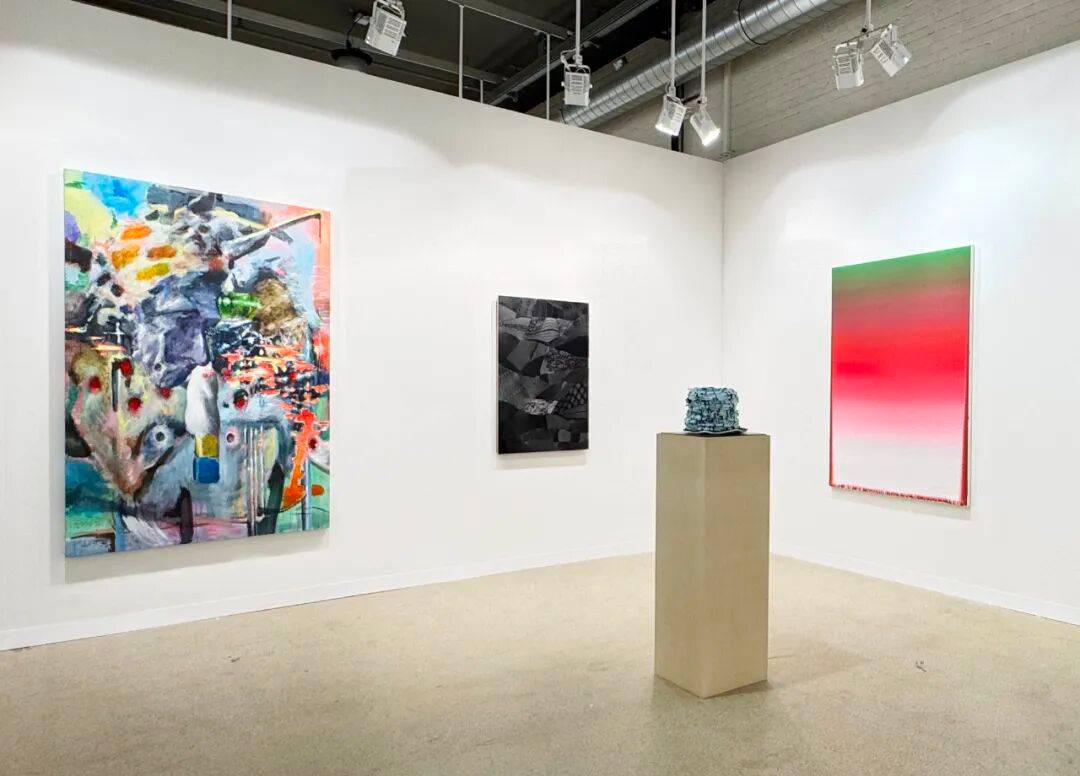
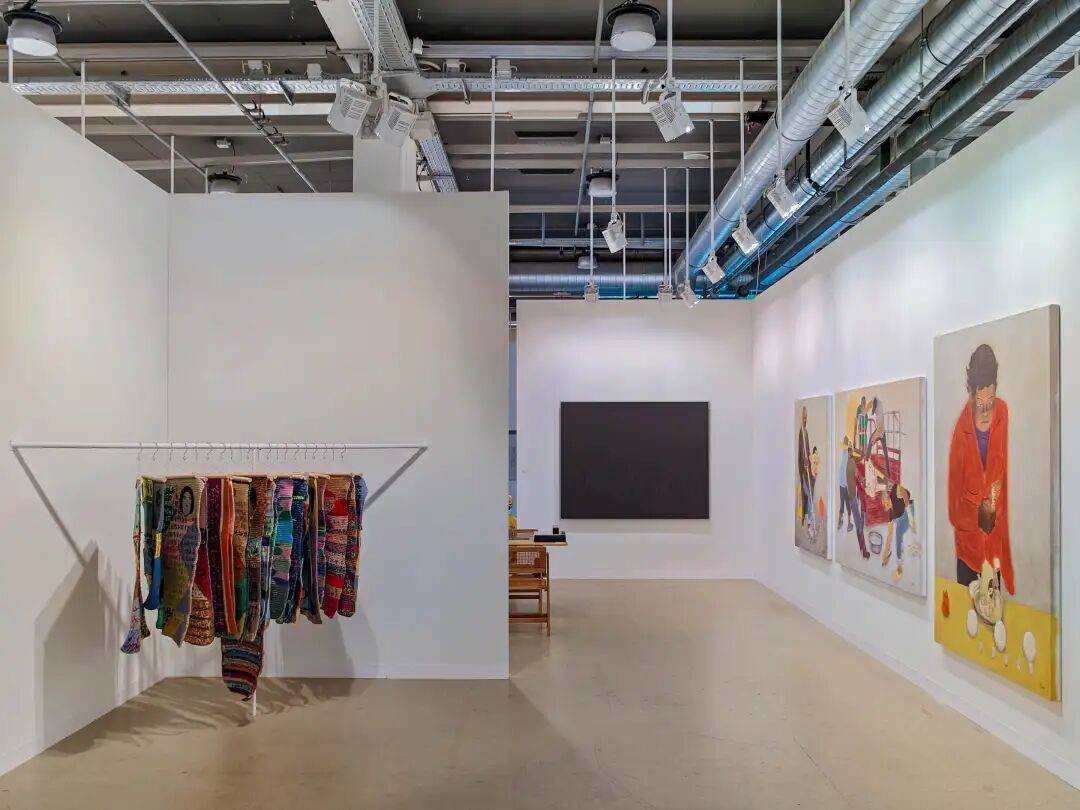
"Being able to enter the main Galleries sector at Basel is a milestone in our 17-year history. We can show the West more work by artists living in China, whose practices are rooted in Chinese soil and completely different from ways of making shaped in a Western context." At Art Basel in Basel, at the Magician Space booth, 2025. For example, Liu Sheng’s paintings revolve around the daily lives of farmers in villages in his native Guangdong, folding the bodily experience of agricultural labor into painting.
Hu Yinping, meanwhile, gives over the right of speech to the aunties living in a small town in Sichuan, who use needle and thread to weave their own personal resumes. At Art Basel in Basel, in the Unlimited sector, Qin Yifeng solo project, 2025. Beyond the main Galleries sector, Magician Space also took part in two other sections this time: the artist Qin Yifeng participated in Unlimited, presenting the large-scale Disappearing Photography series, while Liu Ding joined Kabinett with the solo project Vast Room, presented as an exhibition within the exhibition.
At Art Basel in Basel, at the Magician Space booth, Liu Ding solo project Vast Room, 2025. The work that drew the greatest number of inquiries at the booth, and that most interested European collectors, was Liu Ding’s. At the center of the installation is a delivery worker resting on the ground, scrolling on his phone in the interval before the next assignment. It is a work sharply reflective of phenomena in contemporary Chinese society. By the end of the first VIP day, Magician Space had already sold four works, and they were confident about what would follow.
"At Basel, painting accounts for only 40 percent of the whole, and people are more interested in discussing art, especially the act of making itself. At Chinese art fairs, painting holds 90 percent of the discourse, and collectors approach it more like picking stocks," Qu Kejie told us. At Art Basel in Basel, at the Vitamin Creative Space booth, 2025. Image courtesy of the artist and Vitamin Creative Space. Among mainland galleries, Vitamin Creative Space has long been a notably mysterious presence, almost never giving interviews and simply continuing, quietly, to work with artists whose visual language it considers distinctive.
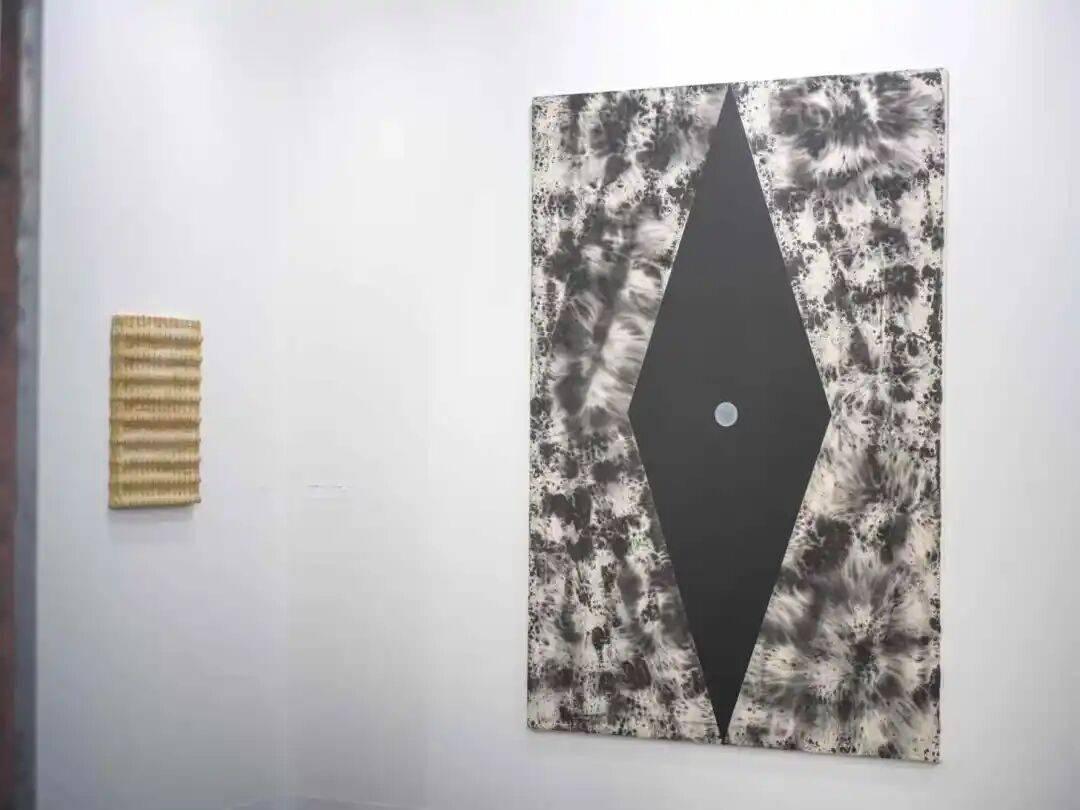
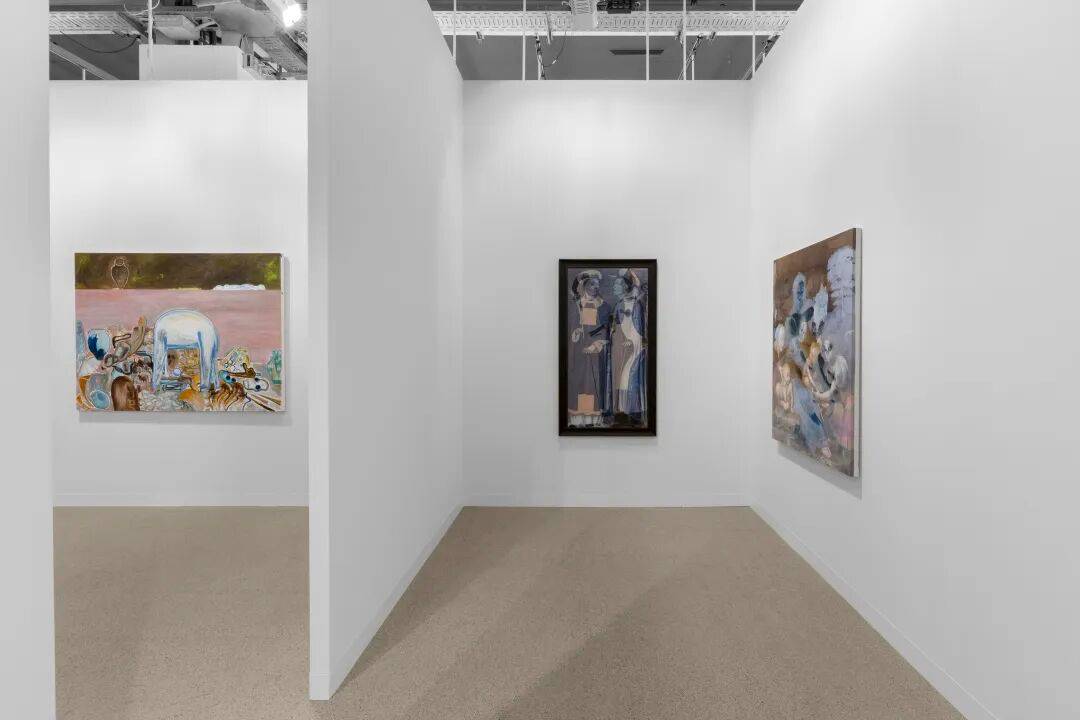
In fact, after ShanghART, it was the second mainland Chinese gallery to enter the main Galleries sector at Basel, combining strength with serious intellectual ambition. At Art Basel in Basel, at the Vitamin Creative Space booth, 2025. Image courtesy of the artist and Vitamin Creative Space. This booth took the form of a dual solo presentation featuring the artists Duan Jianyu and Zheng Guogu. Each, in a different way, possesses a strong consciousness of the image.
Duan Jianyu’s works were installed on the outside of the booth, in a more outward, youthful mode of expression. At Art Basel in Basel, at the Vitamin Creative Space booth, 2025. Image courtesy of the artist and Vitamin Creative Space. Zheng Guogu’s works, by contrast, amount to a cultural translation of Western religious painting and the Madonna and Child. They carry a deep inwardness, better suited to the small room constructed inside the booth, which even gives off the feeling of a confessional.
The layered relationships within the image retain Western technique, recalling 14th- and 15th-century Dutch landscape painting, while also conveying the resonance of Chinese landscape painting. At Art Basel in Basel, in the Unlimited sector, 2025. Another sign of Chinese strength was the recognition of Cao Fei and Pan Daijing in the Art Basel Awards. Both will also appear at the inaugural Art Basel Awards Summit.
Cao Fei said that she felt deeply honored to receive the award, though her work would continue as before. Next year, the artist will present to the public a project in Europe that has been in preparation for 3 years. Speaking of the new trend represented by the rise of AI in recent years, she said, "I will continue to pay attention to this field, and not only from the angle of AI enabling innovation in art; issues such as technological ethics and other problems brought by technology should also be taken seriously." At Art Basel in Basel, 2025. The younger artist Pan Daijing, born in the 1990s, feels that winning an award seems to presuppose a kind of completion, but for her it does not mean that anything has been completed; it only means that at this particular moment, she has happened to be seen.
"Of course, being seen brings some positive things, but it also comes with more misreadings. I accept that, but I won’t adjust my pace or direction because of it. Making work still returns to the most basic things."
Pan Daijing: Mute, installation view, Haus der Kunst, 2022-2024. Image courtesy of the artist. Because she is adept at working with sound, many people regard her as a sound artist, though she herself does not see it that way.
"Sound is only one part of my artistic language. Like image, space, body, and memory, it is one of the materials from which a work is built. Sound has a particular entangled and fluid tension. In my work, it is a climate, a rhythm; it affects how the viewer exists within that space." In Basel, she told us, "I am always waiting for the encounters and conversations that happen outside the fair, for things that seem to grow out of a crack."