Antony Gormley's Qingdao Exhibition: The Most Comprehensive, Most Ambitious Presentation of His Work in Asia
The British sculptor Antony Gormley is one of the most influential artists working today. For nearly forty years he has made sculptures of the human body and works for public space, winning prizes that include the Turner, showing in major museums and institutions around the world, and receiving a knighthood from the former Queen of England. Five years after his last visit, he returned to China this past April with Living Time, his exhibition at TAG Art Museum in Qingdao — the most comprehensive and most ambitious presentation of his work Asia has yet seen......
By / Xirui Huang · 12 min read
Antony Gormley's Qingdao Exhibition: The Most Comprehensive, Most Ambitious Presentation of His Work in Asia
British sculptor Antony Gormley has spent decades exploring the human body and art in public space. His awards include the Turner Prize, and he was knighted by Queen Elizabeth II. His works appear in museums and public settings around the world. In late April 2023, he travelled to Qingdao to install Living Time at TAG Art Museum, an extensive presentation of his practice in Asia.
How does Antony Gormley use body sculpture to explore space, and what did Living Time in Qingdao show?
Antony Gormley is a British sculptor who uses the human form to explore the body’s relationship with space, nature and the viewer. Living Time at TAG Art Museum in Qingdao in 2023 brought together 39 sculptures spanning more than four decades. In her on-site interview, Xirui Huang asks Gormley how natural light, body casts and steel-block structures shape visitors’ experience of space, and revisits Asian Field and its creation with participants in China.
The British sculptor Antony Gormley is one of the most influential artists working today. For nearly forty years he has made sculptures of the human body and works for public space, winning prizes that include the Turner, showing in museums and institutions around the world, and receiving a knighthood from the former Queen of England.
Artist | Antony Gormley: A Conversation with Life Through Sculpture
Five years after his last visit, Gormley returned to China at the end of this past April, bringing with him Living Time, a major exhibition at TAG Art Museum on Qingdao's west coast. It is, so far, the most comprehensive and most ambitious presentation of his work that Asia has seen — thirty-nine sculptures spanning more than forty years of his career.
"I've never shown my own work quite like this before. It's extremely dangerous, and quite brutal, really. But I think the way the pieces are arranged reflects, in some way, just how anxious people in China are right now," the artist said. Before the show opened, we spoke with Gormley, who had just finished installing the exhibition, inside Gallery 4 of the museum — a room whose natural light he had spent considerable care adjusting — about this unusual show and about his own deep ties to China.
SECTION 01 | If you can’t find a single work that resonates, the exhibition is a failure.”
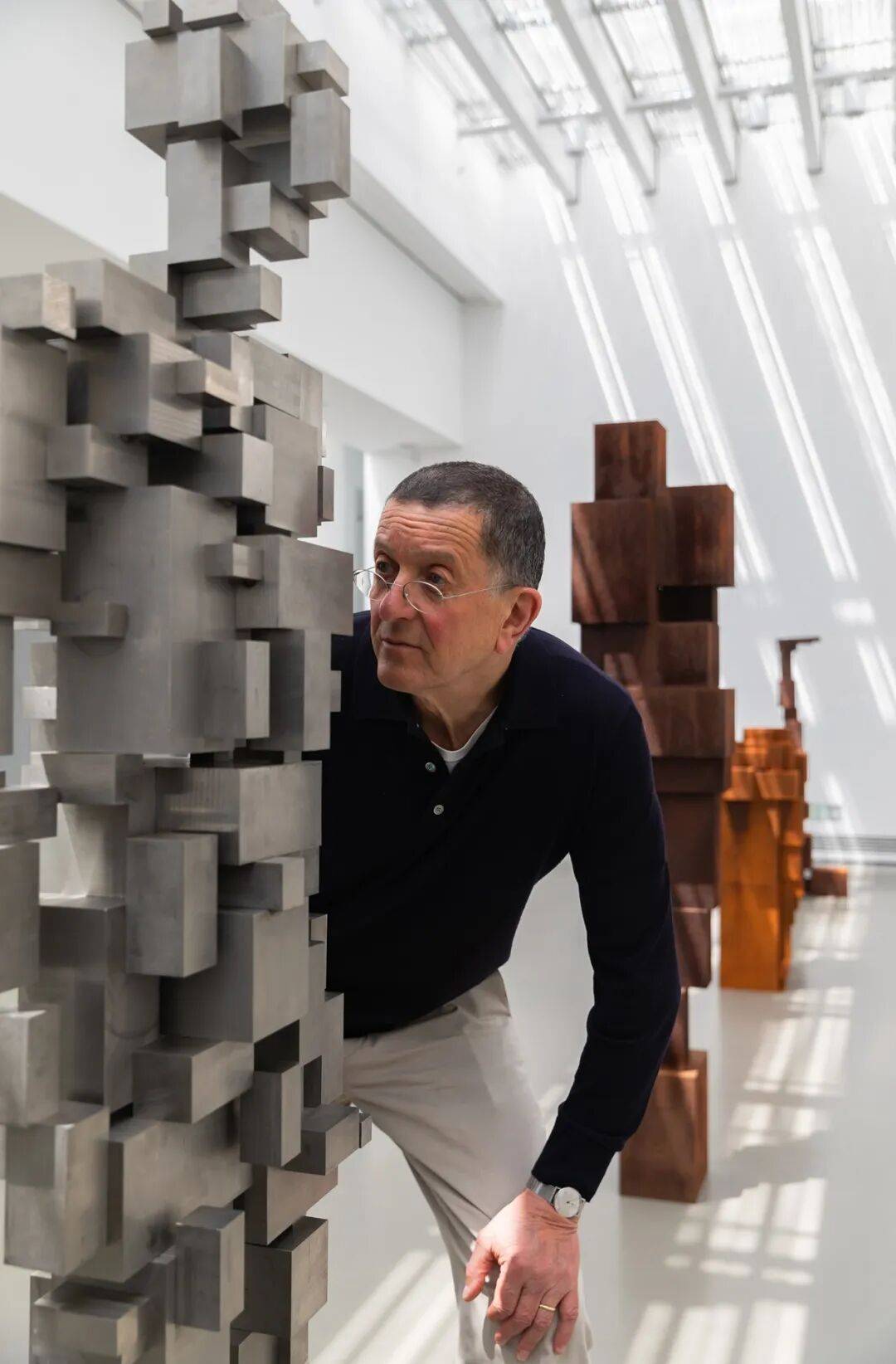
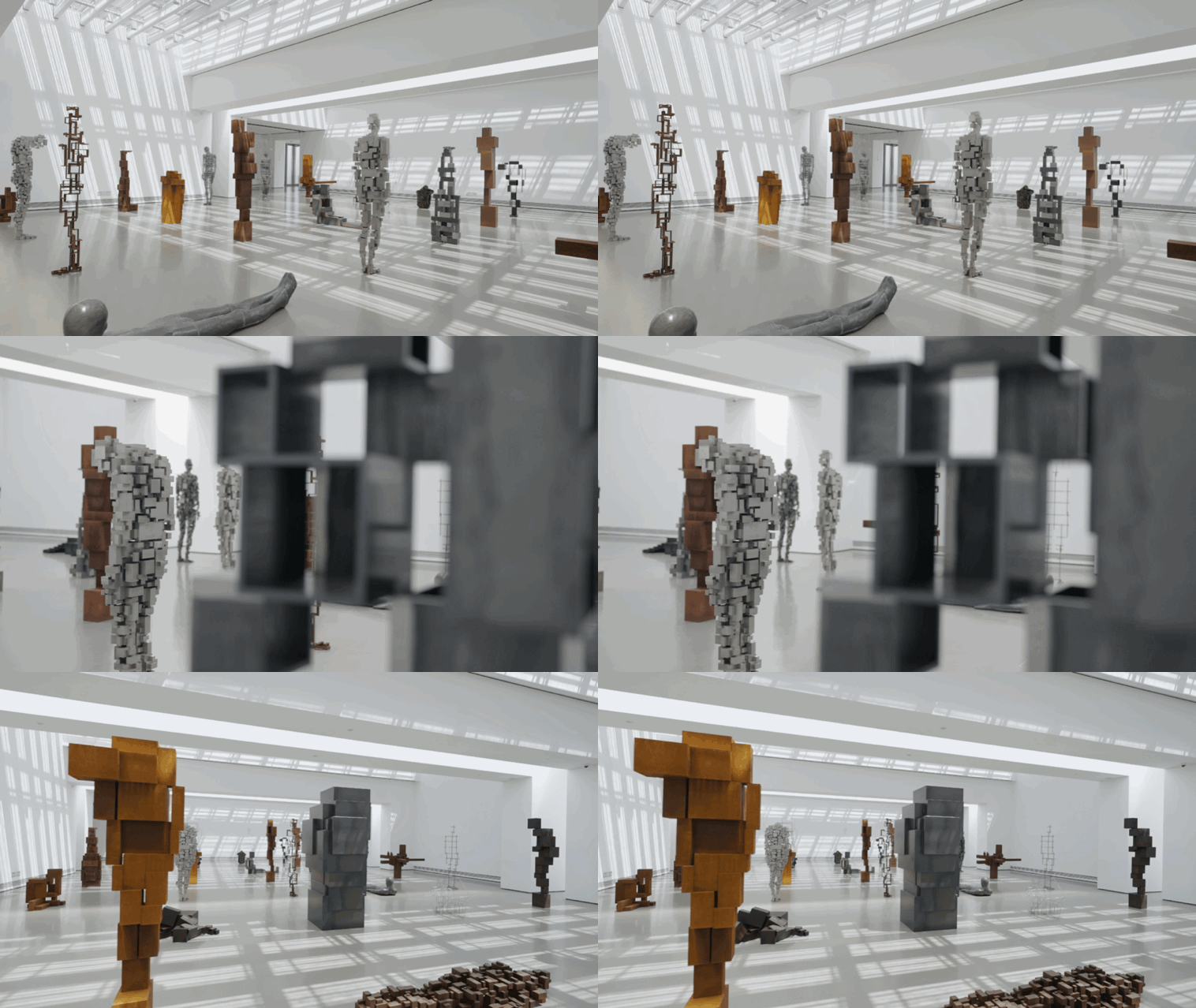
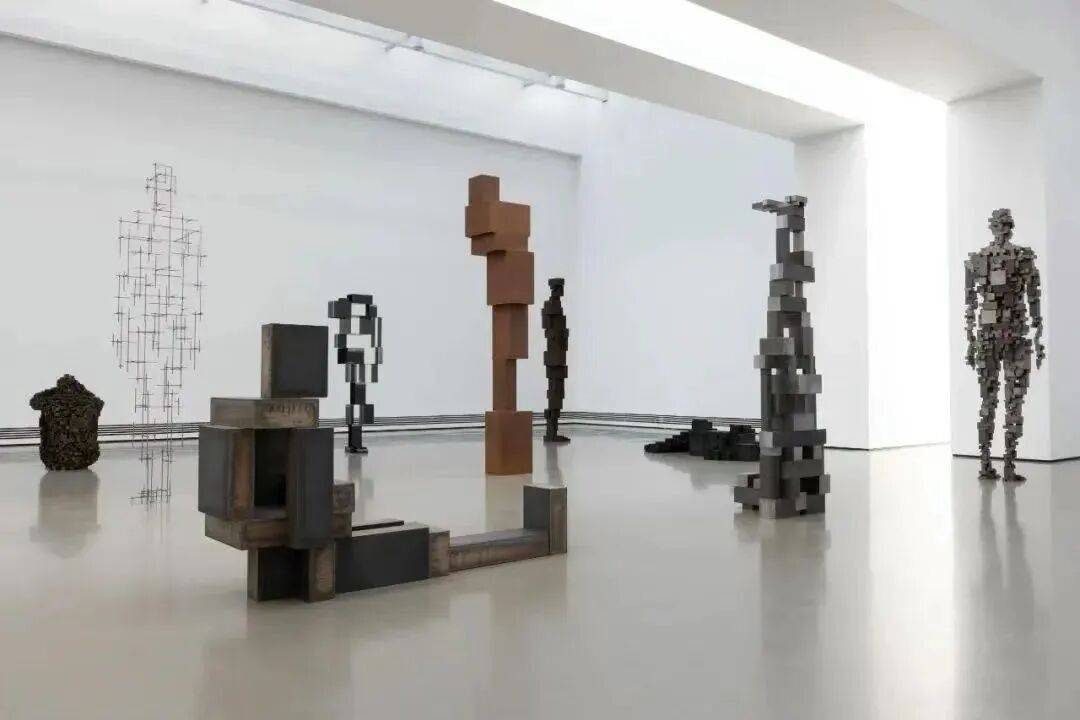
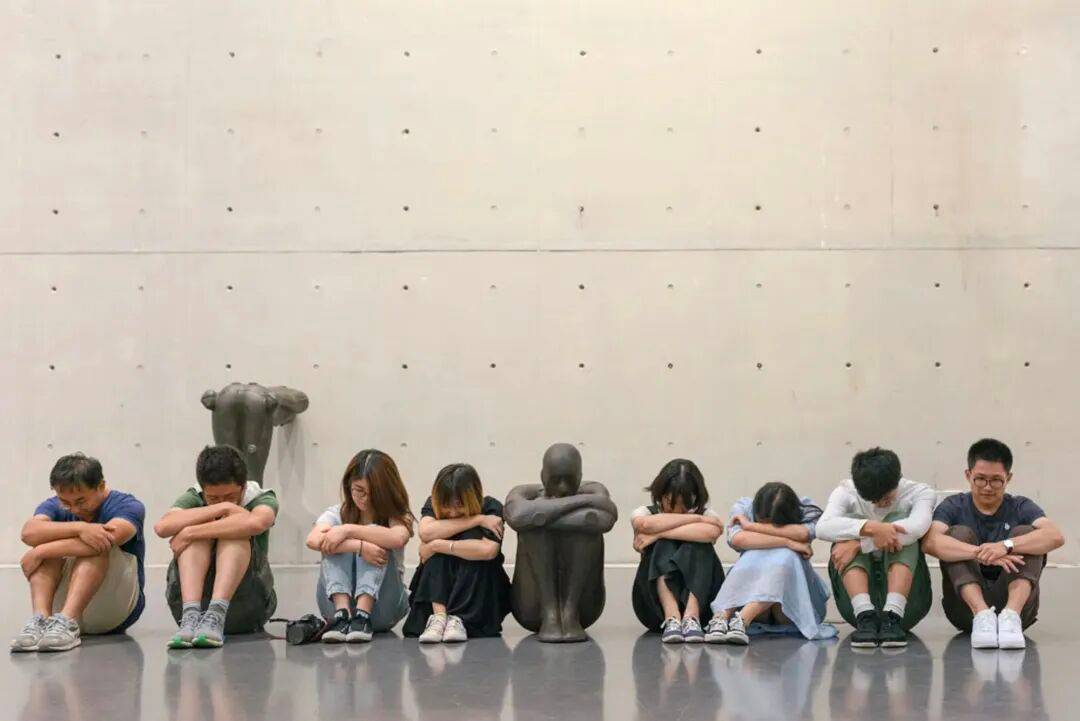
The weather on the day of our interview with Gormley was extraordinary, the morning light especially affecting, warm enough to raise a faint flush on the skin. Walking into Gallery 4 at TAG, we found sunlight falling from the ceiling through a grid of louvered shades, laying itself in bands across the artist's body-form sculptures. The interplay between light and object gave the room a quiet vitality. Thirty-five works — some standing, some seated, some lying down, some curled around their own knees — were arranged in tight, exact rows across the hall, and that density, that regularity, was startling to see in person.
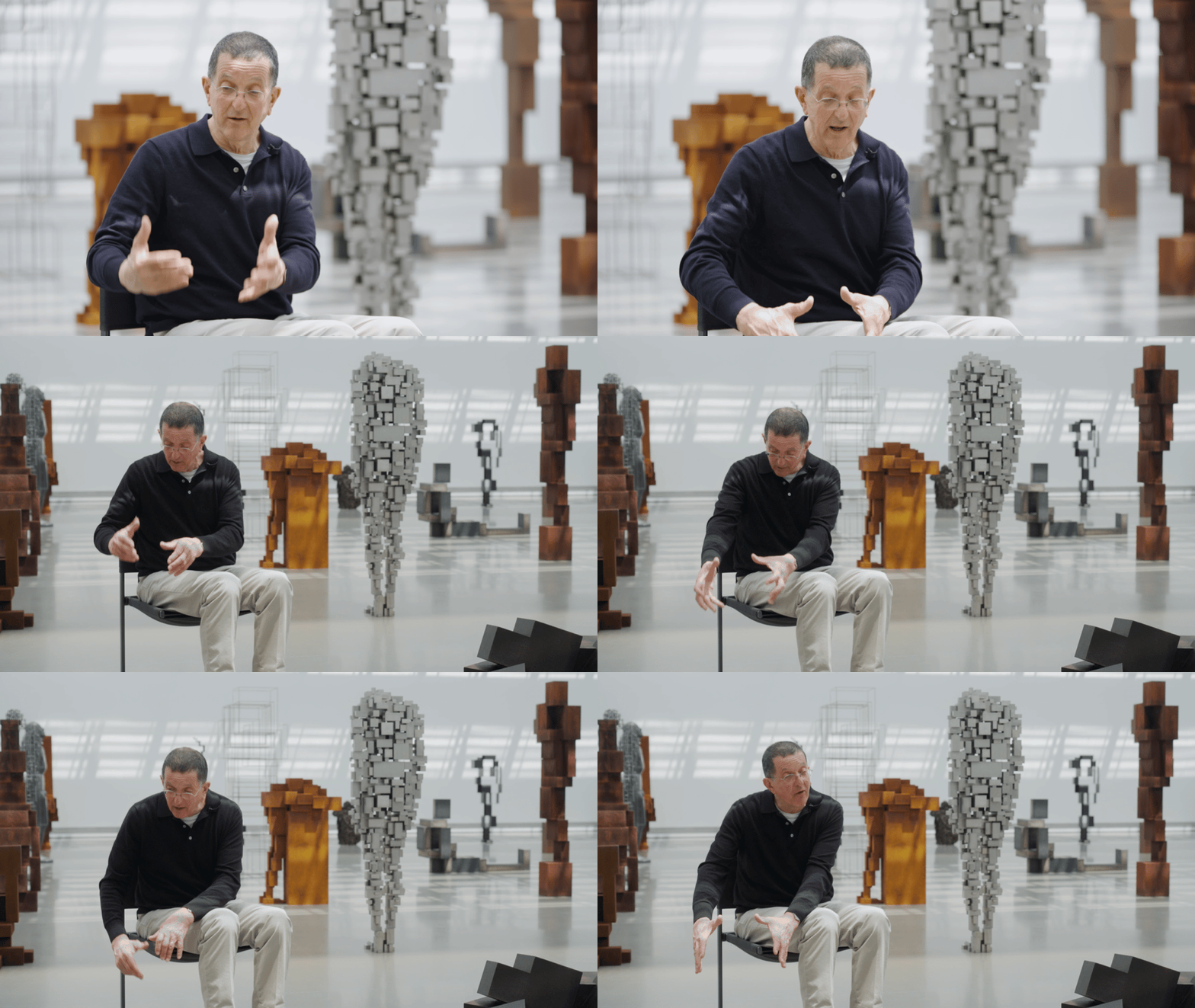
The whole gallery had the stillness of a painting, and yet every one of those silent metal figures seemed to be straining to speak to us. Gormley himself is tall and lean, and he strode toward us that day in a navy knit polo shirt, his walk and the way he paused between steps oddly reminiscent of the sculptures around him. We joked that he and his sculptures looked remarkably alike. He laughed and told us that his early sculptures were, in fact, cast directly from his own body.
Gormley was full of praise for how the room had finally come together. Throughout the install, he insisted the museum's spotlights stay off, relying only on natural light. That soft, shifting light, changing as the day wore on, became part of the exhibition itself.
"I think of the show as something like a gymnasium for the soul — you move from one piece of equipment to the next and see how you react," Gormley told us. He admitted he had never before tried presenting so many works from so many different periods this densely in a single room, laid out almost like a catalogue, with no embellishment, nothing dressed up.
Before he did it, he thought the idea was too dangerous, too brutal. He did it anyway. "Maybe I don't understand China well enough, but it seems to me there's a tremendous anxiety running through Chinese life right now, and the way these works are arranged reflects, to some degree, that present condition." He did not name the show Living Time out of any wish to center himself in it.
"Living Time isn't 'my time' — it's 'your time.' I'm really using these works of mine as a kind of medium, a way for you to go looking for yourself." He joked that if a visitor walked through the whole show and didn't find a single piece that resonated with them, "then, first of all, the show has failed — and second, I'd honestly worry about that person." The two earliest works in the exhibition date from the 1980s and '90s, both highly figurative, both still legible as casts of the artist's own body.
The piece Plateau was the first work Gormley made in what would become a more than twenty-year engagement with the human figure.
"Those two early works are divided by vertical and horizontal axes, almost like a globe — like the X, Y, Z of a Cartesian coordinate system," Gormley said. He wanted the sculptures to convey a sense of space without edges, extending outward indefinitely.
"We're all separate, distinct individuals. We have different tastes, we walk, speak, and write in our own ways. But we all experience that same universal space."
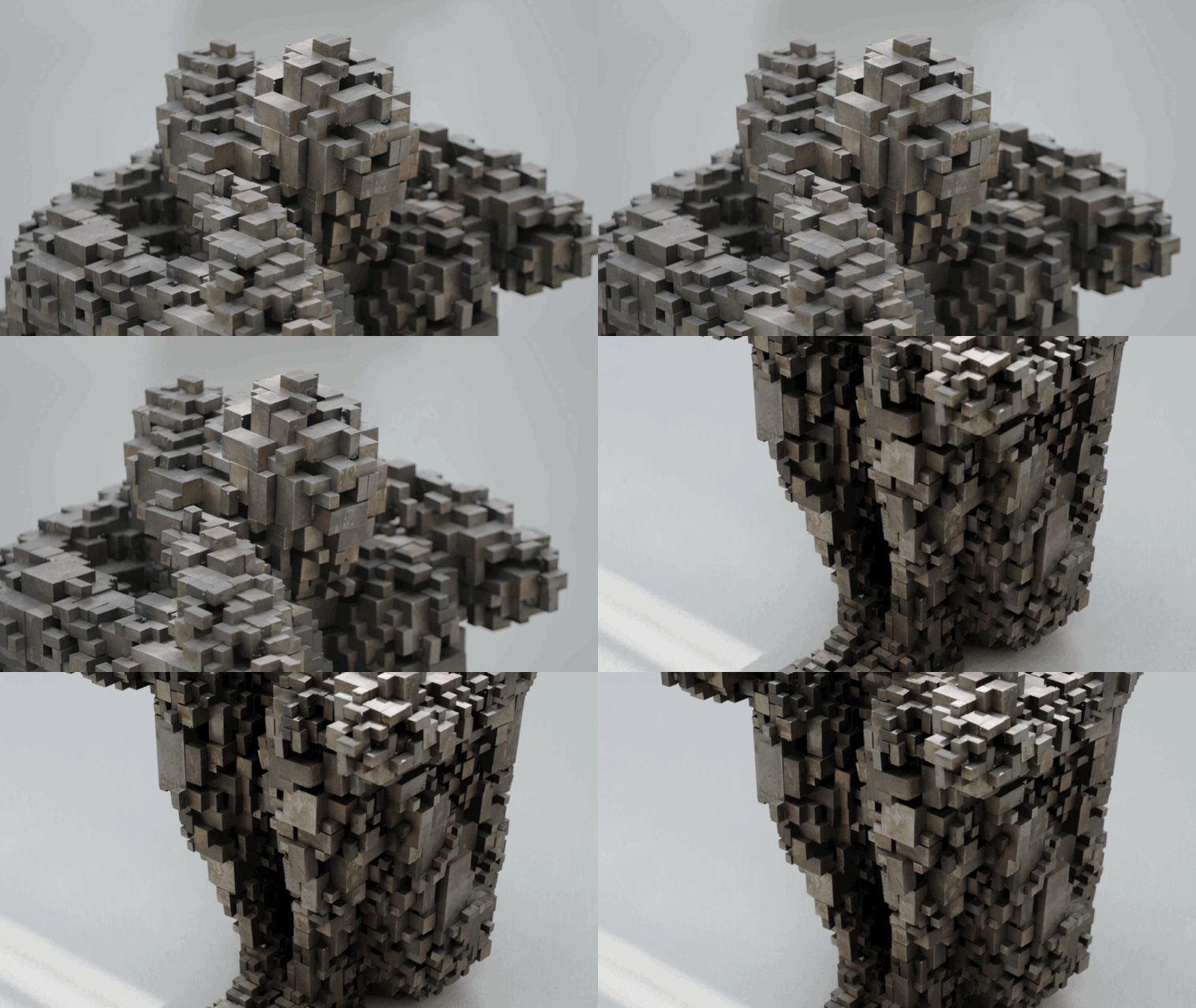
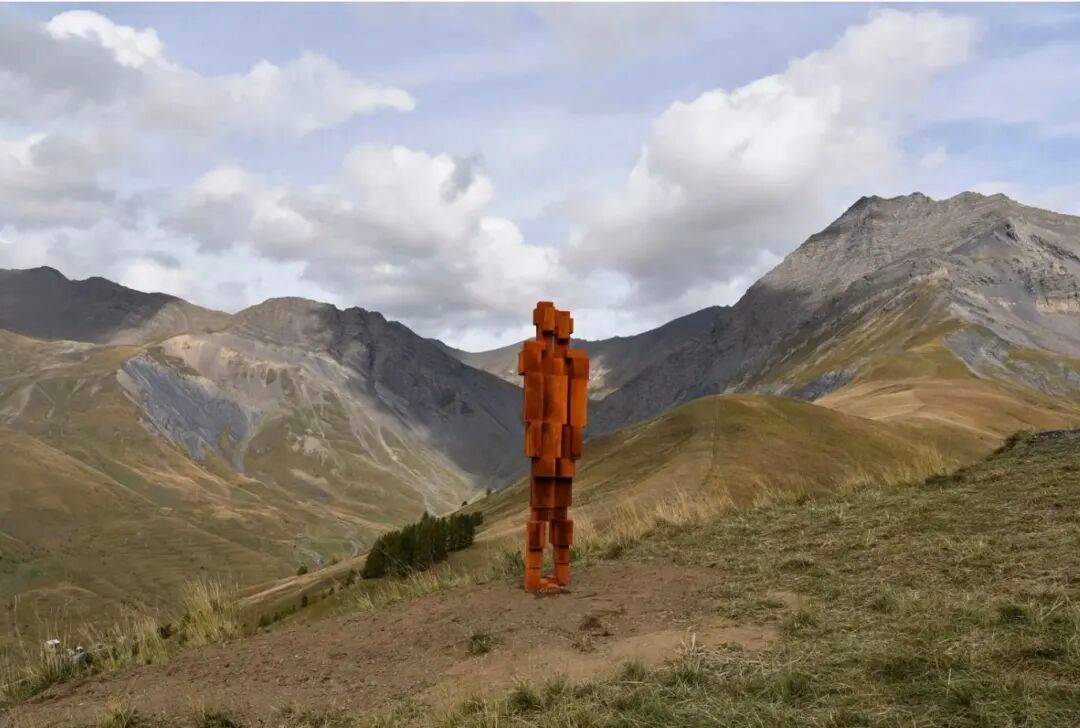
Elsewhere in the gallery stood one of Gormley's signature pixelated works, Assembly I, built from thousands of steel blocks of different sizes — 12 by 25, 25 by 25, 50 by 50, 100 by 100, 200 by 200 inches, and so on.
Even though the figure is barely legible, you can still make out a kind of held head, a quiet, almost desperate loneliness in the pose.
"Assembly I was the first time I realized I could build space out of elements — from the part to the whole. You can see the blocks are quite rough, still smoked from the welding," Gormley said. He believes these broken-apart little steel blocks are capable of carrying real feeling. "But I think none of these works have any value until someone sees them. They need the viewer to connect with them, to give them attention and emotional meaning."
SECTION 02 | closure and explosion
He also told us he genuinely worries the piece might one day just collapse into a scattered heap, like pixels falling apart. "The whole sculpture weighs around 350 kilograms, but all of that weight rests on one small 25-by-25 connecting block. Bump it, and it could come down."
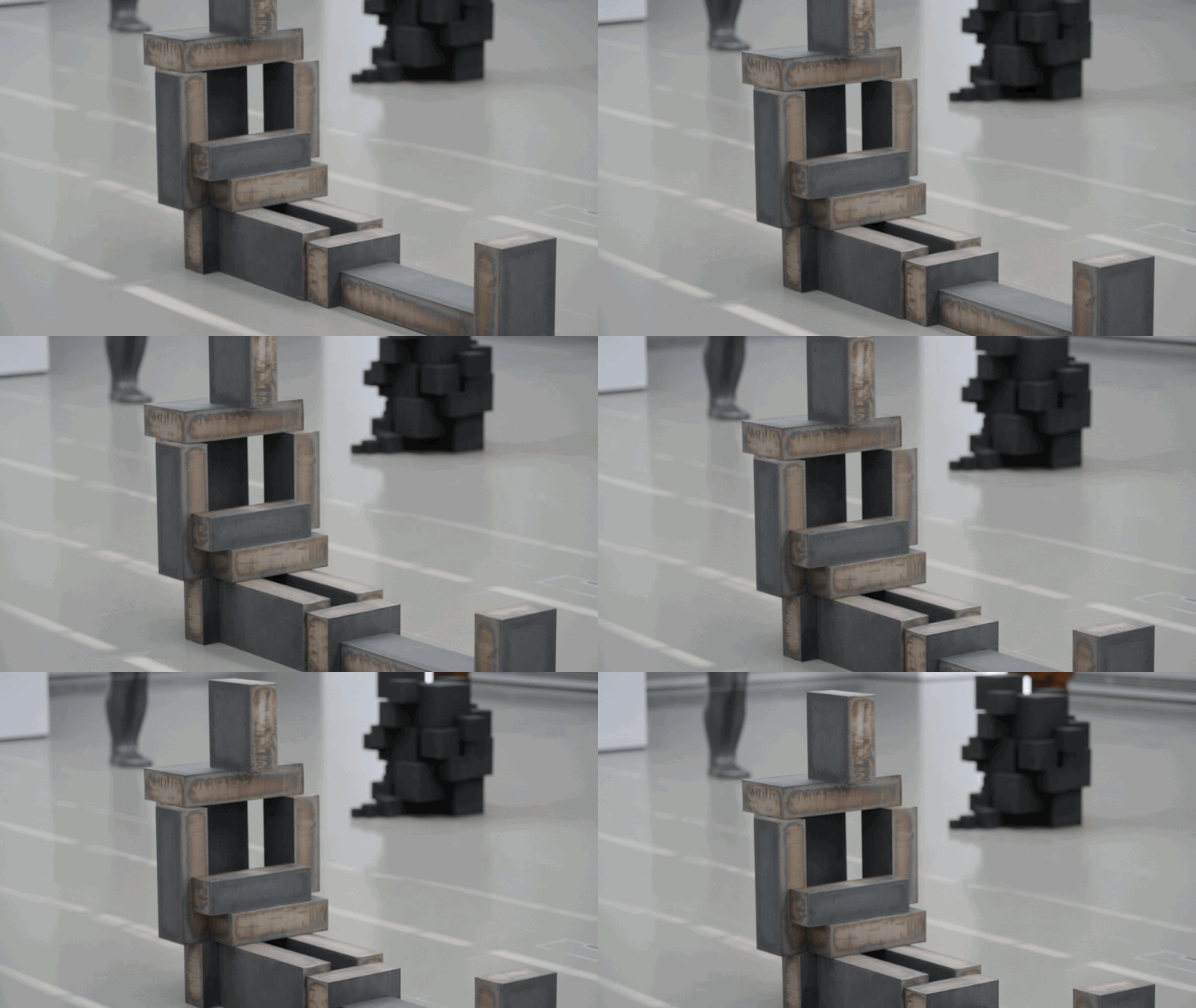
The newest work in the show, Feed IV, looks almost feral — Gormley says it is the most structurally loose piece in the whole exhibition; the steel blocks aren't even welded together, just held in place by a central pin. The way he built it has everything to do with where the idea came from.
"One New Year's, I was riding the London Underground and saw people all over the train who clearly hadn't made it home — they'd had too much to drink the night before. They were just sitting there, collapsed in on themselves, in exactly the posture of this sculpture," Gormley said.
Gallery 4, connected to the museum's exterior along the coastline, feels almost like a labyrinth — visitors are free to wander it without constraint, searching out whichever piece speaks to them, sharing the room with these silent metal figures. The suspended gallery beyond it, by contrast, reads like a transparent, open, luminous box. Light comes from every direction there, even the walls seem to glow, and the whole space connects, without interruption, to the blue sky and coastline just outside the museum.
"This exhibition is really a dialectic between the two galleries — a conversation, a dynamic, a tension," the artist said.
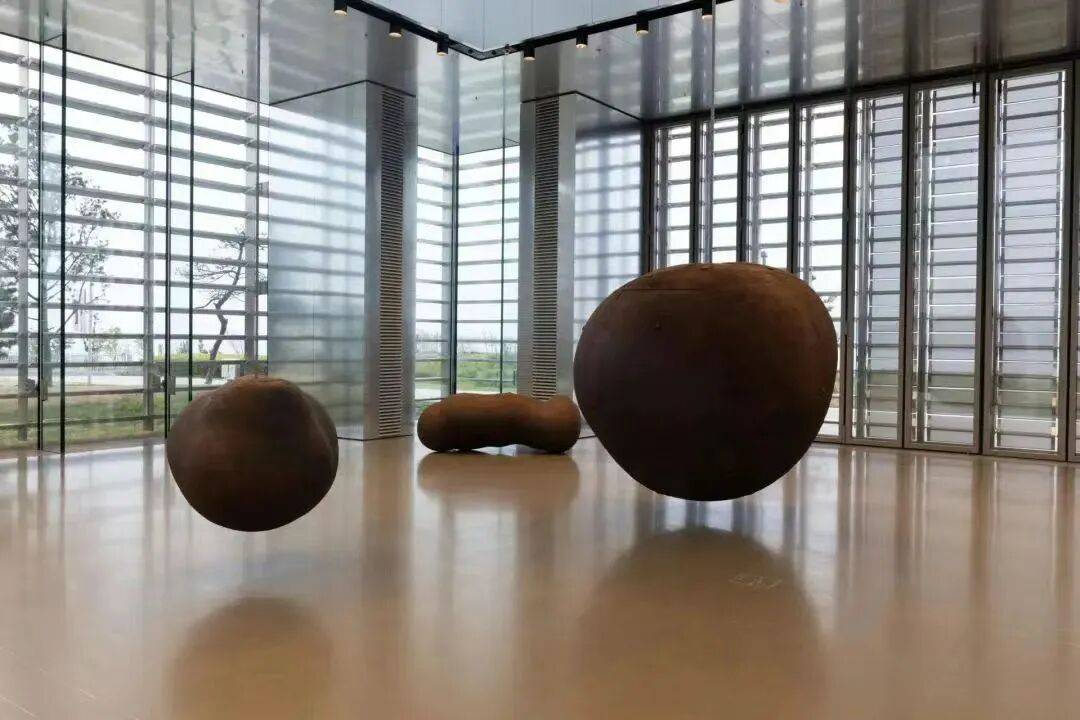
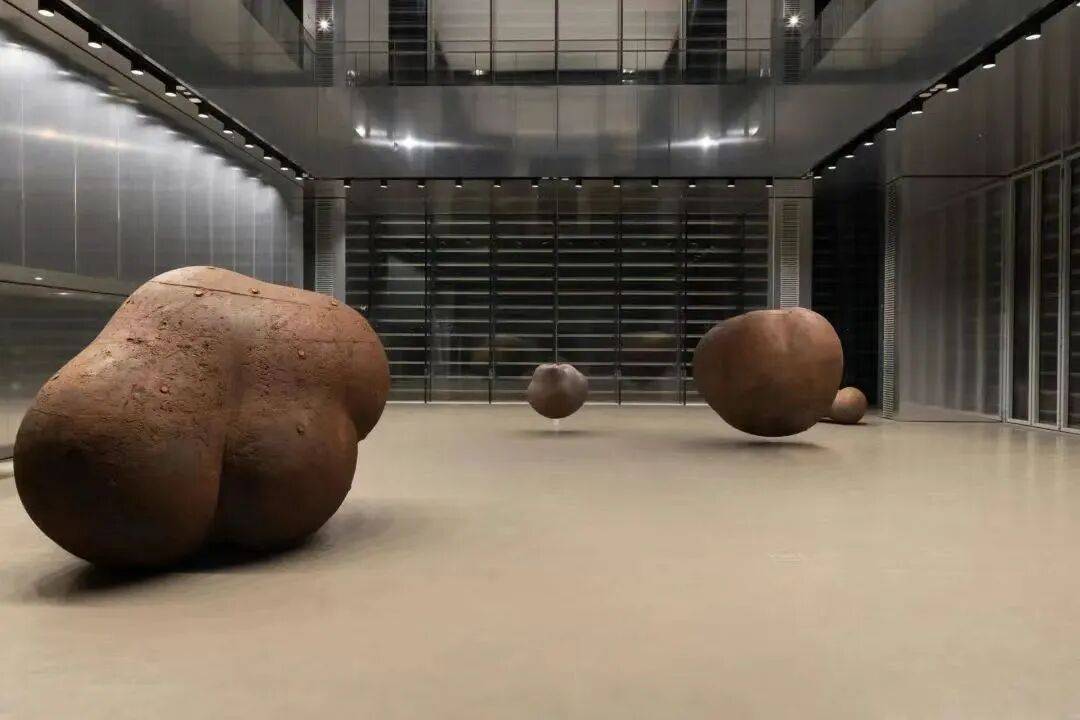
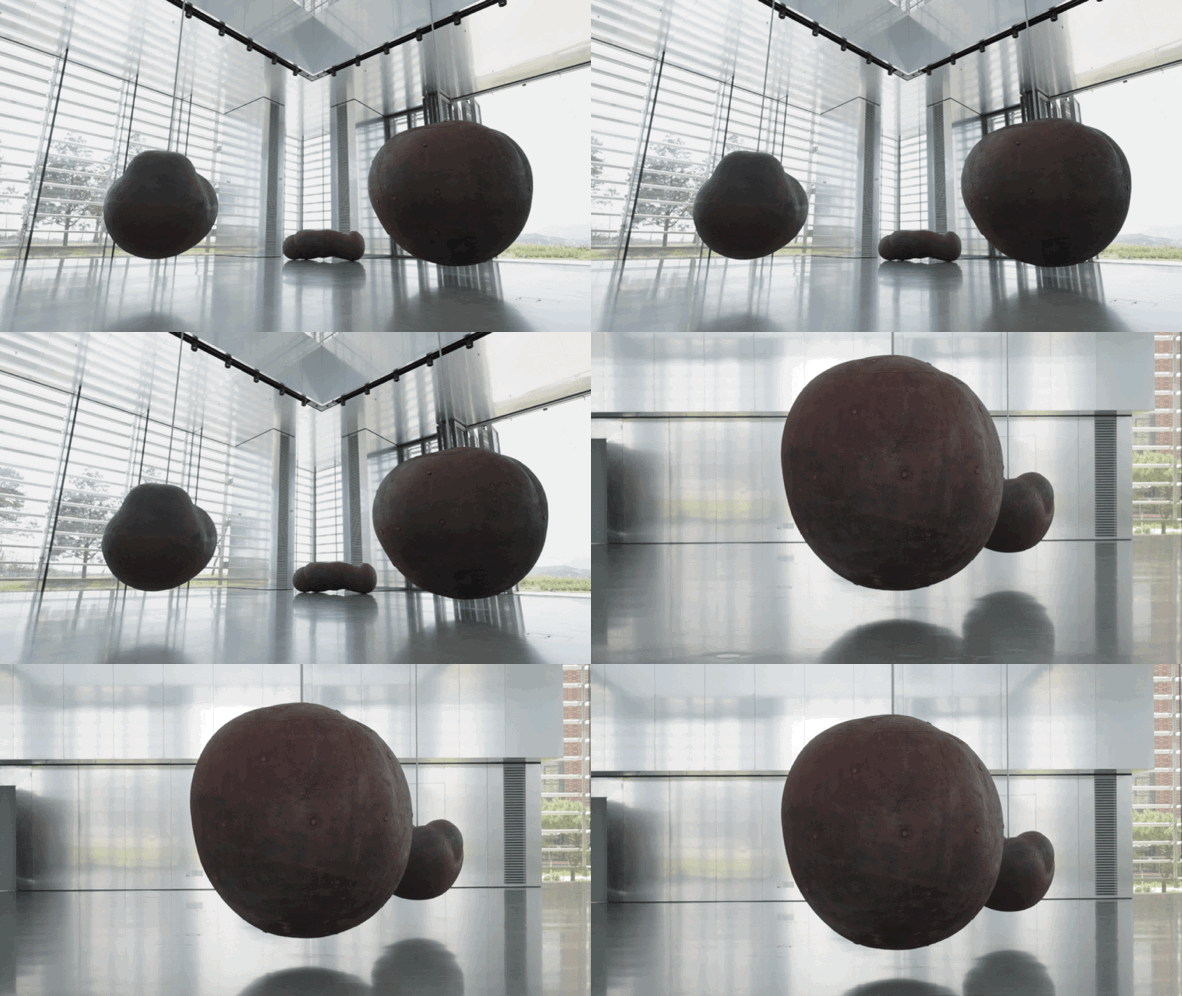
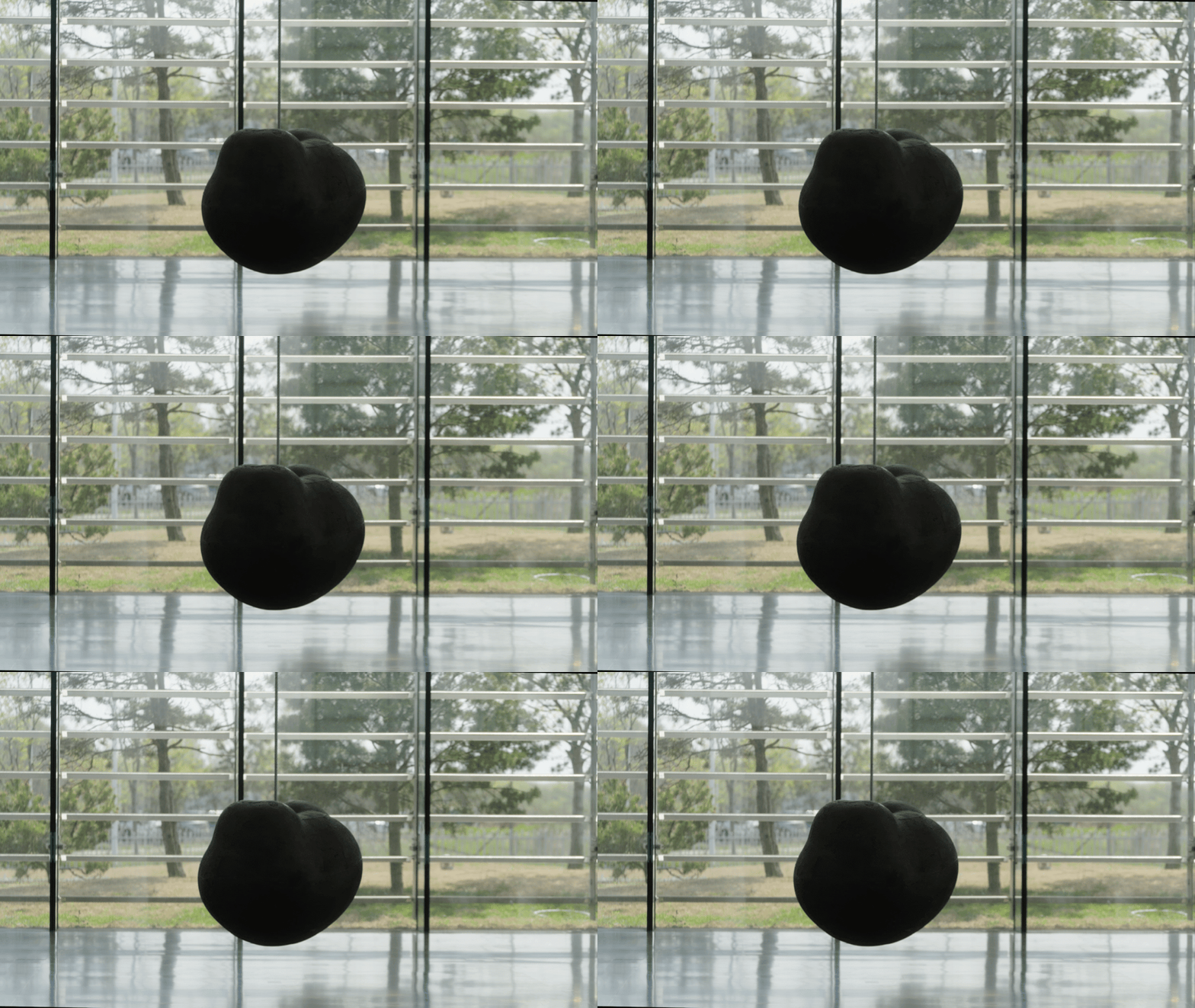
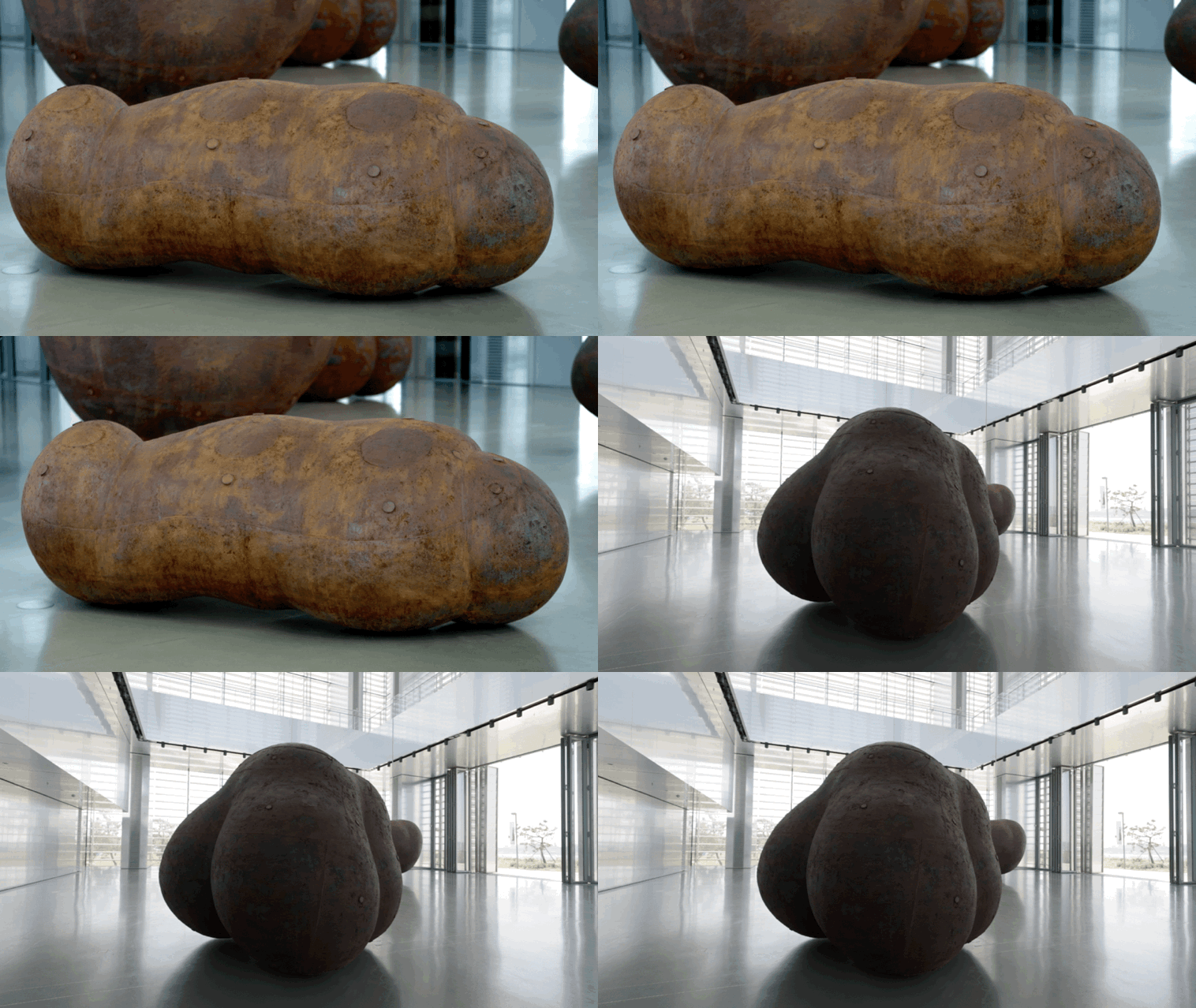
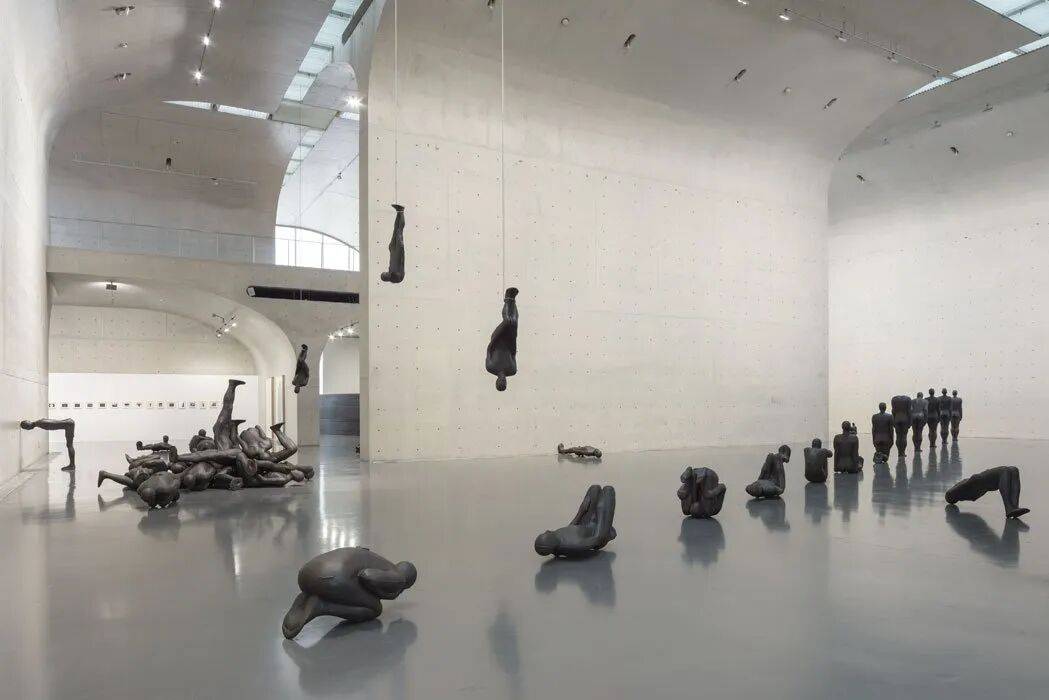
"These two suspended pieces, Fruit and Body, dramatize gravity, while Earth and End Product bring that sense of floating back down to the ground," Gormley said. The four works in Gallery 5 — two hung by steel cable, two resting on the floor — all come from the artist's Expansion series of the early 1990s, born out of his fascination with reshaping the boundary of skin. Earth represents a body in free fall; End Product, a standing human figure.
"Fruit, or a seed, is also a kind of bomb — it holds a potential that can explode, express itself, multiply," Gormley said, and that idea of multiplication ties directly back to where the works began: the curled posture of a fetus inside its mother. As visitors moved slowly through the room and a sea breeze drifted in from outside, the two suspended pieces, Fruit and Body, swayed faintly with the trembling air, and in that moment motion and stillness struck a kind of perfect balance.
SECTION 03 | Every time I come to China, I am inspired
"At the heart of this exhibition is a dialogue between the organic and the constructed. It's rooted in Chinese philosophy — the order between heaven and earth, and how human nature comes to understand both," Gormley told us. Over the course of the interview, he returned more than once to his fascination with Chinese culture and to an emotional connection with China he described as inseparable from who he is.
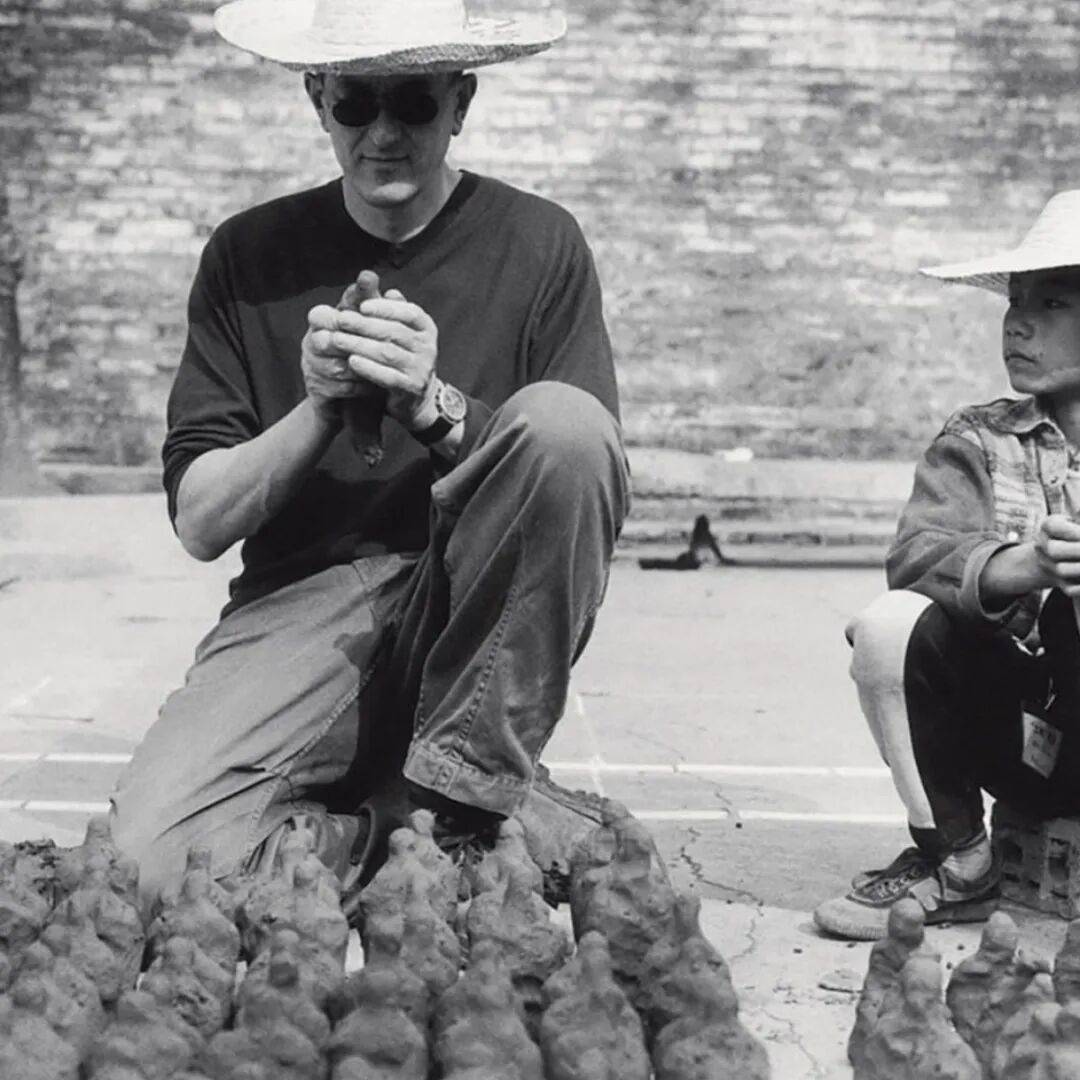
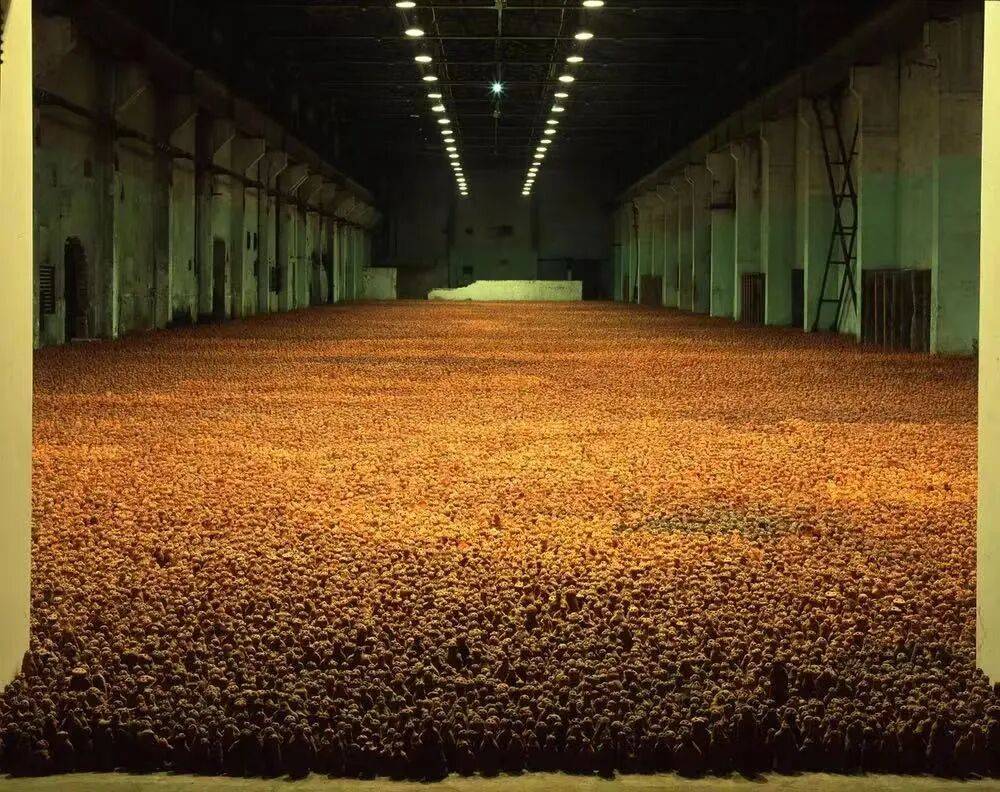
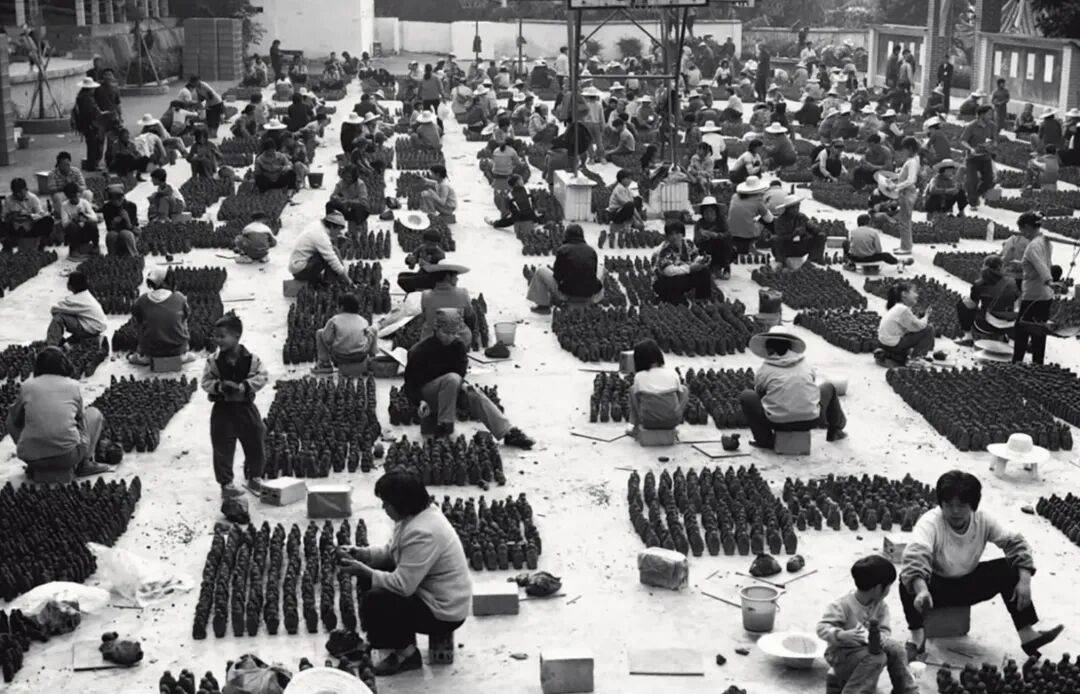
"I first came to China in 1995. Over the past thirty years, I've watched Chinese society go through an extraordinary transformation — from a relatively scattered, low-intensity agricultural society to a place where we all now live in dense, high-rise megacities." Every time he returns to China and sees how much has changed, Gormley finds himself reaching for the same word: "magical." That love for the country is also what led him, in 2002, to make Asian Field, a large-scale work for which he invited 350 villagers from Xiangshan village outside Guangzhou, along with students from the Guangzhou Academy of Fine Arts, to spend five days in February making 230,000 small clay figures.
Gormley asked three generations of the same families to make the clay figures together. "I remember the youngest child was only five. Everyone had their own workspace — a meter wide, three meters long, marked out in chalk. You had to sit next to either an elder or a young person, but it couldn't be your own child or grandchild." He still laughs recalling the rules he laid down for the villagers that year.
"What you find is something almost magical — the children weren't afraid at all, they thought it was one big party.
It was the adults who were self-conscious, who held back." The project used 130 tons of clay in total, with each participant making somewhere between 100 and 300 palm-sized clay figures every day. Recalling the scene, Gormley still lights up. "For me, it was like sitting in a restaurant — someone would just walk up and set down a little wooden board covered in tiny clay figures."
Antony Gormley's Qingdao Exhibition: The Most Comprehensive, Most Ambitious Presentation of His Work in Asia
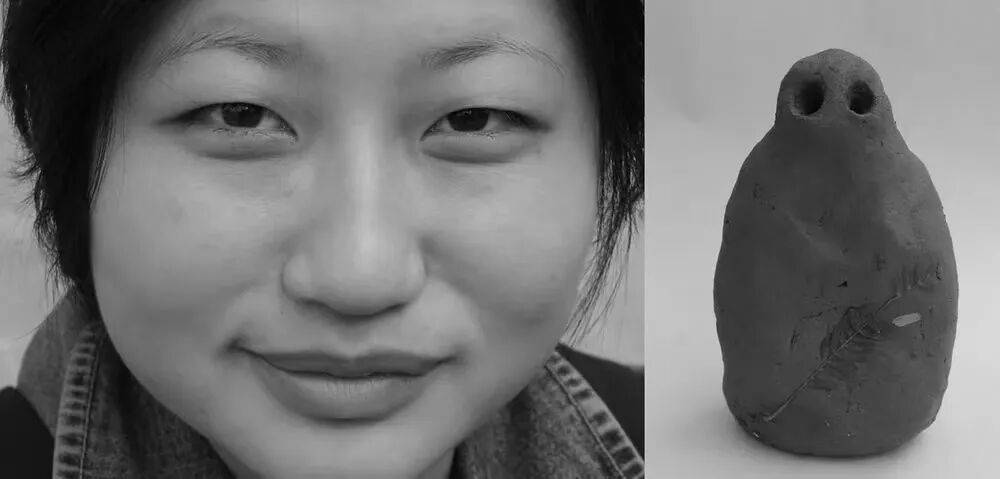
Gormley laughed telling us that story. The villagers would ask him, "Is this what you wanted?" And his answer was always the same: "No — this was never about what I wanted. It's about what you can find. You take a lump of clay, you shape it, and then you give it eyes, and it comes alive." Over those five days, the villagers worked like office employees on a nine-to-five schedule — eight hours a day, from nine in the morning until eleven, then lunch, a look at what everyone else had made, and back to work in the afternoon.
"The funniest part was watching the villagers try to recognize each other's work. They'd argue over it — 'that looks just like Zhang Wei, did she make that one?'" the artist said, laughing. Gormley says he has always been proud of Asian Field. It came from the hands of ordinary working people in China, and it takes up the shifting, dialectical relationship between the one who looks and the one being looked at.
The work is now a landmark piece in Asia, part of the permanent collection at M+ in Hong Kong, where it fills an 80,000-square-foot gallery: 400,000 eyes fixed on you, with nowhere in the room to escape their gaze.
"I think of Asian Field as a vast reservoir holding more unspoken feeling and thought than you can measure. The figures occupy the entire space so completely that you can't actually enter their space — instead, you become the one being watched by the art. They're all asking you the same questions: Who are you? What do you have? What memories do you carry?" Every time Gormley comes to China, he says, he feels as though he has been handed some kind of revelation.
He rattles off China's historical sites and landscapes like an old friend — the Terracotta Army at the Yellow Emperor's mausoleum near Xi'an, the Sanxingdui ruins in Sichuan, the Ming Xiaoling tomb and its spirit way in Nanjing, and Huangshan.
"The last time I came was 2018 — I spent a week on horseback in the snow with a Tibetan guide, up to 4,700 meters. I love going to western China, to the places with no roads. Out there you feel a kind of real life, closer to the earth," he said. His fascination with China took root at university, when he first encountered the Dao De Jing and the I Ching, and he has held a deep affinity ever since for the ancient Chinese concept of the five elements — metal, wood, water, fire, earth — which he believes Chinese thinkers pushed further than their medieval European counterparts ever did.
"I think Chinese culture has influenced and inspired me in more ways than I can count, and it will keep doing so," Gormley said. He told us that the day before our interview, he had gone to Qingdao University, curious to see what young people in China were up to.
SECTION 04 | 'Art Should Be Returned to Nature'
"They were out on the stairwells, studying with real urgency, hoping to pass their graduate entrance exams, hoping to be part of the future of their city and their country. It was genuinely moving," he said. For an artist of Gormley's global stature, he is remarkably unpretentious. He even walked us through what he called a "boring day" back home in England.
"My day is very boring, honestly. I get up around seven, do a bit of gentle exercise — call it a small salute to the sun — then have breakfast and head to the studio," Gormley said, laughing.
"My studio is right next door to my wife's. I usually get there before ten, check in on however many projects are underway, do some drawing, make small models — that's really the process behind my work." Gormley says his studio employs around twenty-five people. "We all eat lunch together, and afterward we play some table tennis, or football, or basketball."
We must have looked surprised, because he burst out laughing. "We're lucky — we have a big courtyard, so it's more like a whole community working together." "I always try to have everything wrapped up by eleven at night. But you know, that's not always possible. There's always someone flying in from Italy, or somewhere, wanting to talk something through."
Gormley gave a mock-helpless shrug. He told us that these days, what pulls his focus most is putting on exhibitions.
"I'm trying to do fewer shows and concentrate more on permanent works in public space." When the conversation turned to art in public space, Gormley visibly lit up.
He has made countless works set out in the natural world — Another Place, Angel of the North, Horizon Field, among many others — pieces so at ease with their surroundings that they feel as though they were always meant to stand there, between earth and sky.
"We're used to seeing art in galleries and museums, but sculpture, honestly, 'likes' the natural environment — it's a completely different experience from an interior venue. It makes you far more aware of how nature is changing: is it sunny today, overcast, raining?"
"I love making work for public space — it can be on a street, on a mountainside, on a beach, in the sea itself. You could say there's something almost magical about putting something human-made back into nature — it can even feel like something you're compelled to do," Gormley said. Near the end of the interview, he gave us a preview of what's next on his schedule.
"I'm heading to Korea very soon — I have two really exciting permanent projects underway there. Both will take at least three years, maybe five, to finish. They're quite complicated."