Why Did the Two First Ladies Visit This Exhibition?
In 2024, 150 years after the first Impressionist exhibition shocked Paris, the first ladies of China and France toured the Musée d’Orsay’s landmark exhibition “Paris 1874: Inventing Impressionism” together on May 6, the 60th anniversary of China–France diplomatic relations......
By / Xirui Huang · 10 min read
How did the Musée d’Orsay explain the significance of the 1874 Impressionist exhibition?
The Musée d’Orsay’s 2024 Paris 1874 exhibition places the first Impressionist exhibition within its urban and social setting. The report follows the independent presentation in Nadar’s former studio alongside the official Salon of the same year. Their subjects, brushwork, light and colour invite comparison. Archival material and reconstructed settings show that Impressionism involved artists choosing how to exhibit and represent modern life, as well as developing a different way of painting.
Exhibition | Paris 1874: Inventing Impressionism
In 2024, exactly 150 years after the first Impressionist exhibition shocked Paris, the first ladies of China and France toured the Musée d’Orsay together on May 6, the 60th anniversary of China–France diplomatic relations. They paid particular attention to the museum’s major exhibition, “Paris 1874: Inventing Impressionism” (Paris 1874, Inventer l’impressionnisme).
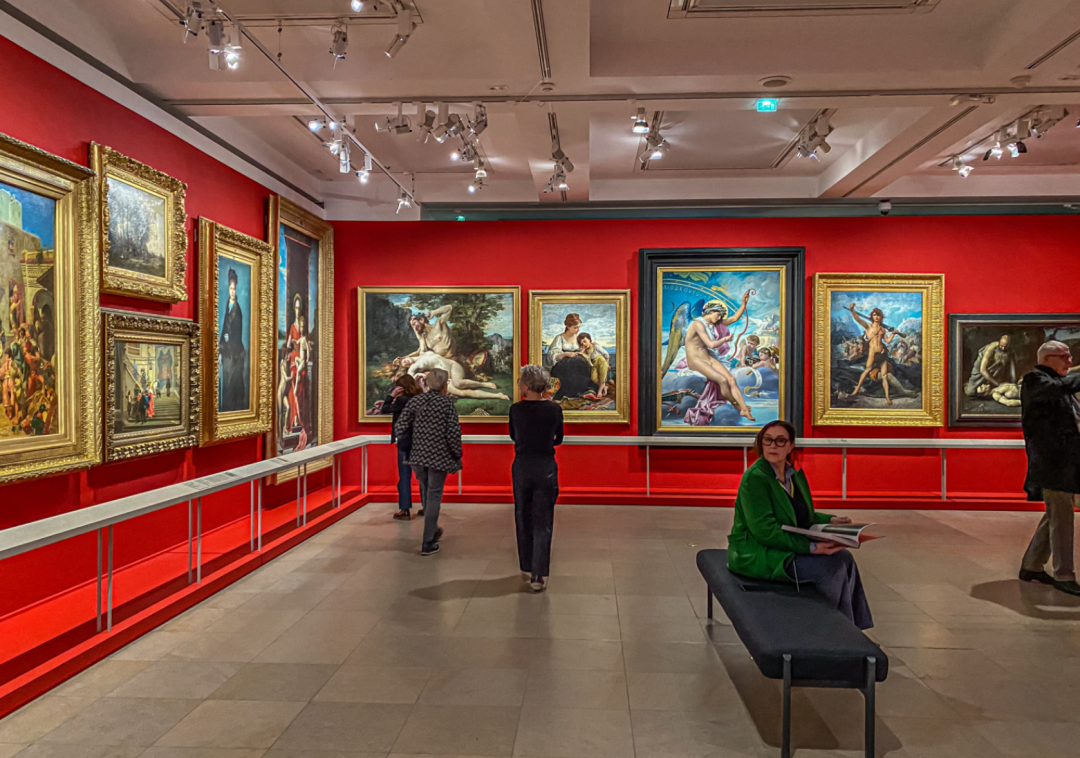
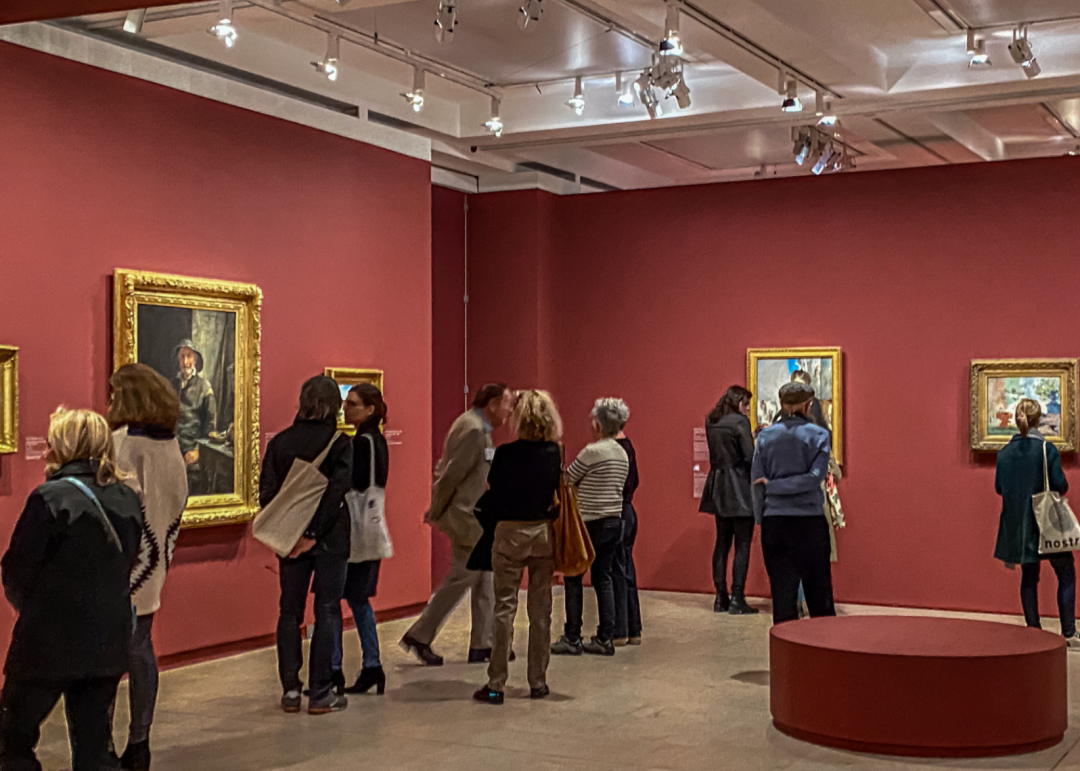
Image source: CCTV News. The Musée d’Orsay holds the world’s largest collection of Impressionist works, and most visitors probably have the same impression: the galleries displaying Impressionist art are always the most crowded. This exhibition brought together more than 130 representative works. To present the movement’s development as fully as possible, the museum borrowed works from more than 30 museums and institutions around the world, setting them alongside the academic Neoclassical paintings of the period’s official Salon. Through this reconstruction, visitors can immerse themselves in the “golden age” of French Impressionism in the second half of the 19th century.
SECTION 01 | Travel back to Paris 150 years ago and visit the birthplace of Impressionism
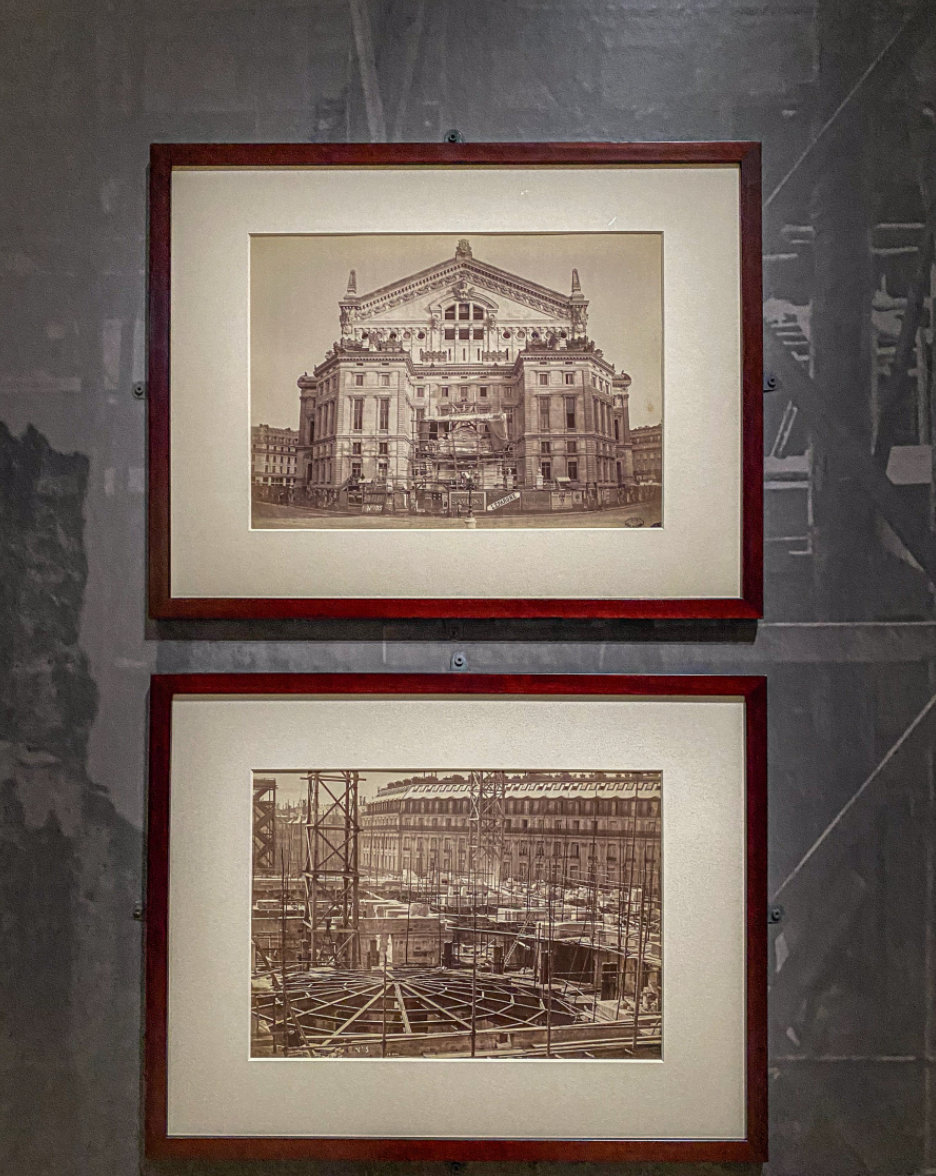
“Paris 1874: Inventing Impressionism,” Musée d’Orsay, 2024. The image shows the Paris Opéra under reconstruction in 1894. “Paris 1874: Inventing Impressionism,” Musée d’Orsay, 2024. In the exhibition’s VR experience, photographer Nadar’s old Paris studio has been restored to its original appearance. On April 15, 1874, an extraordinarily unconventional exhibition appeared in the studio of the photographer Nadar, at 35 Boulevard des Capucines, near Paris’s new opera house. The works on view had blurred outlines, somewhat disorderly brushwork, and an entirely intuitive approach to depiction. Light and shadow were everywhere; some paintings were almost excessively bright in color.
Nadar’s studio, converted into exhibition space, contained seven or eight rooms over two floors, and visitors could take an elevator between them. The galleries were flooded with sunlight during the day, while at night the works could be viewed by gaslight, inaugurating the Parisian “night exhibition.”
“Paris 1874: Inventing Impressionism,” Musée d’Orsay, 2024. In the exhibition’s VR reconstruction, the galleries of the 1874 Impressionist exhibition have been recreated at the Musée d’Orsay. The red walls and many of the exhibition’s important works have been restored; in some rooms, even the placement of the paintings corresponds to the original. The aim is to transport visitors back to Paris 150 years ago and give them as accurate as possible a sense of the social and historical circumstances in which Impressionism developed.
Yet many visitors entering the first gallery may find themselves puzzled: Why are there only historical documents and photographs? Where are the paintings?
“Paris 1874: Inventing Impressionism,” Musée d’Orsay, 2024. The exhibition’s two curators, Anne Robbins and Sylvie Patry, believe that the birth of Impressionism was inseparable from the social conditions of its time. They therefore wanted to foreground that context from the beginning. In the 1870s, the French army suffered a devastating defeat in the Franco-Prussian War, followed by the failure of the Paris Commune, leaving society deeply divided.
On one side, traditional conservative forces remained absorbed in the aristocratic order of the preindustrial era. On the other, the upheavals of urbanization brought on by the Industrial Revolution, along with the rise of capitalism and the working class, transformed daily life. People watched the “iron hulk” of the Eiffel Tower rise beside classical buildings, while railway stations and factories appeared at remarkable speed. Their ways of living, aesthetic preferences, and cultural identities changed radically. This was the underlying reason for the conflict between Impressionism and the academic Salon: society’s structure had changed, and traditional artistic forms no longer fit the narrative of the age.
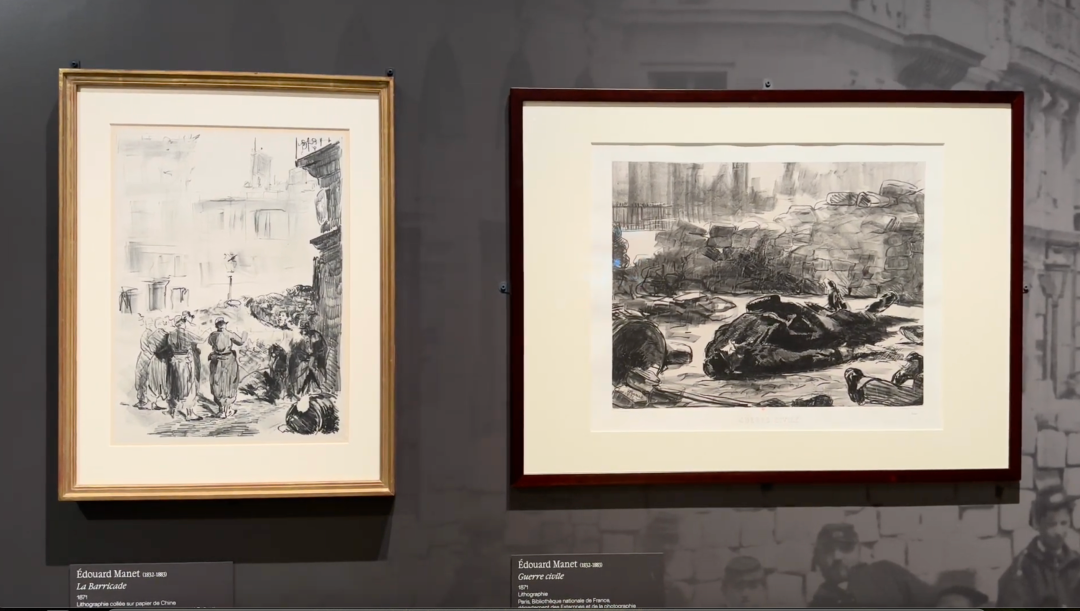
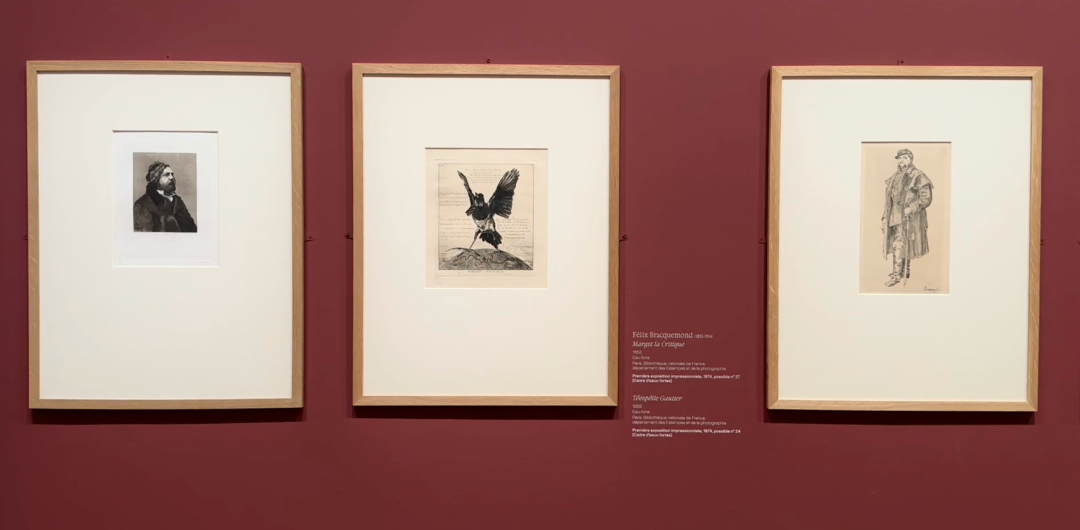
“Paris 1874: Inventing Impressionism,” Musée d’Orsay, 2024. Both drawings depict the Civil War by Édouard Manet. The second room we enter is titled “Chez Nadar,” the site of the first Impressionist exhibition in 1874. The third room reconstructs the exhibition itself. Monet, Renoir, Pissarro, Cézanne, Degas, Morisot, Sisley, Bazille, and 23 other artists who were unwelcome in the mainstream Salon took part in an exhibition called the “Exhibition of the Society of Anonymous Painters, Sculptors, and Engravers,” showing a total of 165 works.
“Paris 1874: Inventing Impressionism,” Musée d’Orsay, 2024. Claude Monet, Boulevard des Capucines, 1873–1874. Paul Cézanne, The Modern Olympia, 1873–1874. These artists, rejected by the Salon, differed in age by more than 40 years, yet each exhibited according to his or her own wishes.
Contrary to what we might expect, oil paintings were not the majority of the works on view; there were only half as many oils as works on paper. The exhibition also included approximately 40 prints, more than ten sculptures, and several enamel paintings. Unlike the official Salon, it hung drawings and paintings side by side. That arrangement has also been recreated at the Musée d’Orsay.
“Paris 1874: Inventing Impressionism,” Musée d’Orsay, 2024. Through this exhibition, the artists sought to escape the academic establishment’s stranglehold on the art world and its taste for skillfully executed depictions of grand historical subjects. They wanted to establish an independent school, painting landscapes, cafés and railway stations, people and children in the countryside, and even brothel scenes—subjects previously considered unfit for art. The artists had hoped to attract several thousand, perhaps even tens of thousands, of visitors. Instead, the exhibition met with indifference: only 3,500 people paid to see it, far fewer than attended the official Salon.
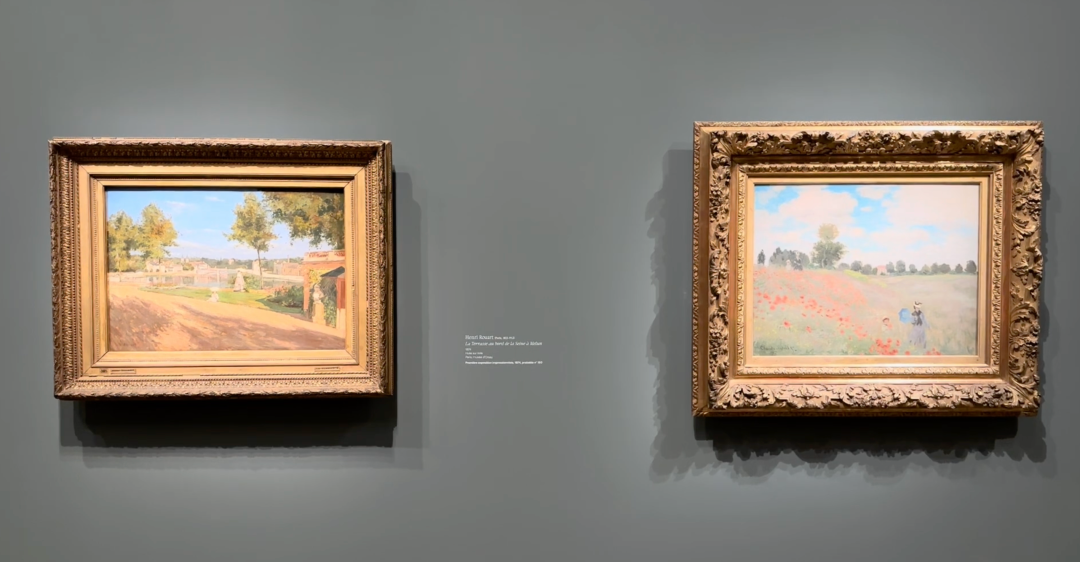
Only a few paintings by Monet, Renoir, Cézanne, and Sisley were bought by collectors. Auguste Renoir, The Dancer, 1874. Claude Monet, Impression, soleil levant, 1872. Most responses to the exhibition were negative. The work that drew the harshest criticism was Monet’s now world-famous Impression, soleil levant, depicting sunrise over the port of Le Havre in purple morning mist.
After visiting the exhibition, the art critic Louis Leroy mocked Monet’s Impression, soleil levant in the mainstream magazine Le Charivari, calling it rough and unfinished: “It seems that what they are seeking above all is ‘impression’ (ce qu’ils semblent rechercher avant tout, c’est l’impression).” Ironically, this phrase, intended as a taunt, became the name of a movement that would flourish for more than 100 years: Impressionism.
“Paris 1874: Inventing Impressionism,” Musée d’Orsay, 2024. Academic and Impressionist works are juxtaposed in galleries 4 through 6. We see numerous major Impressionist works alongside paintings from the official Salon. This, too, reflects the historical reality: at least 12 artists exhibited in both the Salon and the Impressionist exhibition, simply to ensure that their work was seen and “sold for a good price.”
SECTION 02 | The debate between impressionism and academicism
“Paris 1874: Inventing Impressionism,” Musée d’Orsay, 2024. Camille Cabaillot-Lassalle’s painting depicts the official Salon of 1874. That same year, on May 1, France’s most prestigious art exhibition—the official Salon organized by the Académie des Beaux-Arts—opened at the Palais des Beaux-Arts on the Champs-Élysées. It was only a 20-minute walk from 35 Boulevard des Capucines, the site of the first Impressionist exhibition.
The official Salon resembled a large art fair backed by the academy. It was the principal platform through which artists presented their work to dealers, patrons, and collectors. Monet, Renoir, Pissarro, Cézanne, Degas: names that now command instant recognition were then artists barred by the official Salon and regarded as marginal. Compared with the Impressionist exhibition’s mere 165 works, the 1874 Salon was enormous, with nearly 2,000 paintings spread across 24 galleries.
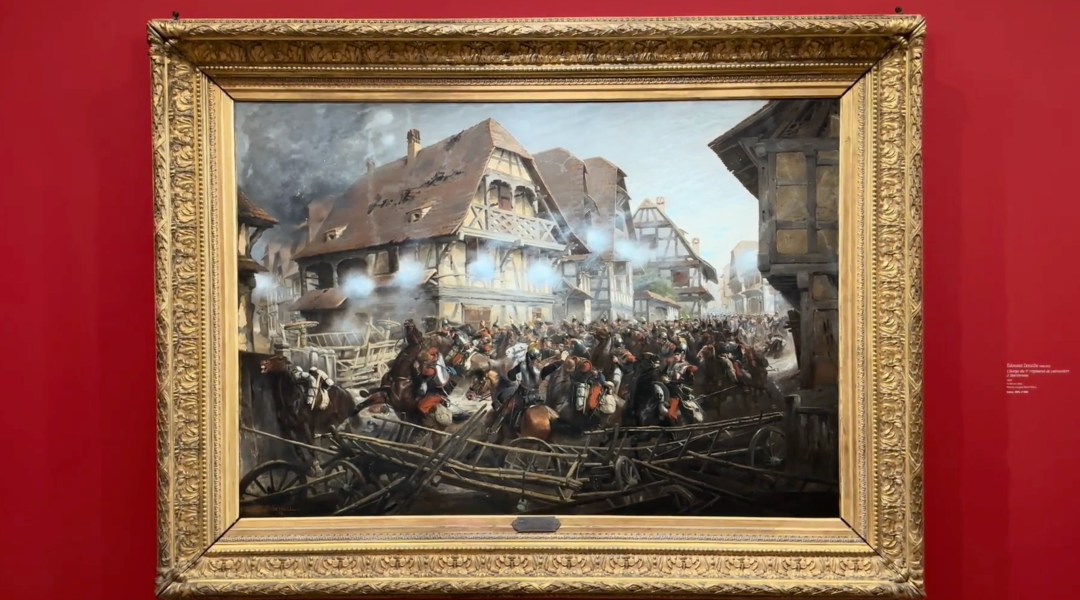
“Paris 1874: Inventing Impressionism,” Musée d’Orsay, 2024. Many academic works depict brutal scenes of war. Their themes were also markedly different from those of the Impressionists. They told historical, religious, or mythological stories, and included finely detailed landscapes and portraits in which the brushwork was nearly invisible. The critic Émile Zola observed, “The public is very taken with the tragic scenes of the final battles of the Franco-Prussian War.”
Édouard Manet, Masked Ball at the Opera House, 1873. Édouard Manet, Chemin de fer, 1873. Yet the Salon was not entirely conservative. In fact, Chemin de fer, one of Manet’s most important foundational works, was selected by the official Salon and displayed as a “radical” painting.
The painting depicts a young woman seated beside a railway station, with a child playing nearby. It was one of the few works in the exhibition that did not depict a historical event, instead portraying modern life and industrial society. Although Manet considered himself an avant-garde artist, he firmly refused an invitation to exhibit with the Impressionists at 35 Boulevard des Capucines. He did not want to distance himself from the official Salon, which he regarded as the only route to success.
“Paris 1874: Inventing Impressionism,” Musée d’Orsay, 2024. Éva Gonzalès, A Box at the Théâtre des Italiens Circa, circa 1874. Éva Gonzalès also declined the invitation to the Impressionist exhibition. Her painting depicts an unmistakably modern couple, rendered in a style typical of Impressionism and entirely consistent with the movement’s exhibition requirements.
The retrospective makes clear that in 1874 the boundary between the old order of the Salon and the avant-garde of Impressionism remained ambiguous and indistinct. Claude Monet, Poppies, 1873. The three works above are by Eugène Boudin, who was also Monet’s teacher. Armand Guillaumin, Soleil couchant a lory, 1873. There is no doubt that, as industrialization, globalization, and urbanization advanced, the emerging bourgeois way of life was vividly and comprehensively mapped by Impressionist painters. Some focused on domestic life; others painted Paris, where old and new buildings stood side by side after modernization; still others brought the emblematic achievements of the Industrial Revolution—trains, steamships, and large cranes—into their pictures.
Claude Monet, Saint-Lazare Station, 1877. Monet, as we know him, painted the station he often visited many times, usually in the morning mist. One of the best-known examples, Saint-Lazare Station, captures a steam train releasing white vapor that spreads beneath the station’s vaulted roof. The steam seems to cast a dreamlike blue-violet filter over the surrounding people and architecture.
Why Did the Two First Ladies Visit This Exhibition?
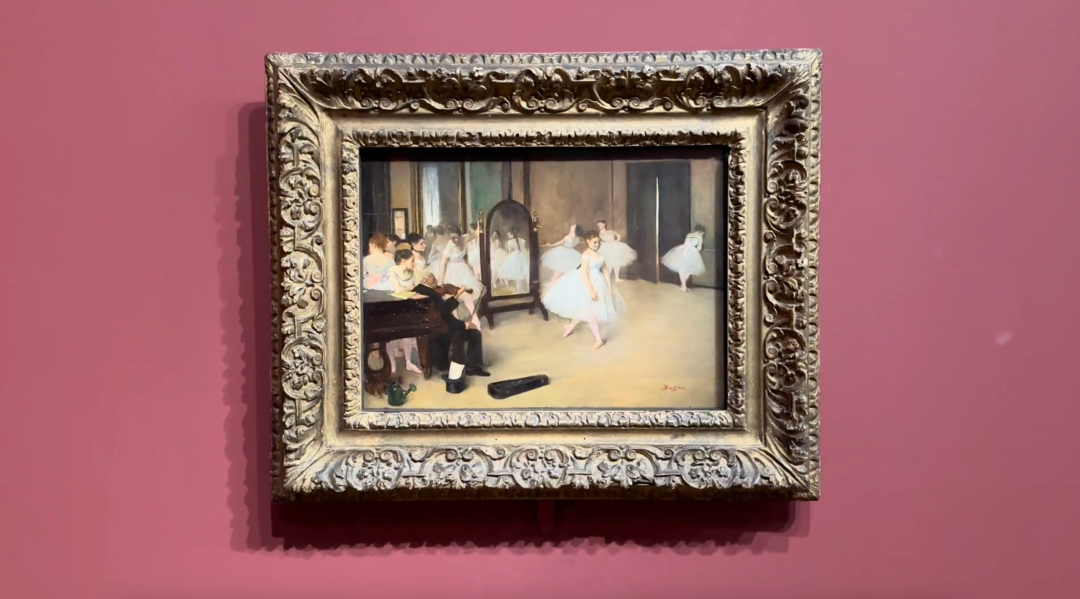
He also loved to paint churches and buildings, to work outdoors in nature, and to depict flowers, grass, blue skies, and white clouds. In his later years, he repeatedly painted the Japanese bridge, pond, and water lilies in his garden in different seasons. The one constant was that the people in his paintings were always blurred. Two works by Alfred Sisley. Edgar Degas, The Ballet Class, circa 1870. Edgar Degas, At the Races in the Countryside Circa, circa 1869. Degas devoted himself to “putting the postures and appearances of all the ballet girls in Paris into his paintings.” He was equally drawn to depicting men and horses.
When these Impressionist painters depicted people, they began with the urban life of Paris’s upper classes. For them, modernity was not only a source of new subjects but also a way of observing a fast-changing world. They wanted art to draw close to life and to represent its own time.
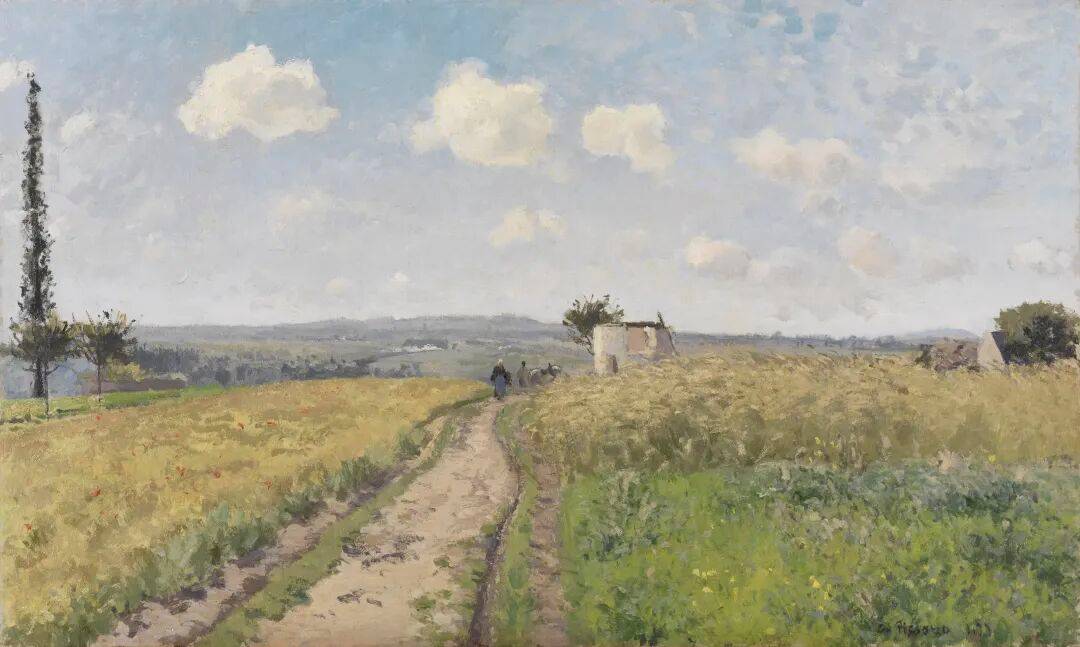
“Paris 1874: Inventing Impressionism,” Musée d’Orsay, 2024. Camille Pissarro, June Morning at Pontoise, 1873. The final two rooms of the exhibition present works shown at the second and third Impressionist exhibitions, held in 1876 and 1877.
By this point, the Impressionists had finally found a patron: Gustave Caillebotte. Although they were still far from commercially successful, the third exhibition gave this marginalized group a genuine sense of belonging. They began collectively to declare that “they belonged to Impressionism,” and even published a magazine under that name. Berthe Morisot, Vue du petit port de Lorient, 1869. Berthe Morisot, Le Berceau, 1872. “Paris 1874: Inventing Impressionism,” Musée d’Orsay, 2024. Berthe Morisot, Reading, 1873. This time, the exhibition occupied a spacious Paris apartment at 6 Rue Le Peletier. Eighteen artists participated, showing as many as 245 works, including those by two women artists: Berthe Morisot and Degas’s friend the Marquise de Rambures. The exhibition demonstrated Impressionism’s avant-garde character and openness at the time.
Auguste Renoir, Ball at the Moulin de la Galette, 1876. The works shown at the 1877 exhibition were of exceptionally high quality, distinctive in both style and subject, and clearly focused on modern life. It was arguably the most “Impressionist” of the series. One of the movement’s masters, Renoir, often compared with Monet, exhibited one of his best-known large-scale works, Ball at the Moulin de la Galette, at the 1877 Impressionist exhibition.
The painting is full of warmth. In an inexpensive open-air dance hall in Paris, people dance, talk, eat, and drink; the scene is both ordinary and beautiful. Auguste Renoir, The Theatre Box, 1874. Auguste Renoir, La balançoires, 1876. Renoir delighted in using bright, fluid colors, almost liquid in their movement, to depict all kinds of people—especially children and aristocratic men and women from the upper classes.
The Swing, for example, hung beside Ball at the Moulin de la Galette and depicts a sunlit afternoon in which young aristocratic men and women chat as they swing. By 1886, the Impressionists had organized eight exhibitions on their own initiative. Although their works were hung together, each artist possessed a strong individual style and an unmistakable individualism. They firmly resisted classification and continued, separately, to explore new ways of depicting the world.
“Paris 1874: Inventing Impressionism,” Musée d’Orsay, 2024. Camille Pissarro, The Public Garden at Pontoise, 1874. Edouard Béliard, Pontoise. View from Quartier de l’Ecluse Circa, circa 1872. Public taste is always late to arrive.
Impressionist paintings, led by Monet’s, were almost entirely ignored in the 1870s. In the 1880s and 1890s, they became somewhat more acceptable, attracting a few scattered patrons. It was not until the beginning of the 20th century that the movement as a whole rose to fame. Today, Impressionism is familiar to nearly everyone. It is often the first art movement many people can name, and the point at which many newcomers begin to take an interest in art. Exhibitions of the Impressionist masters are consistently crowded and popular, while the elements of their paintings continue to enter popular culture.
150 years later, looking back at Impressionism through this exhibition, we can see that its victory was hard-won. Some images courtesy of the Musée d’Orsay.