At Taikang Art Museum, a major survey traces four decades of Zhang Peili’s work through the artist’s body, identity, and private experience......
By / Xirui Huang · 9 min read
Who is Zhang Peili, and how do 30×30 and his bodily data works explore identity?
Zhang Peili is a pioneer of Chinese video art whose practice spans painting, moving images and installation. His 1988 video 30×30 repeatedly shows a mirror being broken and repaired, testing viewers’ patience and the boundaries of art. Later works translate data from his own organs into sculptures to explore body and identity. In this 2024 Hangzhou studio interview, Xirui Huang discusses his Taikang Art Museum exhibition, 2011.4.27—Long Term, connecting glove paintings, childhood memories of hospitals and four decades of experiments across media.
Artist | Zhang Peili: Forty Years of Exploring the "Body"
Zhang Peili is often described as the father of Chinese video art, and as the first Chinese video artist whose work was collected by MoMA. But his practice extends far beyond moving images. Across forty years, whether working in easel painting, sculpture, installation, video, sound, performance, or new media, he has continually tested the boundaries of art-making. What has remained constant is his ongoing “dissection” of the self. On August 24, 2024, Taikang Art Museum opened Zhang Peili’s large-scale solo exhibition “2011.4.27—Long Term,” which for the first time takes the artist’s body, identity, and personal experience as its principal thread, bringing together more than thirty works or series made from 1984 to the present.
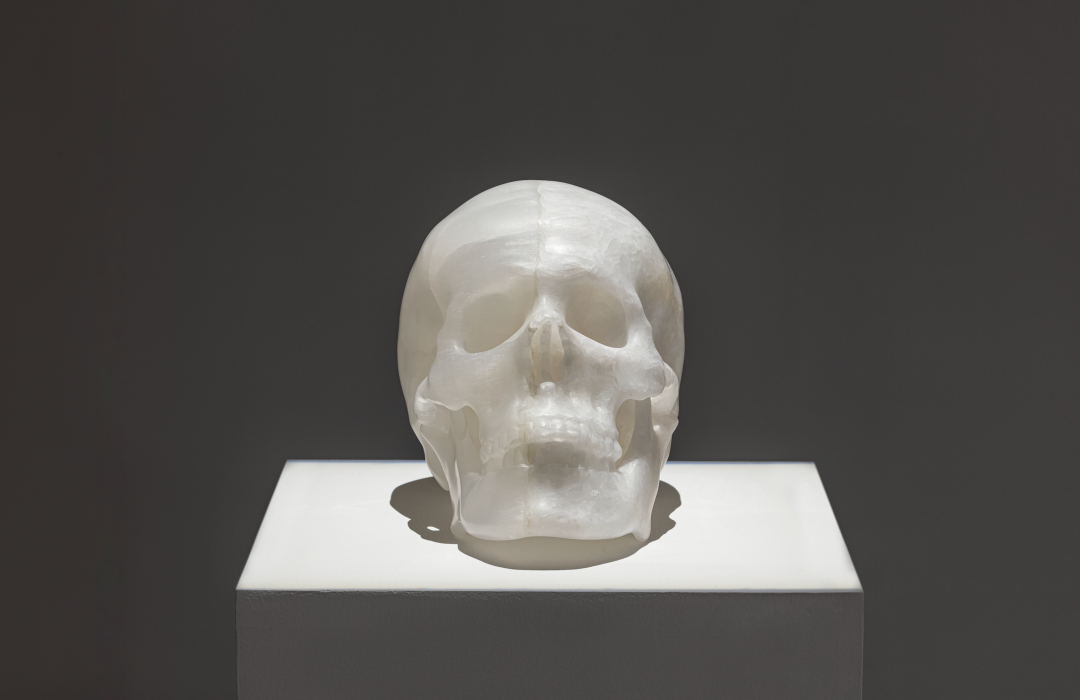
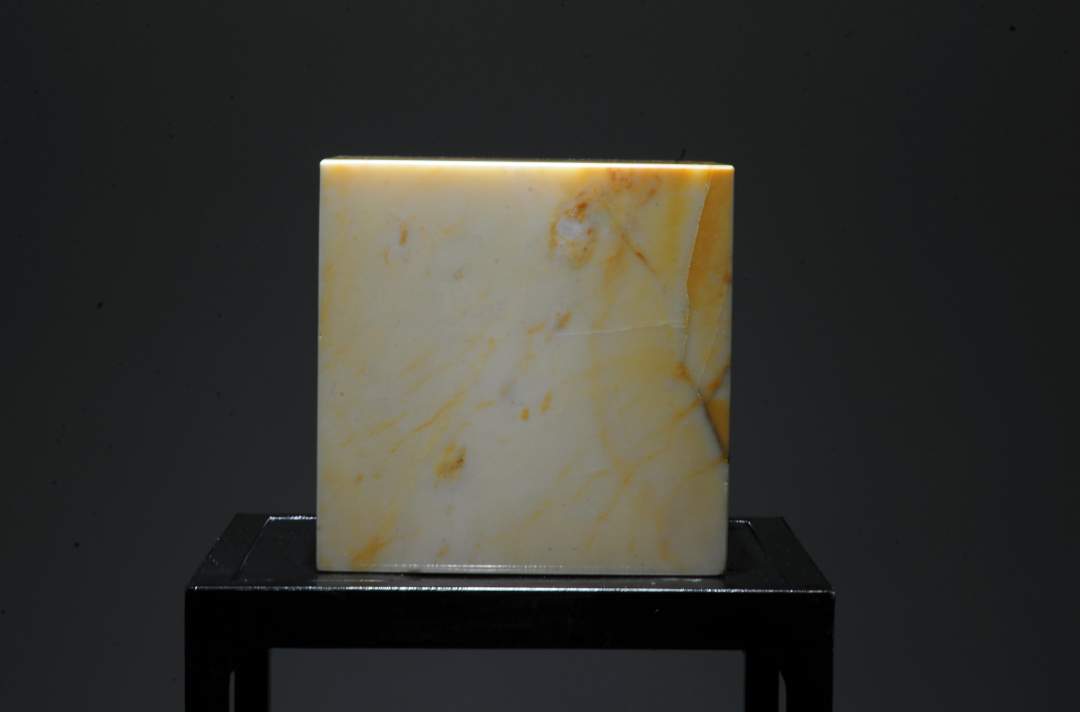
In the exhibition, his celebrated “glove paintings” from the 1980s lead to 30×30, the first video work to shock the Chinese art world, and then to recent pieces in which plaster, agate, crystal, and other hard, enduring materials reproduce the bones, blood, and organs of his own body. The result seems to offer a complete “Zhang Peili,” while at the same time presenting only a pieced-together “person.”
SECTION 01 | dissect myself
In August, we traveled to Zhuantang, in Hangzhou, to speak with Zhang, who had just returned home after installing the Beijing show. In his studio, we talked about the exhibition, and about his work and life over the years. The day we met him there, the temperature in Hangzhou had reached 39 degrees Celsius, and the sun, though autumn had technically begun, was still glaring. Stepping into the studio, we found darkness: in it, a group of his video works glowed from the floor and the walls. Farther in was a white space, also occupied by video installations.
Deeper inside was another darkened room, a tea room lit by a dim yellow table lamp. Zhang, in a black T-shirt, sat on a sofa; rock tea had already been poured on the table. On first meeting us, he responded with a rapid series of questions, revealing something essential about his way of moving through the world as an artist: permanently curious, and fully engaged. He told us that this exhibition breaks from linear chronology and takes “I” as its central thread, setting past and present works side by side in a way he had never done before.
The exhibition presents the self along two dimensions: a social identity, or spiritual dissection, and a bodily, physical dissection of the flesh.
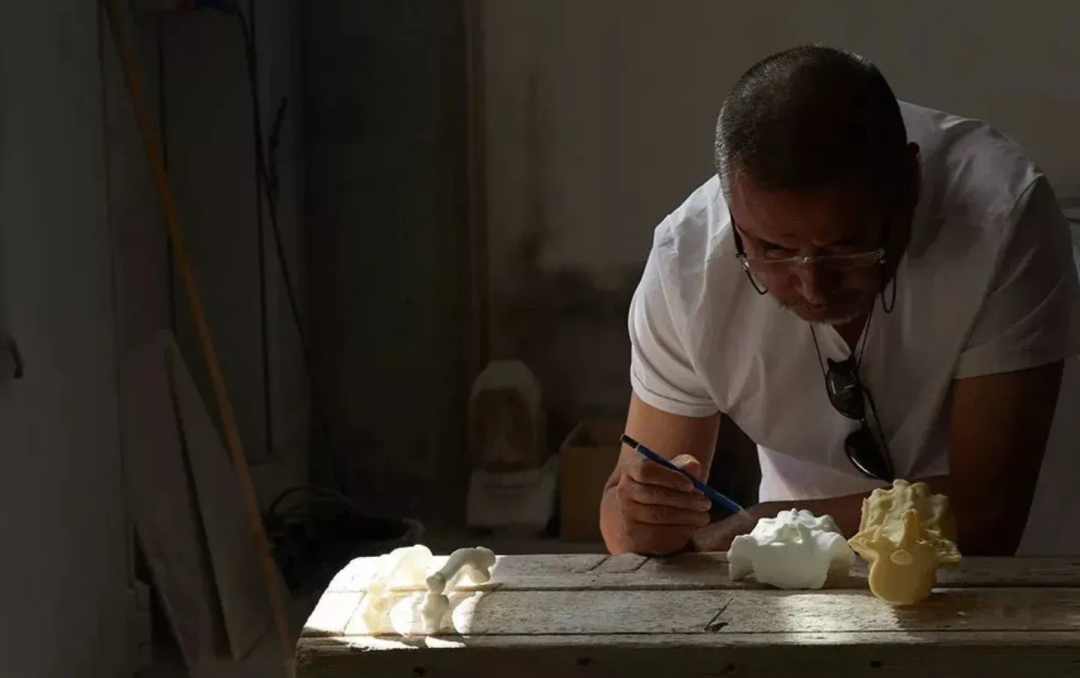
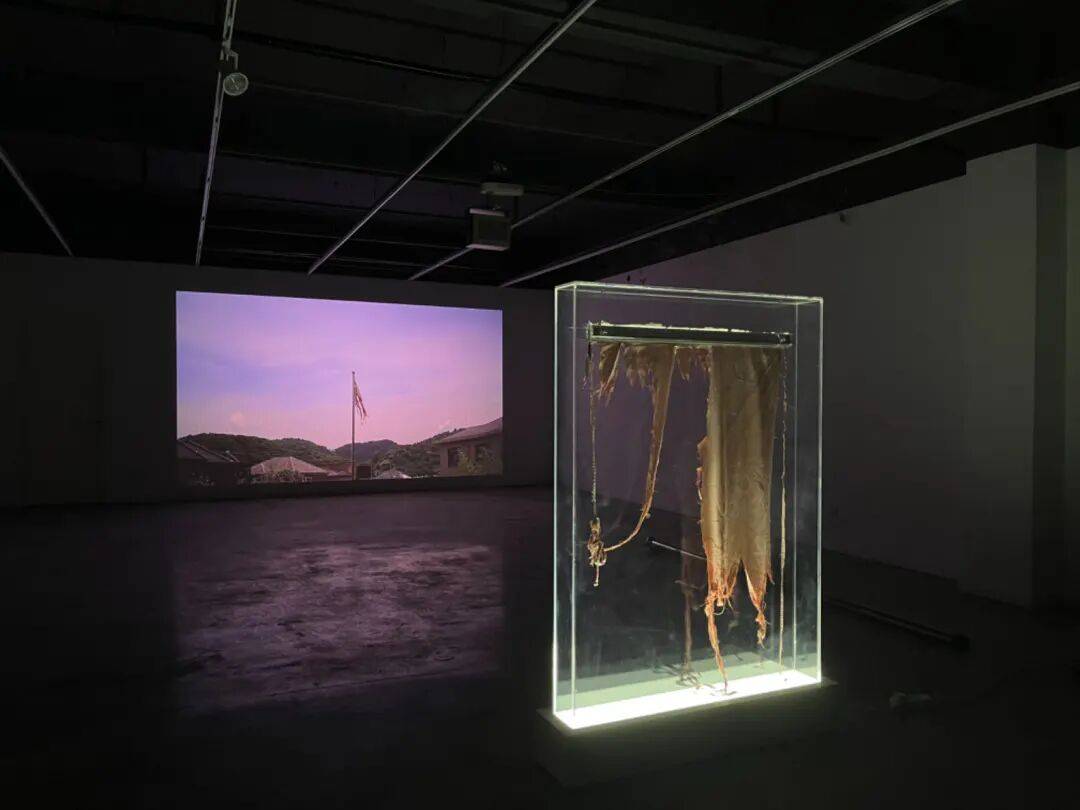
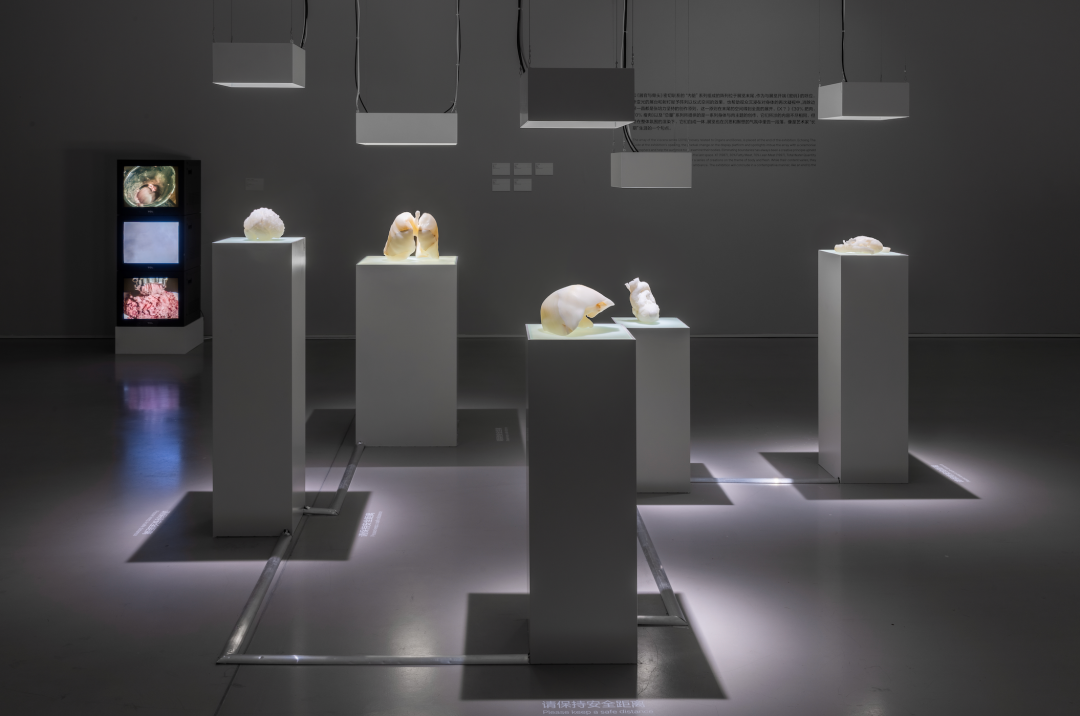
This entire series appears in the exhibition alongside the curtain installation On the Data of the Lungs, Gallbladder, Common Bile Duct, Arterial Blood Vessels, Pulmonary Arteries, and Pulmonary Nodules, produced by encoding and printing the data of Zhang’s own body. Together they stage a double existence: in reality, and on paper.
“I’ve always been curious about new possibilities. Both my father and mother worked in hospitals, so from childhood I was exposed to things like human anatomy. After finishing high school, I spent several years at the medical college where my father worked, drawing teaching diagrams for anatomy.” Zhang said that the process of making this “body organs” series also set off a cascade of thoughts.
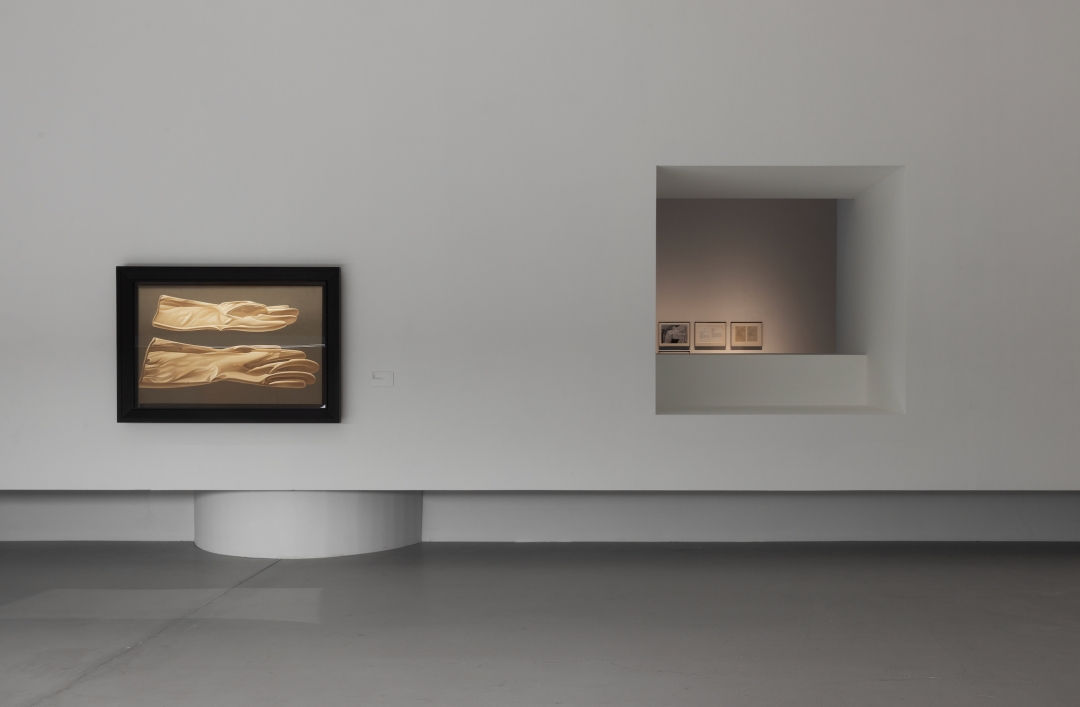
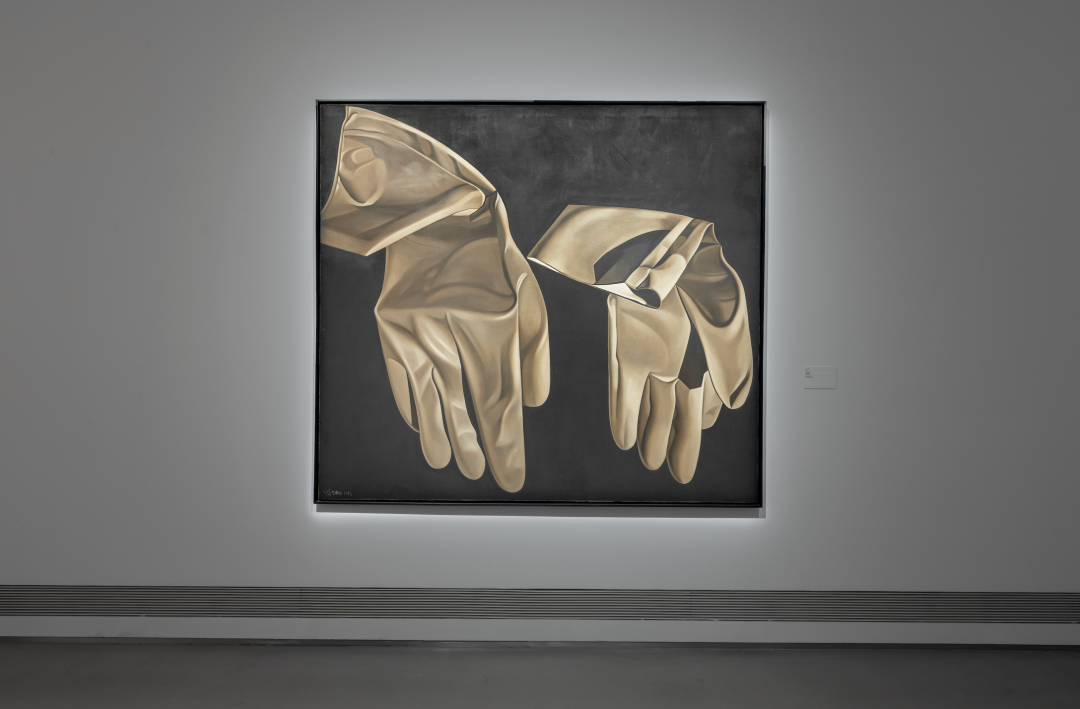
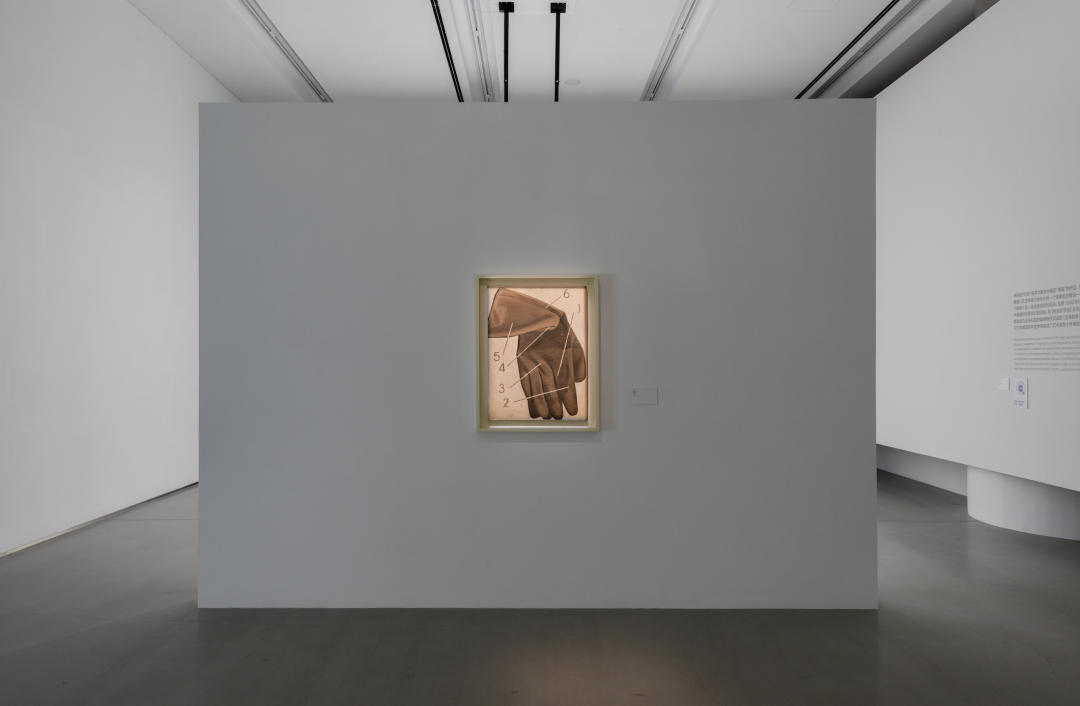
“When I see technology this advanced now, I think that if my parents had still been alive, and I could have scanned the data from one of their bones or from a heart and made a sculpture like this, maybe it would be a comfort to me now. But there is no ‘if.’ Ten or fifteen years earlier, the technology simply couldn’t do what it can do today.” After saying this, Zhang gave a slight twist of the mouth. Another work connected to his childhood memories of hospitals is his representative 1980s series X?, the “glove paintings.”
Many people assume that the image of the glove must have to do with the medical rubber gloves he often saw as a child. Zhang said that the original impulse is actually difficult to pin to any single concrete thing: it may be connected to hospitals, to the external environment, or even to social metaphor.
“I think a painting ought to be impossible to explain clearly. Viewers can look at it however they want, and they’d all be right. Painting isn’t retelling an experience; it’s giving you an experience.” Zhang originally planned to make one hundred different “glove paintings,” but in the end completed about a quarter of them. When we asked why he never finished the full hundred, he laughed with disarming candor and said, “It was too tiring. I couldn’t keep going. In the same format, too much repetition makes you tired yourself.”
Zhang Peili: Forty Years of Taking Himself Apart
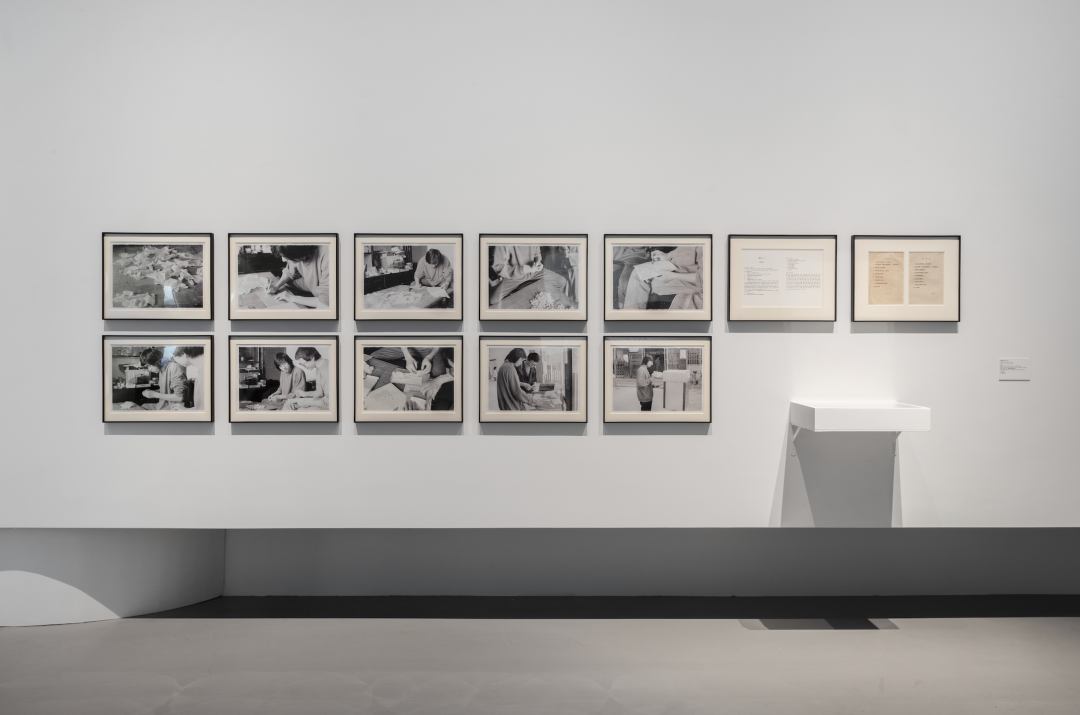
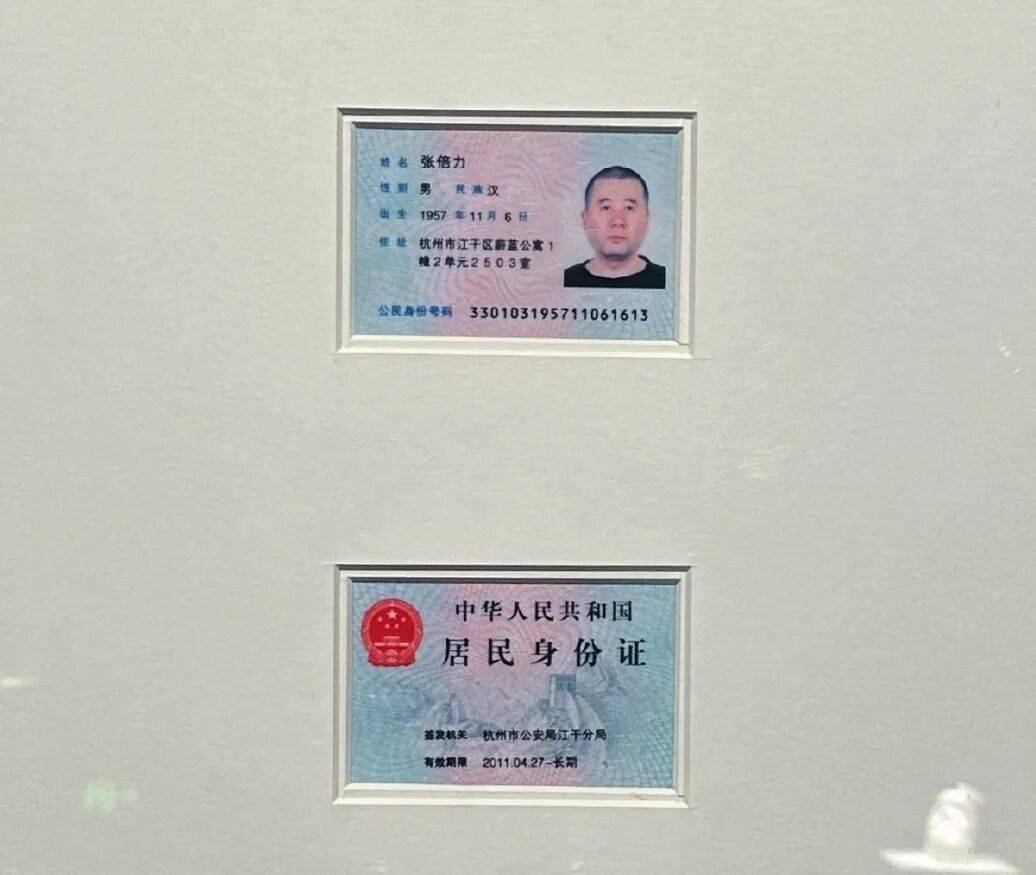
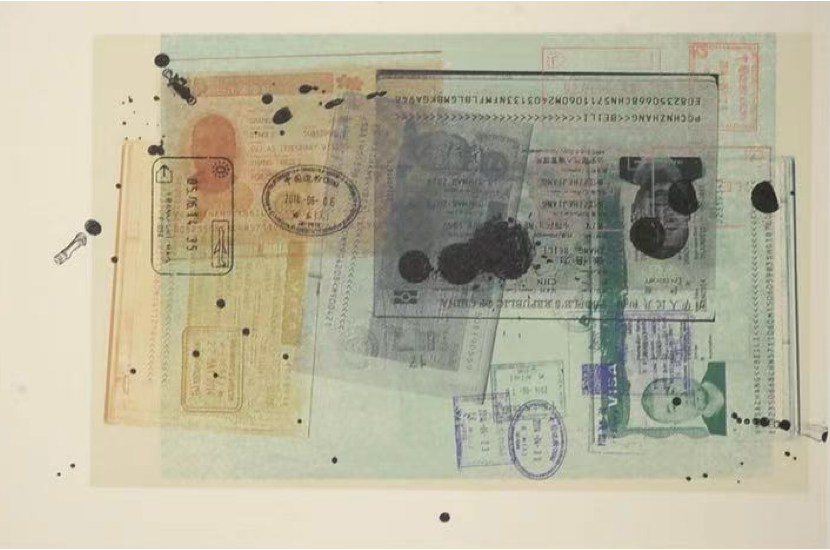
At the exhibition, viewers can see Zhang enlarging and boldly hanging his identity card, passport, and other documents on the museum walls, laying bare the key information that constitutes his social identity. For the artist, this is simply another way of exploring identity. It also reveals that the exhibition title, “2011.4.27—Long Term,” is in fact the validity period of Zhang Peili’s identity card.
The title prompts a knowing smile: plainspoken, direct, and bound to the artist’s identity.
“What does 2011—Long Term stand for?
“‘2011’ is definitely there because I lost my previous identity card, so I had no choice but to get a new one. And ‘Long Term’ means that by the time I got this card, I was already past a certain age. Younger people may need to renew theirs every ten years. When you get to a certain age, like me, the authorities decide there’s no need for you to change it again.” That was Zhang’s explanation. In fact, a person’s appearance can still change a great deal between sixty and eighty. Why, then, does society assume that old age means no further renewal is necessary?
SECTION 03 | Create something like ‘There is always a winner and a loser in a bet’
At first, many viewers assumed this was a small joke the artist was playing. In fact, “Beili” really is his legal name.
“My father actually gave me that name. It means ‘double the effort,’ and it has very much the atmosphere of the 1950s. When I was in elementary school, I don’t know who started it, but someone got my name wrong, and it became ‘Peili.’ Little by little, teachers and classmates all called me ‘Peili,’ and no one used my real name, ‘Beili,’ anymore.” Zhang said that the mistaken name lasted so long partly because, when he was young, the elders in his family called him by his nickname in their hometown dialect, ‘beibei,’ and in that pronunciation you couldn’t really hear the difference between ‘Pei’ and ‘Bei.’
We asked whether, after so many years of being called by the wrong name, he had ever thought of changing it. Zhang smiled and explained, “Of course I did. I even brought it up with my father at the time, but he didn’t seem very happy about it, so the matter was dropped.” Seen now, the confusion helped produce, in this work, a discussion of misreading and multiplicity within human “identity.” From our conversation it was easy to see that, although Zhang’s work is often avant-garde, hard-edged, profound, even destructive and violent, he himself is inwardly soft and sensitive, and when something moves him, he often pauses.
Those pauses struck us as an exactly right kind of blank space. The style of his speech may share a basic logic with the way he makes art. For forty years, his work has never been a fully spelled-out story; it stops at the point of suggestion and leaves room for interpretation. Many people have asked Zhang how a particular work ought to be explained.
Zhang was frank: “I can’t explain it completely myself, and I don’t expect anyone else to arrive at a wholly complete explanation either. I don’t think it’s necessary. Viewers can see it however they want.” Early in his career, in the 1980s, he made a large number of paintings. By the early 1990s, painting alternated with photography, video, mixed-material installation, and performance. By the late 1990s, painting had basically disappeared from his practice.
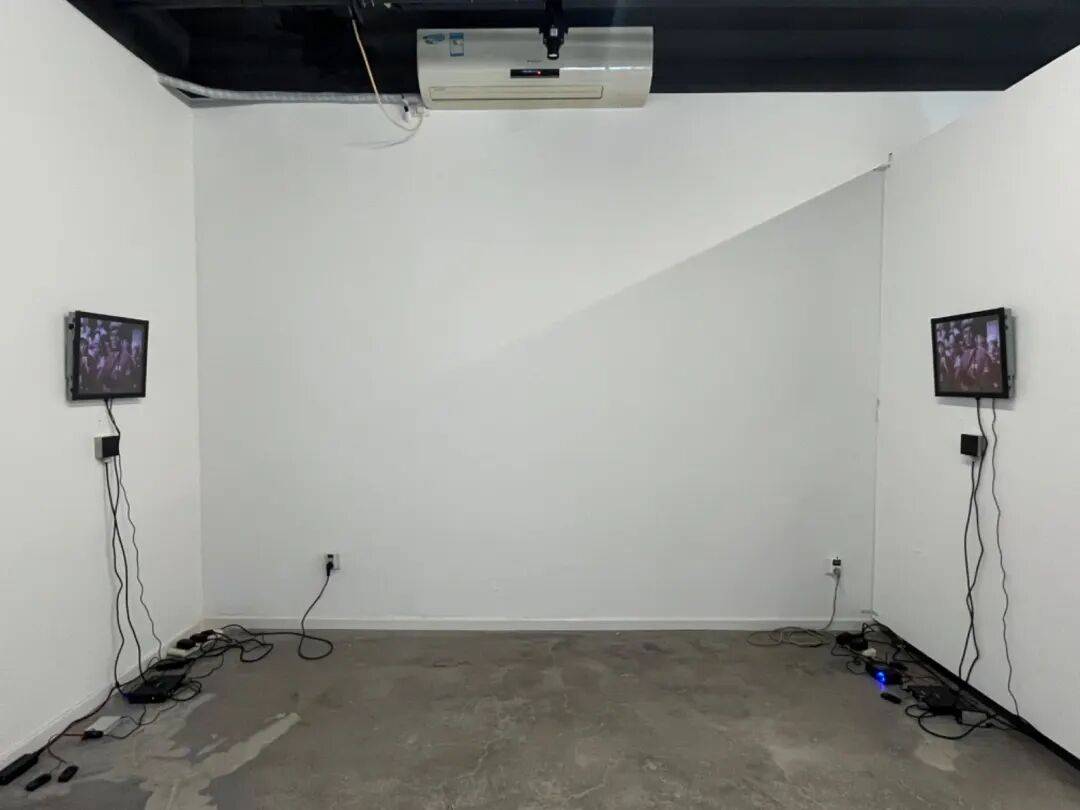
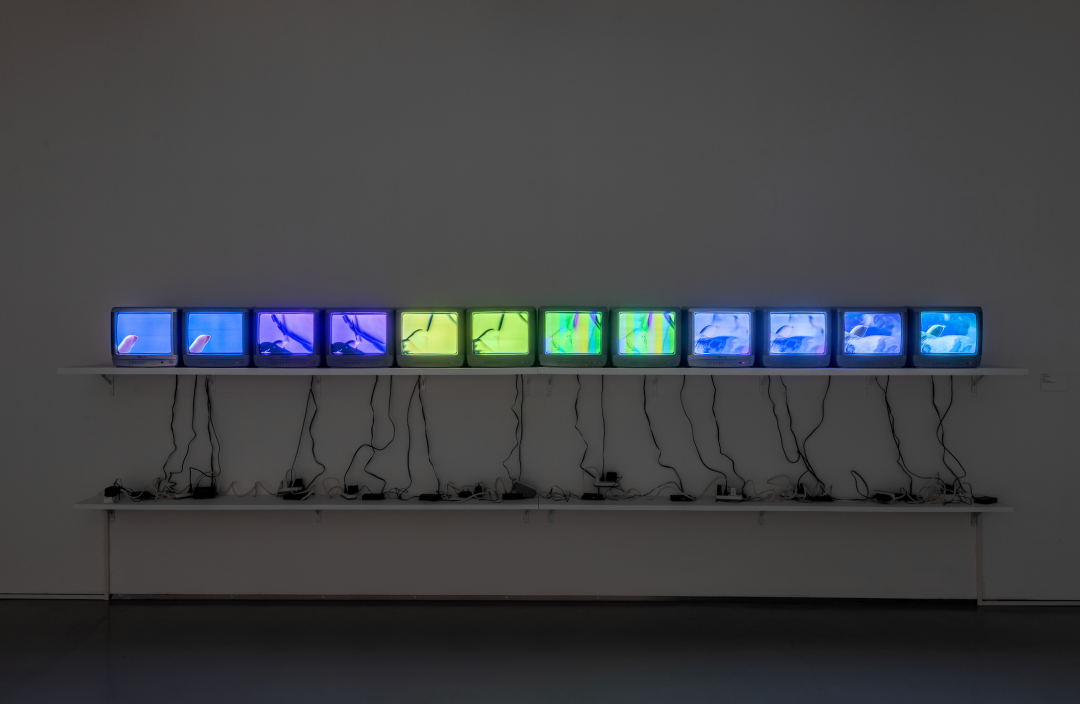
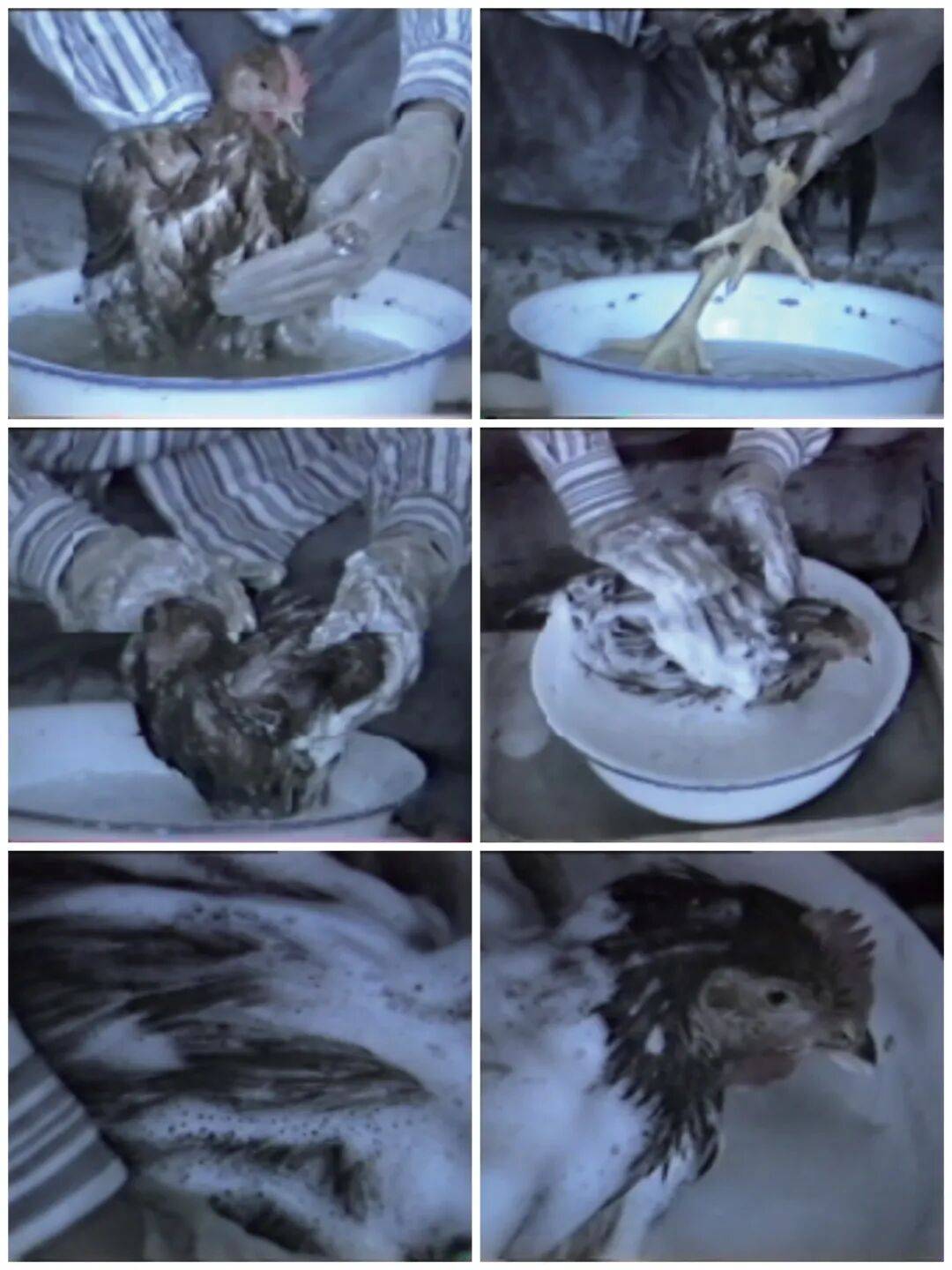
One of the best-known video works in the exhibition is Zhang Peili’s 1988 piece 30×30. Here, the image of the glove appears again. Wearing rubber gloves, Zhang smashes a mirror measuring 30 cm by 30 cm, glues it back together with 502 adhesive, smashes it again, glues it again, and repeats the cycle for 180 minutes. Zhang might prefer to call the work a “social experiment”: it tests the limits of viewers’ patience and challenges their sense of where the boundaries of art lie.
In the 1990s, Zhang produced a considerable number of video works that often landed heavy blows within the art world, earning him the widely recognized title of “the father of Chinese video art.” Among them is Zhang Peili, (Wei) Character No. 3, 1991. By the late 1990s and early 2000, he had stopped filming footage himself and gradually turned instead to found images, including old movies, which he recombined and reset. His enduring attachment to the moving image also grew out of the visual experience of loving old films as a child.
“When I was little, I was always staying at home because I wasn’t in good health, so I got to like them. There wasn’t really any reason. It’s like liking a person. If you really like someone, there’s no reason for it. It’s only when you don’t like someone that you need all sorts of reasons: too short, too ugly, family has no money, those are all reasons.” From 2010 to the present, technological change has allowed his works to become larger in scale, and he has begun combining video with mechanical installations and other mixed media.
A case in point is Deadline, a project he did in June of this year at Chi She, four days before all the galleries at Shanghai’s West Bund were required to move out. At first, he had hoped to use an installation of blue oxygen cylinders to blast through a wall with one final thunderous crash, marking the end of the West Bund art enclave after ten years, but in the end he was unable to achieve the effect he wanted. The exhibition site was Chi She, Deadline, 2024, photograph by Zhang Hong.
“All of that is painful, and it’s also the greatest pleasure in my work. It’s like someone walking into a casino: he can win, but he can also lose. Some ideas can be realized. Some ideas can’t be made to happen no matter how hard you try.” Returning to “2011.4.27—Long Term,” it seemed to us that the artist’s thread of “identity” had already been rendered very complete.
He himself, though, still felt there were regrets.
“The original plan was actually to borrow some of my works from M+ in Hong Kong, but that didn’t work out in the end.
“There’s another work, too: a painting I made in 1987 of two white dental treatment chairs. I truly, especially hoped to show that one, but it’s in the hands of an American collector, and I haven’t been able to reach him.” The work is Zhang Peili, X?-Dental Treatment Chair, 1987. In the late 1980s, the Zhejiang Academy of Fine Arts, now the China Academy of Art, held an invitational oil-painting exhibition. As soon as this painting was shown there, it was bought by an American collector, and Zhang has never seen the work again.
“You have to understand, artists always remain haunted by the works they’re satisfied with. I’ve been thinking about it for so many years,” Zhang said with a sigh. At the end of our conversation, he mentioned that he was meeting friends that evening, and we casually asked about the artistic atmosphere in Hangzhou.
“I think the intimate exchanges among artists in Hangzhou are like that group of artists on the heights of Montmartre in Paris in the 20th century. People eat, drink, and talk about everything under the sun. In Beijing and in Shanghai, that’s already much rarer. But I’ve always felt that this is what the growth of art ought to look like.”