A beautiful boy with a muscular body and a child’s face, a boxer with bulging veins, a voluptuous sofa: at first glance, Shang Liang’s works seem full of contradictions and charged with force. Look closer, and these exaggerated, transformed figures echo both the young, powerful athletes of ancient Greek sculpture and the idealized idols shaped by today’s entertainment industry—as if they were images of the “posthuman” our era is on the verge of producing......
By / Xirui Huang · 9 min read
Why does Shang Liang combine exaggerated muscles with youthful faces?
Published in 2023, Xirui Huang’s interview explores Shang Liang’s 2022 works shown at Cc Foundation. Exaggerated muscles, youthful faces and soft colours create tensions between strength and vulnerability. Series such as Good Hunter connect classical bodies with contemporary idols and science-fiction imagery, considering how bodies become symbols and why ideals of perfection, youth and renewed identity persist.
Shang Liang: The 'Post-Human' of Muscle Men
A beautiful boy with a muscular body and a child’s face, a boxer with bulging veins, a voluptuous sofa: at first glance, Shang Liang’s works seem full of contradictions and charged with force. Look closer, and these exaggerated, transformed figures echo both the young, powerful athletes of ancient Greek sculpture and the idealized idols shaped by today’s entertainment industry—as if they were images of the “posthuman” our era is on the verge of producing. Shang Liang, the artist behind these new “hard men,” is a female artist born in the 1980s. She graduated from the Oil Painting Department and the School of Experimental Art at the Central Academy of Fine Arts. Her new works from 2022 are on view at the Cc Foundation & Art Center in Shanghai.
“Shang Liang: Newcomers,” exhibition view, Cc Foundation & Art Center, 2022. The solo exhibition “Newcomers” is Shang Liang’s summation of her work over the past year. 2022 was a prolific year for her: alongside continuing “Good Hunter,” a series with a ten-year history, she developed a new series, “My Divided Self.” Exaggerated muscle lines and dreamy, gentle colors create contrasts throughout. At the beginning of the exhibition, we spoke with Shang Liang about the new work and the path that led her to it.
SECTION 01 | Muscular man with leather and metal shell "skin"
Facing one hulking man after another, she recalled how illustrations of human tissue in her childhood medical books first opened her eyes, and spoke about the shifting meanings of the body and gender in contemporary culture. Why create so many “new new humans” who embody strength and beauty while carrying on the classical spirit? Shang Liang urged us to return to art’s earliest beginnings: “Art is a struggle against the desire to preserve perfection and youth forever, against the ultimate questions of life.”
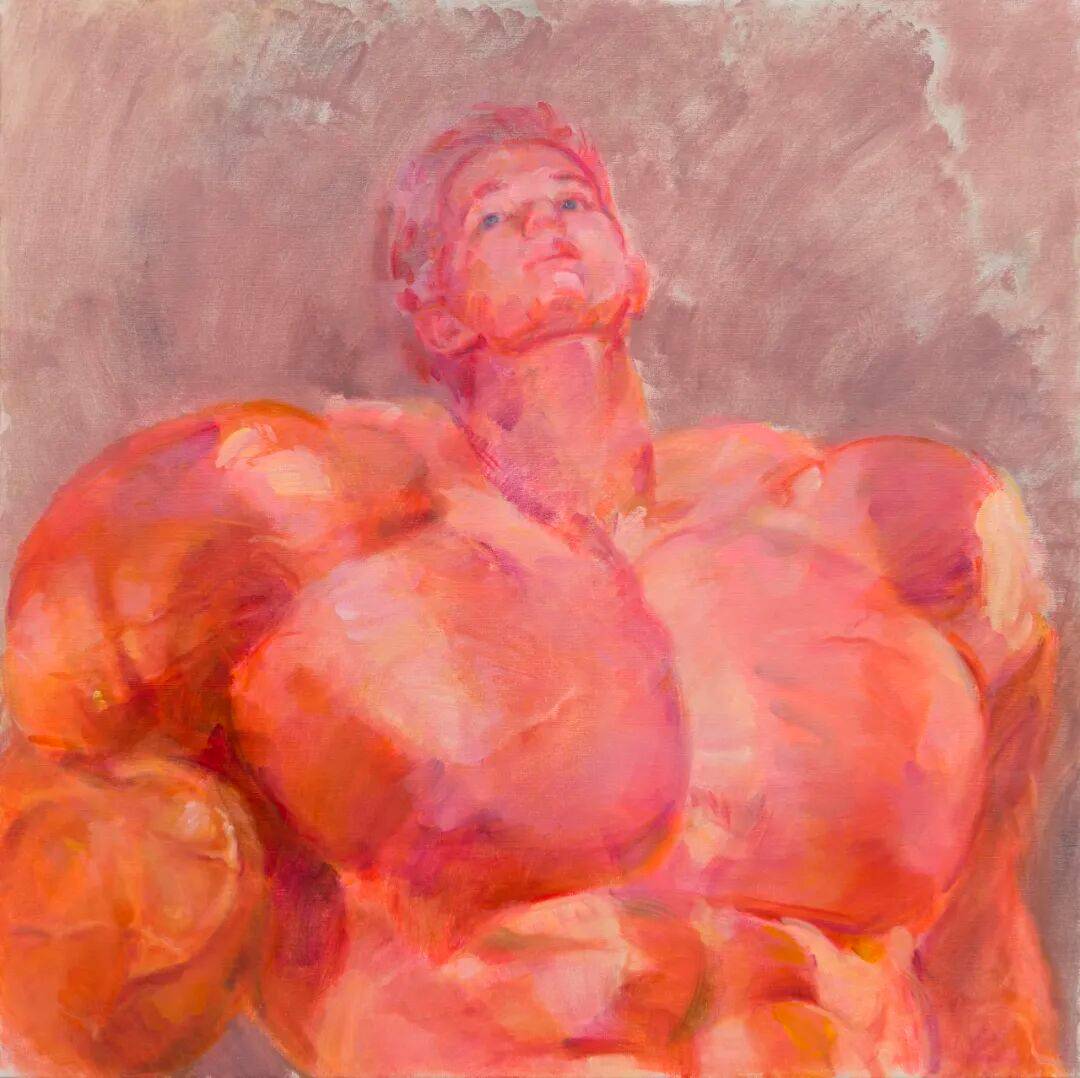
“Shang Liang: Newcomers,” exhibition view, Cc Foundation & Art Center, 2022. Shang Liang, Good Hunter—Copy No. 3, 2022. As soon as we entered the exhibition, we saw a “Good Hunter” lying suspended in midair. Against a purplish-red canvas, his young, handsome face was blurred; his head was grotesquely large in proportion to his body, and the muscles and veins across his torso stood out. His hands had been rendered as pistols, as if he were ready to leap up and fire at any moment, answering the series title, “Good Hunter.”
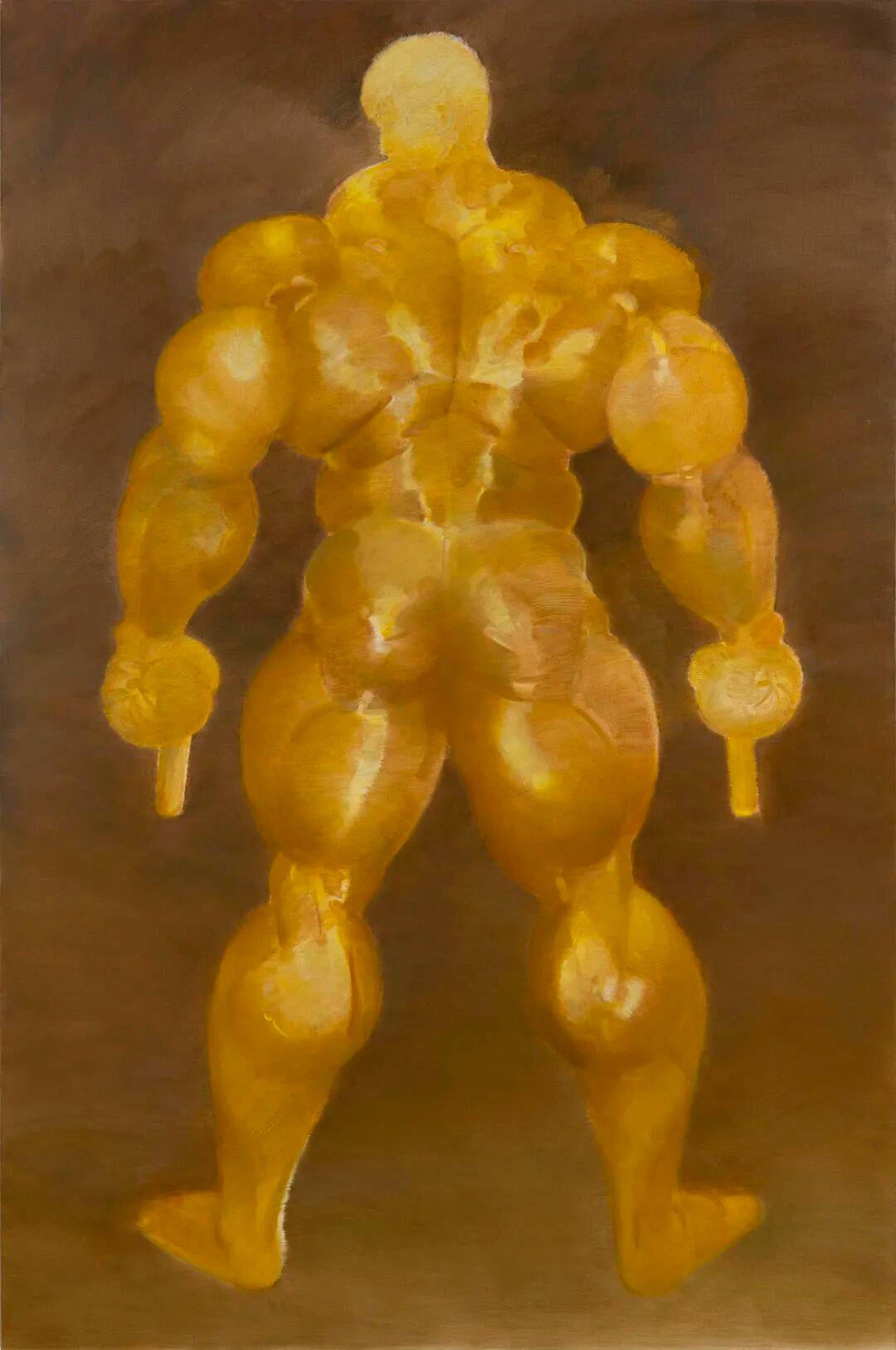
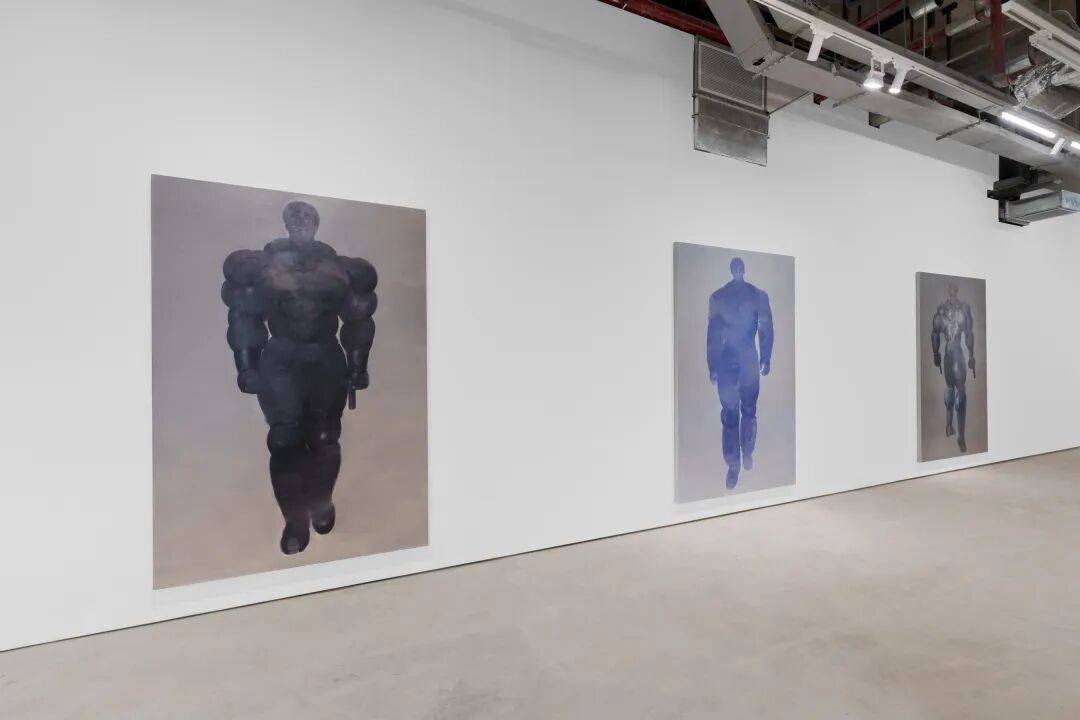
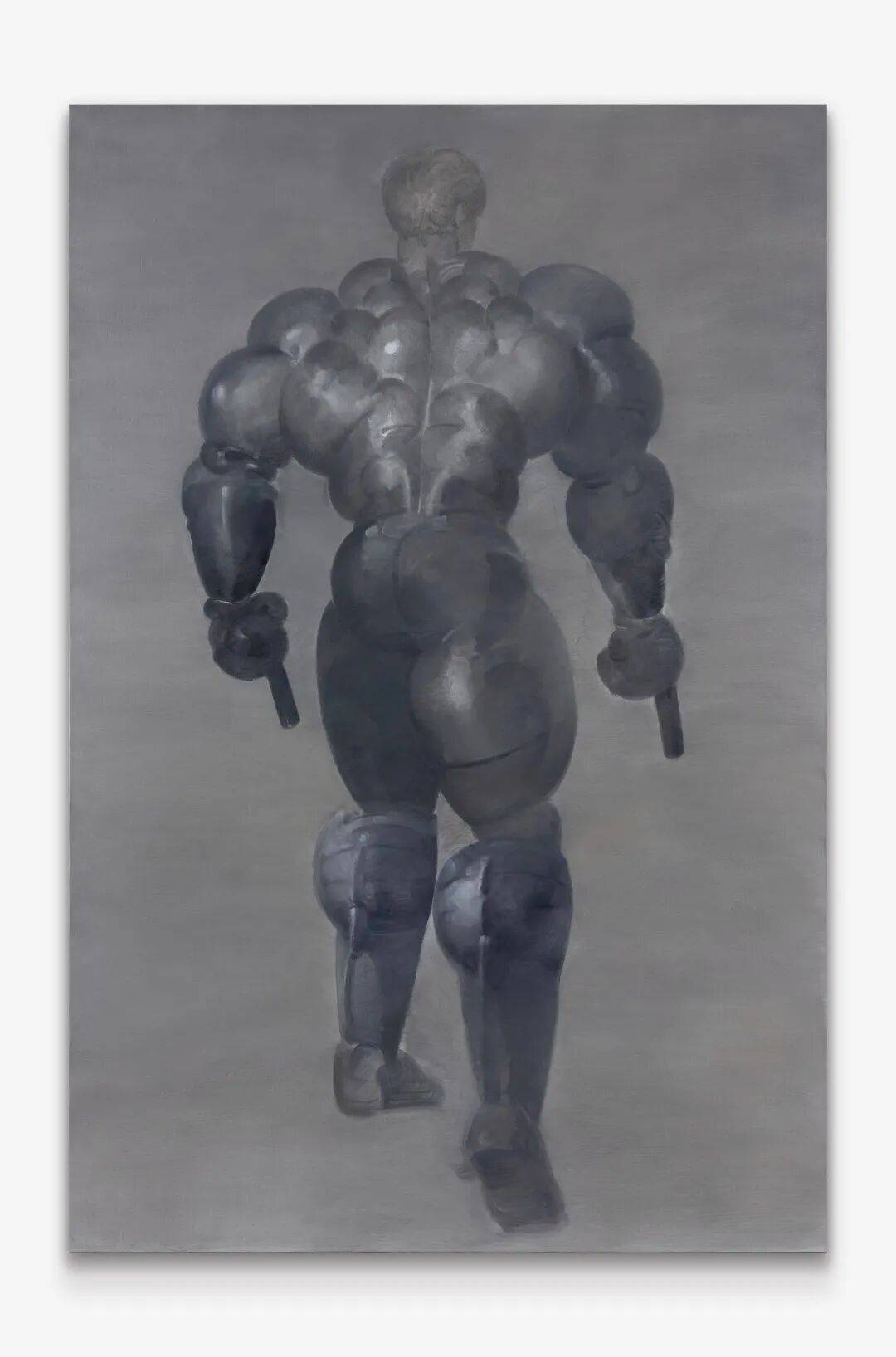
Shang Liang, Good Hunter—Copy No. 3 (detail), 2022. The excessively enlarged muscles and blood vessels, rendered in pale pink and pale yellow, do not appear jarring. Instead, they feel strange and new. Shang Liang, Good Hunter No. 17, 2022. Farther inside, the black “Good Hunter” has grown leatherlike tissue and donned machinery. Shang Liang, Good Hunter No. 20, 2022. Another figure, glittering in gold, stands with his back to the viewer, the lines of his back resembling armor cast in gold.
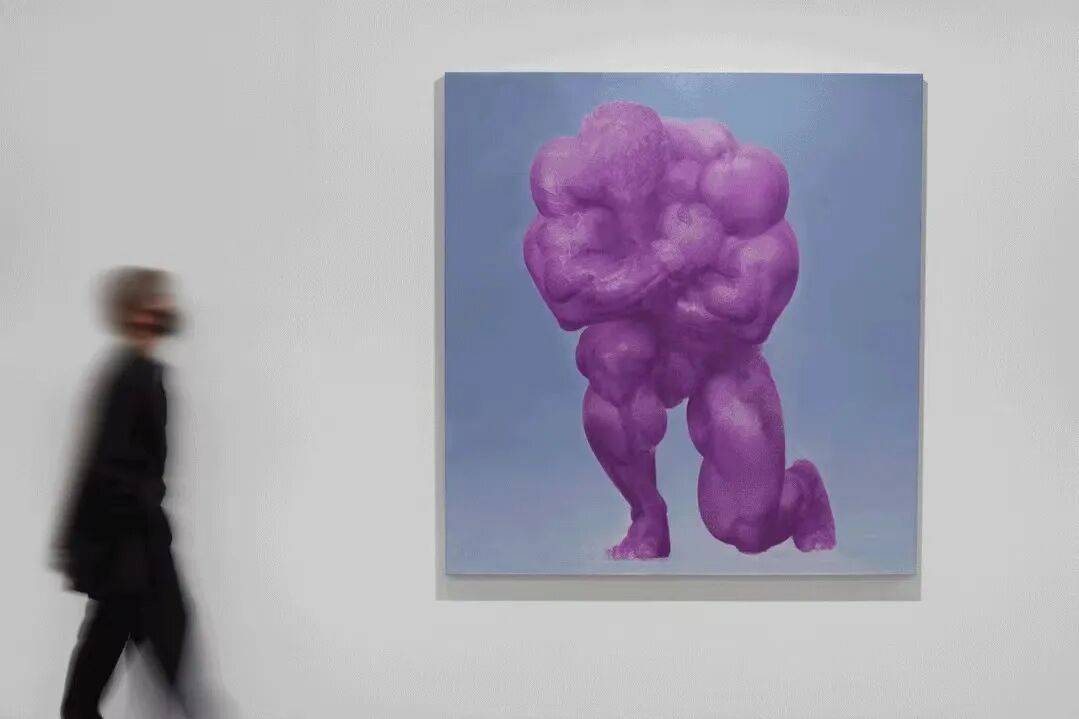
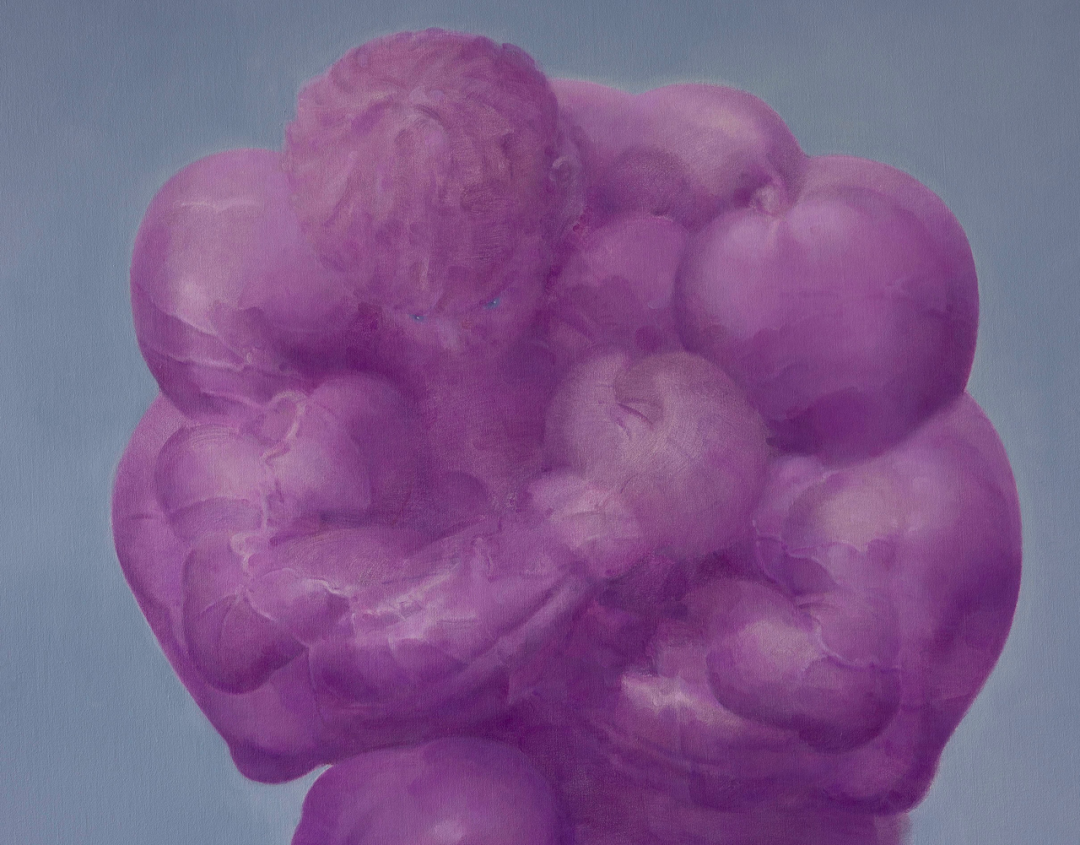
Shang Liang, Good Hunter—Copy No. 1, 2022. Shang Liang, Good Hunter—Copy No. 1 (detail), 2022. Among these new works, Good Hunter—Copy No. 1 was the first the artist completed. The figure’s purple body floats against a gray-blue background, its pair of blue eyes startlingly bright. She chose purple because it suggests depth and ambiguity, and looks like “a color with a sense of ritual.”
Shang Liang, Good Hunter—Copy No. 2, 2022. The figure in Good Hunter—Copy No. 2 is shown in a rare crouching pose, as if it might be awakened at any moment and burst out of the picture in the next.
“Shang Liang: Newcomers,” exhibition view, Cc Foundation & Art Center, 2022. “Good Hunter” occupies most of the exhibition. The monumental paintings make us feel as though we have entered a formation of giants.
“Every figure in the exhibition is a block of energy. They are like beings actively changing their skin, changing roles,” Shang Liang said. The word “copy” in the titles, she explained, has two sources: an inspiration drawn from the “replicants” of science-fiction and superhero films, and her desire to ask why human beings gradually become symbols. Shang Liang, Good Hunter No. 18, 2022. Although we now advocate a diversity of aesthetic ideals, the beauty most people pursue tends to look very similar.
“When people see the figures in my paintings, they may feel that he isn’t any particular person but a symbolized collective. It’s like the superhero films we’ve seen, with so many images of perfect heroes. In the end, perhaps all we vaguely remember is an inverted triangle, a muscular body…” The ungendered muscular figures Shang Liang paints are the remaking of the human body by a culture that is constantly evolving—“posthumans” that may one day exist within our own imagination.
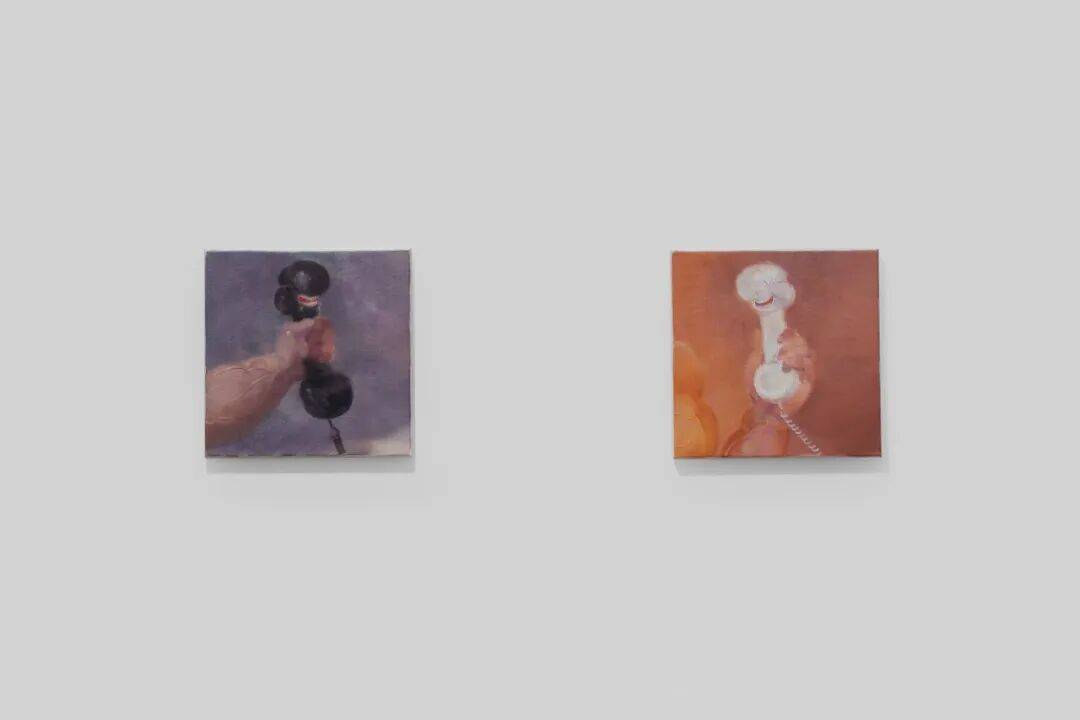
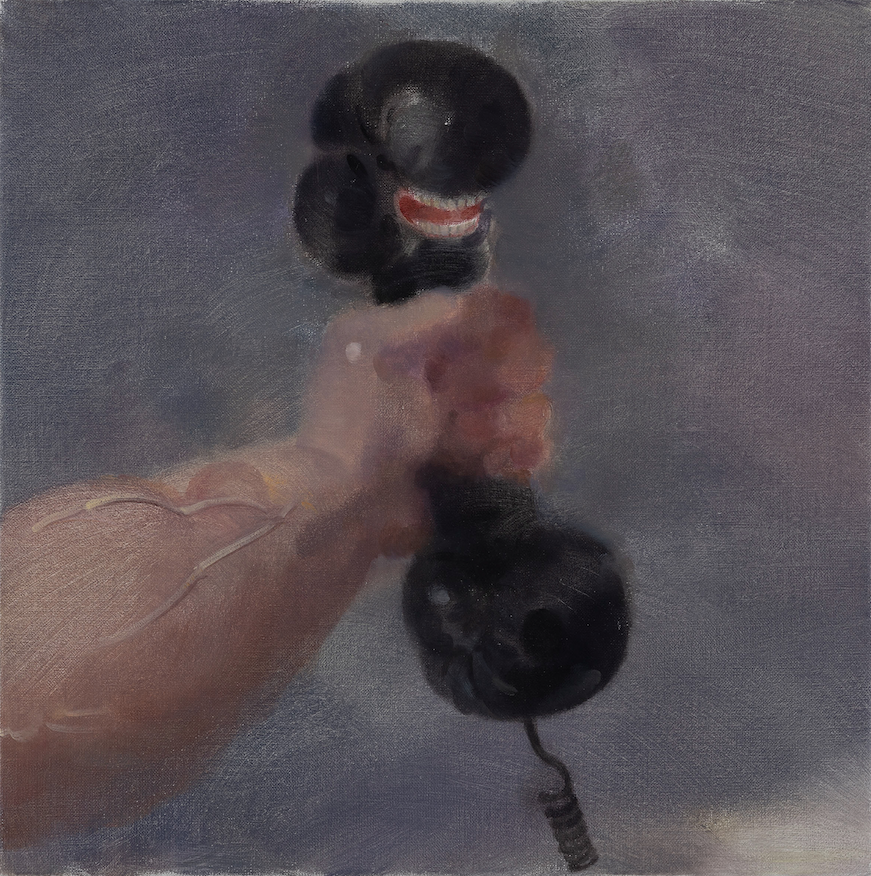
“My Divided Self” series. “Shang Liang: Newcomers,” exhibition view, Cc Foundation & Art Center, 2022. In this exhibition, a wholly new series, “My Divided Self,” features two black-and-white telephones that seem suddenly ready to play a prank, transforming into the “Boxer” figures the artist had painted earlier. Black and white are locked in opposition. Unlike the earlier “Boxers,” these figures have grown teeth, shifting from cute and harmless to aggressive. Shang Liang, My Divided Self No. 1, 2022. “I called it ‘My Divided Self’ to suggest a state of unknowability.”
“It’s unclear whether these two receivers are answering a call or transmitting one, and unclear who is at either end. Once an inorganic object acquires life, it becomes an extension of the body. Another ‘self’ can split off from it, and the ‘self’ also remains in every object that bears its traces,” Shang Liang said. Shang Liang’s studio, with a work in progress. In each of her series, the part of the male body that is most emphasized is the musculature. But she is not trying to attract attention deliberately. The original impulse is simple: muscle represents energy and power.
In 2018, she created the first group of works in the “Good Hunter” series, an important series in her career. Shang Liang, Good Hunter No. 11, 2019. The protagonist of “Good Hunter” has the face of a boy on the cusp of adolescence, attached to a constantly changing, heavily muscled torso—like a boy-band “pretty boy” paired with the body of the action star Dwayne “The Rock” Johnson, incongruous but faintly comic. The artist told us that she chose boys of this age because they represent fluidity and uncertainty.
“The faces of adolescent boys are always changing, and their bodies are still developing and growing. They seem to be in a period of transformation, without a fixed form. I’m very interested in exploring that uncertainty.” Her exaggerated treatment of the body is also an inward-looking response to the excessive consumption of young idols within today’s mainstream values. Shang Liang, Good Hunter No. 19, 2022. The 2022 version of “Good Hunter” in this exhibition differs from its predecessors in one important respect.
SECTION 02 | The characters in my paintings will "evolve" independently
He is no longer entirely flesh and blood.
“The figures I paint evolve, too. They become increasingly greedy, growing machinery and leather goods on their bodies, completing a union of people and objects—or even an externalization of fetishism,” Shang Liang explained. This brings to mind the fetishism produced by consumerism in contemporary society, and the desire for decorative objects to grow directly onto the body, as though that were the only way to become a complete self. Shang Liang, Straight Shooter No. 1, 2016. The predecessor to “Good Hunter” was the “Straight Shooter” series, which began in 2012.
At that time, Shang Liang began to focus on the emotional ethics between people and on individual self-examination. This expression needed a vehicle that could be detached from the self, so she began with isolated parts of the human body and created Straight Shooter No. 1.
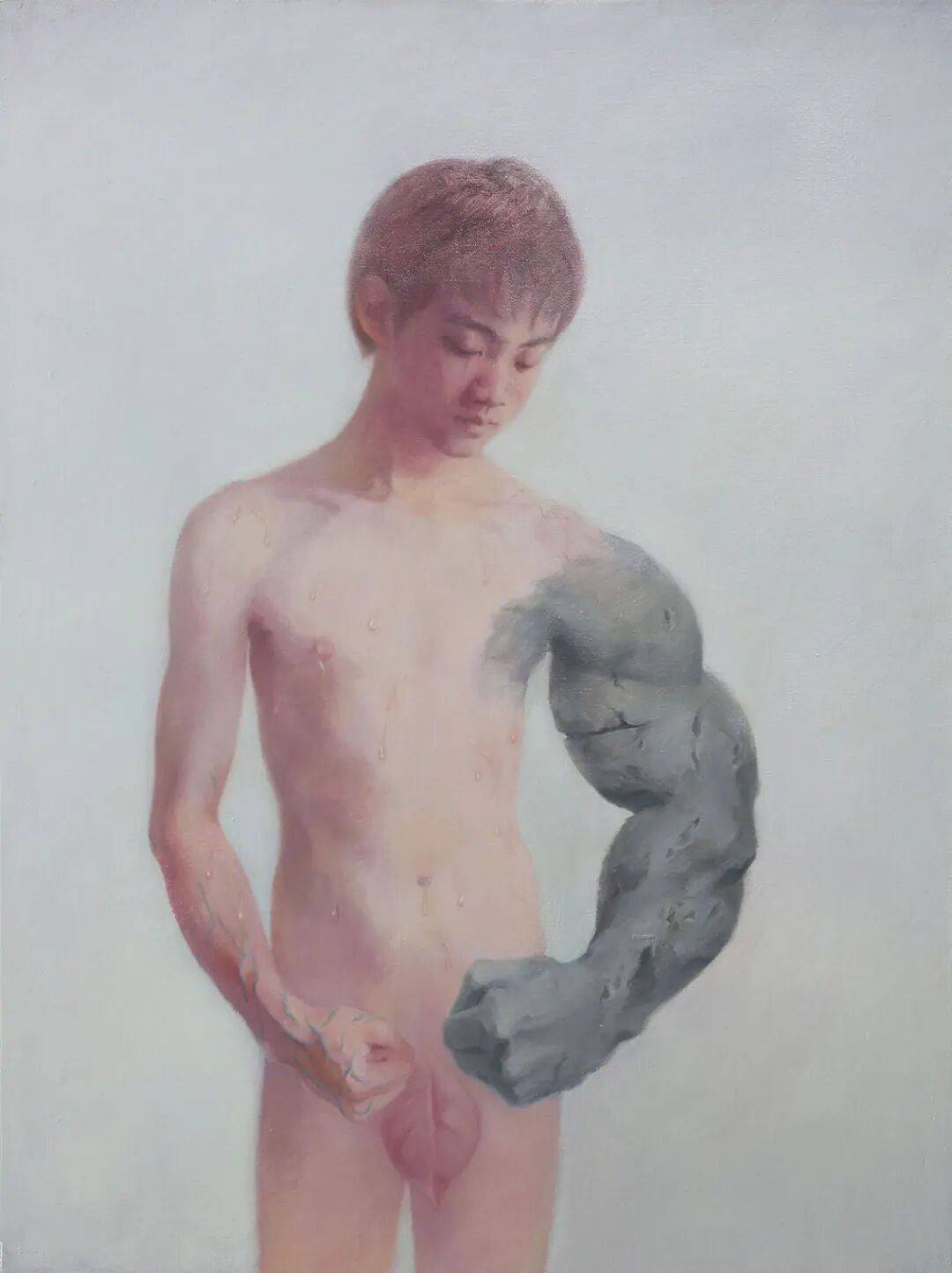
The figures in the “Straight Shooter” series have one conspicuous feature: parts of their bodies are transformed. In the first “Straight Shooter,” for example, the figure’s arm becomes a powerful stone, while the rest of the body remains thin. Left: Shang Liang, Straight Shooter No. 20, 2016. Right: Shang Liang, Straight Shooter No. 19, 2016. Shang Liang, Straight Shooter No. 25, 2016. In later metamorphoses, some figures grow very long Pinocchio noses, which can be used to alter any part of the body, making it large and full.
“The nose symbolizes self-deceiving lies. He wants to prove himself, to change himself through some kind of fantasy,” Shang Liang said of the early “Straight Shooter” personality. At this stage, the figures’ faces were also more childlike. By 2018, Shang Liang felt that the personality of “Straight Shooter” had grown up, and that the body had become more and more proportionate. “Straight Shooter” came to an end, and “Good Hunter” evolved from it. Shang Liang, Sofa Man No. 6, 2020. “Shang Liang: Newcomers,” exhibition view, Cc Foundation & Art Center, 2022. Alongside painting, some of the “transformed people” gradually evolved into installations and sculptures.
The most representative is the “Sofa Man” series. In the atrium of this new exhibition stood an unusual sofa, actually formed by two entirely black, faceless muscular men sitting side by side. For Shang Liang, “Sofa Man” examines the relationship between people and objects, as well as the objectification of people. Shang Liang’s work at the group exhibition “play,” 2018. “‘Sofa Man’ is a person confined within the role of the sofa. At the same time, the sofa was originally invented to meet human needs.
“Take the smartphone we can least do without. It has begun to control and imprison us in return,” Shang Liang said. Although her paintings have generally preceded her sculptures, the experience of making sculpture has fed back into her painting, making the figures’ forms more precise and more three-dimensional. Shang Liang, Boxer No. 12, 2019. Shang Liang: “The Commoner at the Helm,” exhibition view, MadeIn Gallery, Shanghai, 2021. With “Boxer,” the figures appear somewhat more cartoonlike. The head is no longer a face but resembles a boxing glove; the legs grow directly from beneath it, while the hands and feet are joined to the body as boxing gloves.
Their poised, ready-to-strike forms seem about to attack, yet also seem to be taking part in a game.
“Everything we see in life now seems to operate according to all kinds of rules for games. Boxing is a particularly representative form of game-like combat. It is highly destructive, but because the athletes wear gloves, it seems to have another layer between it and us.”
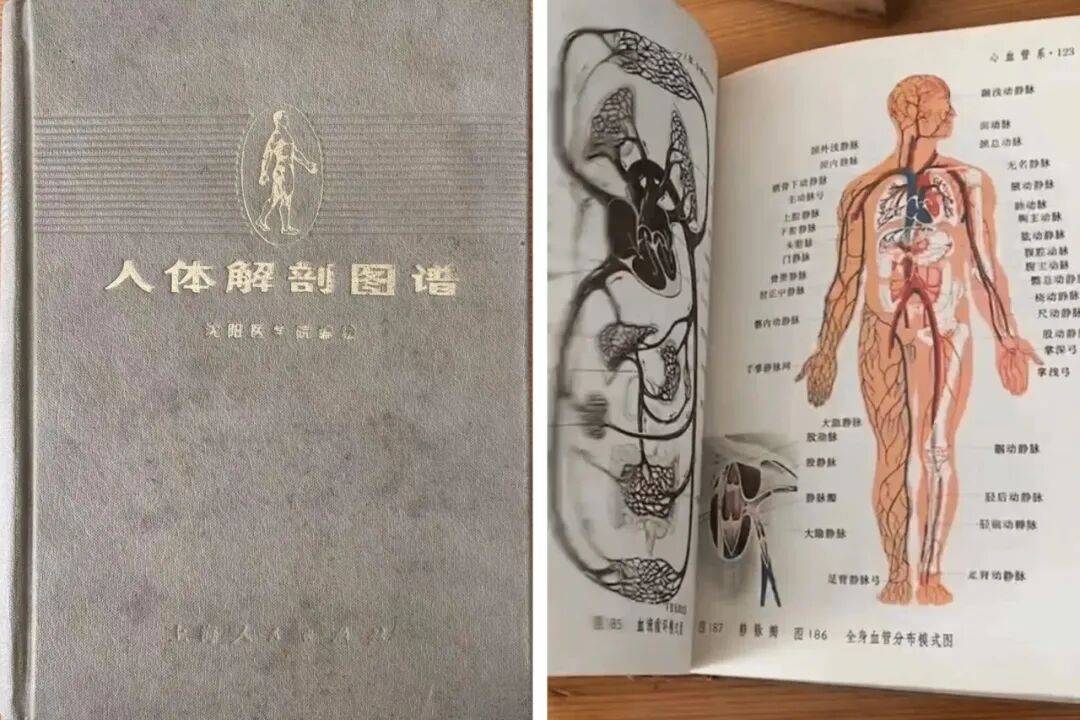
“‘Boxer’ is a relatively aggressive assemblage. It isn’t only the brain that thinks; the entire body is the subject, and the entire body can enter a state of thought,” the artist said. The figures in Shang Liang’s work are often covered with finely rendered muscle tissue and capillaries. The earliest influence on this imagery came from the medical books in her home. Shang Liang’s copy of Atlas of Human Anatomy, which she often leafed through as a child, was also an early source of inspiration. “My mother was a head nurse. When I was still in elementary school, I especially loved looking through the thick medical texts at home.
“How the human body is constructed, how the capillaries and muscles are organized, and the colors associated with the body—red, yellow, pink, and so on—all these childhood memories continue to influence me,” Shang Liang said. A native of Beijing, Shang Liang grew up with a father who was a mechanical engineer and a maternal grandfather who was a construction engineer. Drawings and blueprints were everywhere in the house, and she often saw her elders sketching and drafting with pencils.
“I always thought their work was creative, and they were always happy to sit with me and draw. As a child, I was allowed not to begin learning to write right away. Instead, from the age of three, I freely expressed myself through drawing,” Shang Liang said with a laugh. Shang Liang in her studio, painting a 2022 work from the “Good Hunter—Copy” series. As a child, she was fascinated by characters on television and liked to draw them all. Sometimes she would rewrite their story lines by creating fan fiction in the form of comic strips.
Shang Liang’s enthusiasm for “making up stories” continued from childhood into adulthood. During university, she became deeply interested in moving images for a time—writing scripts and making independent theater—and “really considered switching into the film industry.” Shang Liang, Good Hunter No. 9, 2019. She eventually returned to painting because she felt that drawing, which had accompanied her from childhood onward, was the medium closest to her, and that the brush was the form of expression she knew best.
After graduating with a bachelor’s degree from the Oil Painting Department at the Central Academy of Fine Arts, she essentially decided to become a professional artist. Asked about the influence of nearly 10 years of academic training—from the affiliated high school of the Central Academy of Fine Arts through her master’s degree—the artist said that she had built a solid foundation and strong painting skills during that time, giving her greater freedom in her work. Technically, many ideas could be realized without limitation.
SECTION 03 | From drawing comics to becoming a mature artist
“As an artist, you have to keep encountering things in the outside world, and keep studying them in depth, so that you remain permanently sensitive and fresh.” A hand used to help shape works in Shang Liang’s studio. In her work, Shang Liang considers herself a perfectionist; in life, she is particularly simple. Creative blocks inevitably arise, but her state of mind remains calm—perhaps she will look at something else, relax, and then set out again.
More important, she keeps working, thinking, and reflecting, ensuring a continuing capacity for invention.