Three Exhibitions in Beijing, London, and Changsha: Why Julian Opie’s Urban Figures Have Taken the World by Storm
Julian Opie, the British artist whose witty, spare human figures have become globally recognizable, has been unusually busy: a Beijing exhibition was still on view when a new show opened in London, and last weekend he flew to Hunan to visit his solo exhibition in Changsha. At sixty-four, he seems remarkably at ease, both in and outside the studio......
By / Xirui Huang · 12 min read
Why does Julian Opie bring public signs and everyday gestures into art?
In Xirui Huang’s 2023 interview, Julian Opie recalls how simplified figures in public signage helped him develop a way to describe people. He draws on the gestures of friends, dancers and ordinary passers-by, retaining recognisable outlines while reducing detail. Painting, sculpture, LED and VR place these figures in different settings. The emphasis extends from faces to bodily movement and the relationship between people and urban life.
Julian Opie, the British artist whose witty, spare human figures have become globally recognizable, has been unusually busy. His exhibition at Lisson Gallery in Beijing was still on view when a new show opened in London, and last weekend he flew to Hunan to visit his solo exhibition in Changsha. At sixty-four, the artist seems remarkably at ease, both in and outside the studio.
Artist | Julian Opie: Figures in Simple Lines
“Every morning I cycle to the studio. The round trip takes about an hour. I’ve been doing this for several years, and I take the same route every day,” Opie says. Installation view of Julian Opie’s recent exhibition. Opie is known for his sharp observations of urban people. His spare figures appear across paintings, sculpture, advertising posters, LED screens, record covers, and large-scale public art. After more than thirty years of working, he shows no sign of aging creatively. Recently, he combined dancing figures with TikTok and the electronic-dance-music style of the early 2000s, using LEDs to create a striking juxtaposition of elements from different eras.
This March, Opie’s new exhibition in London was equally ambitious. He presented the first VR exhibition in Lisson Gallery’s history, allowing visitors to experience the work in all dimensions through Bluetooth headphones. We recently spoke with Opie about his work on “people.” Julian Opie’s spare self-portrait. Opie was born in London, England, in 1958. As a boy, he lived for a time in Oxford. From his teens onward, he drew with pencils and watercolors. For him, describing the world through lines was a natural and satisfying process.
SECTION 01 | Over 30 Years of Sketching Urbanites
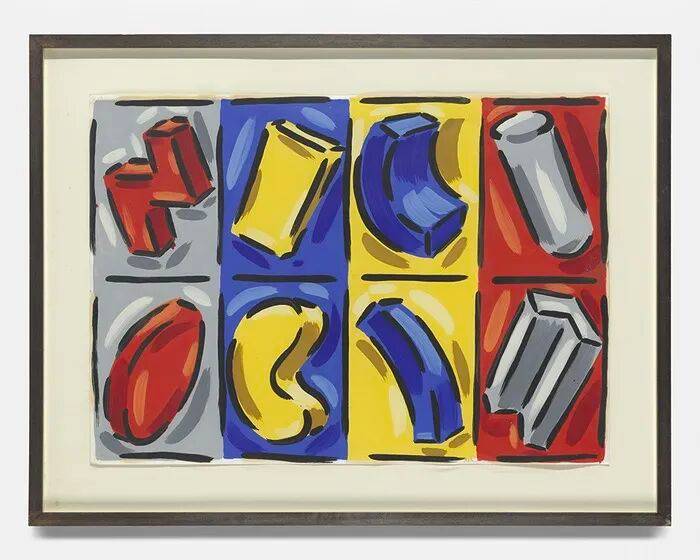
Julian Opie, Abstract composition 1, 1989. Image courtesy of the artist’s website. Oxford’s museums, with their many different styles, gave him abundant inspiration. Beginning with the objects in their collections, he came to understand and appreciate diverse cultures, gradually absorbing influences from abroad: Japanese woodblock prints, Egyptian hieroglyphs, Syrian wall reliefs, and Southeast Asian wooden figures.
He once recalled traveling in Egypt, where he was absorbed by the experience. Every day, he went to a museum, examined each object closely, and photographed the exhibits one by one, continuing his study after returning home. Although most of the Opie works we see today are associated with symbolically rendered urban figures, his practice of “drawing people” did not begin until the mid-to-late 1990s, when he was already approaching forty.
As for how to draw the kind of “person” he wanted, the inspiration came unexpectedly from the sign on a men’s restroom door. Julian Opie, Imagine you can order these (3), 1992. Image courtesy of the artist’s website. Julian Opie, Imagine you are driving, 1993. Image courtesy of the artist’s website. The event that prompted him to seek a new direction was a solo exhibition in 1993.
That year, he held a large retrospective of earlier work at the Hayward Gallery. The exhibition received some unfriendly reviews, and people questioned why an artist only thirty-four years old, who painted “simple” abstract landscapes, should be given a solo show at such an important museum. After the controversy, Opie spent a long time wanting to try drawing people and searching for a more recognizable, symbolic pictorial language.
Many of Opie’s early works depicted his friends. Image courtesy of the artist’s website. One day, he saw the sign on a men’s restroom door and suddenly felt an urge to make something. He went to a nearby furniture retailer, bought the men’s and women’s restroom signs, and used a computer to draw his friends’ faces onto the blank symbols. From then on, he began appropriating and extending the black-and-white system of public-space figure signs into a range of different styles, drawing every ordinary person he encountered in a concise, distilled manner.
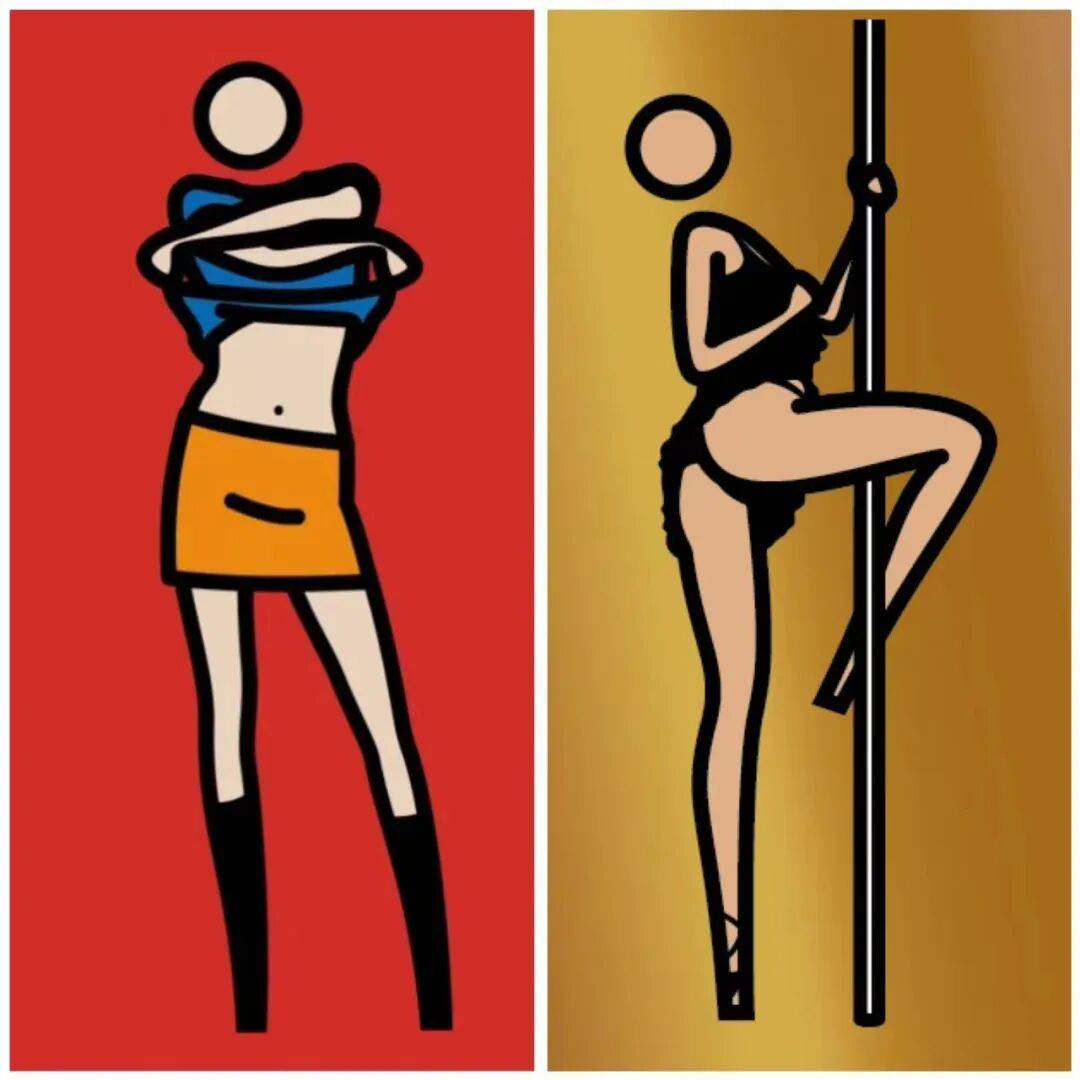
Left: Julian Opie, Sara gets undressed. 03, 2003; right: Julian Opie, This is Shahnoza. 05, 2006. Image courtesy of the artist’s website. Julian Opie, Bryan plays guitar (double), 2004. After working for some time on “putting his friends’ faces on restroom signs,” he began thinking about developing another series.
In this series, the face became simply a blank circle; the body’s movement was the focus. Early on, Opie invited a newsstand owner, a guitarist, and a pole dancer to model for him, recording the postures of their bodies. Julian Opie, Bijou gets undressed (flocking). 08.12, 2005. Image courtesy of the artist’s website. At the same time, he extended the series on bodily movement into a series of “close-ups,” as if examining individual parts of the body through a magnifying glass and leaving room for the imagination.
Left: Julian Opie, Anya with cocktail dress, 2005; right: Julian Opie, Hirofumi with staff, 2005. Image courtesy of the artist’s website. By 2005, he had broken with the fixed pattern of depicting only faces or only bodily movement. He began combining highly linear faces with precisely rendered clothing.
The simple outlines of the face, set against detailed clothing and accessories, produced a deeply contradictory juxtaposition of styles that made Opie’s work more recognizable. Some have said that he created a new kind of “portraiture”: viewers can quickly identify the person depicted from the accessories and the style of the clothes. Julian Opie, The Bisang family, 2009. Image courtesy of the artist’s website. Opie often mentions the profound influence of classical portraiture on his work.
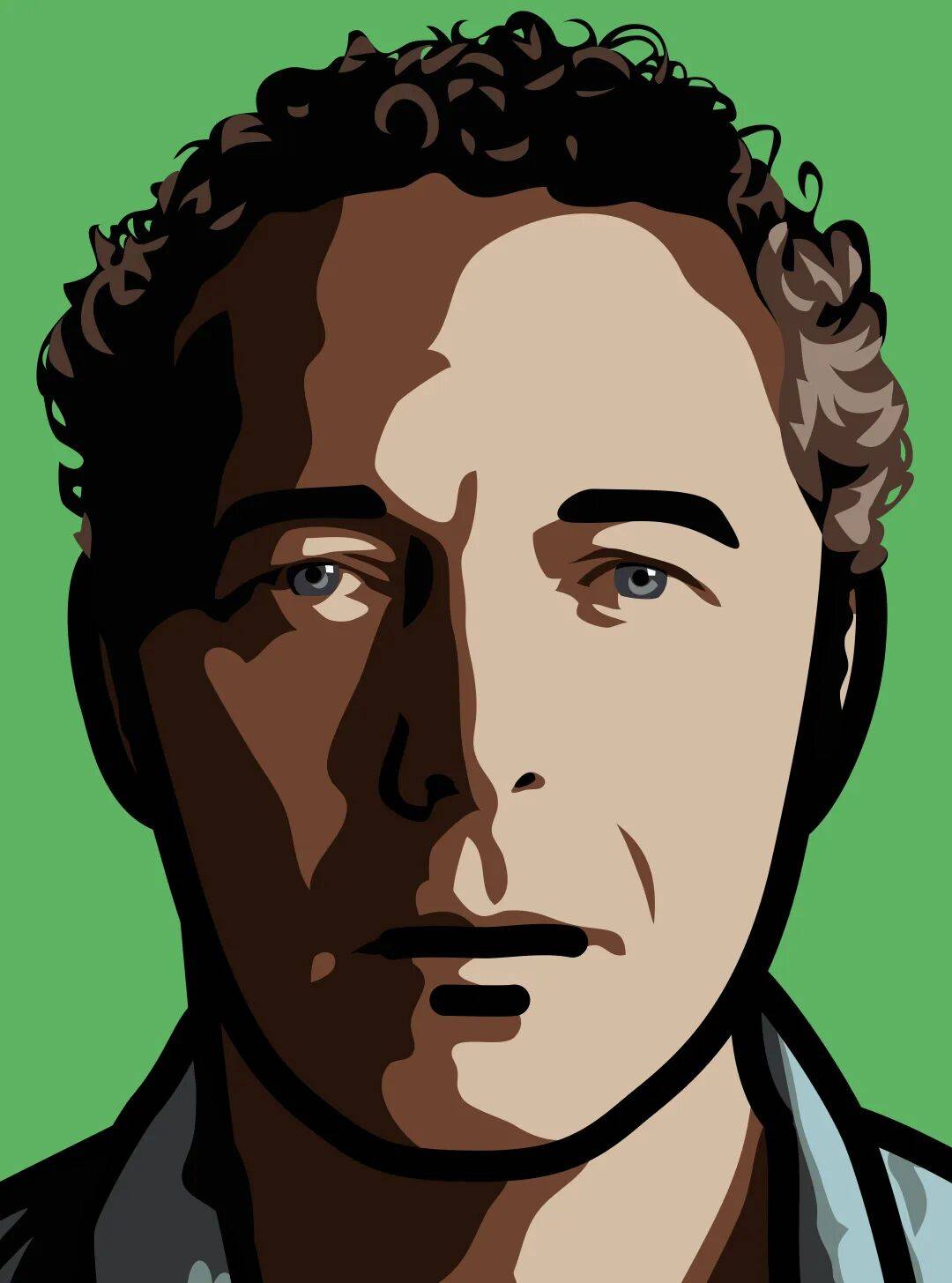
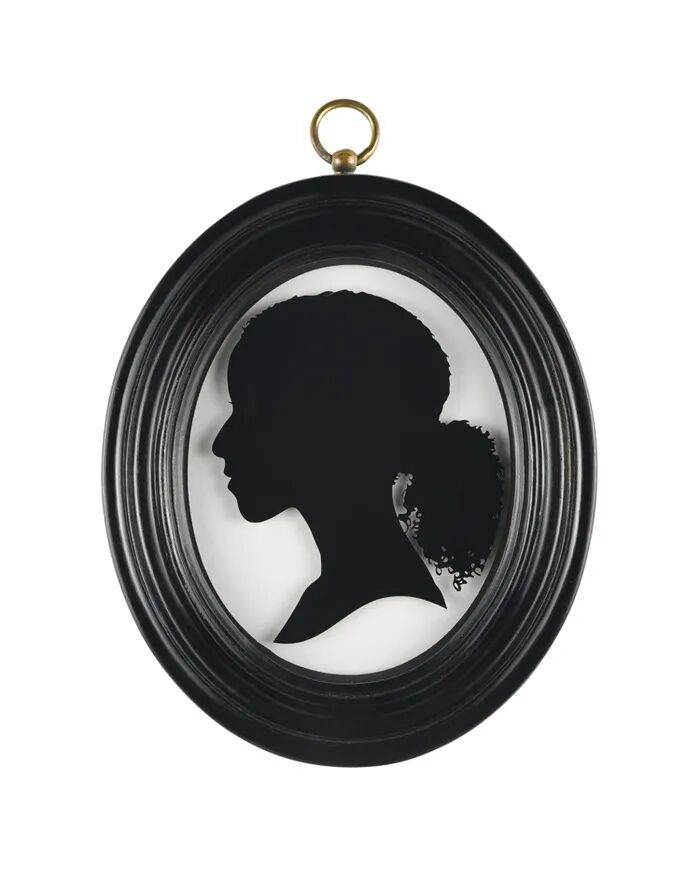
This led to another parallel line of work: the “new portraits,” begun in 2009. He depicted celebrities, including politicians and bankers, as well as individuals and families. Compared with the photorealistic portraits of the Baroque and classical periods, Opie’s new portraits use rougher lines, larger blocks of color in the faces and clothing, and brighter hues. The combination of these broad areas of color gives the portraits a greater warmth. Julian Opie, Imogen, silhouette., 2010. Image courtesy of the artist’s website. During this period, he also created the new-symbol series: black silhouettes on white backgrounds, deliberately retaining oval frames that resemble antique pendants set with figure silhouettes.
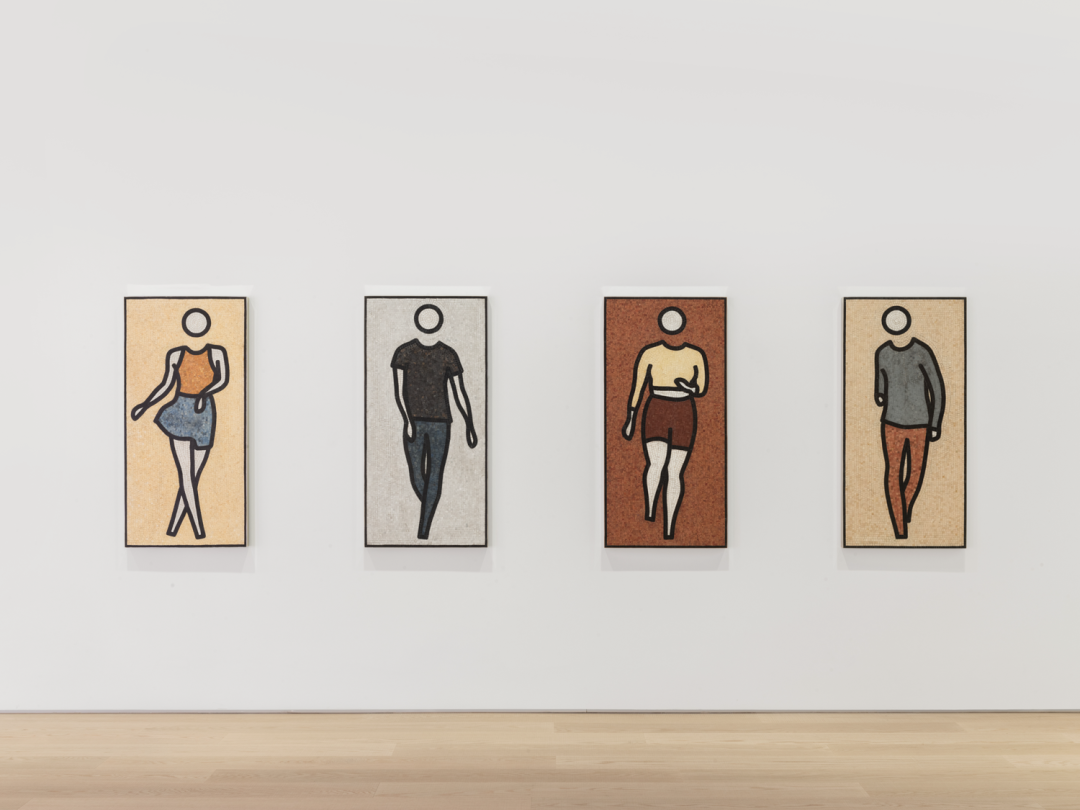
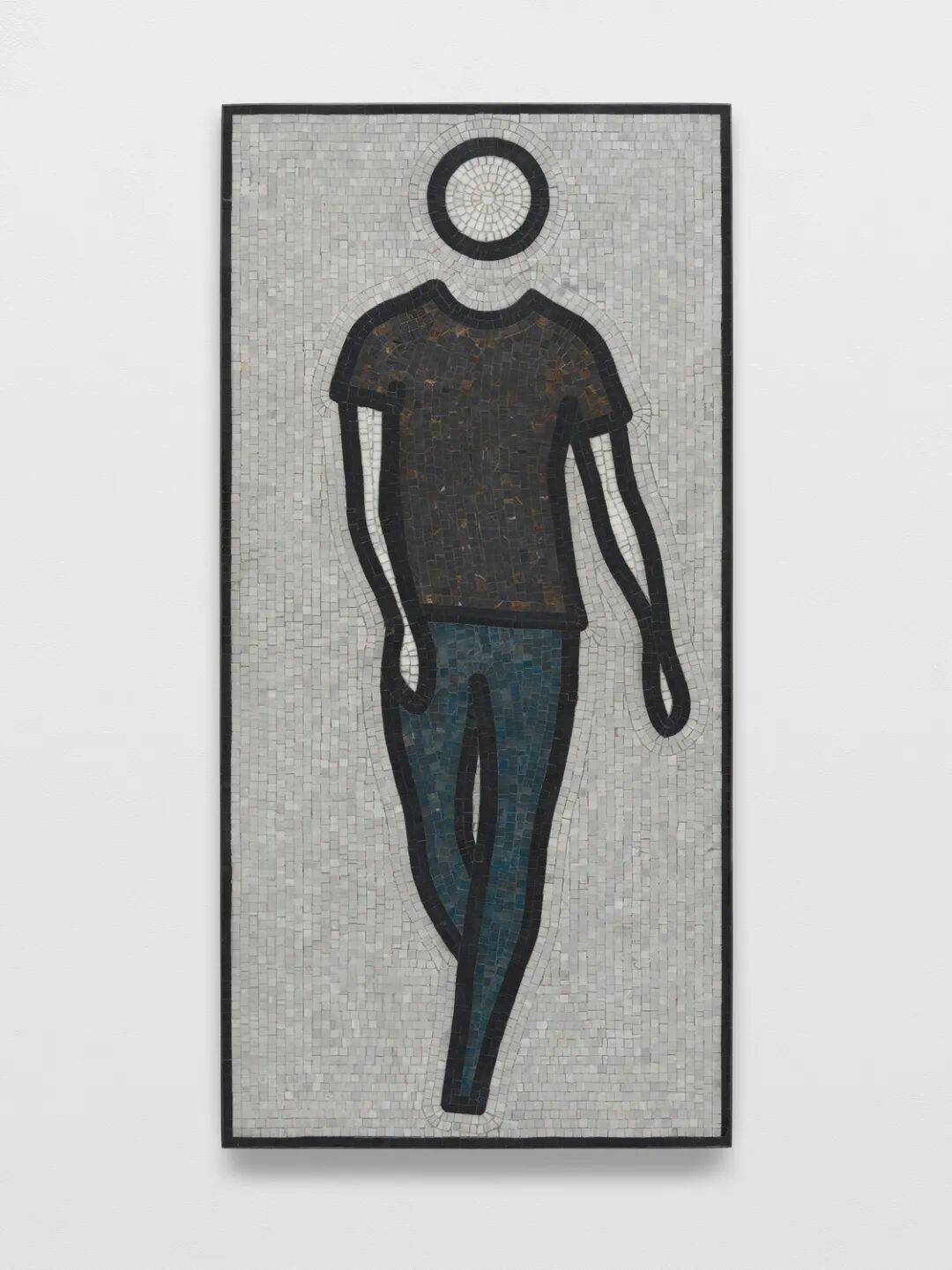
Julian Opie, Ali, 2011. Image courtesy of the artist’s website. Julian Opie, Ellie.2, 2011. Image courtesy of the artist’s website. In its development, Opie’s artistic language has remained radically simplified. Over time, his portraits began to move toward pixelation. Mosaic—the artistic language most closely identified with Opie—appeared. The uneven, rough-textured granules of ancient Roman-style mosaics offered the artist another way of expressing line and plane.
Julian Opie, Summer07, 2012. Image courtesy of the artist’s website. Julian Opie, Moon.4, 2016. Image courtesy of the artist’s website. His interest in line and pixelation also appears in his landscape series. Whether depicting city streets, highways, countryside, or seashores, the works display a strong tendency toward symbolism and abstraction. For Opie, they are a way of rendering the roads he has traveled and the landscapes he has seen. A few strokes and several blocks of color are enough to bring a remembered scene back onto the canvas.
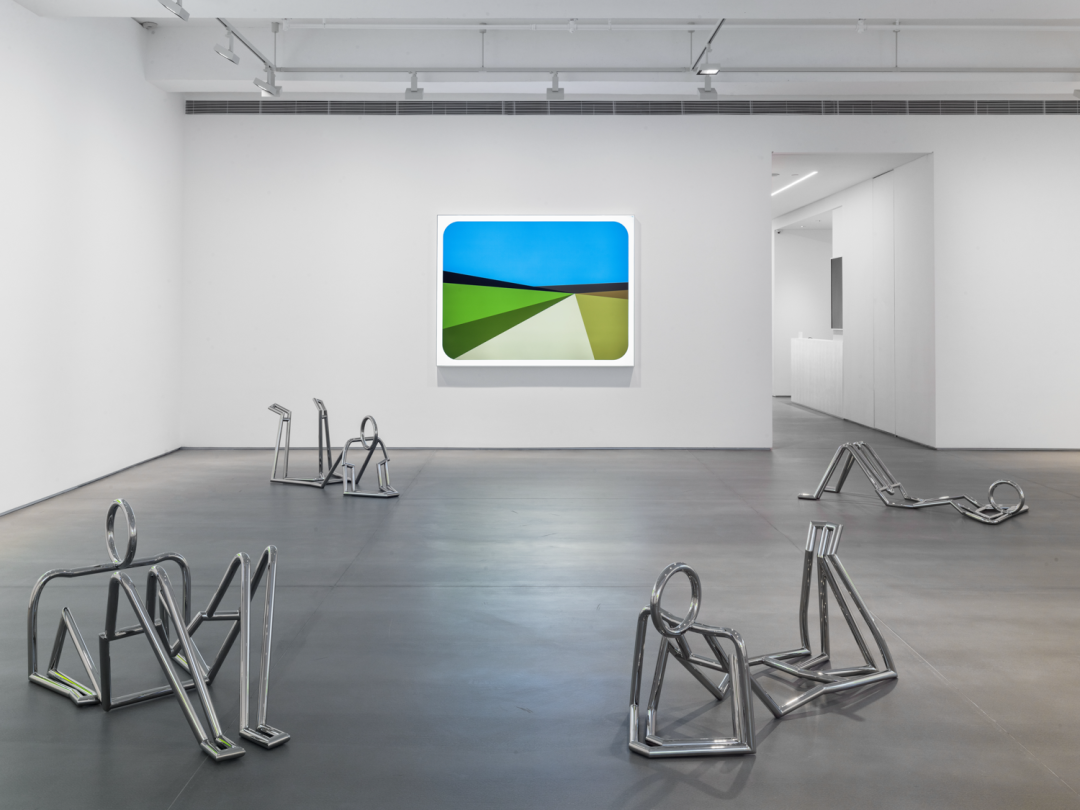
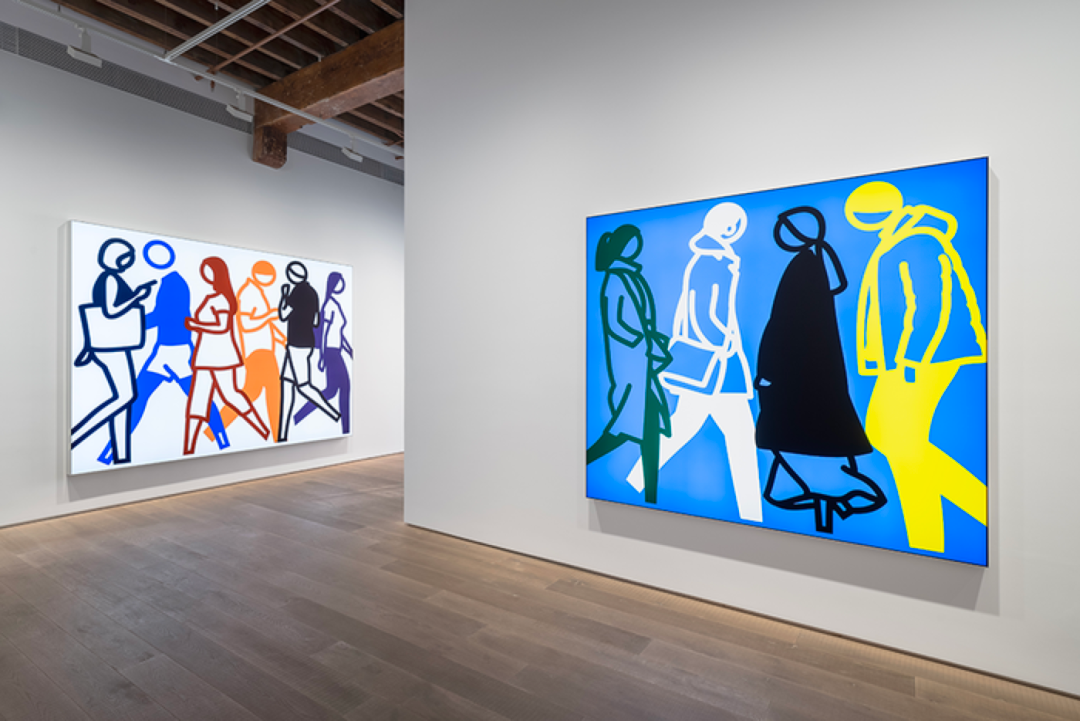
At the beginning of this year, Opie’s solo exhibitions were on view at Lisson Gallery’s Bell Street space in London and at Lisson Gallery in Beijing. The two exhibitions use different media: spare figures in landscape light boxes, a new series of human sculptures in stainless steel, and figures made from vinyl and mosaic tiles. Standing, lying on their sides, jogging, or looking down at their phones, the figures all derive from the artist’s latest observations of urban people and daily life.
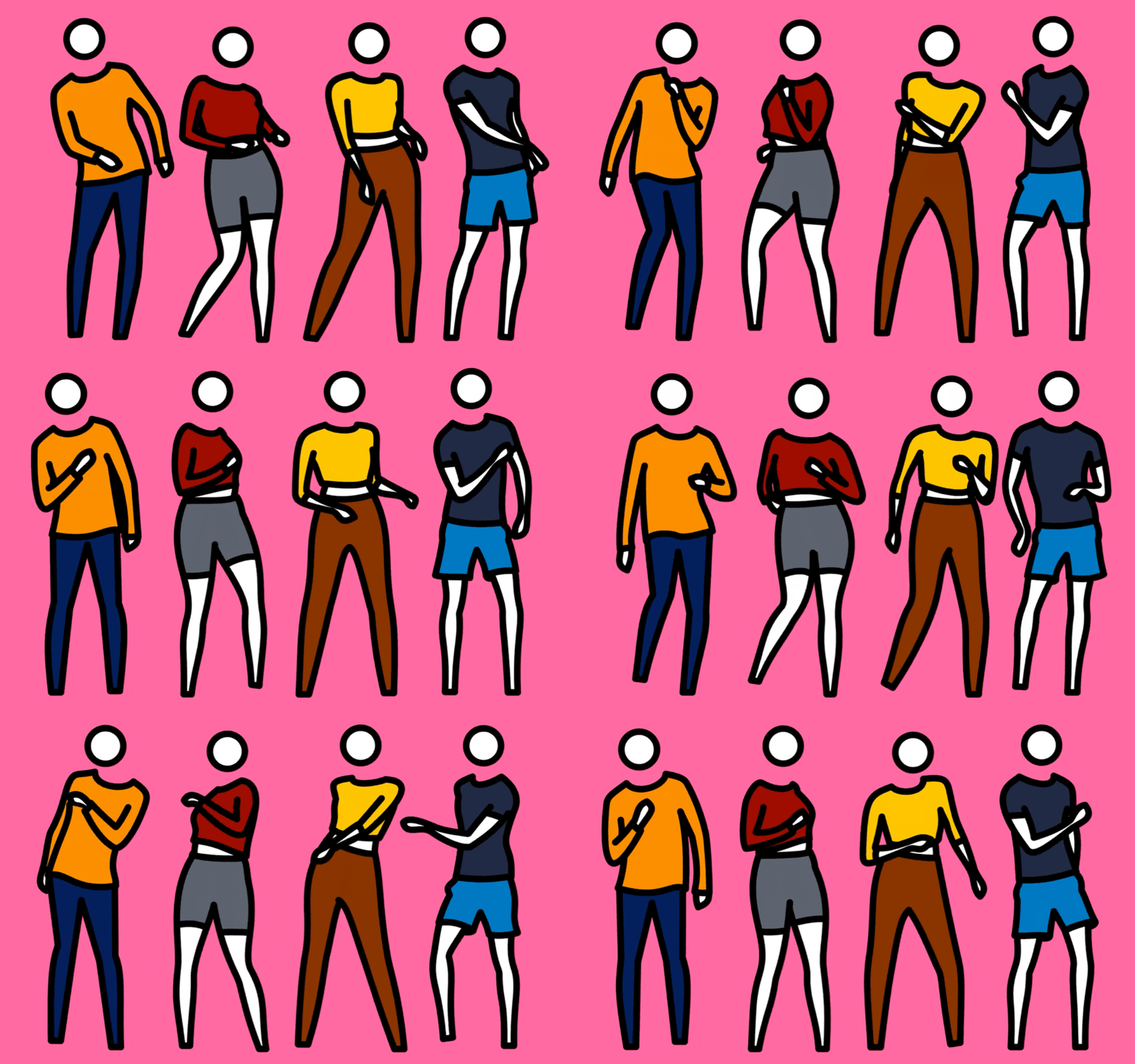
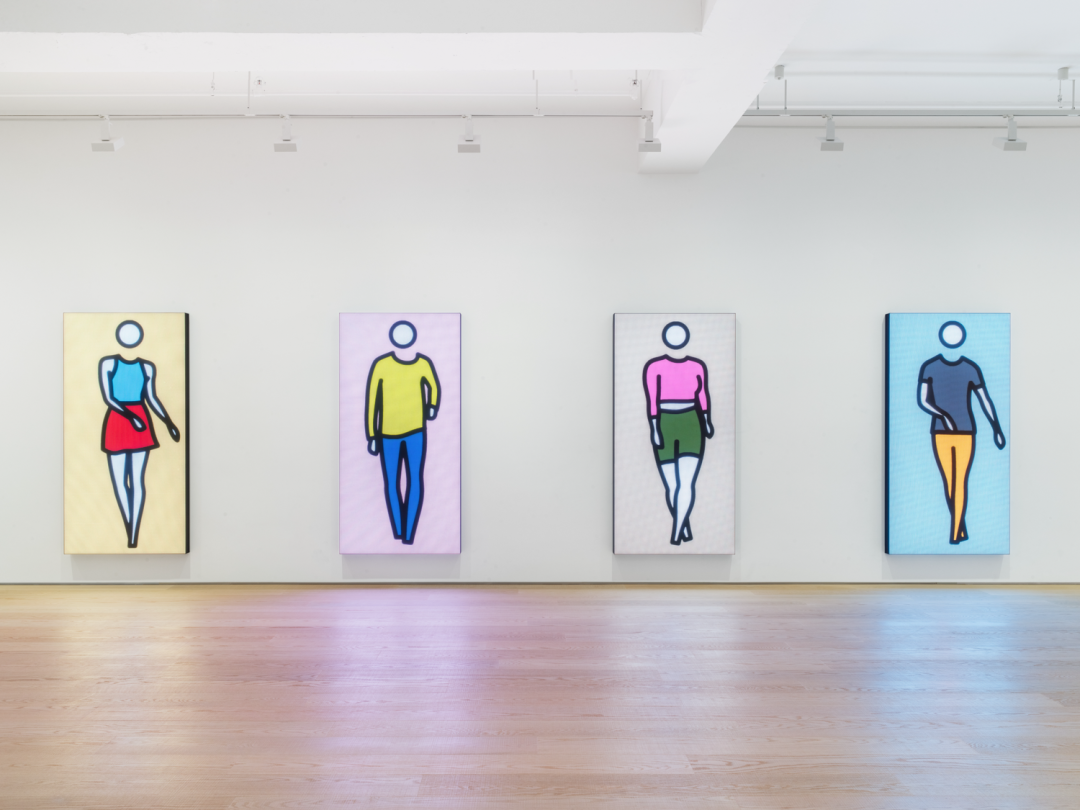
Julian Opie, solo exhibition at Lisson Gallery Beijing, 2023. In the north gallery of Lisson’s Beijing space, the most eye-catching figures are the dancers. Opie “sealed” TikTok-style dance steps into continuous animations displayed on four LED screens and a four-sided LED column. He had conceived the idea of animated figures decades ago, but the technology was not yet mature enough.
Visitors stare at the “expressionless” dancers as they sway continuously across the LED screens, accompanied by early-2000s electronic dance music specially commissioned by Opie from a musician. The loop is hypnotic. Julian Opie, solo exhibition at Lisson Gallery Beijing, 2023. In the south gallery, LED landscape light boxes depict tranquil scenes of the French countryside—mountains, fields, and roads. They continue his familiar pixelated style, but here the geometric blocks of color are stronger and the work more abstract.
SECTION 02 | Latest Observations on Urban Life People Dancing, People Lying Down
Scattered among the landscapes are stainless-steel human figures, “lying” in relaxed poses as if happily enjoying a quiet afternoon in the countryside. The inspiration came from Opie’s observation that people have recently been eager to spend time in nature, lying in various positions on park lawns while picnicking, reading, or looking at their phones. He photographed many such scenes. Unlike his earlier, flat human sculptures, these figures have joints bent in different directions, making them more dynamic and closer to the actual structure of the body.
To render the figures more realistically, he invited models to his studio and asked them to assume the poses he had seen in the park. On the occasion of the new exhibition in Beijing, we interviewed Julian Opie. The following is an edited selection. Julian Opie, solo exhibition at Lisson Gallery Beijing, 2023. Q: A Magazine. A: Julian Opie. Q: Your current exhibition at Lisson Gallery Beijing presents several series of works. Could you briefly introduce each one and explain how they offer us different experiences?
A: The exhibition is an experience, like a landscape that gradually unfolds as you walk through the space. Like a film, it has timed moments that draw you in and surprise you. The north gallery presents a series based on dancing figures; the south gallery shows pastoral scenes, with various “bodies” resting on the floor amid images of landscapes. These two spaces allow me to explore different technologies. Roman-style mosaics and LED digital screens have a surprising similarity: both use colored pixels to depict the dancers.
Vinyl paintings are cut by computer, a powerful method of image production drawn from modern and ancient urban architecture. These works move among dynamics, color, and composition. I also referred to YouTube videos and TikTok dances, and added music to them. I had to balance all these elements to create a pleasurable visual experience. Julian Opie, solo exhibition at Lisson Gallery Beijing, 2023. Julian Opie, Human 3, Pose 4, 2022. By contrast, the south gallery is calm and silent.
The works on the walls in this area resemble backlit panels, presenting distant views that seem to glow. The relaxed-looking figure sculptures are made of stainless steel. These are familiar, commonplace materials, and I know how to explain and handle them. But the process of depicting “people” made these familiar materials somewhat difficult to control, giving me new insights and shocks in my own experience of making art. Julian Opie, solo exhibition at Lisson Gallery Beijing, 2023. Julian Opie, Dance 2 Portrait 2 Dance Step 1, 2022. Q: There is an evident contrast between the mosaic paintings and the pixelated LED screens.
Apart from their very different techniques, what similarities and differences do you see between these two media? A: Although separated by several centuries, the two systems are actually very similar. Images are deeply affected by their materials. Your eyes and brain see stone and light as separate elements. But it is remarkable that the juxtaposition is also convincing on another level: you can see and feel the static stones, yet you also feel the dancers moving fluidly; the light flickers statically, yet you can feel the bodies swaying to the rhythm.
Julian Opie, Dance 4 Dance Step 1, 2022. Q: You do not seem particularly active on social media. How did you discover the “shuffle dance” on TikTok and use it as one source of inspiration for the works in this exhibition? How do these dancers differ from those depicted in your earlier works, such as the ballet dancers? A: The “shuffle dance” suddenly appeared as something that, for me, was usable material.
The dance is simple, repetitive, powerful, and novel. It is optimistic and suited to being presented in painting. In fact, I no longer remember exactly how I discovered it; perhaps I should check my browser history. My “ballet” series is of course related to this one. I made an earlier series using simple disco dancing. But I find the “shuffle dance” very distinctive, quite unlike the atmosphere usually associated with art.
Likewise, the music is both moving and evocative, with an extremely popular, down-to-earth melody. I like the combination. Julian Opie, solo exhibition at Lisson Gallery Shanghai, 2020. Q: People and crowds have long been central themes in your artistic practice. What do you want to capture from “people”? A: Until the mid-1990s, I had never drawn “people.” I remember making a large exhibition in 1993, and the art critics complained that there were no “people” in it.
SECTION 03 | Painting is a way of thinking and a way of enjoying
So I began consciously looking for a way to draw people. I had always drawn animals, buildings, and cars, but people were more difficult. I needed a language and a system that could be easily recognized. Once, I saw the sign representing a man on a men’s restroom door, so I bought the male and female signs. Then I drew the faces of some friends onto the signs on a computer, adjusting the shapes of the simple icons to fit their faces.
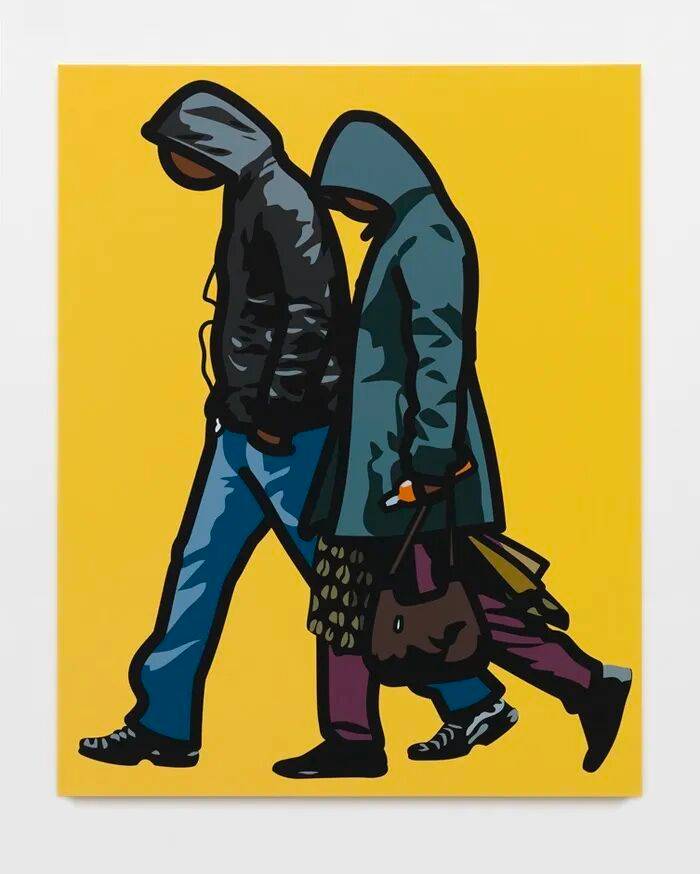
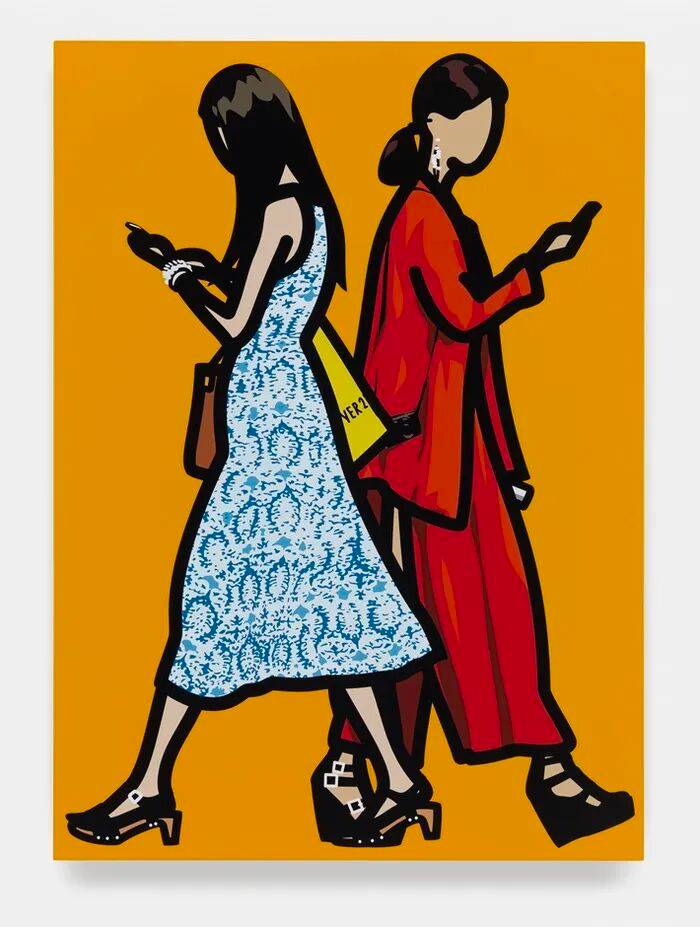
I was very pleased with the result, so I began using the black and white of the signs to depict everyone I encountered, applying the same logic to different faces. Julian Opie, Couple in the rain with hoods, 2012. Image courtesy of the artist’s website. Julian Opie, Paisley dress and red gown, 2015. Image courtesy of the artist’s website. On another occasion, I was sitting in my car outside a school, waiting to pick up my child, when I noticed the pedestrians passing beyond the windshield. I saw an endless, rich variety of human gestures and poses.
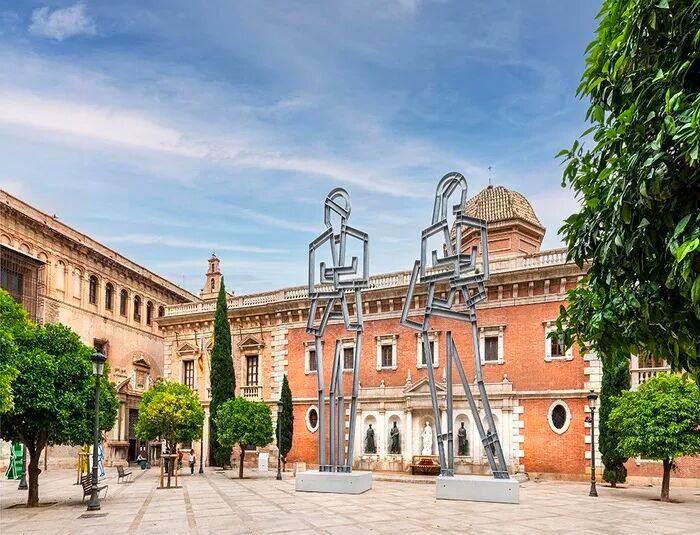
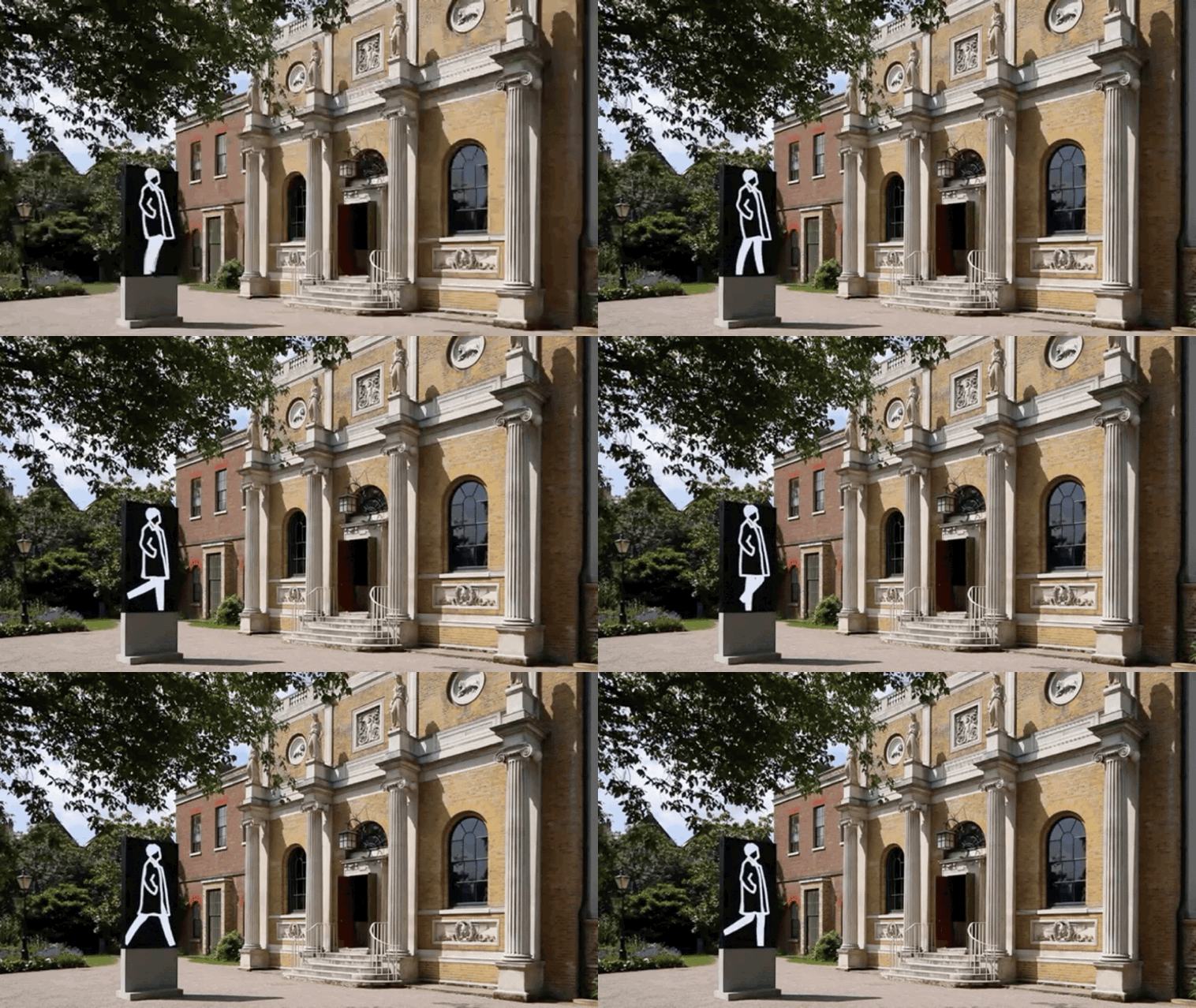
I quickly realized that I could turn these people into animations, into moving images. I repeat this process of observing people wherever I am in the world, expanding the range of people I depict and looking for different compositions, colors, and styles. Julian Opie, London street project, United Kingdom, 2009. Image courtesy of the artist’s website. Julian Opie, solo exhibition at the Lanu Cultural Center, Valencia, Spain, 2021. Image courtesy of the artist’s website. Q: In your artistic practice, what matters most to you?
A: That is difficult to answer. Making an artwork involves many circumstances. It is a path I have to follow, so there is no more or less important part. In fact, the entire process of making art is a continuous road. I may encounter dead ends, experience sudden breakthroughs, or circle back to earlier projects. Often I think of something that seems workable, only to reject it the next day because it appears absurd.
Even when that does not happen, the beginning of a project involves a long process of adjustment and experimentation. But once I am sufficiently convinced that I can commit to a project in depth—to look for models, materials, and methods of making—I usually produce a large body of work, with a very distinct character. These works are realized slowly, with the help of many people. Julian Opie, solo exhibition at Fitzhagen Gallery, London, United Kingdom, 2021. Image courtesy of the artist’s website. Q: You draw inspiration from a remarkably broad range of images, both ancient and contemporary. Are there specific childhood memories that influenced the way you make art?
A: I am sixty-four, so I really cannot remember many things from my childhood. There were paintings on the walls at home, mostly reproductions of British postwar art. I remember staring at them and imagining myself inside the spaces in the paintings. I grew up in Oxford. In secondary school, I would walk around the city’s famous art museums wearing headphones, visiting both history museums and contemporary art museums. Oxford also had an anthropology museum that fascinated me, with objects and sculptures from around the world.
I did not actually think about becoming an artist then. I simply kept drawing. It was a habit, as well as a way of thinking and enjoying myself. Q: What is the greatest challenge of making art for you? A: The greatest challenge I face is not being afraid. The second is actually making the work, which is much harder than it looks. Image courtesy of the artist’s studio and Lisson Gallery.