A Young Artist Heals Herself Through Art—and Pushes Beyond the Limits of the Body
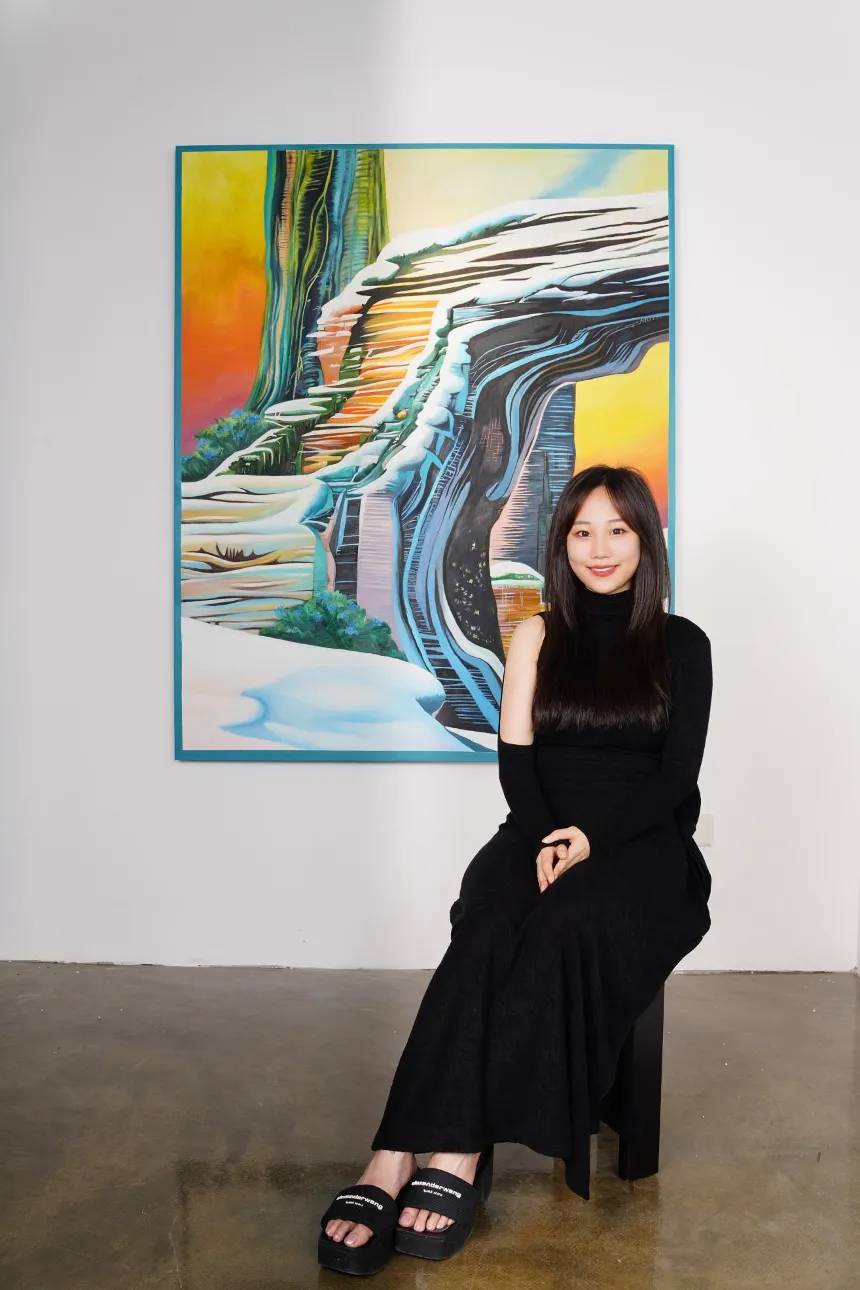
Artist Zhu Liqing, born in Hong Kong in 1997, has lived with Tourette syndrome since childhood, making it difficult for her to concentrate and causing involuntary bodily tics. But painting has greatly eased her symptoms, quieting her whole being. Her artistic education and life have taken her from Hong Kong to Spain, then to the United States and Italy, and finally back to the Central Academy of Fine Arts, where she studied under Qiu Zhijie, one of the leading figures in contemporary art today. She is due to complete her master’s degree this June......
By / Xirui Huang · 9 min read
How does Liane Chu bring movement and digital experience into painting?
In the 2024 interview, Liane Chu connects bodily movement, the flicker of screen images and memories of nature with the restless, overlapping lines in her paintings. Mountains, plants and vivid colours carry experiences of studying and living in different places. New works shown at Art Central also introduce figures linked to childhood memories. These images bring personal feeling, technological experience and an imagined natural world into the same pictorial space.
Artist Zhu Liqing, born in Hong Kong in 1997, has lived with Tourette syndrome since childhood, making it difficult for her to concentrate and causing involuntary bodily tics. But painting has greatly eased her symptoms, quieting her whole being. Her artistic education and life have taken her from Hong Kong to Spain, then to the United States and Italy, and finally back to the Central Academy of Fine Arts, where she studied under Qiu Zhijie, one of the leading figures in contemporary art today. She is due to complete her master’s degree this June.
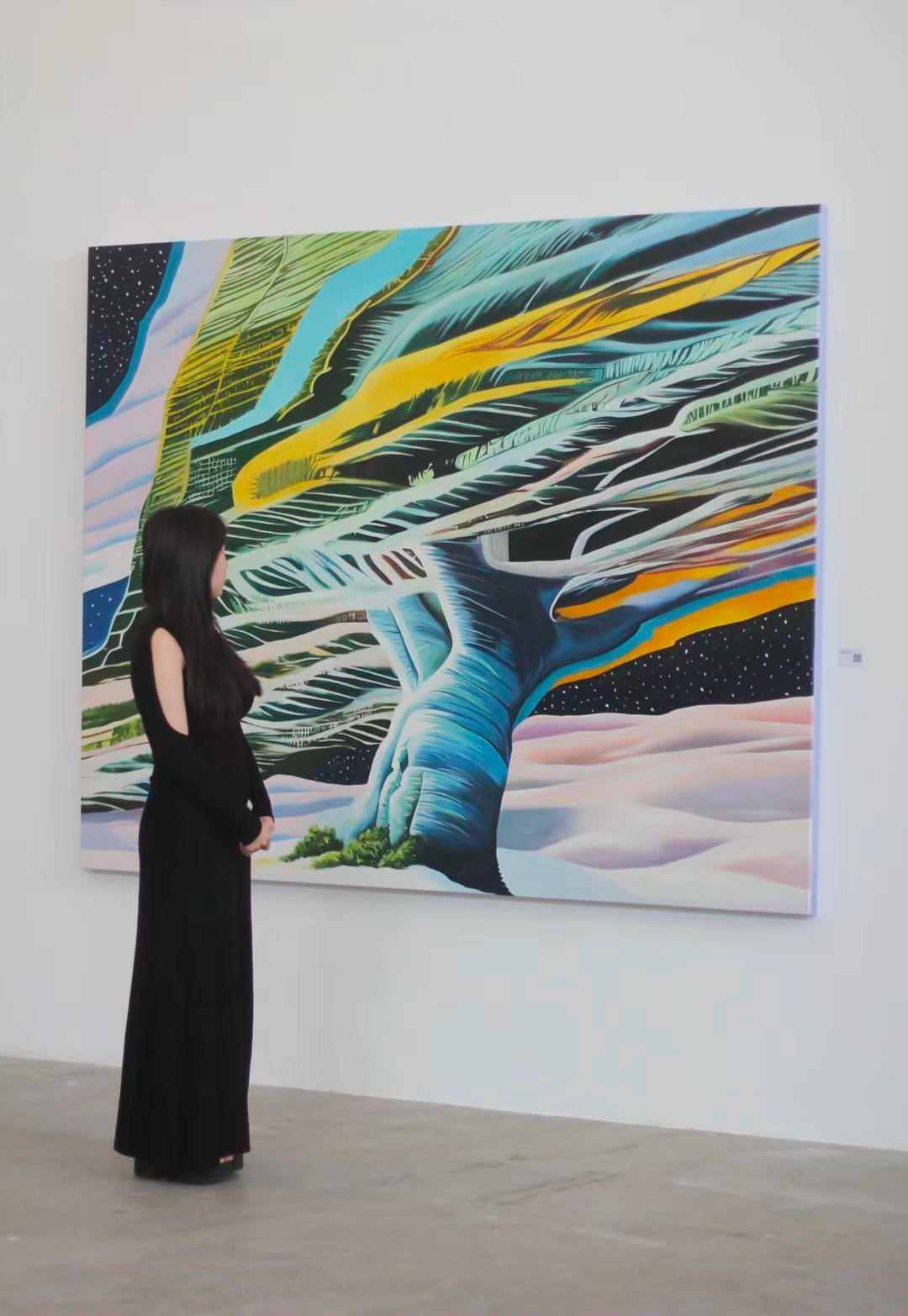
Her paintings are vivid in color and often set the figurative against the abstract: surreal plants on a monumental scale, towering peaks, oddly shaped rocks. Their sharp lines seem doubled, as if the images were being tugged and jerked. Zhu Liqing, “Transient Moment,” exhibition view, Aurora Museum, Shanghai, 2023; the two works pictured are from the Aurora Museum’s collection. “This ‘jerking’ is actually the idea of a flickering screen in the networked world, and it also points toward a certain future—technology, cyborgs.”
“Everyone is addicted to their phones now, and we often overlook nature. I hope my work can awaken a renewed connection with it,” Liqing told us. Her inspiration from mountains, rivers, and vegetation also comes from studying traditional Chinese painting as a child. As an artist born in the 1990s, she has had a relatively smooth start. Her work has been covered by Hong Kong’s major art media and exhibited in London, New York, Finland, and elsewhere around the world. At the end of last year, she completed a solo exhibition at Shanghai’s Aurora Museum.
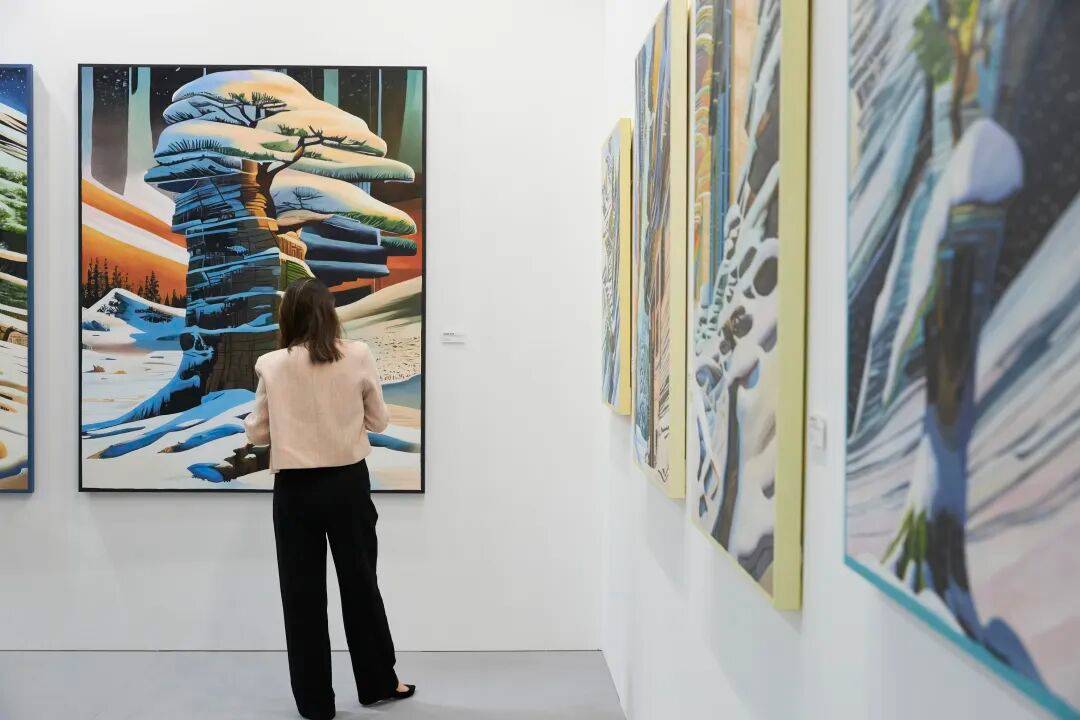
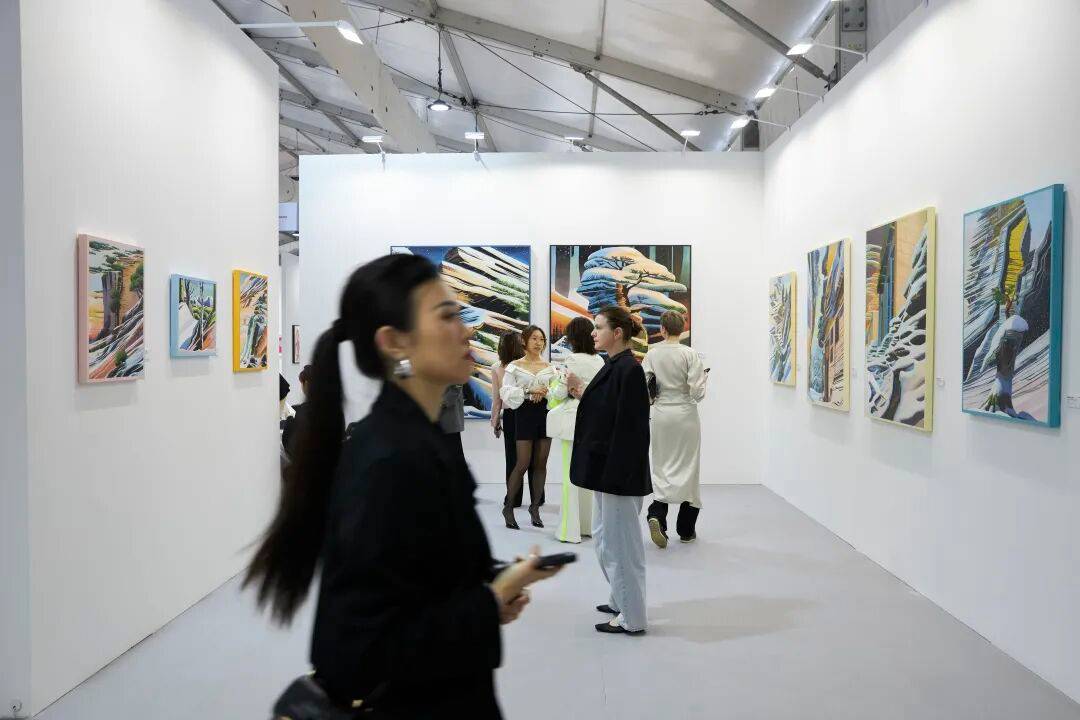
At the end of March this year, we encountered her again at her solo booth at Art Central during Hong Kong Art Week and spoke with her about the exhibition’s new works and what she had seen during the fair. Zhu Liqing, “The Interstellar Drifter,” exhibition view, Art Central, Hong Kong, 2024. At the booth, Zhu Liqing explains her work to visitors (second from left). She told us that the small jade-like corn cob in her hand represents “a house filled with gold and jade—rice in the bag, rice in the hand, and peace in every ear of grain.” The day we met, she wore a simple gray suit and black trousers and greeted us with a smile, clutching the small corn cob, which looked carved from jade.
A Young Artist Heals Herself Through Art—and Pushes Beyond the Limits of the Body
She has a quality that is at once demure and unruly, young and traditional—an ideal match for the character of the new works in this exhibition. At the Seefoodroom booth at Art Central in Hong Kong, her solo exhibition “The Interstellar Drifter” presented ten recent works. Two paintings immediately caught our attention: works she created especially for this year’s Children’s Day, each featuring the back of a small child, a boy in one and a girl in the other. Nothing like them had appeared in her earlier work.
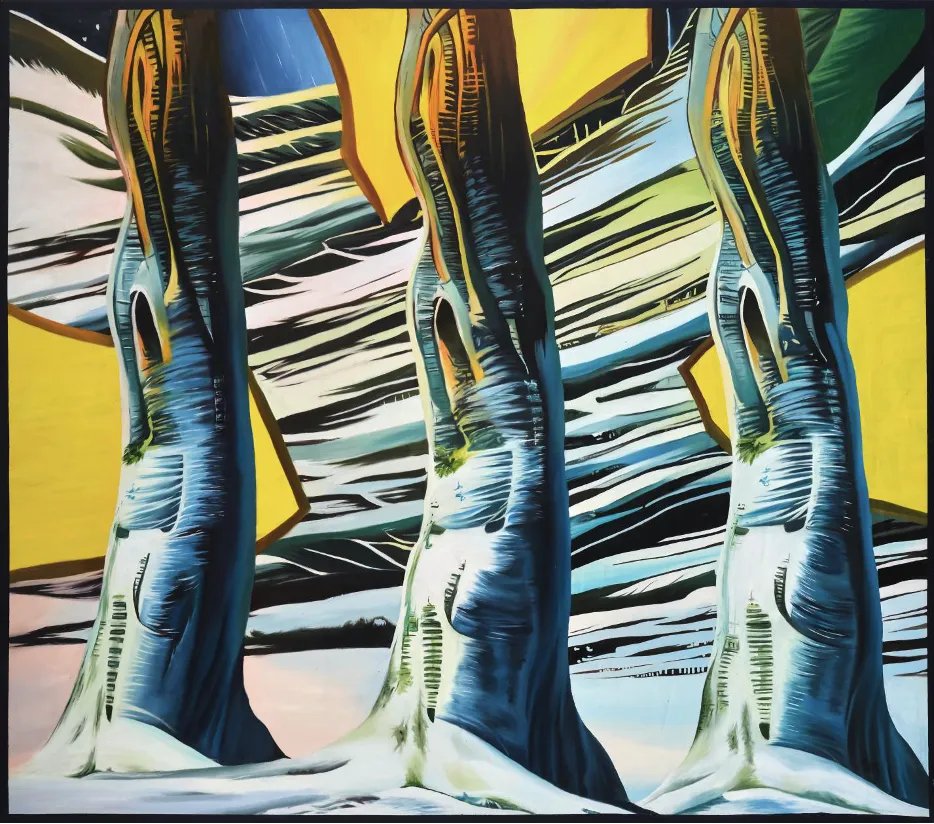
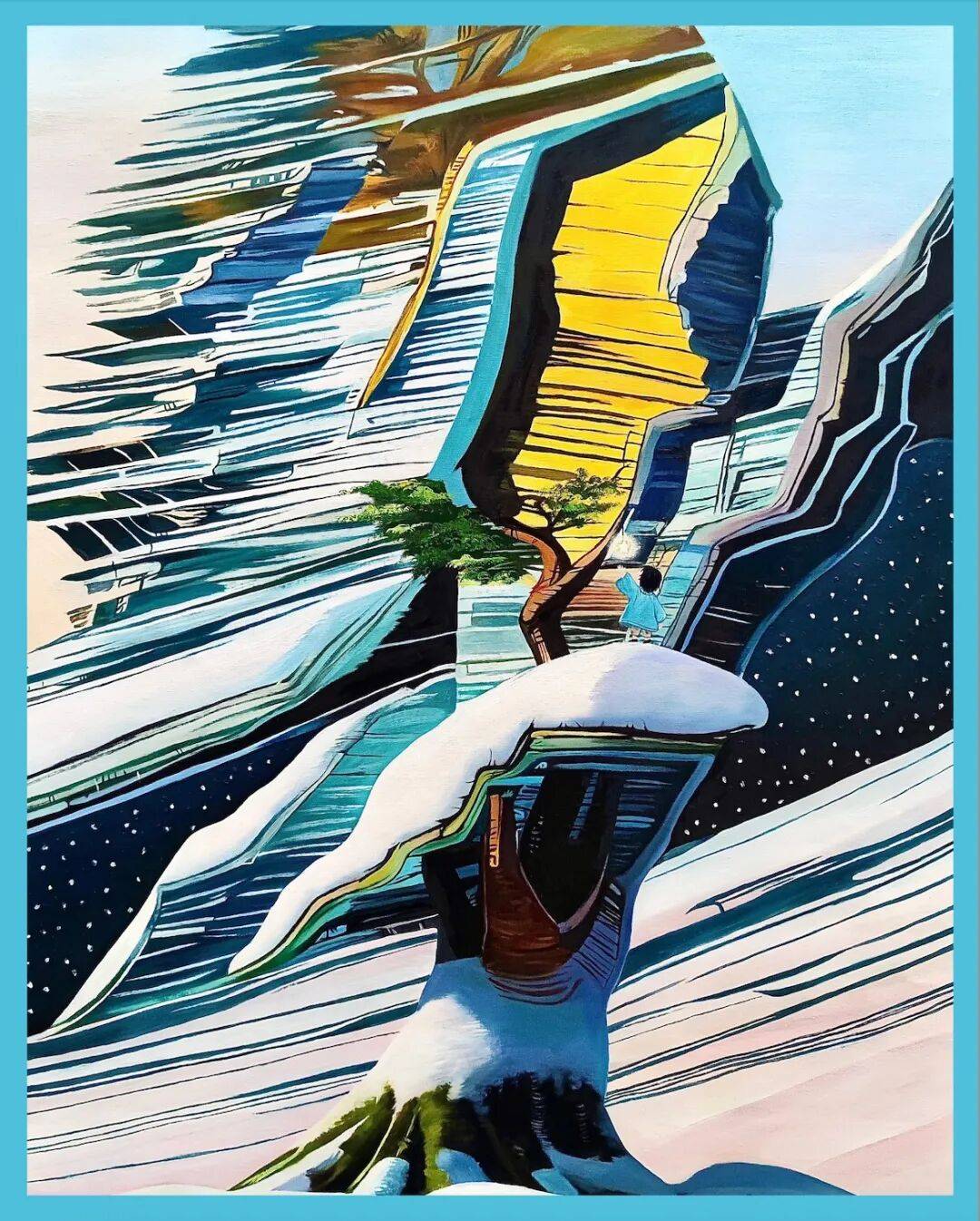
She told us that the stories in the paintings came from her own childhood memories. Zhu Liqing, “Midnight Trio,” 2023, oil on canvas, 152 × 173 cm. The inspiration for “Midnight Trio” came from Mozart. Zhu Liqing is especially fond of trios and created the painting as a tribute to the composer. Zhu Liqing, “Shall We Meet at the Summit?,” 2023. Discovery Bay, Hong Kong. “The little girl in the painting is actually me as a child.”
“I grew up in Discovery Bay on Lantau Island, Hong Kong, which was very different from the city. It was an island embraced by nature, accessible only by boat. For a child, it was like a paradise apart from the world, and every day was joyful. Later, high-rises gradually began to appear on the island. As I grew up, I often watched the vegetation being cleared from the mountains, which remained bald for a long time, before the buildings began to go up.”
“Whenever I passed those bald peaks, I felt a kind of sublime grandeur. In Critique of Judgment, the German philosopher Kant said that the sublime ‘comes from awe before things that are vast, infinite, and incomprehensible.’ So there is a contrast of forces in the image: the girl is small, gentle, and very sweet, while the peaks before her are jagged and sharp. You have to climb over them to see the landscape beyond the summit,” Liqing said. Zhu Liqing, “The Interstellar Drifter,” exhibition view, Art Central, Hong Kong, 2024. Zhu Liqing, “I’m Almost Catching the Meteor!”
2024. In another painting, a small boy appears about to catch a meteor. But what Liqing wants to express is that a child can realize a dream only after going through a great deal. The sharp horizontal lines represent the wind rushing past, as well as the difficulties one may encounter along the road to adulthood.
“I think adults should probably not give children too many illusory fantasies or make them feel they are certain to achieve their dreams. They may have to pay a great price before they can say they are ‘almost catching the meteor,’” Liqing said. Zhu Liqing, “The Interstellar Drifter,” exhibition view, Art Central, Hong Kong, 2024. Zhu Liqing, “A Galactic Encounter, Together Toward the Land of Dreams,” 2023. Zhu Liqing, “My Home Is My Brilliant Galaxy,” 2023. Her paintings also contain rainbows and images of interstellar space. This grand, hard-edged vision of the landscape began, in fact, with her family of origin.
“From the moment I was born, my family was essentially my world. Until I was eighteen, I was protected by my parents. There was only one place that could let me escape that framework: my dreams. The moment I closed my eyes, I could go to the world outside—to mysterious outer space and the Milky Way. That was where my dreams came true.” Zhu Liqing as a child, holding a paintbrush. This, too, closely mirrors her personal history. Before she turned eighteen, she was the obedient daughter in the eyes of her parents and elders, subject even to a 9:30 p.m. curfew.
Until she defied her family’s opposition and insisted on becoming a professional artist, her parents cut off her financial support for five or six years in an effort to stop what they considered an “unrealistic” idea. It was during that period that she grew rapidly, teaching children to draw while studying and making her own work, and caught the “meteor” in her dreams. Zhu Liqing, “The Interstellar Drifter,” exhibition view, Art Central, Hong Kong, 2024. Zhu Liqing, “Across the Four Seasons: Spring, Summer, Autumn, Winter,” 2024. The exhibition also included three small paintings corresponding to the famous film trilogy Liqing loves, the “Before” trilogy—Before Sunrise, Before Sunset, and Before Midnight. She said the second film was her favorite.
Zhu Liqing rehearsing with a band in high school. “What stayed with me most was the ending of the second film, the song written by the female protagonist. Every time I hear it, I think it’s incredibly romantic. I was in a band in high school, and I could play that song on the guitar,” Liqing said, breaking into a smile. Zhu Liqing, “The Interstellar Drifter,” exhibition view, Art Central, Hong Kong, 2024. We also noticed that Liqing had added a “frame” to every painting. This reflects her thoughts about the electronic age.
“This is the world we see now! We look at our phones, iPads, and televisions, always through the ‘frame’ of an electronic device. Everything we see has passed through the filter of that ‘frame.’” Zhu Liqing, “The Giant Tree Waits Quietly for Me,” 2023. Zhu Liqing, “The Flicker Has Finally Reached Us,” 2023, oil on canvas, 152 × 194 cm. Why do so many trees and plants appear in her paintings?
Because she believes that trees and nature are exceptional listeners. Unlike human beings, they do not regard others with strange looks or prejudice; they simply listen and gaze in silence. Yet the colors of her trees are “abnormal.” Their twitching lines and psychedelic hues express the idea of the “flickering screen,” while reminding contemporary people not to let prolonged immersion in phone and computer screens draw their attention away from nature. “In my work, I also reflect on what is ‘normal’ and ‘abnormal’ in the electronic age. When we look at social media, it appears that we are directing our own browsing, but in fact we are passively receiving media information and being shaped by algorithms. Without discernment, it is easy to fall into the trap of the ‘abnormal.’”
The works are also a dialogue between Liqing and her own body. “I had Tourette syndrome as a child, and I blinked and shook frequently. When I was very young, I thought it was the trees moving, that nature was waving to me. When I grew a little older, I realized that I was the one who was twitching. Because the illness caused sudden, uncontrollable ‘jerks,’ I was the one who was ‘abnormal,’” Liqing said.
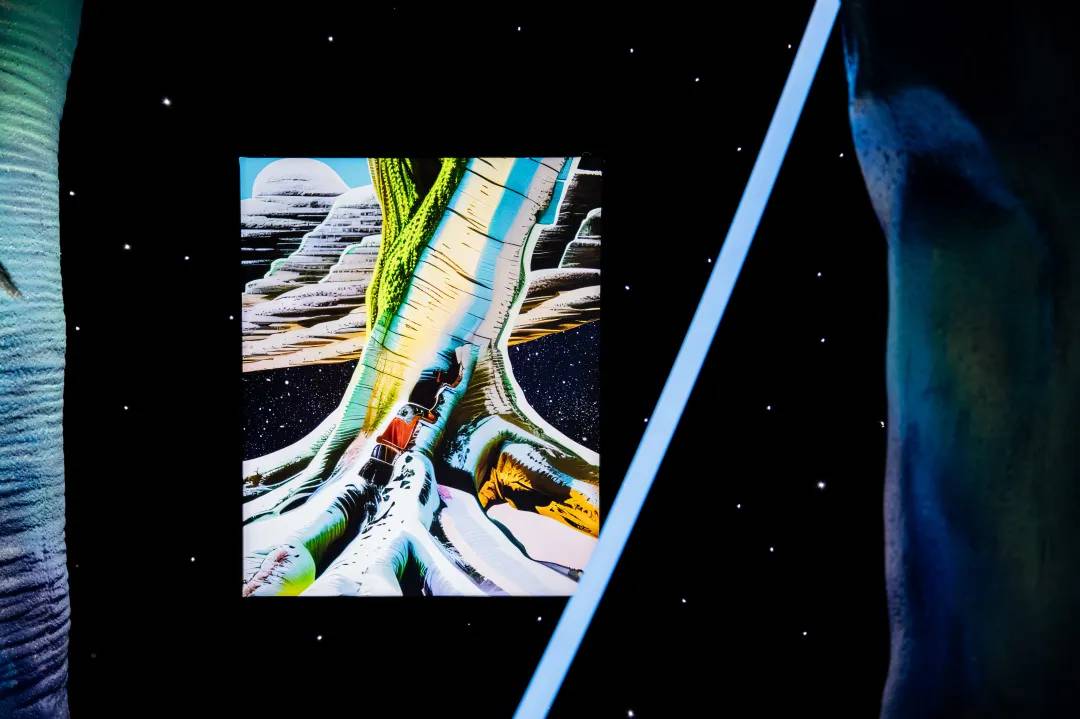
“I believe many people were frightened by thunder and lightning as children. But as we grow older, sometimes dancing with the ‘storm,’ with the things we fear, may not be a bad thing.” Zhu Liqing, personal project, exhibition view, SKP-S, Xi’an, 2023. She told us that, beyond painting, she has become increasingly interested in making installations and sculptures. Last year, she completed two large-scale projects.
“I like creating works in different media around the same theme, and I enjoy the way different media influence one another and generate new ideas.” Her sculptural installations are more dazzling, mechanical, and fantastical. She extracts the “abnormal” elements from her paintings, transforming two-dimensional images into three-dimensional tree sculptures. Visitors can encounter these “abnormal” natural environments directly in the exhibition space. Zhu Liqing, personal project, exhibition view, SKP-S, Xi’an, 2023. Her work draws increasingly on a futuristic cyberpunk sensibility because she wants to create work that reflects her life and develops a narrative belonging to the present.
“I hope my work can create a new image, one that belongs to China. I come from Hong Kong, China, and neon lights are a very important part of Hong Kong culture. That is essentially cyberpunk. If you’re looking for a cyberpunk place in China, it has to be Hong Kong! And if I become famous one day, I don’t want people to say, ‘She paints like so-and-so.’ You know what I mean?” Zhu Liqing’s paintings as a child. Liqing studied traditional Chinese painting in Hong Kong as a child, an experience that nourished her understanding of Chinese landscape painting.
SECTION 02 | Technology, Cyberpunk and Nature
The plants and mountains in her paintings, as well as the Chinese elements in the ink-splashed “Crack Series” she made earlier, grew out of those early studies. Later, she spent every summer studying in a different country. In Spain, the art school she attended had been founded by students from Picasso’s former studio. There, she encountered oil and acrylic painting for the first time, saw colors of extraordinary richness and brilliance, and learned what “creativity” truly meant. Zhu Liqing sketching from life in class during her studies in Europe. “One thing that really shook me was that, in China, the body is still considered an object that can evoke a certain shame.”
“But in Europe, the body is seen as an expression of nature and beauty, so students are happy to take turns modeling nude. I was chatting happily with a girl when she suddenly took off her clothes in front of me and walked onto the stage to model. I was startled, but I also found it remarkable. Men and women alike felt that revealing the body was for art, without the slightest embarrassment or coyness,” Liqing told us. Zhu Liqing during her studies in Europe. Among the European art schools she attended, the academy in Florence, Italy, leaned more toward classical tradition, teaching the oil painting known as “academic” painting.
“During the three-month program, I painted only one picture. Every day I painted the same thing, outlining the lines. I also learned that at their school, all the students spend four years painting only ten pictures, continually copying.” In the space of a single summer, she came to feel deeply their respect for art and their inheritance of the classical tradition. Zhu Liqing during her studies in Europe. “New York was exactly what New York is supposed to be. I learned what contemporary art and street art were.”
“New York is an extremely open city, highly diverse, and very accepting. It is full of creativity.” She eventually returned to China and continued her studies at Beijing’s Central Academy of Fine Arts, where she pursued academic depth. In conversations with her mentor, Qiu Zhijie, the two can leap freely from art history to art philosophy. Of the city where she now lives, Shanghai, she says that art there has become an IP, entering everyone’s daily life. Zhu Liqing with her earlier “Crack Series.” “My grandfather was from Meixian, Guangzhou; my grandmother was half Shanghainese and half Taiwanese; my mother came from Fujian; and I grew up in Hong Kong.”
“I feel as if I carry all the places in China within me.”
“At first, my family did not support my becoming a professional artist. But in the end, through passion and perseverance, I really did survive as an artist. I feel that I have been ‘embraced’ by everyone,” Liqing told us. Zhu Liqing, “There Is Light and Water There—Wouldn’t That Also Be Happiness?,” 2023. Zhu Liqing, “The Little Path That Leads Into a Dream,” 2023. When we asked about her plans for this year, we were surprised to find that her schedule was nearly full, with a series of exceptionally large solo projects. After her solo exhibition at Art Central in March, she will participate in Taipei Dangdai in May; in June, while preparing for a solo exhibition at Guangzhou K11, she will also complete her final master’s thesis defense.
In July, she will present an independent personal project at New York’s well-known Long Story Short. After a solo exhibition at Dumonte in Paris in October, she will hold another exhibition at Dumonte in Shanghai at the end of the year. Zhu Liqing at the exhibition site of her personal project. “I think being busy is a good thing. I used to be an obedient girl who had to go to bed at nine every night. Later, in order to experience life, I spent a year going to parties every night, coming home at three or four in the morning. Now that I am focused on studying and making art, I feel fulfilled and calm inside.”
SECTION 03 | Departing from China, returning to China again
Speaking about her artistic practice, Liqing told us: “China was the source of inspiration in my childhood; studying abroad nourished me; and the period after returning to China has been a flowering. After going to so many places, I still hope to carry Chinese culture outward through art.” Advertisement